Report ID: 1353 |
Published Date: 28 Sep 2026 |
Report Format: |
Delivery Timeline: 48-72 Business Hours
Marine Electronics Market Outlook:
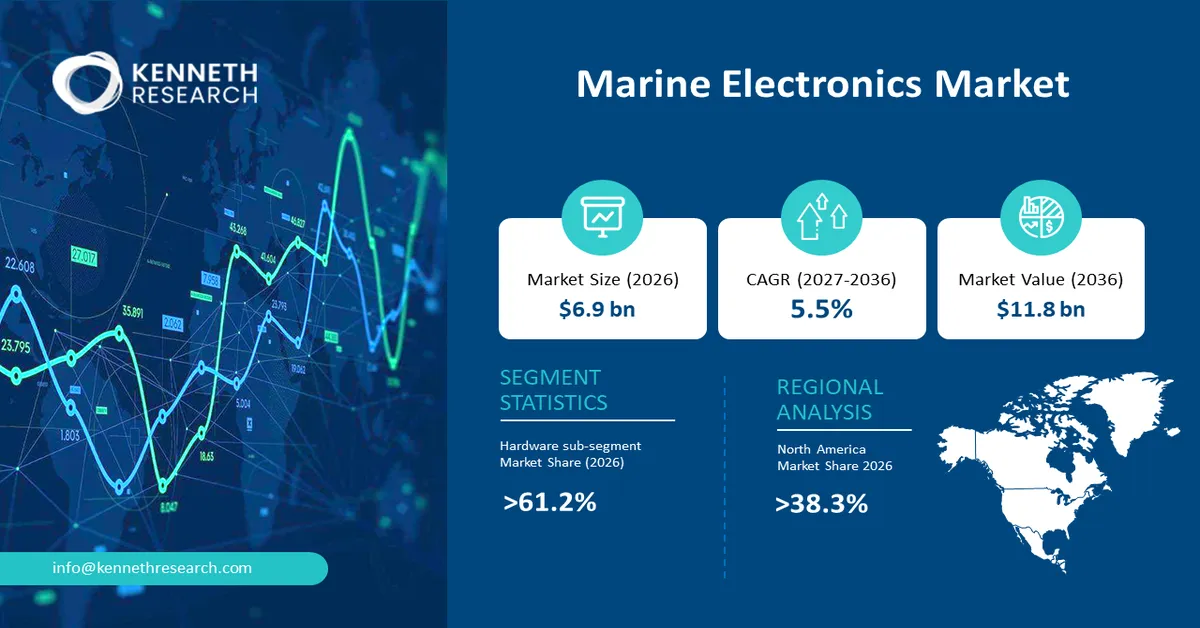
Marine Electronics Market size was valued at USD 6.9 billion in 2026 and is projected to reach USD 11.8 billion by the end of 2036, rising at a CAGR of 5.5% during the forecast period, i.e., 2027-2036. In 2027, the industry size of the marine electronics is estimated at USD 7.3 billion.
The primary growth driver for the marine electronics market is the increasing emphasis on maritime safety, navigation accuracy, and real-time vessel awareness. Modern vessels increasingly rely on integrated electronic systems to support navigation, collision avoidance, communication, positioning, and operational decision-making.
The marine electronics market comprises electronic equipment, systems, and integrated technologies designed for navigation, communication, vessel monitoring, safety, and operational management in marine environments. These solutions are deployed across commercial ships, passenger vessels, fishing vessels, offshore platforms, recreational boats, and other marine applications.
The market encompasses hardware and associated electronic systems such as navigation systems, marine radar, electronic chart display and information systems, global navigation satellite system equipment, automatic identification systems, sonar and echo-sounding equipment, communication systems, autopilots, vessel monitoring equipment, and related digital interfaces.
Key Marine Electronics Market Insights Summary:
Key Takeaways: Market Trends & Insights
- Global market value reached USD 6.9 billion in 2026 with a projected value of USD 11.8 billion by 2036 at a CAGR of 5.5%
- North America remains the leading regional market share at 38.3% in 2026, supported by continued technology adoption and maritime modernization across the U.S. and Canada.
- Hardware is expected to remain the leading Component segment, accounting for 61.2% of the market in 2026, driven by increasing demand for physical infrastructure, advanced equipment, and reliable technological components across various industries.
- Navigation Systems are gaining importance as the maritime industry moves toward digital navigation, integrated bridge environments, standardized electronic charting, and enhanced vessel situational awareness.
Market Drivers
- Increasing adoption of digital navigation and maritime situational-awareness systems
- Growing integration of connected and automated vessel technologies
- Rising emphasis on maritime safety, collision avoidance, and regulatory compliance
- Increasing deployment of advanced marine electronics for fleet monitoring and operational efficiency
Challenges
- Cybersecurity Risks Across Increasingly Connected Marine Electronics
- Interoperability Constraints and Legacy-System Integration
Marine Electronics Market Overview & Supply Chain
The marine electronics market is supported by the increasing digitalization of vessel operations, where electronic systems are used to improve navigation, communication, vessel monitoring, safety, and maritime situational awareness. Government maritime systems demonstrate the operational importance of these technologies.
The supply chain begins with the procurement of electronic components and specialized technologies, including processors, sensors, displays, communication modules, positioning components, antennas, semiconductors, circuit boards, and ruggedized marine-grade materials. Component suppliers provide the underlying technologies required to withstand vibration, moisture, saltwater exposure, temperature fluctuations, and continuous operational use.
Marine Electronics Market: Growth Drivers & Challenges
Growth Drivers:
- Increasing adoption of digital navigation and maritime situational-awareness systems: The increasing digitalization of maritime navigation is a major driver of the marine electronics market because vessel operators are replacing conventional navigation practices with connected electronic systems that provide more precise positioning, chart information, vessel tracking, and navigational alerts. Electronic navigational charts (ENCs), radar, AIS, GNSS, and integrated bridge systems allow data from multiple sources to be consolidated, helping crews make faster and more informed decisions.
- Growing integration of connected and automated vessel technologies: The integration of connected and automated technologies across vessel operations is creating another important growth pathway for the marine electronics market. Modern marine electronics are increasingly designed to communicate with one another rather than operate as isolated instruments. Navigation equipment can integrate positioning, digital charts, radar, AIS, depth information, weather inputs, and other sensor data to provide a consolidated operational picture.
Challenges:
- Cybersecurity risks across increasingly connected marine electronics: The growing connectivity of navigation, communication, monitoring, and vessel-control systems creates a significant cybersecurity restraint for the marine electronics market. As traditionally isolated onboard equipment becomes connected through vessel networks and external communication links, vulnerabilities can extend across multiple systems rather than remain confined to an individual device.
- Interoperability constraints and legacy-system integration: Marine electronics manufacturers face interoperability challenges because vessels frequently contain equipment from different generations and suppliers, using varying communication protocols, interfaces, and data formats. Replacing one component may therefore require modifications to connected navigation, communication, monitoring, or bridge systems, increasing installation complexity and creating compatibility risks. The challenge is particularly significant for existing fleets where operators seek incremental upgrades rather than complete replacement of onboard electronics.
Marine Electronics Market Size and Forecast:
| Report Attribute | Details |
|---|---|
| Base Year |
2026 |
| Forecast Period |
2027-2036 |
| CAGR |
5.5% |
| Base Year Market Size (2026) |
USD 6.9 billion |
| Forecast Year Market Size (2036) |
USD 11.8 billion |
| Regional Scope |
|
Marine Electronics Market Segmentation Analysis:
Component Segment Analysis
In the Component segment, the Hardware sub-segment is anticipated to capture the largest market share of 61.2% in 2026.
Demand is supported by fleet modernization, replacement of aging onboard equipment, regulatory requirements, and the increasing integration of multiple marine functions into connected bridge environments. The operating base of commercial vessels also sustains recurring demand for electronic hardware, particularly as operators upgrade equipment to improve reliability and operational awareness. Statistics Canada reported 870 marine vessel owners and operators in Canada in 2023, providing evidence of an active marine operating base requiring vessel equipment and supporting technologies.
Type Segment Analysis
In the Type segment, the Navigation System sub-segment is projected to grow because accurate positioning, route planning, electronic charting, and navigational information are fundamental to safe vessel operations. Demand is being strengthened by the maritime industry's transition toward standardized digital navigation and e-navigation architectures.
On the supply side, vendors are enhancing ECDIS, GNSS, radar, digital charting, and integrated bridge technologies to improve interoperability and information management. Future demand is expected to increasingly center on connected navigation platforms incorporating dynamic data, automation, enhanced situational awareness, and compatibility with emerging autonomous maritime operations.
Our in-depth analysis of the global marine electronics market includes the following segments:
|
Segment |
Sub-segment |
|
Component |
|
|
Type |
|
|
Vessel Type |
|
Marine Electronics Market Regional Insights:
North America Market Trends & Insights:
North America held the dominant position in the marine electronics market, accounting for 38.3% in 2026.
Regional leadership is supported by an extensive maritime operating base, substantial commercial shipping activity, recreational boating, offshore operations, and continued investment in navigation, communication, vessel-monitoring, and safety technologies. The U.S. benefits from a mature marine technology ecosystem, established regulatory frameworks, and demand from commercial, government, defense, and recreational users.
The U.S. represents a major market because of its extensive commercial and recreational maritime activities and strong adoption of advanced navigation, communication, and safety equipment. Regulatory requirements and modernization of vessel systems further support procurement.
Canada offers opportunities through commercial shipping, fishing, ferry operations, offshore resource activities, and port infrastructure. Its marine network includes numerous port and harbour facilities, creating a broad installed base for marine electronics suppliers.
Asia-Pacific Market Trends & Insights:
Asia-Pacific represents a significant opportunity for the marine electronics market because of its extensive shipbuilding activity, commercial shipping networks, fishing fleets, naval modernization, offshore industries, and expanding maritime infrastructure. Strong industrial activity across the region creates sustained demand for navigation, communication, radar, vessel-monitoring, and integrated bridge systems. Government initiatives supporting maritime digitalization, safer navigation, fleet modernization, and smart-port development are also encouraging technology adoption.
Japan remains an important market because of its advanced shipbuilding industry, sophisticated maritime technology base, and established manufacturers of navigation and communication equipment.
China offers substantial opportunities through its large shipbuilding sector, extensive commercial fleet, fishing industry, naval activities, and expanding maritime infrastructure. Increasing adoption of digital vessel technologies and smart-port initiatives is expected to encourage demand for integrated navigation, communication, and monitoring systems.
Leading Companies Operating in the Marine Electronics Market:
Here is a list of upstream, downstream, and key players operating in the global marine electronics market competitive ecosystem:
- FURUNO (Japan)
- Company Overview
- Business Strategy
- Key Product Offerings
- Financial Performance
- Key Performance Indicators
- Risk Analysis
- Recent Development
- Regional Presence
- SWOT Analysis
- Garmin (U.S)
- Raymarine (United Kingdom)
Recent Developments
- September 2025: Garmin launched the SmartDrive autopilot for sailboats and catamarans, expanding its marine portfolio with an autopilot solution designed for automated steering and improved vessel control.
- November 2025: Raymarine officially released the Pathfinder ECDIS, an IMO type-approved electronic chart display and information system for vessel applications ranging from workboats to large cargo ships and superyachts.
Frequently Asked Question
In 2026, the marine electronics market exceeded USD 6.9 billion.
The marine electronics market is projected to reach USD 11.8 billion by the end of 2036, expanding at a CAGR of 5.5% over the forecast period (2027-2036).
The major players in the market are FURUNO, Garmin, Raymarine, JRC, Wärtsilä, and others.
In the component segment, the hardware sub-segment is anticipated to capture the largest market share of 61.2% in the future and exhibit lucrative growth opportunities during 2027-2036.
North America is projected to hold the largest market share of 38.3% by the end of 2026 and provide more business opportunities in the future.
Why Choose Kenneth Research ?
-
Insight with Impact : We don’t just gather data — we uncover stories, trends, and opportunities that fuel business growth.
-
Experts Who Get It : Our team speaks your industry’s language and knows what really matters to your customers and market.
-
Custom-Built for You : Forget one-size-fits-all. We craft research and consulting solutions as unique as your business vision.
-
Partners, Not Just Providers : We work with you, not for you — collaborating closely to turn insights into smart, strategic moves.
-
Results That Speak : Our work powers brands, startups, and industry leaders alike — with a track record of ideas that work in the real world.
Report ID: 1353 |
Published Date: 28 Sep 2026 |
Report Format: |
Delivery Timeline: 48-72 Business Hours

Copyright © 2025 Kenneth Research. All rights reserved. Terms of Use | Privacy Policy
