Report ID: 1166 |
Published Date: 25 Aug 2026 |
Report Format: |
Delivery Timeline: 48-72 Business Hours
Magnetic Carbon Nanofoam Market Outlook:
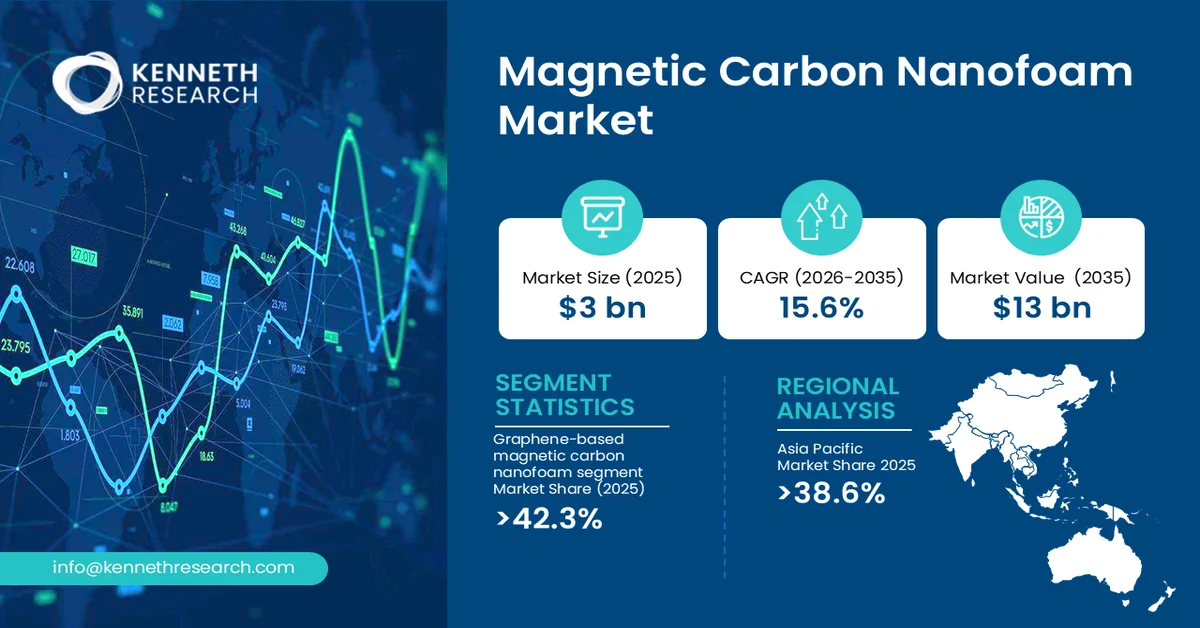
Magnetic Carbon Nanofoam Market size was valued at USD 3 billion in 2025 and is projected to reach USD 13 billion by the end of 2035, rising at a CAGR of 15.4% during the forecast period, i.e., 2026–2035. In 2026, the industry size of the magnetic carbon nanofoam is estimated at USD 3.5 billion.
The primary growth driver for the magnetic carbon nanofoam market is increasing demand for lightweight, multifunctional materials with magnetic, electrical, thermal, and electromagnetic absorption properties. Magnetic carbon nanofoams can combine low density with high surface area and tunable magnetic behavior, creating opportunities in electromagnetic interference shielding, sensors, energy systems, electronics, automotive components, and advanced defense technologies. Growing development of lightweight electronic and energy-efficient systems is further supporting research and commercialization.
The magnetic carbon nanofoam market comprises lightweight, porous carbon-based nanostructured materials engineered with magnetic properties through suitable carbon architectures, magnetic nanoparticles, or related functional modifications. These materials combine the characteristic high surface area and low density of carbon nanofoams with magnetic and electromagnetic-response capabilities, enabling multifunctional performance.
Magnetic carbon nanofoams can be engineered for applications requiring electromagnetic interference absorption, magnetic sensing, energy storage, catalysis, thermal management, and lightweight structural or functional components.
Key Magnetic Carbon Nanofoam Market Insights Summary:
Key Takeaways: Market Trends & Insights
- The magnetic carbon nanofoam market is projected to grow from USD 3 billion in 2025 to USD 13 billion by 2035, registering a 15.4% CAGR.
- Asia Pacific held the largest regional share at 38.6% in 2025, supported by electronics manufacturing, automotive production, advanced materials research, and energy technologies.
- Graphene-based products represented the leading Product Type segment with a 42.3% share in 2025, benefiting from high conductivity, lightweight characteristics, large surface area, and tunable electromagnetic properties.
- Automotive is an important application area, supported by vehicle electrification, increasing electronic content, electromagnetic interference management, sensing, and lightweight material requirements.
- Key challenges include high production and scale-up costs and limited standardization and commercial validation, which can slow adoption and increase qualification requirements for emerging applications.
Market Drivers
- Rising demand for electromagnetic interference shielding.
- Expansion of electric and connected vehicles.
- Growing applications in advanced sensors and electronics.
- Increasing research into multifunctional nanomaterials.
Challenges
- High production and scale-up costs
- Limited standardization and commercial validation
Magnetic Carbon Nanofoam Market: Market Overview & Supply Chain
The magnetic carbon nanofoam market is supported by expanding demand for advanced nanomaterials in electronics, automotive systems, energy technologies, sensing, electromagnetic shielding, and specialized industrial applications. Magnetic carbon nanofoams offer a combination of low density, porous structure, electrical conductivity, and magnetic functionality, allowing them to address applications where conventional carbon materials may not provide sufficient multifunctional performance.
Japan's Ministry of Economy, Trade and Industry tracks production across electric machinery, transport machinery, precision machinery, chemicals, and other manufactured products, providing an indication of the broad industrial base relevant to advanced carbon nanomaterial applications.
The supply chain begins with carbon precursors, graphene or other carbon nanomaterials, magnetic nanoparticles or metallic precursors, catalysts, binders, and processing chemicals. Manufacturers then employ synthesis, carbonization, activation, magnetic functionalization, and other nanomaterial-processing techniques to produce specialized nanofoam structures. Finished materials are supplied to component manufacturers, research organizations, electronics producers, automotive companies, energy developers, and industrial users.
Magnetic Carbon Nanofoam Market: Growth Drivers & Challenges
Growth Drivers:
- Rising demand for advanced electromagnetic shielding: The growing use of compact electronic systems, sensors, communication equipment, and electrically powered vehicles is increasing demand for materials capable of managing electromagnetic interference. Magnetic carbon nanofoams can combine electrical conductivity, magnetic loss, low density, and porous structures, making them promising candidates for lightweight electromagnetic absorption and shielding applications. Their multifunctional characteristics can provide advantages where conventional shielding materials add excessive weight or lack tunable electromagnetic performance. Continued development of advanced electronics and high-frequency systems should create additional opportunities for magnetic carbon nanofoam technologies.
- Expansion of electric and advanced automotive systems: Increasing electrification of vehicles is creating opportunities for lightweight functional materials used around batteries, power electronics, sensors, motors, and electronic control systems. Magnetic carbon nanofoams may provide electromagnetic absorption, thermal-management, and lightweighting benefits in selected automotive applications. The U.S. Department of Energy identifies lightweight materials and advanced technologies as important pathways for improving vehicle efficiency, supporting broader interest in advanced material solutions.
Challenges:
- High production and scale-up costs: Magnetic carbon nanofoams require specialized synthesis, controlled porosity, magnetic functionalization, and precise material processing. Maintaining consistent pore structure, particle distribution, magnetic properties, and carbon quality during larger-scale production can increase manufacturing complexity and cost. Laboratory-scale processes may also be difficult to translate into economical commercial production. These factors can limit adoption in price-sensitive applications and make process optimization essential. Manufacturers must improve precursor utilization, production yields, process automation, and batch-to-batch consistency to achieve commercially competitive materials.
- Limited standardization and commercial validation: Magnetic carbon nanofoam technologies remain relatively specialized, with performance varying substantially according to carbon precursor, pore architecture, magnetic phase, synthesis conditions, and functionalization methods. The absence of broadly established industry standards for performance characterization can make comparison between materials difficult. End users may also require extensive testing before integrating emerging nanomaterials into automotive, electronics, energy, or industrial systems. Developing standardized testing protocols, reliable quality specifications, and application-specific performance benchmarks will therefore be important for wider commercialization. Greater validation of long-term durability, safety, and manufacturing consistency can help reduce adoption barriers.
Magnetic Carbon Nanofoam Market Size and Forecast:
| Report Attribute | Details |
|---|---|
| Base Year |
2025 |
| Forecast Year |
2026-2035 |
| CAGR |
15.6% |
| Base Year Market Size (2025) |
USD 3 billion |
| Forecast Year Market Size (2035) |
USD 13 billion |
| Regional Scope |
|
Magnetic Carbon Nanofoam Market Segmentation Analysis:
Product Type Segment Analysis
In the Product Type segment, Graphene-based magnetic carbon nanofoam is anticipated to capture the largest market share of 42.3% in 2025.
Their strong electrical conductivity, high surface area, lightweight structure, and tunable electromagnetic properties make graphene-based structures attractive for advanced shielding, sensing, energy storage, and electronic applications.
Graphene can also be combined with magnetic nanoparticles or other functional materials to enhance electromagnetic absorption and provide multiple performance characteristics within a single lightweight material. This makes graphene-based magnetic carbon nanofoams particularly relevant to applications requiring low weight, conductivity, magnetic response, and structural stability. Growing development of advanced electronics, electric vehicles, sensors, energy-storage systems, and electromagnetic-management technologies is expected to support demand. Continued research into scalable graphene production, controlled pore structures, improved magnetic functionalization, and cost-effective manufacturing should further expand the commercial potential of graphene-based magnetic carbon nanofoams.
Application Type Segment Analysis
The Automotive segment is expected to witness strong growth as vehicles incorporate increasing numbers of electronic control systems, sensors, communication technologies, power electronics, and battery-related components. This growing electronic content increases the importance of lightweight materials capable of managing electromagnetic interference while maintaining thermal and structural performance.
Magnetic carbon nanofoams can potentially serve in electromagnetic absorption, shielding, sensing, thermal management, and lightweight functional components. Their porous architecture and tunable magnetic properties provide opportunities where conventional metal-based shielding materials may add excessive weight. The U.S. Department of Energy highlights lightweight materials as an important pathway for improving vehicle efficiency, reinforcing the broader automotive shift toward advanced lightweight material technologies.
Our in-depth analysis of the global magnetic carbon nanofoam market includes the following segments:
|
Segment |
Sub-segment |
|
Product Type |
|
|
Application |
|
|
Material Composition |
|
|
Form |
|
Magnetic Carbon Nanofoam Market Regional Insights:
Asia Pacific Market Trends & Insights:
Asia Pacific accounted for 38.6% of the magnetic carbon nanofoam market in 2025, supported by expanding electronics manufacturing, automotive production, energy technologies, advanced materials research, and industrial development.
The region has strong capabilities in nanotechnology, specialty materials, electronics, and advanced manufacturing, creating a favorable environment for development and commercialization of multifunctional carbon nanomaterials.
Japan represents an important market because of its advanced electronics, automotive, energy, and materials-science industries. Its established research ecosystem supports development of specialized nanomaterials for sensing, electromagnetic management, energy storage, and other high-performance applications.
China provides substantial opportunities through its large electronics, automotive, battery, renewable-energy, and industrial manufacturing base. China's National Bureau of Statistics reported that industrial output increased 5.8% in 2024, demonstrating continued manufacturing activity across downstream industries relevant to advanced nanomaterial applications.
North America Market Trends & Insights:
North America represents an important market for magnetic carbon nanofoams, supported by advanced electronics, automotive, aerospace, defense, energy, and nanotechnology research. The region has strong capabilities in advanced-material development and high-performance manufacturing, creating opportunities for multifunctional carbon materials in electromagnetic shielding, sensing, energy storage, thermal management, and lightweight automotive systems.
The U.S. remains the primary regional market because of its extensive automotive, electronics, aerospace, defense, and technology industries. The U.S. Department of Energy identifies lightweight materials, including advanced composites and other innovative material technologies, as important for improving vehicle efficiency and supporting next-generation transportation systems.
Canada provides additional opportunities through advanced manufacturing, automotive, aerospace, clean-energy, and materials-research activities. Government-supported research and industrial development can support commercialization of emerging nanomaterials and related technologies. Across North America, growing deployment of electric vehicles, increasing electronic content in transportation, and demand for electromagnetic-management solutions should create additional opportunities for magnetic carbon nanofoam manufacturers.
Leading Companies Operating in the Global Magnetic Carbon Nanofoam Market:
Here is a list of upstream, downstream, and key players operating in the global magnetic carbon nanofoam market competitive ecosystem:
- Cabot Corporation(U.S)
- Company Overview
- Business Strategy
- Key Product Offerings
- Financial Performance
- Key Performance Indicators
- Risk Analysis
- Recent Development
- Regional Presence
- SWOT Analysis
- Graphene Platform Corporation(Japan)
- NanoXplore Inc. (Canada)
- ACS Material(U.S)
Recent Developments
- April 2026: NanoXplore Continued expansion of graphene-based material development for automotive and industrial applications, including lightweight and electrically functional materials.
- January 2026: Cabot Corporation Continued development of conductive carbon solutions for battery, automotive, electronics, and other advanced applications.
Frequently Asked Question
The magnetic carbon nanofoam market was valued at USD 3 billion in 2025.
The market is projected to reach USD 13 billion by 2035, expanding at a CAGR of 15.4% during 2026–2035.
Key companies operating across the relevant carbon nanomaterial and graphene-based technology landscape include Cabot Corporation, Graphene Platform Corporation, NanoXplore, ACS Material, and XG Sciences, among others.
Within the Product Type segment, Graphene-based magnetic carbon nanofoam held the largest share at 42.3% in 2025, supported by graphene's conductivity, high surface area, lightweight structure, and tunable electromagnetic properties.
Asia Pacific is projected to remain the leading region, accounting for 38.6% in 2025, supported by advanced electronics, automotive manufacturing, energy technologies, and nanomaterial research across Japan and China.
Why Choose Kenneth Research ?
-
Insight with Impact : We don’t just gather data — we uncover stories, trends, and opportunities that fuel business growth.
-
Experts Who Get It : Our team speaks your industry’s language and knows what really matters to your customers and market.
-
Custom-Built for You : Forget one-size-fits-all. We craft research and consulting solutions as unique as your business vision.
-
Partners, Not Just Providers : We work with you, not for you — collaborating closely to turn insights into smart, strategic moves.
-
Results That Speak : Our work powers brands, startups, and industry leaders alike — with a track record of ideas that work in the real world.
Report ID: 1166 |
Published Date: 25 Aug 2026 |
Report Format: |
Delivery Timeline: 48-72 Business Hours

Copyright © 2025 Kenneth Research. All rights reserved. Terms of Use | Privacy Policy
