Report ID: 1449 |
Published Date: 29 Sep 2026 |
Report Format: |
Delivery Timeline: 48-72 Business Hours
Magnesium Battery Market Outlook:
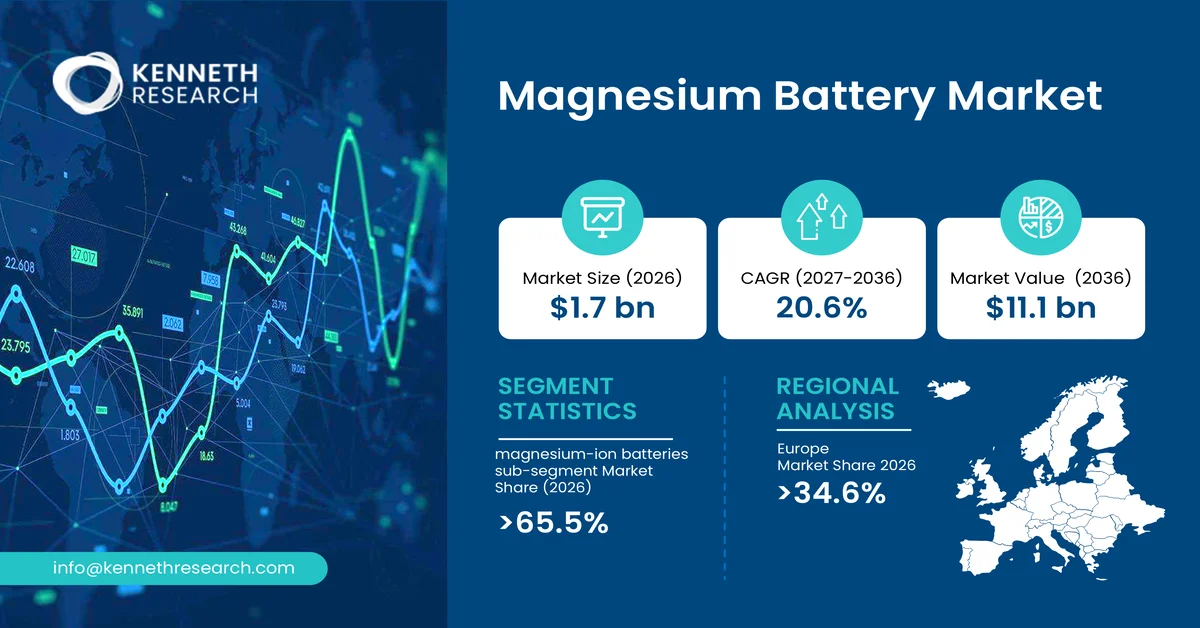
Magnesium battery market size was valued at USD 1.7 billion in 2026 and is projected to reach USD 11.1 billion by the end of 2036, expanding at a CAGR of 20.6% during the forecast period, i.e., 2027–2036. In 2027, the industry size of the magnesium battery market is estimated at USD 2.0 billion.
The primary growth driver for the magnesium battery market is the accelerating need for safer, scalable energy-storage technologies as electricity systems integrate more variable renewable generation. The International Energy Agency reported that battery storage in the power sector was the fastest-growing commercially available energy technology in 2023, reinforcing demand for alternative battery chemistries.
The magnesium battery market comprises technologies that use magnesium-based electrochemical systems to store and release electrical energy. These batteries are being developed as an alternative to conventional rechargeable battery chemistries, with research focused on magnesium as an active charge carrier and on compatible cathode, electrolyte, anode, and cell designs.
A defining characteristic is the use of magnesium ions or magnesium metal within the electrochemical process, depending on the battery architecture. Magnesium-based systems are being investigated for their potential combination of material availability, safety characteristics, electrochemical performance, and suitability for stationary and other demanding applications. Technology development encompasses materials research, electrolyte formulation, electrode engineering, cell architecture, manufacturing processes, and system integration.
Key Magnesium Battery Market Insights Summary:
Key Takeaways: Market Trends & Insights
- magnesium battery market value is USD 1.7 billion in 2026 and is projected to reach USD 11.1 billion by 2036
- The magnesium-ion batteries segment holds the largest share at 65.5% in 2026
- Europe leads the global market with a 34.6% market share in 2026
- The magnesium battery market is projected to expand at a CAGR of 20.6% from 2027 to 2036
- Germany and France are the key countries supporting Europe, while China and Japan strengthen the Asia Pacific opportunity
Market Drivers
- Government support for next-generation battery manufacturing
- Growing demand for alternative grid energy storage chemistries
- Advances in magnesium-compatible electrolytes and electrode materials
- Increasing emphasis on battery supply-chain diversification
Challenges
- Electrolyte and electrode compatibility constraints
- Limited commercial manufacturing maturity
Magnesium Battery Market Overview & Supply Chain
Adoption of magnesium batteries is increasing as battery technology expands beyond established chemistries and energy systems require safer, diversified, and potentially more resource-resilient storage options. Magnesium-based systems are being investigated because magnesium can serve as an alternative electrochemical carrier, while advances in electrode, electrolyte, and cell engineering are addressing technical barriers to commercialization.
The magnesium battery value chain begins with sourcing magnesium and other battery-grade inputs, alongside materials required for cathodes, electrolytes, current collectors, separators, and cell components. Upstream participants include mineral producers, chemical processors, specialty-material suppliers, and research organizations developing magnesium-compatible materials. Manufacturing then involves electrode preparation, electrolyte formulation, cell assembly, formation, testing, module integration, and battery-system manufacturing. Distribution connects cell and system manufacturers with integrators, equipment suppliers, utilities, industrial customers, and other downstream buyers. End users can include grid operators, renewable-energy developers, commercial and industrial facilities, and stationary-storage providers.
Magnesium Battery Market - Growth Drivers & Challenges
Growth Drivers
- Government Support for Next-Generation Battery Manufacturing: Government-backed investment in next-generation battery technologies is strengthening the innovation pipeline for magnesium-based storage. Public funding helps researchers and manufacturers address technical barriers involving materials, electrode performance, electrolytes, cell architecture, manufacturing processes, and scale-up.
- Growing Demand for Alternative Grid Energy Storage Chemistries: The expansion of renewable electricity is increasing the need for energy-storage technologies capable of supporting grid flexibility, reliability, and longer-duration applications. This creates an opportunity for magnesium batteries as an emerging chemistry that can diversify the technology base beyond conventional lithium-ion systems. Magnesium-based storage research can benefit from growing demand for alternatives that potentially use more readily available materials and address specific safety, cost, or duration requirements.
Challenges
- Electrolyte and Electrode Compatibility Constraints: A fundamental restraint is the difficulty of developing electrolyte systems that simultaneously enable reversible magnesium plating and stripping, remain chemically stable, and operate effectively with high-voltage cathodes. Magnesium’s interfacial chemistry can produce passivating layers that restrict ion transport and reduce electrochemical reversibility.
- Limited Commercial Manufacturing Maturity: The market faces a second restraint from the limited manufacturing maturity of magnesium battery technologies. Most development remains concentrated on laboratory research, material validation, and prototype-level cell configurations rather than standardized, high-volume production. This creates a gap between promising electrochemical concepts and commercially deployable battery systems.
Magnesium Battery Market Size and Forecast:
| Report Attribute | Details |
|---|---|
| Base Year |
2026 |
| Forecast Year |
2027-2036 |
| CAGR |
20.6% |
| Base Year Market Size (2026) |
USD 1.7 billion |
| Forecast Year Market Size (2036) |
USD 11.1 billion |
| Regional Scope |
|
Magnesium Battery Market - Segment Analysis
Type Segment Analysis
In the type segment, magnesium-ion batteries sub-segment is anticipated to capture the largest market share of 65.5% by the end of 2026.
Magnesium-ion batteries lead the type segment because their architecture directly aligns with the market’s core technological proposition: using magnesium ions as the charge carrier. Current development is being supported by demand for alternative rechargeable chemistries that can complement established lithium-ion platforms, particularly where material availability, safety, and supply-chain diversification are strategic considerations. Research activity is increasingly focused on improving magnesium-ion transport, cathode compatibility, electrolyte stability, and reversible cycling, strengthening the pathway from laboratory development toward practical cells. Broader battery demand also provides a supportive environment for emerging chemistries. The International Energy Agency reported that global demand for electric-vehicle batteries exceeded 950 GWh in 2024, demonstrating the scale of the underlying battery ecosystem and the commercial incentive to develop additional chemistries.
Application Segment Insights
The grid energy storage is projected to grow as the second-largest segment in the magnesium battery market due to four converging demand drivers.
Grid energy storage is projected to be the fastest-growing application segment as electricity systems increasingly require flexible resources to balance variable renewable generation, manage peak demand, and strengthen grid reliability. Magnesium-based batteries could benefit from this trend because stationary applications can provide a broader pathway for emerging chemistries to mature without immediately competing with established batteries across every mobility requirement. Adoption is also supported by utilities and renewable-energy developers seeking storage technologies capable of energy shifting, ancillary services, and network support. The International Energy Agency reported that utility-scale battery storage additions reached 63 GW in 2024, a record level, underscoring accelerating deployment of storage infrastructure. On the supply side, increasing investment in stationary-storage manufacturing, system integration, and demonstration projects can create opportunities for alternative chemistries.
Our in-depth analysis of the magnesium battery market includes the following segments:
|
Segment |
Sub-segment |
|
Type |
|
|
Application |
|
Magnesium Battery Market - Regional Analysis
Europe Market Trends & Insights:
Europe magnesium battery market is projected to hold the largest revenue share of 34.6% by the end of 2026.
Its leadership reflects a well-established battery industrial base, substantial clean-energy investment, strong research capabilities, and coordinated regulatory support for battery manufacturing and circularity.
Germany is a principal regional hub, supported by automotive manufacturing, battery-material development, engineering capabilities, and expanding storage infrastructure. A Joint Research Centre assessment based on Eurostat data identifies Germany as the leading EU member state by battery-manufacturing turnover, demonstrating its industrial significance.
France complements this position through its automotive ecosystem, energy-sector capabilities, research infrastructure, and participation in European battery-value-chain initiatives. Together, these countries strengthen Europe’s manufacturing, technology-development, and investment ecosystem for emerging battery chemistries.
Asia Pacific Market Trends & Insights:
Asia Pacific represents a strategically important development region for the magnesium battery market, supported by extensive battery manufacturing capabilities, expanding renewable-energy deployment, and active government efforts to strengthen energy-storage ecosystems.
China remains the region’s principal industrial center, with a deeply developed battery manufacturing ecosystem spanning materials, cells, equipment, and system integration. Its policy focus on new energy storage creates opportunities for magnesium-based technologies as developers seek additional chemistry options.
Japan complements China through advanced materials research, precision manufacturing, and coordinated battery-industry policy. In 2026, Japan revised its battery strategy to strengthen domestic manufacturing, secure upstream resources, reinforce supply chains, and accelerate next-generation battery technologies.
Magnesium Battery Market Competitive Landscape
Here is a list of upstream, downstream, and key players operating in magnesium battery market competitive ecosystem:
- CVMR Energy Metals Inc. (Canada)
- Company Overview
- Business Strategy
- Key Product Offerings
- Financial Performance
- Key Performance Indicators
- Risk Analysis
- Recent Development
- Regional Presence
- SWOT Analysis
- Sion Power Corporation (United States)
- A123 Systems LLC (United States)
- Furukawa Battery Co., Ltd. (Japan)
Recent Developments
- In February 2017, Furukawa Battery Co., Ltd. announced that its MgBOX (Magnesium Air Battery) series received Green Purchasing Law compliance certification from the Japanese government.
The MgBOX and MgBOX slim were certified as compliant products for emergency portable power supplies under the Green Purchasing Law, which was amended to add emergency portable power sources to disaster stockpile items. The certification requires electrical capacity of 100Wh or more and a guaranteed period or recommended use period of 5 years or more.
Frequently Asked Question
In 2026, the magnesium battery market exceeded USD 1.7 billion.
The magnesium battery market is projected to reach USD 11.1 billion by the end of 2036, expanding at a CAGR of 20.6% over the forecast period (2027-2036).
The major players in the market are CVMR Energy Metals Inc. (Canada), Sion Power Corporation (United States), A123 Systems LLC (United States), Furukawa Battery Co., Ltd. (Japan), and others.
In the Type segment, the Magnesium-ion Batteries sub-segment is anticipated to capture the largest market share of 65.5% in the future and exhibit lucrative growth opportunities during 2027-2036. This growth trajectory is largely attributed to advances in magnesium-compatible electrolytes and electrode materials.
Europe is projected to hold the largest market share of 34.6% by the end of 2026 and provide more business opportunities in the future. Continuous investments in battery manufacturing, energy storage, research capabilities, and supportive regulatory frameworks are fostering the region's dominance.
Why Choose Kenneth Research ?
-
Insight with Impact : We don’t just gather data — we uncover stories, trends, and opportunities that fuel business growth.
-
Experts Who Get It : Our team speaks your industry’s language and knows what really matters to your customers and market.
-
Custom-Built for You : Forget one-size-fits-all. We craft research and consulting solutions as unique as your business vision.
-
Partners, Not Just Providers : We work with you, not for you — collaborating closely to turn insights into smart, strategic moves.
-
Results That Speak : Our work powers brands, startups, and industry leaders alike — with a track record of ideas that work in the real world.
Report ID: 1449 |
Published Date: 29 Sep 2026 |
Report Format: |
Delivery Timeline: 48-72 Business Hours

Copyright © 2025 Kenneth Research. All rights reserved. Terms of Use | Privacy Policy
