Report ID: 1417 |
Published Date: 25 Sep 2026 |
Report Format: |
Delivery Timeline: 48-72 Business Hours
Low VOC Coating Additives Market Outlook:
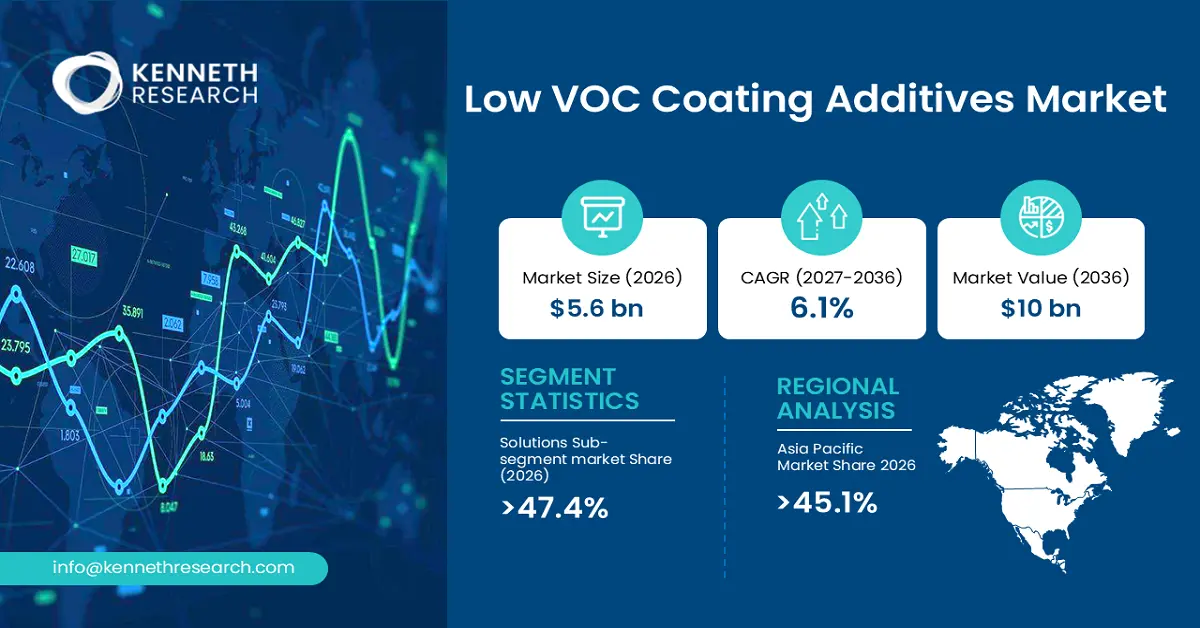
Low VOC Coating Additives Market size was valued at USD 5.6 billion in 2026 and is projected to reach USD 10 billion by the end of 2036, rising at a CAGR of 6.1% during the forecast period, i.e., 2027–2036. In 2027, the industry size of the Low VOC Coating Additives Market is estimated at USD 5.9 billion.
The primary growth driver for the low VOC coating additives market is the increasing regulatory and industry emphasis on reducing volatile organic compound emissions from coating formulations while maintaining coating performance.
The low VOC coating additives market encompasses additives, formulation ingredients, and performance-enhancing materials used to reduce or control VOC emissions in coating systems while preserving or improving application and functional characteristics. These additives can support properties such as flow and leveling, wetting, dispersion, defoaming, surface modification, rheology control, drying, adhesion, and film formation across different coating formulations.
The market covers additives used in waterborne, solvent-reduced, high-solids, UV-curable, and other low-emission coating technologies. Applications span architectural coatings, industrial coatings, automotive coatings, protective coatings, wood coatings, and other specialty coating systems. Within the value chain, additive manufacturers supply specialized chemical components to coating formulators, who incorporate them into finished coating systems for industrial and commercial end users.
Key Low VOC Coating Additives Market Insights Summary:
Key Insights : Market Trends & Insights
- The Low VOC Coating Additives Market is projected to expand from USD 5.6 billion in 2026 to USD 10 billion by 2036, supported by increasing demand for lower-emission coating formulations.
- Waterborne Technology is the leading technology segment, accounting for 47.4% in 2026, as coating manufacturers increasingly prioritize formulations that reduce VOC emissions while maintaining performance.
- Architectural Coatings represents a key application area, supported by regulatory requirements and the growing need for additives that optimize wetting, dispersion, rheology, defoaming, flow, and surface properties.
- Asia-Pacific is the dominant regional market, holding 45.1% in 2026, with Japan and China providing strong opportunities through coating-industry development and environmental initiatives.
Market Drivers
- Tightening VOC emission controls and increasing adoption of low-emission coating technologies
- Growing demand for high-performance waterborne coating formulations
- Increasing use of environmentally compatible coatings in architectural and construction applications
- Continuous development of multifunctional additives that improve coating performance while supporting lower-VOC formulations
Challenges
- Performance Trade-Offs During Low-VOC Formulation Reformulation
- Complex Additive Compatibility and Reformulation Requirements
Low VOC Coating Additives Market Overview & Supply Chain
The low VOC coating additives market is supported by the broader transition toward coating systems that reduce emissions while maintaining application performance, durability, appearance, and surface quality. The market comprises specialized additives incorporated into coating formulations to improve properties such as wetting, dispersion, flow and leveling, defoaming, rheology, adhesion, surface modification, drying, and film formation.
The supply chain begins with chemical feedstocks and specialty raw materials used to manufacture functional additives. These inputs are processed by additive manufacturers into products such as dispersants, defoamers, wetting agents, rheology modifiers, and surface-control additives. Manufacturers then supply these materials to coating formulators, who integrate them with binders, pigments, solvents or water, and other formulation components to produce finished coating systems.
Low VOC Coating Additives Market: Growth Drivers & Challenges
Growth Drivers
- Tightening VOC Emission Controls and Shift Toward Low-Emission Coatings: Stricter environmental requirements are accelerating the adoption of coating formulations designed to reduce VOC emissions, increasing demand for additives that enable waterborne and other low-emission systems to achieve required performance. The U.S. Environmental Protection Agency identifies waterborne, UV-cured, high-solids, and powder coatings as examples of low- or no-VOC coating technologies. The regulatory emphasis is particularly relevant to architectural applications, where coating manufacturers must balance VOC compliance with durability, appearance, drying, adhesion, and application characteristics.
- Growing Demand for High-Performance Waterborne Coating Formulations: The transition toward waterborne coatings is creating sustained demand for additives that can compensate for formulation challenges associated with reduced solvent content. Waterborne systems can require specialized dispersants, wetting agents, defoamers, rheology modifiers, flow-control additives, and surface modifiers to achieve consistent application and film performance. As coating manufacturers expand waterborne product portfolios, additive suppliers can capture growth by developing multifunctional solutions that improve several performance characteristics within a single formulation.
Challenges
- Performance Trade-Offs During Low-VOC Formulation Reformulation: The primary restraint is the technical difficulty of maintaining conventional coating performance while reducing VOC content. Lower solvent levels can alter evaporation behavior, viscosity, surface tension, film formation, and additive compatibility, making waterborne and other low-emission formulations more sensitive to formulation changes. This can create problems with leveling, adhesion, drying, gloss, workability, and surface appearance, particularly when coatings must perform under variable temperature and humidity conditions.
- Complex Additive Compatibility and Reformulation Requirements: The increasing diversity of low-VOC coating technologies creates compatibility challenges for additive suppliers and coating manufacturers. A shift from solventborne to waterborne, high-solids, or other low-emission systems can substantially change the chemical environment in which additives operate, meaning an additive package optimized for one formulation may not deliver equivalent results in another. Interactions among dispersants, defoamers, wetting agents, rheology modifiers, binders, pigments, and other components can influence stability and finished-coating performance.
Low VOC Coating Additives Market Size and Forecast:
| Report Attribute | Details |
|---|---|
| Base Year |
2026 |
| Forecast Year |
2027-2036 |
| CAGR |
6.1% |
| Base Year Market Size (2026) |
USD 5.6 billion |
| Forecast Year Market Size (2036) |
USD 10 billion |
| Regional Scope |
|
Low VOC Coating Additives Market Segmentation Analysis:
Technology Type Segment Analysis
In the technology segment, the waterborne technology sub-segment is anticipated to capture the largest market share of 47.4% in 2026.
Its dominance is supported by the growing preference for coating systems that reduce VOC emissions while maintaining application and performance requirements. Waterborne formulations also create continued opportunities for specialized additives that improve dispersion, wetting, defoaming, rheology, flow, leveling, and film formation. As coating manufacturers increasingly optimize formulations for environmental compliance and performance, demand for additives compatible with waterborne systems is expected to remain strong.
Application Type Segment Analysis
In the application segment, architectural coatings represent a key demand area for low-VOC coating additives because building paints and finishes increasingly need to satisfy stringent emission requirements while maintaining appearance, durability, adhesion, and application performance. Regulatory frameworks are directly influencing formulation requirements; for example, updated architectural-coating limits in California establish tighter VOC thresholds for multiple coating categories, increasing the need for additive packages that support compliant formulations without compromising functional properties.
Our in-depth analysis of the global low VOC coating additives market includes the following segments:
|
Segment |
Sub-segment |
|
By Type |
|
|
Technology |
|
|
Application |
|
Low VOC Coating Additives Market Regional Insights:
Asia-Pacific Trends & Insights:
Asia-Pacific dominated the low VOC coating additives market, accounting for 45.1% in 2026, supported by expanding coating production, environmental compliance initiatives, and increasing adoption of lower-emission formulation technologies across Japan and China.
Japan represents a significant market within Asia-Pacific, supported by its advanced manufacturing base and established architectural, automotive, industrial, and specialty-coating industries.
China provides substantial growth opportunities due to its extensive manufacturing base, construction activity, and broad consumption of architectural and industrial coatings. Increasing environmental requirements are encouraging coating manufacturers to transition toward cleaner formulations and technologies with lower emissions.
North America Trends & Insights:
North America represents a significant secondary region for the low VOC coating additives market, supported by established coating manufacturing capabilities, environmental regulations, and increasing demand for lower-emission formulations.
The U.S. is a key market within North America, supported by its mature architectural, automotive, industrial, and protective coatings industries. Federal and state-level environmental requirements governing VOC emissions continue to encourage coating manufacturers to develop lower-emission formulations.
Canada provides additional growth opportunities through its established construction, manufacturing, and coatings industries and its regulatory focus on reducing VOC emissions from architectural coatings.
Leading Companies Operating in the Low VOC Coating Additives Market:
Here is a list of upstream, downstream, and key players operating in the global low VOC coating additives market competitive ecosystem:
- BASF (Germany)
- Company Overview
- Business Strategy
- Key Product Offerings
- Financial Performance
- Key Performance Indicators
- Risk Analysis
- Recent Development
- Regional Presence
- SWOT Analysis
- BYK (Germany)
- Arkema (France)
- Evonik Industries AG (Germany)
- Dow Inc. (United States)
- Elementis plc (United Kingdom)
Recent Developments
- In July 2026, BASF announced the expansion of its certified biomass-balanced additives portfolio for architectural coatings with the introduction of Dispex AA 4145 MB, Rheovis PU 1333 MB, and Rheovis HS 1169 MB.
- In July 2026, BYK announced the introduction of DISPERBYK-2180, a new wetting and dispersing additive for inorganic pigments and fillers in aqueous systems. The company stated that the additive is designed for high pH stability and is suitable for biocide- and VOC-free architectural coatings.
Frequently Asked Question
In 2026, the low VOC Coating additives market exceeded USD 5.6 billion.
The low VOC coating additives market is projected to reach USD 10 billion by the end of 2036, expanding at a CAGR of 6.1% over the forecast period (2027-2036).
The major players in the market are BYK, BASF, Dow, Elementis, Arkema, and others.
In the technology segment, the waterborne technology sub-segment is anticipated to capture the largest market share of 47.4% in the future and exhibit lucrative growth opportunities during 2027-2036.
Asia-Pacific is projected to hold the largest market share of 45.1% by the end of 2036 and provide more business opportunities in the future.
Why Choose Kenneth Research ?
-
Insight with Impact : We don’t just gather data — we uncover stories, trends, and opportunities that fuel business growth.
-
Experts Who Get It : Our team speaks your industry’s language and knows what really matters to your customers and market.
-
Custom-Built for You : Forget one-size-fits-all. We craft research and consulting solutions as unique as your business vision.
-
Partners, Not Just Providers : We work with you, not for you — collaborating closely to turn insights into smart, strategic moves.
-
Results That Speak : Our work powers brands, startups, and industry leaders alike — with a track record of ideas that work in the real world.
Report ID: 1417 |
Published Date: 25 Sep 2026 |
Report Format: |
Delivery Timeline: 48-72 Business Hours

Copyright © 2025 Kenneth Research. All rights reserved. Terms of Use | Privacy Policy
