Report ID: 1437 |
Published Date: 25 Sep 2026 |
Report Format: |
Delivery Timeline: 48-72 Business Hours
Logistics Automation Market Outlook:
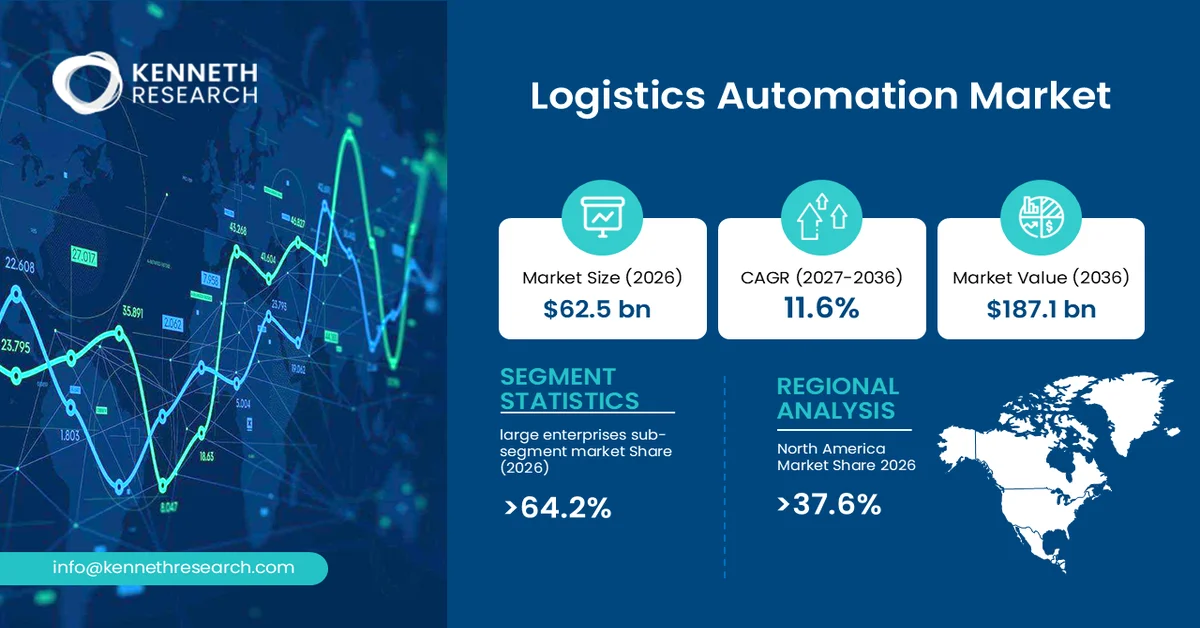
Logistics Automation Market size was valued at USD 62.5 billion in 2026 and is projected to reach USD 187.1 billion by the end of 2036, rising at a CAGR of 11.6% during the forecast period, i.e., 2027–2036. In 2027, the industry size of the logistics automation market is estimated at USD 69.7 billion.
Supply chain resilience and the increasing need for faster, more coordinated goods movement are major growth drivers for the logistics automation market.
The logistics automation market encompasses technologies, equipment, software, and integrated systems used to automate the movement, storage, handling, tracking, and management of goods across logistics and supply-chain operations. It includes automated storage and retrieval systems, conveyor and sorting technologies, autonomous mobile robots, automated guided vehicles, robotic picking and palletizing systems, warehouse management software, machine-vision solutions, sensors, and data-driven control platforms.
A defining characteristic of the market is the integration of physical automation with digital intelligence. Modern logistics environments increasingly combine robotics, sensors, warehouse execution systems, artificial intelligence, Internet of Things connectivity, and real-time data analytics to coordinate material flows and support operational decision-making.
Key Logistics Automation Market Insights Summary:
Key Takeaways: Market Trends & Insights
- Logistics Automation Market is projected to grow from USD 62.5 billion in 2026 to USD 187.1 billion by 2036 at an 11.6% CAGR.
- North America accounted for the largest regional share at 37.6% in 2026.
- Large Enterprises will remain the leading Organization Size segment, accounting for 64.2% of the market in 2026.
- On-Premise deployment is expected to maintain strong demand as enterprises seek greater control over automation infrastructure, operational data, system configuration, and integration with existing warehouse environments.
Market Drivers
- Rising demand for warehouse productivity and labor optimization
- Expansion of digitally connected supply chains
- Growth of e-commerce and high-speed fulfillment requirements
- Increasing adoption of robotics, artificial intelligence, and autonomous material-handling technologies
Challenges
- High capital investment and uncertain return on investment
- Integration complexity across legacy logistics infrastructure
Logistics Automation Market Overview & Supply Chain
Global adoption of logistics automation is increasing as retailers, manufacturers, distributors, and logistics providers seek faster fulfillment, greater inventory visibility, and more consistent material handling. The expansion of digital commerce is particularly relevant because it increases pressure on fulfillment networks to process orders efficiently across increasingly complex distribution structures. Automation also supports integration between physical handling equipment and digital systems, allowing operators to coordinate inventory flows, monitor processes, and respond more rapidly to operational changes.
The logistics automation value chain begins with raw-material and technology inputs, including metals, plastics, electronic components, motors, sensors, controllers, batteries, industrial computers, networking equipment, and software-development resources. Equipment manufacturers and automation specialists then engineer and assemble robotic systems, conveyors, automated storage and retrieval equipment, sortation platforms, autonomous vehicles, sensors, and control systems. Software providers contribute warehouse-management, warehouse-control, fleet-management, analytics, and integration platforms that coordinate automated assets.
Logistics Automation Market: Growth Drivers & Challenges
Growth Drivers
- Rising demand for warehouse productivity and labor optimization: The increasing need to improve warehouse productivity is accelerating adoption of automation across distribution and fulfillment operations. Logistics providers face growing requirements to process orders accurately while maintaining consistent throughput, making robotic handling, automated storage, sorting systems, warehouse management software, and autonomous vehicles increasingly valuable. Automation enables organizations to shift repetitive activities from manual processes toward coordinated machine-based workflows, improving process consistency and allowing employees to focus on supervision, exception handling, and higher-value activities.
- Expansion of digitally connected supply chains: The transition toward digitally connected supply chains is creating stronger demand for automation systems that can communicate across warehouse, transportation, inventory, and enterprise platforms. Logistics operators increasingly require real-time visibility and coordinated decision-making rather than isolated equipment performing individual tasks. This encourages integration between warehouse-management systems, warehouse-control software, robotics, sensors, autonomous vehicles, and analytics platforms.
Challenges
- High capital investment and uncertain return on investment: The transition from manual logistics operations to fully automated warehouses requires substantial upfront investment in robotic systems, automated storage and retrieval equipment, conveyor networks, warehouse control software, sensors, and supporting infrastructure. For many organizations, particularly regional logistics providers and mid-sized distribution operators, these capital requirements create lengthy approval cycles and uncertainty around payback periods. Commercially, high implementation costs often delay modernization projects, causing uneven automation adoption across facilities with different throughput levels.
- Integration complexity across legacy logistics infrastructure: Many logistics facilities continue operating with legacy warehouse management systems, aging material-handling equipment, and fragmented digital platforms that were not designed for intelligent automation. Integrating robotics, autonomous vehicles, machine vision, IoT sensors, and analytics into these environments requires extensive customization, data standardization, and operational redesign. The industry impact extends beyond technology, as implementation often disrupts warehouse workflows, increases commissioning time, and demands specialized engineering expertise.
Logistics Automation Market Size and Forecast:
| Report Attribute | Details |
|---|---|
| Base Year |
2026 |
| Forecast Period |
2027-2036 |
| CAGR |
11.6% |
| Base Year Market Size (2026) |
USD 62.5 billion |
| Forecast Year Market Size (2036) |
USD 187.1 billion |
| Regional Scope |
|
Logistics Automation Market Segmentation Analysis:
Organization Size Segment Analysis
In the organization size segment, the large enterprises sub-segment is anticipated to capture the largest market share of 64.2% in 2026.
Large enterprises dominate the organization-size segment because their logistics networks typically involve multiple facilities, high transaction volumes, complex inventory flows, and extensive integration requirements, creating a stronger business case for automation than smaller operators. Large organizations can deploy automation across distribution centers, manufacturing sites, fulfillment facilities, and transportation interfaces while spreading technology and integration costs across broader operational footprints.
Demand is increasingly shaped by requirements for centralized control, standardized processes, labor optimization, inventory accuracy, and scalable fulfillment. Large enterprises also have greater access to capital and dedicated engineering teams, supporting adoption of automated storage and retrieval systems, robotics, autonomous mobile robots, sortation, and integrated warehouse software.
Deployment Mode Segment Analysis
On-premise deployment remains relevant where logistics operators require direct control over operational data, automation infrastructure, system configuration, and integration with existing warehouse equipment. This deployment model is particularly suitable for organizations operating complex facilities with established information-technology environments, strict internal governance requirements, or workflows that depend on continuous connectivity between warehouse-control platforms and physical automation. Demand is supported by the increasing scale and complexity of logistics activity, which encourages enterprises to maintain tightly controlled automation environments.
Our in-depth analysis of the global logistics automation market includes the following segments:
|
Segment |
Sub-segment |
|
By Component |
|
|
Automation Type |
|
|
Organization Size |
|
|
Application |
|
|
End User |
|
|
Technology |
|
Logistics Automation Market Regional Insights:
North America Market Trends & Insights:
North America dominated the logistics automation market, accounting for 37.6% of the global market share in 2026.
The region’s established manufacturing, retail, e-commerce, transportation, and third-party logistics ecosystems create sustained demand for automated material handling, robotics, warehouse software, and integrated fulfillment systems. The regional operating environment also benefits from close integration between U.S. and Canadian transportation networks.
The U.S. represents the region’s largest technology and deployment base, supported by extensive warehousing, retail, manufacturing, parcel delivery, and fulfillment operations. Demand is reinforced by investments in digital supply-chain infrastructure and the modernization of distribution facilities.
Canada contributes through its extensive freight transportation and warehousing ecosystem and close commercial integration with the U.S. Statistics Canada reported that nearly 152,000 business locations operated in Canada’s truck transportation subsector as of June 2024, illustrating the breadth of the country's logistics infrastructure.
Asia-Pacific Market Trends & Insights:
Asia-Pacific represents an important growth opportunity for the logistics automation market, supported by expanding manufacturing ecosystems, sophisticated export-oriented supply chains, e-commerce activity, and increasing investment in intelligent logistics infrastructure. Governments across the region are also encouraging logistics digitalization and operational efficiency.
Japan offers strong opportunities for automation suppliers because logistics operators are increasingly encouraged to improve productivity through mechanization, digitalization, and standardized operating processes.
China provides substantial opportunities through its manufacturing base, extensive distribution infrastructure, and policy emphasis on intelligent logistics. Government initiatives promote digital upgrades, smart logistics facilities, autonomous equipment, and integrated logistics technologies, supporting broader adoption across warehouses, industrial facilities, ports, and distribution networks.
Leading Companies Operating in the Global Logistics Automation Market:
Here is a list of upstream, downstream, and key players operating in the global logistics automation market competitive ecosystem:
- Dematic (U.S)
- Company Overview
- Business Strategy
- Key Product Offerings
- Financial Performance
- Key Performance Indicators
- Risk Analysis
- Recent Development
- Regional Presence
- SWOT Analysis
- Daifuku (Japan)
- SSI SCHAEFER (Germany)
- Honeywell Intelligrated (United States)
- SSI SCHAEFER (Germany)
- KNAPP AG (Austria)
Recent Developments
- In January 2026, Dematic announced a formal partnership with Hai Robotics covering Europe. The agreement combines Dematic's supply-chain automation capabilities with Hai Robotics' autonomous mobile robot technology to develop scalable warehouse and logistics automation solutions.
- In February 2026, Daifuku announced the launch of its SOTR-M, an intralogistics sorting-transfer robot. The product was introduced as part of Daifuku's material-handling and intralogistics product portfolio.
Frequently Asked Question
In 2026, the logistics automation market exceeded USD 62.5 billion.
The logistics automation market is projected to reach USD 187.1 billion by the end of 2036, expanding at a CAGR of 11.6% over the forecast period (2027-2036).
The major players in the market are Daifuku, Dematic, SSI SCHAEFER, Honeywell, and others.
In the organization size segment, the large enterprises sub-segment is anticipated to capture the largest market share of 64.2% in the future and exhibit lucrative growth opportunities during 2027-2036.
North America is projected to hold the largest market share of 37.6% by the end of 2036 and provide more business opportunities in the future.
Why Choose Kenneth Research ?
-
Insight with Impact : We don’t just gather data — we uncover stories, trends, and opportunities that fuel business growth.
-
Experts Who Get It : Our team speaks your industry’s language and knows what really matters to your customers and market.
-
Custom-Built for You : Forget one-size-fits-all. We craft research and consulting solutions as unique as your business vision.
-
Partners, Not Just Providers : We work with you, not for you — collaborating closely to turn insights into smart, strategic moves.
-
Results That Speak : Our work powers brands, startups, and industry leaders alike — with a track record of ideas that work in the real world.
Report ID: 1437 |
Published Date: 25 Sep 2026 |
Report Format: |
Delivery Timeline: 48-72 Business Hours

Copyright © 2025 Kenneth Research. All rights reserved. Terms of Use | Privacy Policy
