Report ID: 1097 |
Published Date: 18 Aug 2026 |
Report Format: |
Delivery Timeline: 48-72 Business Hours
Liver Biopsy Market Outlook:
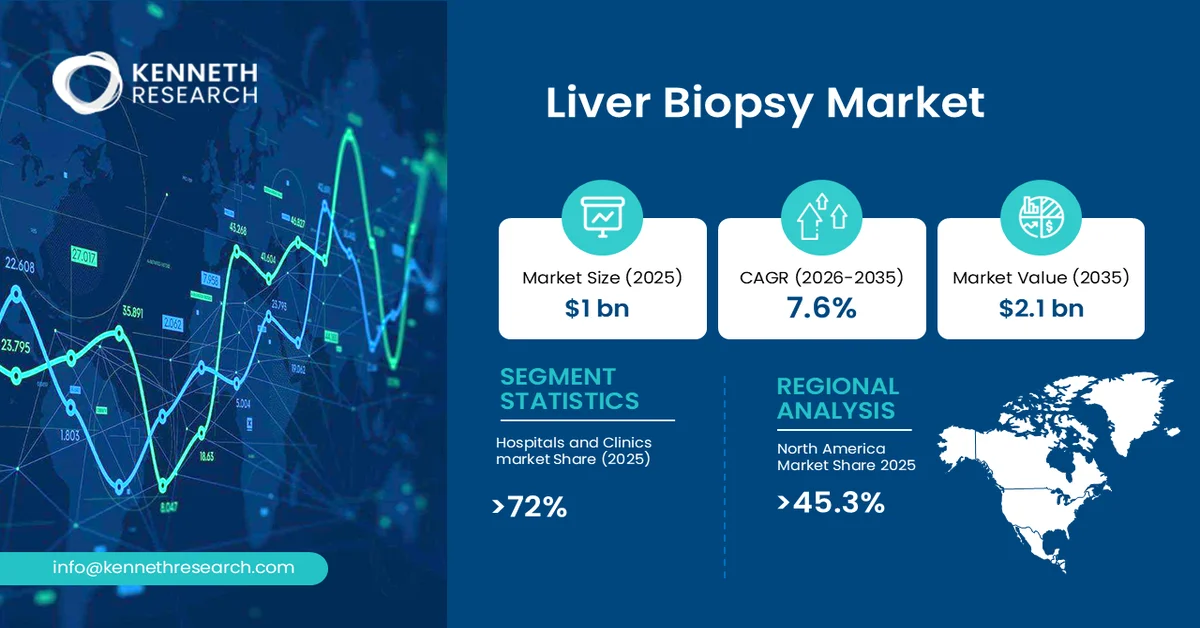
Liver Biopsy Market size was valued at USD 1 billion in 2025 and is projected to reach USD 2.1 billion by the end of 2035, rising at a CAGR of 7.6% during the forecast period, i.e., 2026-2035. In 2026, the industry size of the liver biopsy is estimated at USD 1.1 billion.
The primary growth driver for the liver biopsy market is the increasing clinical need for definitive histopathological diagnosis of chronic liver diseases, fibrosis, cirrhosis, and liver cancer when non-invasive assessments are inconclusive. Liver biopsy remains an essential diagnostic tool for disease staging, treatment selection, and monitoring therapeutic outcomes.
The liver biopsy market comprises medical devices, biopsy needles, imaging-guided systems, consumables, and related procedural services used to obtain liver tissue samples for microscopic examination. A liver biopsy is a diagnostic procedure in which a small tissue specimen is collected from the liver and evaluated by a pathologist to identify cellular abnormalities, determine disease severity, and support clinical decision-making. Common approaches include percutaneous, transjugular, and surgical liver biopsy, selected according to patient condition and clinical requirements.
The market is characterized by increasing adoption of image-guided procedures, minimally invasive biopsy techniques, and standardized pathology workflows that improve diagnostic accuracy while reducing procedural risks. Liver biopsy continues to serve as an important reference standard in cases where laboratory findings and imaging studies alone cannot provide sufficient diagnostic certainty, particularly for evaluating fibrosis, inflammation, and complex liver disorders.
Industrial relevance remains strong across hospitals, specialty clinics, diagnostic centers, and academic research institutions, where liver biopsy supports disease diagnosis, treatment planning, clinical research, and the evaluation of emerging therapies for chronic liver conditions.
Key Liver Biopsy Market Insights Summary:
Key Takeaways: Market Trends & Insights
- Liver Biopsy Market is projected to grow from USD 1 billion in 2025 to USD 2.1 billion by 2035, registering a 7.6% CAGR during 2026-2035
- Hospitals and Clinics led the end user segment with a 72% share in 2025, supported by strong adoption of image-guided biopsy procedures and specialized diagnostic infrastructure
- North America accounted for the largest regional share at 45.3% in 2025, driven by advanced healthcare systems, high procedural volumes, and widespread availability of hepatology services
- Percutaneous Biopsy is expected to witness strong growth throughout the forecast period owing to increasing preference for minimally invasive, image-guided tissue sampling techniques
- The market is supported by rising demand for accurate histopathological diagnosis of chronic liver diseases, liver cancer, fibrosis, and cirrhosis, alongside continuous advancements in biopsy devices and imaging technologies
Market Drivers
- Increasing adoption of precision medicine in hepatology
- Expanding availability of advanced diagnostic infrastructure in emerging healthcare systems
- Growing investment in liver disease clinical research and therapeutic development
- Increasing preference for image-guided minimally invasive biopsy procedures
Challenges
- Growing preference for non-invasive diagnostic alternatives
- Procedural risks and limited patient acceptance
Liver Biopsy Market Overview & Supply Chain
Global adoption of liver biopsy procedures is increasing as healthcare systems prioritize accurate diagnosis and staging of chronic liver diseases, autoimmune liver disorders, metabolic liver conditions, and hepatic malignancies. Although non-invasive diagnostic technologies continue to evolve, liver biopsy remains an important reference procedure when histopathological confirmation is required for clinical decision-making. Technological advances in image-guided biopsy systems, improved needle designs, and enhanced pathology workflows have strengthened procedural safety and diagnostic precision. In parallel, expanding national liver disease screening initiatives and evidence-based clinical guidelines are supporting appropriate biopsy utilization across tertiary care settings. Industry relevance is reinforced by the growing burden of viral hepatitis worldwide. According to the World Health Organization (WHO), an estimated 240 million people were living with chronic hepatitis B infection globally in 2024, highlighting the sustained need for accurate liver disease assessment and management pathways that include biopsy when clinically indicated.
The liver biopsy industry value chain begins with suppliers of medical-grade stainless steel, specialty polymers, precision-engineered components, sterile packaging materials, and imaging equipment used in biopsy systems. Device manufacturers design and produce disposable and reusable biopsy needles, automated biopsy instruments, introducer kits, and supporting accessories under stringent quality management and regulatory compliance requirements. Following production, products undergo sterilization, validation, packaging, and distribution through medical device distributors, hospital procurement organizations, and specialized healthcare suppliers. Healthcare providers—including hospitals, ambulatory surgical centers, specialty liver clinics, and diagnostic institutions—perform biopsy procedures using imaging guidance and standardized clinical protocols. Tissue samples are subsequently processed by pathology laboratories for histological evaluation, generating diagnostic insights that guide treatment decisions. Major stakeholders include raw material suppliers, medical device manufacturers, imaging technology providers, pathology laboratories, healthcare providers, regulatory authorities, reimbursement organizations, and clinical research institutions that collectively support product development, commercialization, and patient care.
Liver Biopsy Market - Growth Drivers & Challenges
Growth Drivers:
- Rising burden of chronic liver diseases driving demand for histopathological diagnosis: The increasing prevalence of chronic liver disorders is a major catalyst for the liver biopsy market because tissue-based evaluation remains essential when imaging, laboratory findings, and non-invasive diagnostic techniques do not provide sufficient clinical certainty. Liver biopsy enables physicians to determine disease etiology, assess fibrosis progression, evaluate inflammatory activity, and guide therapeutic interventions with greater confidence. As healthcare systems strengthen hepatology services and expand access to specialist care, demand for reliable biopsy procedures continues to increase across hospitals and tertiary care centers. The growing pipeline of therapies targeting chronic liver diseases also reinforces the need for accurate baseline and follow-up tissue assessment in selected patients.
- Continuous advancements in image-guided and minimally invasive biopsy technologies: Technological innovation is strengthening the clinical value proposition of liver biopsy by improving procedural precision, patient safety, and diagnostic reliability. Modern ultrasound- and CT-guided biopsy systems enable clinicians to accurately target focal liver lesions while minimizing damage to surrounding tissues. Simultaneously, improvements in automated biopsy devices, ergonomic needle designs, and specimen acquisition technologies are enhancing tissue quality and reducing the need for repeat procedures. These advancements encourage broader adoption among healthcare providers seeking standardized diagnostic workflows with predictable clinical outcomes. Integration of digital pathology, artificial intelligence-assisted image interpretation, and advanced imaging modalities is expected to further optimize biopsy planning and pathological assessment. As healthcare providers increasingly prioritize minimally invasive interventions and value-based care, continued innovation will support greater procedural efficiency, improve patient experience, and expand the role of liver biopsy in precision hepatology and oncology.
Challenges:
- Growing preference for non-invasive diagnostic alternatives: The expanding adoption of non-invasive diagnostic technologies represents a significant restraint for the liver biopsy market. Advances in elastography, magnetic resonance-based imaging techniques, and serum biomarker panels enable clinicians to evaluate liver fibrosis and disease progression without exposing patients to invasive procedures. As clinical guidelines increasingly recommend non-invasive assessments as first-line diagnostic tools for many chronic liver conditions, the number of patients requiring biopsy is becoming more selective. This trend influences purchasing decisions among healthcare providers by shifting investments toward advanced imaging platforms and diagnostic software. Commercially, manufacturers of biopsy devices face greater pressure to differentiate their products through improved procedural safety, specimen quality, and workflow efficiency. Going forward, liver biopsy is expected to retain its importance for complex diagnostic cases, but broader market growth will increasingly depend on demonstrating complementary value alongside evolving non-invasive technologies.
- Procedural risks and limited patient acceptance: Despite continuous technological improvements, liver biopsy remains an invasive procedure associated with potential complications such as bleeding, pain, infection, and injury to adjacent structures. These perceived and actual procedural risks often contribute to patient reluctance, particularly when repeated tissue sampling is required for disease monitoring or clinical research. Healthcare providers must also allocate specialized personnel, imaging resources, post-procedure observation, and emergency preparedness, increasing operational complexity and procedural costs. Commercially, these factors can limit procedure volumes, extend decision-making timelines, and create barriers to adoption in facilities with constrained clinical infrastructure. Manufacturers are therefore challenged to develop devices that further reduce complications while improving procedural efficiency. Future market competitiveness will increasingly depend on innovations that enhance patient comfort, simplify clinical workflows, and provide consistently high-quality tissue samples with minimal procedural burden.
Liver Biopsy Market Size and Forecast:
| Report Attribute | Details |
|---|---|
| Base Year |
2025 |
| Forecast Year |
2026-2035 |
| CAGR |
7.6% |
| Base Year Market Size (2025) |
USD 1 billion |
| Forecast Year Market Size (2035) |
USD 2.1 billion |
| Regional Scope |
|
Liver Biopsy Market Segmentation Analysis:
End User Segment Analysis
In the end user segment, the hospitals and clinics sub-segment is anticipated to capture the largest market share of 72% by the end of 2025.
Hospitals and clinics dominate the liver biopsy market because they provide the multidisciplinary infrastructure required for safe biopsy procedures, including advanced imaging systems, interventional radiology expertise, pathology laboratories, and post-procedural monitoring capabilities. These facilities routinely manage patients with chronic liver diseases, suspected hepatic malignancies, autoimmune disorders, and transplant-related conditions that often require histopathological confirmation. Demand is further supported by the concentration of specialized hepatology and oncology services within hospital settings, where integrated diagnostic pathways enable efficient coordination between clinicians, radiologists, and pathologists. On the supply side, manufacturers of biopsy devices prioritize hospitals and large clinics as primary customers due to their higher procedural volumes, established procurement systems, and capacity to adopt technologically advanced biopsy equipment. Future growth is expected to be reinforced by continued investment in minimally invasive interventions, image-guided procedures, and digital pathology integration. Segment demand is supported by the U.S. Centers for Disease Control and Prevention (CDC), which reported 54,803 deaths from chronic liver disease and cirrhosis in the United States in 2022, highlighting the sustained clinical need for specialized hospital-based liver diagnosis and management.
Type Segment Analysis
The percutaneous biopsy is projected to grow as the second-largest segment in the liver biopsy market due to four converging demand drivers.
The percutaneous biopsy segment is projected to grow due to its ability to provide rapid, minimally invasive tissue sampling with high diagnostic accuracy while avoiding the complexity of surgical procedures. It is widely adopted as the preferred first-line biopsy approach for evaluating diffuse liver disease, focal hepatic lesions, and unexplained abnormalities detected through imaging or laboratory testing. Increasing availability of high-resolution ultrasound and computed tomography guidance has further improved procedural precision, enabling clinicians to obtain adequate tissue samples with lower complication rates and shorter recovery periods. On the supply side, manufacturers continue to introduce advanced biopsy needles, automated biopsy devices, and ergonomically designed instruments that enhance specimen quality and procedural efficiency. These innovations support broader adoption across hospitals and specialty hepatology centers. Future growth will also be driven by increasing demand for tissue-based diagnosis in precision medicine and oncology. Supporting clinical demand, the U.S. National Cancer Institute estimates 42,240 new liver cancer cases in the United States in 2025, reinforcing the continued need for image-guided diagnostic procedures such as percutaneous liver biopsy for definitive pathological evaluation.
Our in-depth analysis of the global liver biopsy market includes the following segments:
|
Segment |
Sub-segment |
|
Type |
|
|
Indication |
|
|
End User |
|
Liver Biopsy Market Regional Insights:
North America Market Trends & Insights:
North America liver biopsy market is projected to hold the largest revenue share of 45.3% by the end of 2025.
The region benefits from well-established hepatology and oncology care networks, high availability of interventional radiologists, and extensive access to pathology laboratories capable of supporting complex liver disease diagnosis. Continuous investment in minimally invasive technologies, favorable reimbursement for medically necessary diagnostic procedures, and stringent regulatory oversight for medical devices further reinforce market leadership. In addition, the presence of major medical device manufacturers, robust clinical research activity, and rapid adoption of innovative biopsy technologies contribute to sustained demand across tertiary hospitals and specialty healthcare institutions.
The United States represents the largest contributor within North America, supported by its comprehensive hospital network, significant investment in liver disease research, and widespread utilization of image-guided biopsy procedures in hepatology and oncology. According to the U.S. Centers for Disease Control and Prevention (CDC), 101,525 newly reported cases of chronic hepatitis C were recorded across 45 states and the District of Columbia during 2023, highlighting the continued clinical demand for advanced liver disease evaluation and management.
Canada complements regional growth through universal healthcare coverage, expanding access to diagnostic imaging, and continued investment in specialized liver disease management programs. Increasing collaboration between academic medical centers, provincial health systems, and clinical research organizations supports adoption of advanced biopsy technologies while strengthening diagnostic capacity for complex hepatic disorders across the country.
Europe Market Trends & Insights:
Europe represents a strategically important region for the liver biopsy market due to its mature healthcare systems, strong emphasis on early diagnosis of liver diseases, and continuous adoption of minimally invasive interventional procedures. Demand is supported by the increasing clinical focus on chronic liver disorders, liver cancer, metabolic liver diseases, and transplant-related diagnostics requiring histopathological confirmation in selected patients. The region also benefits from a well-developed medical device manufacturing ecosystem, advanced imaging infrastructure, and widespread availability of specialist hepatology and interventional radiology services. Government-backed healthcare programs, harmonized regulatory frameworks for medical devices, and sustained investment in clinical research encourage the adoption of innovative biopsy technologies across hospitals and specialty centers. Looking ahead, opportunities are expected to emerge from expanding precision medicine initiatives, increasing integration of digital pathology into diagnostic workflows, and continued development of advanced image-guided biopsy systems that improve procedural efficiency and patient outcomes.
Germany serves as a major contributor to regional demand through its highly developed hospital infrastructure, strong domestic medical technology industry, and extensive network of university medical centers specializing in hepatology, oncology, and interventional radiology. Ongoing investment in clinical innovation and advanced diagnostic capabilities supports the adoption of modern liver biopsy devices and image-guided procedures across both public and private healthcare institutions.
The United Kingdom remains another key market, driven by its established specialist liver care services, academic research capabilities, and continued modernization of diagnostic pathways within the healthcare system. Increasing collaboration between healthcare providers, research institutions, and medical device manufacturers is fostering broader implementation of minimally invasive biopsy technologies while supporting improvements in diagnostic accuracy, procedural standardization, and multidisciplinary management of complex liver diseases.
Leading Companies Operating in the Global Liver Biopsy Market:
Here is a list of upstream, downstream, and key players operating in the global liver biopsy market competitive ecosystem:
- Argon Medical Devices, Inc. (United States)
- Company Overview
- Business Strategy
- Key Product Offerings
- Financial Performance
- Key Performance Indicators
- Risk Analysis
- Recent Development
- Regional Presence
- SWOT Analysis
- Mauna Kea Technologies (France)
- MDxHealth (Belgium)
- ZAMAR Care (Italy)
Recent Developments
- January 2025: The U.S. FDA issued draft guidance on including tissue biopsies in clinical trials, providing recommendations for investigators and sponsors on the ethical and scientific use of tissue biopsies, including liver biopsies, in drug development. The guidance is expected to standardize biopsy collection practices and improve the quality of histopathological data in clinical research.
- March 2025: MedTech Dive reported that Johnson & Johnson received FDA 510(k) clearance for an AI-enabled software update to its Monarch robotic biopsy platform. Although designed for lung biopsy, the advancement highlights the growing adoption of AI-assisted navigation technologies that are influencing image-guided biopsy procedures across multiple organs, including the liver.
Frequently Asked Question
In 2025, the liver biopsy market exceeded USD 1 billion.
The liver biopsy market is projected to reach USD 2.1 billion by the end of 2035, expanding at a CAGR of 7.6% over the forecast period (2026-2035).
The major players in the market are Argon Medical Devices, Inc. (United States), Mauna Kea Technologies (France), MDxHealth (Belgium), ZAMAR Care (Italy), and others.
In the end user segment, the hospitals and clinics sub-segment is anticipated to capture the largest market share of 72% in the future and exhibit lucrative growth opportunities during 2026-2035. This growth trajectory is largely attributed to the increasing demand for specialized diagnostic infrastructure, image-guided biopsy procedures, and multidisciplinary liver disease management.
North America is projected to hold the largest market share of 45.3% by the end of 2025 and provide more business opportunities in the future. Continuous investments in advanced healthcare infrastructure, interventional radiology capabilities, and liver disease diagnosis across the United States and Canada are fostering the region's dominance.
Why Choose Kenneth Research ?
-
Insight with Impact : We don’t just gather data — we uncover stories, trends, and opportunities that fuel business growth.
-
Experts Who Get It : Our team speaks your industry’s language and knows what really matters to your customers and market.
-
Custom-Built for You : Forget one-size-fits-all. We craft research and consulting solutions as unique as your business vision.
-
Partners, Not Just Providers : We work with you, not for you — collaborating closely to turn insights into smart, strategic moves.
-
Results That Speak : Our work powers brands, startups, and industry leaders alike — with a track record of ideas that work in the real world.
Report ID: 1097 |
Published Date: 18 Aug 2026 |
Report Format: |
Delivery Timeline: 48-72 Business Hours

Copyright © 2025 Kenneth Research. All rights reserved. Terms of Use | Privacy Policy
