Report ID: 1110 |
Published Date: 19 Aug 2026 |
Report Format: |
Delivery Timeline: 48-72 Business Hours
Lithium Market Outlook:
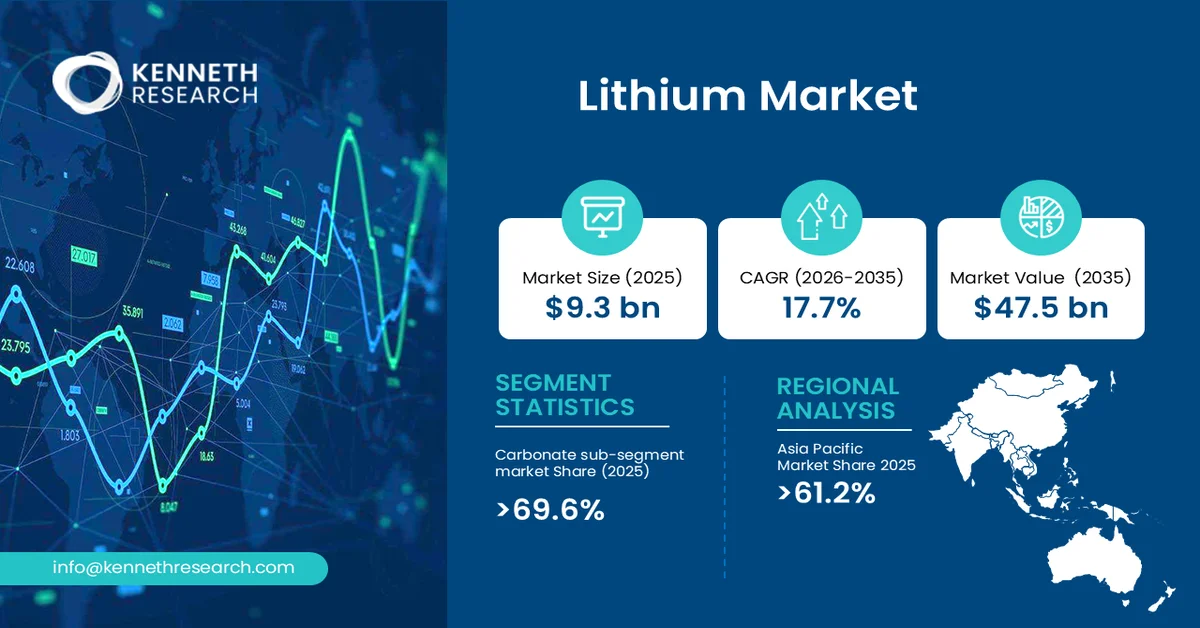
Lithium Market size was valued at USD 9.3 billion in 2025 and is projected to reach USD 47.5 billion by the end of 2035, rising at a CAGR of 17.7% during the forecast period, i.e., 2026-2035. In 2026, the industry size of the lithium is estimated at USD 10.9 billion.
The primary growth driver for the lithium market is the accelerating adoption of electric vehicles and battery energy storage systems. According to the International Energy Agency (IEA), global lithium demand increased by nearly 30% in 2024, driven predominantly by clean energy applications, reinforcing long-term demand across battery manufacturing and energy transition value chains.
The lithium market comprises the global production, processing, distribution, and commercial utilization of lithium and its compounds for industrial, energy, and advanced manufacturing applications. Lithium is a lightweight alkali metal primarily processed into compounds such as lithium carbonate and lithium hydroxide, which serve as essential raw materials for rechargeable lithium-ion batteries, specialty glass and ceramics, lubricating greases, polymers, pharmaceuticals, and metallurgical applications.
The market is characterized by its strategic importance within the critical minerals ecosystem, supported by integrated mining, chemical conversion, refining, and downstream battery manufacturing activities. Product quality, compound purity, resource availability, processing capacity, and supply chain resilience are key characteristics influencing market competitiveness and adoption across end-use industries.
Industrially, lithium has become indispensable for electrification and decarbonization initiatives. It supports battery production for electric mobility, stationary energy storage, consumer electronics, and industrial power systems while enabling manufacturers to meet evolving sustainability and energy security objectives. As governments and industries continue investing in renewable energy infrastructure and battery supply chains, the lithium market remains a foundational component of the global clean energy transition and advanced manufacturing landscape.
Key Lithium Market Insights Summary:
Key Takeaways: Market Trends & Insights
- The Lithium Market is projected to expand from USD 10.9 billion in 2026 to USD 47.5 billion by 2035, registering a 17.7% CAGR during the forecast period
- Carbonate remains the leading compound segment, accounting for 69.6% of the market in 2025, supported by its extensive use in lithium-ion battery manufacturing and established refining infrastructure
- Asia Pacific held the largest regional share of 61.2% in 2025, driven by integrated lithium refining, battery production, and electric vehicle manufacturing ecosystems across China and India
- Growing adoption of lithium hydroxide is accelerating due to increasing demand for high-performance batteries using high-nickel cathode chemistries in next-generation electric vehicles and energy storage applications
- Rising investments in critical mineral development, battery manufacturing, lithium refining, and localized supply chains are strengthening long-term industry growth while improving supply chain resilience and supporting the global clean energy transition
Market Drivers
- Growth in grid-scale energy storage deployment
- Expansion of lithium recycling and circular economy initiatives
- Technological advancements in lithium extraction and refining
- Supportive government policies promoting critical mineral security
Challenges
- Supply chain concentration and refining bottlenecks
- Environmental compliance and lengthy project development cycles
Lithium Market Overview & Supply Chain
The global adoption of lithium is accelerating as governments and industries prioritize transportation electrification, renewable energy integration, and resilient battery supply chains. Lithium compounds are indispensable for lithium-ion batteries used in electric vehicles, stationary energy storage systems, and portable electronics, making the material central to decarbonization strategies and industrial modernization. Policy incentives supporting clean mobility, domestic battery manufacturing, and critical mineral security have further strengthened long-term demand. Industry expansion is also supported by technological advancements in battery chemistry, processing efficiency, and recycling capabilities.
The lithium industry value chain begins with the extraction of lithium-bearing resources from hard-rock deposits, primarily spodumene, and lithium-rich brine reservoirs. These raw materials undergo beneficiation, concentration, and chemical conversion to produce battery-grade compounds such as lithium carbonate and lithium hydroxide, with quality control playing a critical role in downstream suitability. Chemical processors supply refined lithium products to battery material manufacturers, cathode producers, and cell manufacturers that integrate the compounds into rechargeable battery systems. Distribution occurs through long-term supply agreements, commodity trading networks, and direct procurement contracts with industrial customers. Key stakeholders across the ecosystem include mining companies, chemical refiners, battery manufacturers, automotive OEMs, logistics providers, recycling companies, research institutions, and government agencies responsible for critical mineral policy, environmental regulation, and industrial development.
Lithium Market: Growth Drivers & Challenges
Growth Drivers:
- Rapid expansion of electric vehicle and battery manufacturing ecosystems: The accelerating development of electric vehicle (EV) manufacturing and battery production ecosystems is a major growth driver for the lithium market. As countries pursue decarbonization and industrial competitiveness, investments across mining, refining, cathode materials, battery cells, and vehicle manufacturing are increasing simultaneously. This integrated expansion is strengthening long-term procurement agreements for lithium compounds while encouraging additional refining capacity and supply chain localization. The resulting increase in demand for battery-grade lithium carbonate and lithium hydroxide is fostering technological innovation in extraction, processing, and recycling. Over time, continued investments in battery manufacturing clusters are expected to improve supply resilience, reduce dependence on limited geographic sources, and create a more diversified global lithium value chain.
- Increasing strategic investments in critical mineral supply chains: Governments and private enterprises are increasingly recognizing lithium as a strategic mineral essential for energy security, advanced manufacturing, and economic resilience. This recognition has accelerated investments in exploration, resource development, refining facilities, and recycling infrastructure across multiple regions. Simultaneously, manufacturers are diversifying sourcing strategies to reduce supply concentration risks while strengthening regional processing capabilities. These developments encourage the commercialization of advanced extraction technologies capable of improving recovery rates and environmental performance. As battery chemistries continue evolving, demand for high-purity lithium compounds is expected to remain robust across mobility, stationary energy storage, aerospace, and industrial applications. The continued alignment of industrial policy, sustainability initiatives, and private capital investment is likely to reinforce long-term market expansion while supporting greater supply chain transparency and operational resilience.
Challenges:
- Supply chain concentration and refining bottlenecks: A significant restraint for the lithium market is the concentration of mining, processing, and refining capacity within a limited number of countries. Geographic concentration exposes manufacturers to geopolitical uncertainty, trade policy changes, transportation disruptions, and regulatory shifts that can interrupt material availability. Limited refining infrastructure outside established production hubs also constrains the ability of downstream industries to diversify procurement. Commercially, these challenges increase sourcing complexity, extend project development timelines, and create uncertainty for battery manufacturers seeking stable long-term supply. Although governments and companies are investing in regional refining capacity and diversified sourcing strategies, establishing new mines and processing facilities requires substantial capital, environmental approvals, and extended development periods, meaning supply diversification will remain a gradual process.
- Environmental compliance and lengthy project development cycles: The development of new lithium production capacity is frequently constrained by stringent environmental regulations, complex permitting procedures, and increasing stakeholder expectations regarding responsible mining practices. Mining projects often require extensive environmental assessments, water resource management plans, community engagement, and biodiversity protection measures before commercial operations can begin. These requirements can delay project execution and increase development costs for producers. From a commercial perspective, prolonged approval timelines reduce the industry's ability to respond rapidly to changing downstream demand and may discourage investment in high-risk jurisdictions. Looking ahead, companies that integrate sustainable extraction technologies, transparent environmental governance, and effective community partnerships are likely to gain competitive advantages while improving the long-term viability of future lithium supply.
Lithium Market Size and Forecast:
| Report Attribute | Details |
|---|---|
| Base Year |
2025 |
| Forecast Year |
2026-2035 |
| CAGR |
17.7% |
| Base Year Market Size (2025) |
USD 9.3 billion |
| Forecast Year Market Size (2035) |
USD 47.5 billion |
| Regional Scope |
|
Lithium Market Segmentation Analysis:
Compound Segment Analysis
In the compound segment, the carbonate sub-segment is anticipated to capture the largest market share of 69.6% by the end of 2025.
Lithium carbonate remains the dominant compound segment because it serves as the principal feedstock for manufacturing lithium-ion battery materials, particularly lithium iron phosphate (LFP) cathodes, while also supporting applications in glass, ceramics, pharmaceuticals, and specialty chemicals. Strong demand from battery manufacturers has reinforced its position as the preferred lithium compound due to established processing technologies, broad industrial acceptance, and compatibility with large-scale cathode production. On the supply side, producers have significantly expanded refining capacity for battery-grade lithium carbonate, supported by long-term supply agreements and investments in chemical processing infrastructure. Its standardized production processes and mature global supply network further strengthen availability for downstream manufacturers.
Compound Segment Analysis
The hydroxide is projected to grow as the second-largest segment in the lithium market due to four converging demand drivers.
Lithium hydroxide is projected to experience strong growth due to its increasing use in high-performance lithium-ion batteries employing high-nickel cathode chemistries, which are widely adopted in premium electric vehicles requiring greater energy density and extended driving range. Continuous improvements in refining technologies and process optimization are also enhancing production efficiency and product quality. Looking ahead, the growing commercialization of advanced electric vehicles, heavy-duty transport electrification, and next-generation battery technologies is expected to further strengthen demand. Supporting this outlook, the International Energy Agency reported that global EV battery demand grew to over 950 GWh in 2024, representing approximately 25% growth compared with 2023, underscoring the expanding need for battery materials such as lithium hydroxide.
Our in-depth analysis of the global lithium market includes the following segments:
|
Segment |
Sub-segment |
|
Compound |
|
|
Application |
|
|
End-User Industry |
|
Lithium Market Regional Insights:
Asia Pacific Market Trends & Insights:
Asia Pacific lithium market is projected to hold the largest revenue share of 61.2% by the end of 2025.
The region benefits from extensive investments in lithium refining, cathode material production, battery cell manufacturing, and electric vehicle assembly, creating sustained demand for lithium compounds. Favorable industrial policies, expanding renewable energy deployment, and government initiatives aimed at strengthening critical mineral supply chains continue to reinforce regional competitiveness. In addition, the presence of mature chemical processing infrastructure and vertically integrated manufacturers enables efficient conversion of lithium raw materials into battery-grade compounds.
China remains the primary growth engine within the region owing to its leadership in lithium refining, cathode material manufacturing, battery production, and electric vehicle manufacturing. The country's integrated industrial ecosystem, supported by continuous investments in advanced processing technologies and supply chain localization, reinforces its global competitiveness.
India is emerging as a significant growth market through policy initiatives promoting domestic battery manufacturing, electric mobility adoption, and critical mineral development. Investments in battery gigafactories, mineral exploration, and localized supply chains are strengthening the country's long-term position within the regional lithium ecosystem. Together, China and India are expected to remain central to Asia Pacific's leadership by expanding production capabilities, supporting downstream manufacturing, and accelerating the commercialization of clean energy technologies.
North America Market Trends & Insights:
North America represents a strategically important region in the lithium market, supported by rising demand for electric vehicles, grid-scale energy storage, and domestic battery manufacturing. Industrial activity is expanding across the lithium value chain as governments and private companies invest in mineral exploration, refining facilities, battery material production, and recycling capabilities. The region's emphasis on strengthening critical mineral security and reducing reliance on imported battery materials has encouraged the development of localized supply chains through policy incentives and public-private partnerships. In parallel, advances in direct lithium extraction technologies and sustainable processing methods are creating opportunities to improve resource efficiency and environmental performance. Looking ahead, continued investment in battery manufacturing, renewable energy infrastructure, and circular economy initiatives is expected to enhance regional competitiveness while supporting long-term growth across the lithium ecosystem.
The United States is the principal market within North America, driven by expanding investments in domestic lithium extraction, refining capacity, battery manufacturing, and electric vehicle production. Federal initiatives supporting critical mineral development and advanced manufacturing are encouraging greater integration across the battery supply chain while promoting technological innovation in extraction and recycling.
Canada complements this ecosystem through its substantial hard-rock lithium resources, mining expertise, and growing processing infrastructure. The country's focus on responsible mineral development, clean energy, and cross-border collaboration with the United States is strengthening its role as a reliable supplier of battery raw materials. Together, these countries are building a more resilient and diversified regional lithium value chain capable of supporting future electrification and energy transition objectives.
Leading Companies Operating in the Global Lithium Market:
Here is a list of upstream, downstream, and key players operating in the global lithium market competitive ecosystem:
- Albemarle Corporation (United States)
- Company Overview
- Business Strategy
- Key Product Offerings
- Financial Performance
- Key Performance Indicators
- Risk Analysis
- Recent Development
- Regional Presence
- SWOT Analysis
- Ganfeng Lithium Group Co., Ltd. (China)
- Pilbara Minerals Ltd. (Australia)
- Mineral Resources Ltd. (Australia)
- Lithium Americas Corp. (Canada/United States)
- Liontown Resources Ltd. (Australia)
Recent Developments
- In June 2026, lithium producers signaled a major shift in demand drivers at the Fastmarkets Global Lithium, Battery and Critical Materials Conference in Las Vegas, where attendance rose 10% to roughly 1,100. Battery storage systems—driven by AI expansion and grid stability needs—have become the primary new growth driver, with Fastmarkets estimating storage demand growing at 40% per year . Lithium prices have more than tripled since the 2025 conference.
- In July 2026, SQM and Wesfarmers announced a final investment decision to expand the Mt Holland lithium project in Western Australia, doubling spodumene concentrate production from approximately 380,000 tonnes to 760,000 tonnes per year. Construction of a second concentrator is expected to commence in the second half of 2027, with first production volumes anticipated in the first half of 2030 . The expansion was cleared after the mine received regulatory approval.
Frequently Asked Question
In 2025, the lithium market exceeded USD 9.3 billion.
The lithium market is projected to reach USD 47.5 billion by the end of 2035, expanding at a CAGR of 17.7% over the forecast period (2026-2035).
The major players in the market are Albemarle Corporation (United States), Ganfeng Lithium Group Co., Ltd. (China), Pilbara Minerals Ltd. (Australia), Mineral Resources Ltd. (Australia), Lithium Americas Corp. (Canada/United States), Liontown Resources Ltd. (Australia), and others.
In the compound segment, the carbonate sub-segment is anticipated to capture the largest market share of 69.6% in the future and exhibit lucrative growth opportunities during 2026-2035. This growth trajectory is largely attributed to increasing demand for lithium-ion battery manufacturing driven by electric vehicles and stationary energy storage applications.
Asia Pacific is projected to hold the largest market share of 61.2% by the end of 2025 and provide more business opportunities in the future. Continuous investments in battery manufacturing, lithium refining, and electric vehicle supply chains across China and India are fostering the region's dominance.
Why Choose Kenneth Research ?
-
Insight with Impact : We don’t just gather data — we uncover stories, trends, and opportunities that fuel business growth.
-
Experts Who Get It : Our team speaks your industry’s language and knows what really matters to your customers and market.
-
Custom-Built for You : Forget one-size-fits-all. We craft research and consulting solutions as unique as your business vision.
-
Partners, Not Just Providers : We work with you, not for you — collaborating closely to turn insights into smart, strategic moves.
-
Results That Speak : Our work powers brands, startups, and industry leaders alike — with a track record of ideas that work in the real world.
Report ID: 1110 |
Published Date: 19 Aug 2026 |
Report Format: |
Delivery Timeline: 48-72 Business Hours

Copyright © 2025 Kenneth Research. All rights reserved. Terms of Use | Privacy Policy
