Report ID: 1165 |
Published Date: 25 Aug 2026 |
Report Format: |
Delivery Timeline: 48-72 Business Hours
Lithium ion Battery Anode Materials Market Outlook:
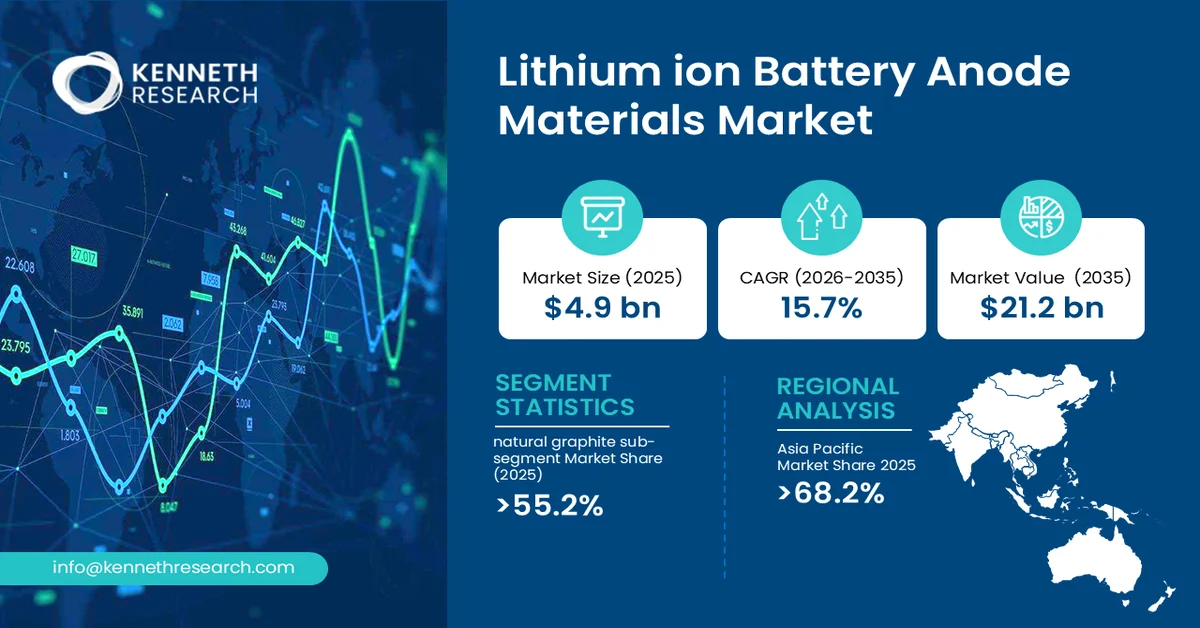
Lithium ion Battery Anode Materials Market size was valued at USD 4.9 billion in 2025 and is projected to reach USD 21.2 billion by the end of 2035, rising at a CAGR of 15.7% during the forecast period, i.e., 2026-2035. In 2026, the industry size of lithium ion battery anode materials is estimated at USD 5.7 billion.
The primary growth driver is accelerating demand for lithium-ion batteries across electric mobility and energy storage. The International Energy Agency reports that energy-sector battery demand reached 1 TWh in 2024, supported by expanding electric-vehicle and storage deployment.
The lithium ion battery anode materials market comprises materials engineered for use as the negative-electrode active component in rechargeable lithium-ion battery cells. These materials enable reversible lithium-ion storage and release during battery charging and discharging, making them fundamental to cell electrochemical performance.
The market primarily encompasses graphite-based materials, including natural and synthetic graphite, alongside emerging anode chemistries and engineered alternatives designed to improve energy density, charging performance, cycle life, safety, and temperature tolerance. Material characteristics such as particle morphology, purity, surface treatment, coating, conductivity, structural stability, and compatibility with electrolyte systems influence their suitability for commercial cell production.
Key Lithium ion Battery Anode Materials Market Insights Summary:
Key Takeaways: Market Trends & Insights
- 2025 market value of the lithium ion battery anode materials market stands at USD 4.9 billion with Natural Graphite leading the type segment at 55.2% share
- The market is projected to reach USD 21.2 billion by 2035, expanding at a 15.7% CAGR during 2026-2035
- Asia-Pacific dominates the market with a 68.2% share in 2025, supported by strong battery manufacturing and anode-material production capabilities across China and Japan
- Synthetic Graphite is positioned as the second and fastest-growing Type segment, supported by demand for consistent, high-performance anode materials and supply-chain localization
- China, Japan, the United States, and Canada represent key strategic markets, with battery manufacturing expansion and regional supply-chain development creating opportunities for anode-material producers
Market Drivers
- Expansion of lithium-ion battery manufacturing capacity
- Rising demand for high-performance battery materials
- Increasing electric-vehicle adoption
- Growth of grid-scale and stationary energy-storage deployment
Challenges
- Concentrated graphite supply chains
- High technical and processing requirements
Lithium ion Battery Anode Materials Market Overview & Supply Chain
Global adoption of lithium-ion battery technologies is increasing as electrification expands across transportation, while battery storage becomes increasingly important for integrating renewable electricity and strengthening power-system flexibility. The technology also benefits from continued improvements in cost, energy density, lifetime, and manufacturing scale. The International Energy Agency (IEA) reports that 42 GW of battery storage capacity was added globally in 2023, reflecting the growing role of batteries in utility-scale storage, behind-the-meter systems, mini-grids, and electricity-access applications. This expansion supports sustained demand for battery components, including anode materials, while encouraging manufacturers to improve material performance, processing efficiency, supply security, and recycling capabilities.
The lithium ion battery anode materials market value chain begins with sourcing raw materials and feedstocks, particularly natural graphite concentrates, synthetic graphite precursors, and other carbon-based or emerging anode inputs. Upstream participants include mining companies, mineral processors, petroleum and chemical feedstock suppliers, and specialty-material producers. Manufacturing then involves purification, shaping, milling, classification, coating, graphitization, and other treatment processes used to achieve the electrochemical and physical specifications required by battery-cell manufacturers. Distribution is coordinated through direct supply agreements, specialty-material distributors, and integrated battery supply chains. The principal downstream customers are lithium-ion battery-cell manufacturers serving electric vehicles, stationary energy storage, consumer electronics, industrial equipment, and other electrified applications.
Lithium ion Battery Anode Materials Market: Growth Drivers & Challenges
Growth Drivers:
- Battery manufacturing capacity expansion: The expansion of lithium-ion battery manufacturing is creating sustained downstream demand for anode materials as cell producers increase procurement of qualified graphite and other anode inputs. Battery manufacturers require consistent material specifications covering particle size, purity, morphology, conductivity, coating, and electrochemical performance. This encourages anode-material suppliers to expand production, improve processing capabilities, and establish long-term supply relationships with cell manufacturers. Government-backed manufacturing programs are reinforcing this trend by supporting domestic battery supply chains and encouraging investment in critical material processing. The U.S. Department of Energy has supported projects designed to strengthen domestic battery-material processing and battery manufacturing capabilities.
- Rising demand for high-performance battery materials: The shift toward higher-performance lithium-ion batteries is increasing the importance of advanced anode-material engineering. Battery manufacturers are seeking materials that can support greater energy density, faster charging, longer cycle life, improved safety, and stable performance across demanding operating conditions. This creates opportunities for suppliers capable of tailoring graphite morphology, particle distribution, surface treatment, coatings, and other material characteristics to specific cell designs. The growth mechanism extends beyond simply increasing material consumption because higher performance requirements also increase the value of material qualification, process control, technical collaboration, and proprietary treatment technologies. As battery architectures evolve, anode suppliers are expected to invest more heavily in research, pilot-scale production, and customer-specific material development.
Challenges:
- Concentrated graphite supply chain: A major restraint is the geographic concentration of graphite extraction, processing, purification, and anode-material production. The root cause is the capital-intensive nature of battery-grade graphite processing, combined with established industrial ecosystems in a limited number of countries. This concentration exposes anode-material buyers to geopolitical tensions, trade restrictions, export controls, logistics disruptions, and changes in industrial policy. The commercial impact extends beyond raw-material availability because battery manufacturers require qualified, consistent anode material, making rapid supplier substitution difficult. New regional suppliers must therefore overcome lengthy qualification processes, substantial processing requirements, and the need to achieve competitive production economics.
- High technical and processing requirements: Anode-material production faces demanding technical requirements because battery manufacturers need highly consistent material properties across large production volumes. The root cause lies in the sensitivity of lithium-ion cells to variations in particle structure, purity, surface characteristics, conductivity, and electrochemical behavior. Material suppliers must therefore maintain tight process control while developing formulations that meet individual cell manufacturers' specifications. These requirements raise commercialization barriers for new producers and can delay the transition from laboratory-scale development to qualified mass production. They also increase the cost and complexity of adopting alternative anode materials, particularly when manufacturers must validate changes without compromising cell reliability or production yields.
Lithium ion Battery Anode Materials Market Size and Forecast:
| Report Attribute | Details |
|---|---|
| Base Year |
2025 |
| Forecast Year |
2026-2035 |
| CAGR |
15.7% |
| Base Year Market Size (2025) |
USD 4.9 billion |
| Forecast Year Market Size (2035) |
USD 21.2 billion |
| Regional Scope |
|
Lithium ion Battery Anode Materials Market Segmentation Analysis:
Type Segment Analysis
In the type segment, the Natural Graphite sub-segment is anticipated to capture the largest market share of 55.2% by the end of 2025.
Natural graphite dominates the Type segment because its established use in lithium-ion anodes, favorable electrochemical characteristics, and compatibility with spherical purification and coating processes support broad battery-industry adoption. Demand is being reinforced by electric vehicles, stationary energy storage, and portable electronics, while battery manufacturers increasingly require scalable sources of battery-grade graphite. The U.S. Geological Survey reported that batteries represented 42% of global natural graphite end use in 2022, demonstrating the segment’s strong connection with the expanding battery industry. Supply-side development is also supporting adoption, with producers investing in flake-graphite mining, purification, spherical graphite processing, and downstream anode-material facilities.
Type Segment Analysis
The Synthetic Graphite is projected to grow as the second-largest segment in the lithium ion battery anode materials market due to four converging demand drivers.
Synthetic graphite is projected to grow strongly because battery manufacturers value its high purity, controlled material properties, and suitability for demanding lithium-ion battery applications. Its adoption is being reinforced by electric-vehicle and energy-storage battery production, while manufacturers increasingly seek consistent anode materials that can support performance and production reliability. Supply-side investment is also accelerating: the U.S. Department of Energy announced a conditional commitment in 2024 for a synthetic-graphite facility in Tennessee, with the planned facility expected to produce 31,500 metric tonnes of anode active material annually for lithium-ion batteries. This investment demonstrates the industry's move toward localized synthetic-graphite production and reduced dependence on concentrated overseas supply chains.
Our in-depth analysis of the global lithium ion battery anode materials market includes the following segments:
|
Segment |
Sub-segment |
|
Type |
|
|
Application |
|
Lithium ion Battery Anode Materials Market Regional Insights:
Asia Pacific Market Trends & Insights:
Asia Pacific lithium ion battery anode materials market is projected to hold the largest revenue share of 68.2% by the end of 2025.
The region’s leadership is supported by its highly integrated lithium-ion battery ecosystem, encompassing graphite processing, anode-material production, cell manufacturing, electric-vehicle supply chains, and energy-storage deployment. Strong manufacturing capabilities, established supplier networks, comparatively mature battery technologies, and government initiatives promoting domestic battery and critical-material supply chains reinforce regional competitiveness.
China remains the principal manufacturing center within Asia-Pacific. According to China’s Ministry of Industry and Information Technology, national lithium-ion battery production reached 1,170 GWh in 2024, demonstrating the scale of the country’s battery manufacturing ecosystem and its importance to demand for battery components and anode materials.
Japan complements China through advanced battery-material expertise, automotive integration, and efforts to strengthen domestic battery manufacturing and supply security. Together, these markets reinforce Asia-Pacific’s position as the core production and technology hub for lithium-ion anode materials.
North America Market Trends & Insights:
North America is emerging as an important regional opportunity for lithium-ion battery anode materials as electric-vehicle manufacturing, stationary energy storage, and domestic battery production expand. Industrial activity is increasingly focused on building an integrated regional battery ecosystem spanning critical-mineral extraction, processing, component manufacturing, cell production, and recycling. In the United States, federal programs are supporting domestic battery-component manufacturing and recycling infrastructure, creating opportunities for anode-material producers to establish localized supply relationships.
The United States remains the principal industrial market in the region, supported by automotive electrification, energy-storage deployment, and policies encouraging domestic battery supply chains. Its opportunity for anode materials is particularly tied to developing local processing and component capacity.
Canada complements this ecosystem through critical-mineral resources, battery-material research, and growing downstream manufacturing activity. Government programs are targeting gaps between mineral extraction and battery manufacturing, creating opportunities for domestic processing technologies and integrated suppliers. Together, the two countries provide a developing regional platform for anode-material production, supply-chain diversification, and technology commercialization.
Leading Companies Operating in the Global Lithium ion Battery Anode Materials Market:
Here is a list of upstream, downstream, and key players operating in the global lithium ion battery anode materials market competitive ecosystem:
- BTR New Energy Material Co., Ltd. (China)
- Company Overview
- Business Strategy
- Key Product Offerings
- Financial Performance
- Key Performance Indicators
- Risk Analysis
- Recent Development
- Regional Presence
- SWOT Analysis
- Shanghai Shanshan Technology Co., Ltd. (China)
- Shanghai Putailai (Jiangxi Zichen Technology) (China)
- JFE Chemical Corporation (Japan)
- POSCO Future M (South Korea)
Recent Developments
- In May 2026, Shanghai Shanshan Technology strengthened its supply chain through a strategic alliance with Liaoning Jincheng Petrochemical, focusing on deepening collaboration across the needle coke supply chain—a critical raw material for artificial graphite anode production. The partnership aims to build a stable, efficient, and secure value chain system.
- In May 2026, POSCO Future M secured a landmark KRW 1 trillion long-term supply agreement with a global automaker to supply artificial graphite anode material over five years from 2027 to 2032. This represents the company's largest anode supply contract since entering the business in 2011.
Frequently Asked Question
In 2025, the lithium ion battery anode materials market exceeded USD 4.9 billion.
The lithium ion battery anode materials market is projected to reach USD 21.2 billion by the end of 2035, expanding at a CAGR of 15.7% over the forecast period (2026-2035).
The major players in the market are BTR New Energy Material Co., Ltd., Shanghai Shanshan Technology Co., Ltd., Shanghai Putailai (Jiangxi Zichen Technology), JFE Chemical Corporation, POSCO Future M, and others.
In the Type segment, the Natural Graphite sub-segment is anticipated to capture the largest market share of 55.2% in the future and exhibit lucrative growth opportunities during 2026-2035. This growth trajectory is largely attributed to its established use in lithium-ion battery anodes and expanding battery manufacturing demand.
Asia-Pacific is projected to hold the largest market share of 68.2% by the end of 2035 and provide more business opportunities in the future. Continuous investments in battery manufacturing, anode-material production, and supply-chain development across China and Japan are fostering the region's dominance.
Why Choose Kenneth Research ?
-
Insight with Impact : We don’t just gather data — we uncover stories, trends, and opportunities that fuel business growth.
-
Experts Who Get It : Our team speaks your industry’s language and knows what really matters to your customers and market.
-
Custom-Built for You : Forget one-size-fits-all. We craft research and consulting solutions as unique as your business vision.
-
Partners, Not Just Providers : We work with you, not for you — collaborating closely to turn insights into smart, strategic moves.
-
Results That Speak : Our work powers brands, startups, and industry leaders alike — with a track record of ideas that work in the real world.
Report ID: 1165 |
Published Date: 25 Aug 2026 |
Report Format: |
Delivery Timeline: 48-72 Business Hours

Copyright © 2025 Kenneth Research. All rights reserved. Terms of Use | Privacy Policy
