Report ID: 1150 |
Published Date: 24 Aug 2026 |
Report Format: |
Delivery Timeline: 48-72 Business Hours
Lithium Carbonate Market Outlook:
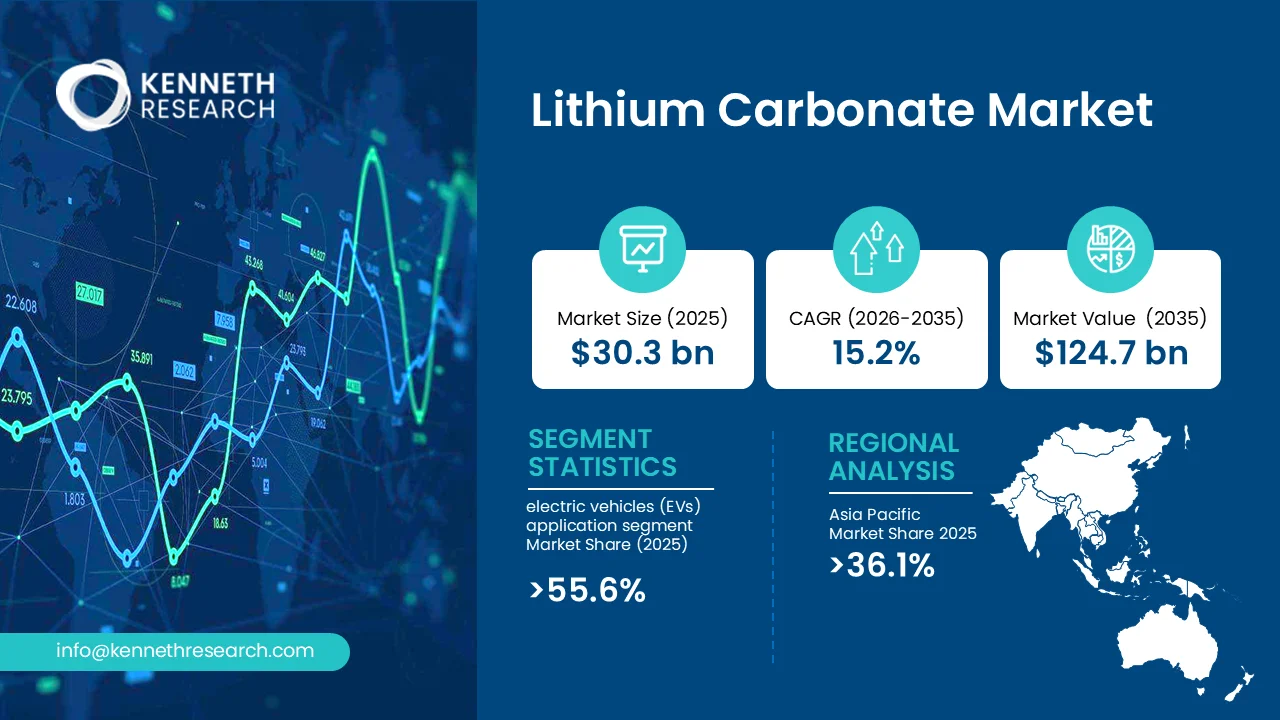
Lithium Carbonate Market size was valued at USD 30.3 billion in 2025 and is projected to reach USD 124.7 billion by the end of 2035, rising at a CAGR of 15.2% during the forecast period, i.e., 2026-2035. In 2026, the industry size of lithium carbonate is estimated at USD 34.9 billion.
Rising electric vehicle production remains the primary growth driver for the lithium carbonate market, as lithium carbonate is a critical raw material for manufacturing lithium-ion battery cathodes. The International Energy Agency reports that EV battery demand exceeded 750 GWh in 2023, with electric cars accounting for 95% of battery demand growth, reinforcing sustained consumption of battery-grade lithium carbonate.
The lithium carbonate market comprises the global production, processing, distribution, and commercialization of lithium carbonate, a refined lithium compound widely used as a precursor for manufacturing lithium-ion battery cathode materials, specialty glass, ceramics, lubricating greases, pharmaceuticals, and selected industrial chemicals. Battery-grade lithium carbonate is produced to stringent purity specifications to meet the performance and safety requirements of rechargeable batteries, while technical-grade material serves diverse industrial applications.
Lithium carbonate is characterized by its high chemical purity, excellent electrochemical compatibility, and suitability for conversion into cathode materials such as lithium iron phosphate (LFP) and nickel-based chemistries. These properties make it an essential feedstock for advanced energy storage technologies, enabling efficient energy density, long battery life, and reliable charging performance.
Industrially, the market plays a strategic role in supporting electric mobility, renewable energy integration, consumer electronics manufacturing, and grid-scale energy storage. Growing investments in battery manufacturing, mineral processing, and localized supply chains have further elevated the importance of lithium carbonate within the broader critical minerals ecosystem, making it a foundational material for the global clean energy transition and advanced manufacturing industries.
Key Lithium Carbonate Market Insights Summary:
Key Takeaways: Market Trends & Insights
- The Lithium Carbonate Market is projected to grow from USD 34.9 billion in 2026 to USD 124.7 billion by 2035, registering a CAGR of 15.2% during the forecast period
- Electric Vehicles remain the leading application segment, accounting for 55.6% of the market share in 2025, supported by accelerating global vehicle electrification and expanding lithium-ion battery manufacturing
- Asia Pacific held the largest regional share of 36.1% in 2025, driven by robust lithium refining capabilities, integrated battery supply chains, and strong manufacturing bases in China and Japan
- The growing deployment of lithium-ion batteries across electric mobility, stationary energy storage, and industrial applications continues to strengthen long-term demand for battery-grade lithium carbonate
- North America is emerging as a high-growth regional market, supported by expanding domestic battery manufacturing, critical mineral supply chain investments, and increasing industrial collaboration across the United States and Mexico
Market Drivers
- Expansion of grid-scale battery energy storage systems
- Advancements in high-performance lithium-ion battery chemistries
- Growing investments in lithium recycling and circular economy initiatives
- Increasing government support for critical mineral processing and battery manufacturing
Challenges
- High dependence on concentrated lithium extraction and refining capacity
- Stringent environmental compliance and water resource management
Lithium Carbonate Market Overview & Supply Chain
Global adoption of lithium carbonate is accelerating as governments and industries prioritize transportation electrification, renewable energy integration, and resilient battery supply chains. Lithium carbonate is a critical precursor for manufacturing lithium-ion battery cathode materials used in electric vehicles and stationary energy storage systems. Expanding investments in battery manufacturing, localization of critical mineral processing, and clean energy policies are strengthening long-term demand across automotive, electronics, and power infrastructure industries. According to the International Energy Agency (IEA), the total volume of batteries used in the energy sector exceeded 2 400 GWh in 2023, representing a fourfold increase from 2020, underscoring the growing industrial significance of lithium-based battery materials and their upstream feedstocks such as lithium carbonate.
The lithium carbonate industry value chain begins with the extraction of lithium-bearing resources from hard-rock deposits, such as spodumene, and lithium-rich brines obtained from salt flats. These raw materials undergo concentration, chemical conversion, purification, and refining processes to produce battery-grade or technical-grade lithium carbonate that meets stringent quality requirements. Processed material is then supplied to cathode active material manufacturers, which integrate it into lithium-ion battery production for automotive, consumer electronics, and energy storage applications. Distribution occurs through direct supply agreements, commodity traders, and regional chemical distributors serving battery manufacturers and industrial customers. Key end users include electric vehicle manufacturers, battery cell producers, energy storage system integrators, glass and ceramics manufacturers, lubricant producers, and pharmaceutical companies. Major stakeholders across the value chain comprise mining companies, chemical refiners, battery material suppliers, cell manufacturers, original equipment manufacturers (OEMs), logistics providers, technology developers, recycling companies, and government agencies supporting critical mineral security and domestic manufacturing initiatives.
Lithium Carbonate Market: Growth Drivers & Challenges
Growth Drivers:
- Expansion of global lithium-ion battery manufacturing capacity: The rapid expansion of lithium-ion battery manufacturing capacity is a fundamental growth driver for the lithium carbonate market because battery-grade lithium carbonate serves as a critical precursor for cathode material production. Governments and private investors are accelerating investments in battery manufacturing facilities to strengthen domestic supply chains, improve energy security, and support the transition toward electrified transportation and renewable energy storage. As new gigafactories become operational, procurement of high-purity lithium chemicals increases across the upstream value chain, encouraging investments in lithium extraction, refining, and processing capabilities. This industrial expansion also stimulates technological improvements in lithium purification and quality control, enabling manufacturers to meet increasingly stringent battery performance standards. According to the International Energy Agency (IEA), global battery manufacturing capacity grew by almost 30% in 2024 to reach more than 3 TWh, highlighting the scale of industrial expansion supporting demand for lithium carbonate across global battery supply chains.
- Increasing localization of critical mineral supply chains: Growing efforts to localize critical mineral supply chains are creating sustained opportunities for the lithium carbonate market. Governments are introducing industrial policies that encourage domestic lithium refining, battery material processing, and integrated manufacturing ecosystems to reduce dependence on concentrated overseas supply sources. This shift is prompting investments in refining technologies, recycling infrastructure, and strategic partnerships between mining companies, chemical producers, battery manufacturers, and automotive OEMs. Localization improves supply security while reducing logistics risks and enhancing traceability across battery production networks. It also encourages long-term procurement agreements that provide greater investment certainty for lithium carbonate producers. As regional battery ecosystems mature, demand for reliable supplies of battery-grade lithium carbonate is expected to diversify geographically, supporting the development of new refining hubs and strengthening resilience throughout the global critical minerals value chain.
Challenges:
- High dependence on concentrated lithium extraction and refining capacity: A major restraint for the lithium carbonate market is the concentration of lithium extraction and refining capacity within a limited number of geographic regions. Developing new mining projects and refining facilities requires extensive capital investment, lengthy permitting processes, environmental assessments, and specialized processing expertise. These barriers can delay capacity additions even as downstream battery manufacturers seek stable supplies. The resulting supply concentration increases exposure to geopolitical developments, trade policy changes, transportation disruptions, and operational interruptions. Commercially, manufacturers often face procurement uncertainty and may need to diversify sourcing strategies or establish long-term supply agreements, increasing procurement complexity. Looking ahead, although investments in new refining facilities and alternative supply regions are expected to improve resilience, bringing these projects to commercial scale will require sustained investment, regulatory coordination, and technological optimization.
- Stringent environmental compliance and water resource management: The production of lithium carbonate is increasingly influenced by stringent environmental regulations and growing scrutiny over water consumption, land use, and waste management associated with lithium extraction and processing. Producers are required to comply with evolving environmental standards, implement advanced monitoring systems, and invest in cleaner processing technologies to maintain regulatory approval and social acceptance. These requirements increase operating costs and extend project development timelines, particularly for new facilities seeking environmental permits. Commercially, companies that fail to demonstrate responsible resource management may experience financing challenges, reputational risks, and delays in customer qualification, especially among battery manufacturers with rigorous sustainability requirements. In the long term, the market is expected to favor producers capable of integrating environmentally responsible extraction methods, resource-efficient processing technologies, and transparent sustainability practices into their operations.
Lithium Carbonate Market Size and Forecast:
| Report Attribute | Details |
|---|---|
| Base Year |
2025 |
| Forecast Year |
2026-2035 |
| CAGR |
15.2% |
| Base Year Market Size (2025) |
USD 30.3 billion |
| Forecast Year Market Size (2035) |
USD 124.7 billion |
| Regional Scope |
|
Lithium Carbonate Market Segmentation Analysis:
Application Segment Analysis
In the application segment, the Electric Vehicles sub-segment is anticipated to capture the largest market share of 55.6% by the end of 2025.
The electric vehicles (EVs) application segment dominates the lithium carbonate market because it represents the largest source of demand for battery-grade lithium carbonate used in lithium-ion battery cathode manufacturing. Global automotive electrification, supported by emissions reduction policies, expanding charging infrastructure, and investments in domestic battery production, continues to accelerate the consumption of high-purity lithium compounds. On the supply side, lithium refiners are increasingly aligning production with battery manufacturers through long-term offtake agreements and integrated supply chain partnerships, ensuring consistent availability of battery-grade material. The segment also benefits from continuous innovation in battery chemistries that rely on lithium carbonate as a key precursor, particularly lithium iron phosphate (LFP) batteries. According to the International Energy Agency (IEA), global electric car sales exceeded 17 million in 2024, with more than 20% of all new cars sold worldwide being electric, demonstrating the expanding downstream demand supporting lithium carbonate consumption.
Battery Segment Analysis
The lithium-ion batteries is projected to grow as the second-largest segment in the lithium carbonate market due to four converging demand drivers.
The lithium-ion batteries segment is projected to witness strong growth because it remains the primary downstream application for battery-grade lithium carbonate across electric mobility, stationary energy storage, and portable electronics. Demand is being reinforced by continued investments in battery manufacturing facilities, localization of critical mineral supply chains, and increasing deployment of energy storage systems that support renewable power integration. On the supply side, lithium refiners are expanding production capacity and improving processing technologies to deliver high-purity lithium carbonate required for advanced cathode materials. Battery manufacturers are also strengthening long-term sourcing partnerships to ensure reliable access to critical raw materials. According to the U.S. Energy Information Administration (EIA), U.S. utility-scale battery storage capacity exceeded 26 gigawatts (GW) in 2024 after increasing by 66% during the year, reflecting accelerating deployment of lithium-ion battery systems across the energy sector.
Our in-depth analysis of the global lithium carbonate market includes the following segments:
|
Segment |
Sub-segment |
|
Battery |
|
|
Grade |
|
|
Application |
|
Lithium Carbonate Market Regional Insights:
Asia Pacific Market Trends & Insights:
Asia Pacific lithium carbonate market is projected to hold the largest revenue share of 36.1% by the end of 2025.
The region's leadership is supported by its integrated battery manufacturing ecosystem, extensive lithium refining infrastructure, strong electric vehicle production base, and sustained investments in advanced energy storage technologies. Governments across the region continue to promote industrial policies that strengthen domestic battery supply chains, encourage critical mineral processing, and expand clean energy manufacturing capabilities. The presence of major cathode material producers, battery cell manufacturers, and electric vehicle OEMs further reinforces demand for battery-grade lithium carbonate. In addition, well-established logistics networks and close integration between upstream chemical processors and downstream battery manufacturers improve supply chain efficiency, enabling the region to maintain its competitive position in global lithium value chains.
China remains the principal growth engine within the region due to its large-scale battery manufacturing capacity, integrated lithium refining industry, and extensive electric vehicle production ecosystem.
Japan complements regional leadership through advanced battery technology development, high-value material innovation, and continued investments in next-generation energy storage solutions. According to the International Energy Agency (IEA), China accounted for around 80% of global battery cell production in 2024, highlighting the country's central role in the global battery supply chain and its influence on lithium carbonate demand across Asia Pacific. Together, China and Japan continue to strengthen regional competitiveness through technological innovation, industrial collaboration, and strategic investments in battery materials and manufacturing.
North America Market Trends & Insights:
North America is emerging as a strategically important region in the lithium carbonate market due to accelerating investments in battery manufacturing, electric vehicle production, and critical mineral supply chain development. The region is actively strengthening domestic refining capabilities to reduce dependence on imported battery materials while enhancing long-term supply security for clean energy industries. Public and private sector investments are supporting the establishment of integrated battery ecosystems that connect mining, chemical processing, cathode production, cell manufacturing, and vehicle assembly. Government policies promoting domestic manufacturing, critical mineral development, and energy transition objectives continue to encourage capacity expansion across the lithium value chain. Increasing deployment of utility-scale energy storage systems, combined with growing demand for electrified transportation and industrial decarbonization, is expected to create sustained opportunities for lithium carbonate producers and downstream manufacturers throughout the coming years.
The United States serves as the primary growth engine in the region, supported by expanding battery manufacturing facilities, investments in domestic lithium refining, and initiatives aimed at developing resilient critical mineral supply chains. Strong collaboration among mining companies, battery manufacturers, automotive OEMs, and technology developers is reinforcing the country's position within the North American battery ecosystem.
Mexico is becoming an increasingly important manufacturing hub due to its well-established automotive production base, expanding participation in electric vehicle supply chains, and proximity to major North American markets. The country's manufacturing capabilities, trade integration, and growing interest in battery-related investments are expected to strengthen its role in supporting regional lithium carbonate demand and downstream industrial development.
Leading Companies Operating in the Global Lithium Carbonate Market:
Here is a list of upstream, downstream, and key players operating in the global lithium carbonate market competitive ecosystem:
- Albemarle Corporation (United States)
- Company Overview
- Business Strategy
- Key Product Offerings
- Financial Performance
- Key Performance Indicators
- Risk Analysis
- Recent Development
- Regional Presence
- SWOT Analysis
- E3 Lithium (Canada)
- Eramet Eramine (France/Argentina)
- Rio Tinto (Fénix Facility) (Global)
- LibertyStream (United States)
Recent Developments
- In October 2025, China's lithium carbonate imports reached approximately 19,597 metric tons, marking a 20% year-over-year increase. Chile and Argentina remained the primary import sources, with Argentina's share growing 56% year-over-year. The SMM battery-grade lithium carbonate index price stood at 80,530 yuan per metric ton (approximately US$11,300), continuing a steady upward trend driven by strong downstream demand from electric vehicle and energy storage system sectors.
- In July 2026, battery-grade lithium carbonate prices in China reached 165,000 yuan per metric ton (approximately US$24,300), recovering from a three-month low of 151,750 yuan reached on June 29. Higher prices have encouraged Australian miners to reactivate previously idled capacity, while Zimbabwe and Mali continue to expand production. The market is closely monitoring potential supply increases from the Jianxiawo restart and spodumene arrivals from Zimbabwe.
Frequently Asked Question
In 2025, the lithium carbonate market exceeded USD 30.3 billion.
The lithium carbonate market is projected to reach USD 124.7 billion by the end of 2035, expanding at a CAGR of 15.2% over the forecast period (2026-2035).
The major players in the market are Albemarle Corporation (United States), E3 Lithium (Canada), Eramet Eramine (France/Argentina), Rio Tinto (Fénix Facility) (Global), LibertyStream (United States), and others.
In the Application segment, the electric vehicles sub-segment is anticipated to capture the largest market share of 55.6% in the future and exhibit lucrative growth opportunities during 2026-2035. This growth trajectory is largely attributed to expanding global electric vehicle adoption and increasing lithium-ion battery manufacturing capacity.
Asia Pacific is projected to hold the largest market share of 36.1% by the end of 2025 and provide more business opportunities in the future. Continuous investments in battery manufacturing, lithium refining, and electric vehicle production across China and Japan are fostering the region's dominance.
Why Choose Kenneth Research ?
-
Insight with Impact : We don’t just gather data — we uncover stories, trends, and opportunities that fuel business growth.
-
Experts Who Get It : Our team speaks your industry’s language and knows what really matters to your customers and market.
-
Custom-Built for You : Forget one-size-fits-all. We craft research and consulting solutions as unique as your business vision.
-
Partners, Not Just Providers : We work with you, not for you — collaborating closely to turn insights into smart, strategic moves.
-
Results That Speak : Our work powers brands, startups, and industry leaders alike — with a track record of ideas that work in the real world.
Report ID: 1150 |
Published Date: 24 Aug 2026 |
Report Format: |
Delivery Timeline: 48-72 Business Hours

Copyright © 2025 Kenneth Research. All rights reserved. Terms of Use | Privacy Policy
