Report ID: 1396 |
Published Date: 25 Sep 2026 |
Report Format: |
Delivery Timeline: 48-72 Business Hours
Liquid Lithium Ion Battery Market Outlook:
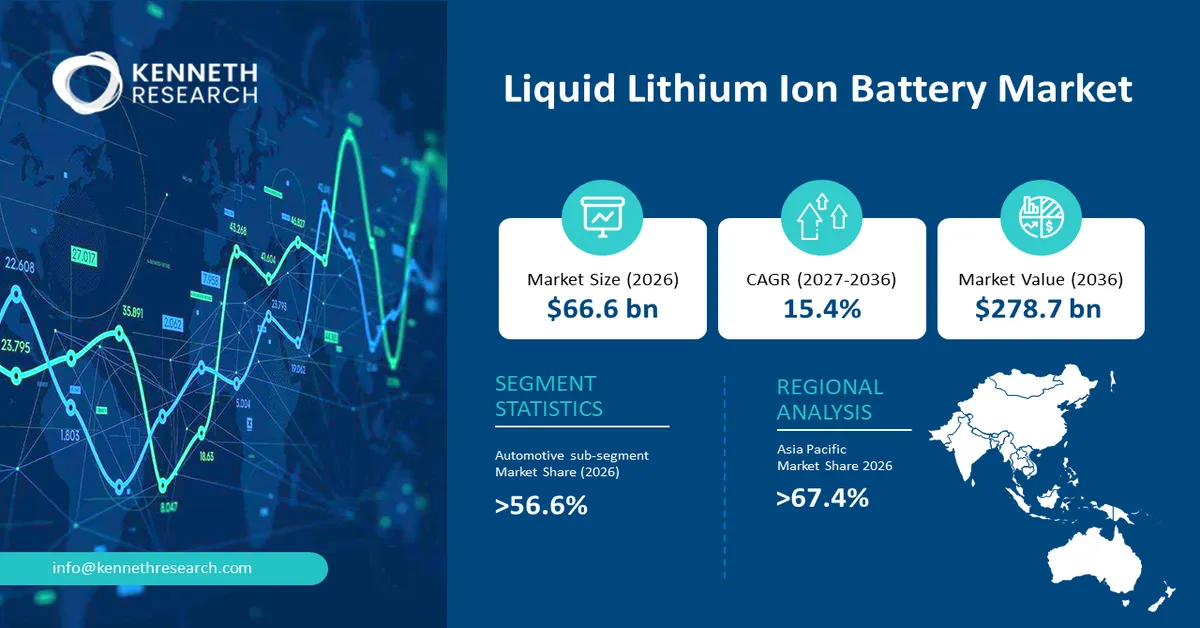
Liquid Lithium Ion Battery Market size was valued at USD 66.6 billion in 2026 and is projected to reach USD 278.7 billion by the end of 2036, rising at a CAGR of 15.4% during the forecast period, i.e., 2027-2036. In 2027, the industry size of the liquid lithium ion battery is estimated at USD 76.8 billion.
The primary growth driver for the liquid lithium ion battery market is the rapid expansion of electric mobility, which is increasing demand for high-performance rechargeable battery systems across passenger vehicles and other automotive applications.
The liquid lithium ion battery market comprises rechargeable lithium-ion battery systems that use a liquid electrolyte to facilitate the movement of lithium ions between the cathode and anode during charging and discharging. These batteries consist of key components including cathode materials, anode materials, separators, liquid electrolytes, current collectors, and protective casing.
The market covers the production, assembly, integration, and application of liquid lithium-ion battery cells and battery packs across automotive, energy storage, consumer electronics, and other end-use industries. Battery cells are manufactured in different form factors, including cylindrical, prismatic, and pouch configurations, depending on application requirements, available space, energy density, thermal management, manufacturing processes, and system design.
Key Liquid Lithium Ion Battery Market Insights Summary:
Key Takeaways: Market Trends & Insights
- Liquid lithium ion battery market projected to grow from USD 66.6 billion in 2026 to USD 278.7 billion by 2036 at a 15.4% CAGR.
- Asia-Pacific accounted for the largest regional share at 67.4% in 2026, driven by strong battery manufacturing capabilities, extensive electric-vehicle production, and established supply chains in Japan and China.
- Automotive is expected to remain the leading End Use segment with a 56.6% market share in 2026, supported by accelerating electric-vehicle adoption and rising demand for high-capacity propulsion batteries.
- Cylindrical batteries will continue to witness strong demand due to their established manufacturing ecosystem, standardized design, mechanical robustness, and suitability for automated high-volume production.
Market Drivers
- Accelerating electric vehicle adoption and automotive electrification
- Expansion of battery energy storage applications
- Increasing investment in lithium-ion battery manufacturing capacity and supply-chain localization
- Continuous technological improvements in battery chemistry, cell design, charging performance, and thermal management
Challenges
- Supply Chain Concentration and Critical Material Dependence
- High Capital Requirements for Battery Manufacturing and Technology Upgrades
Liquid Lithium Ion Battery Market Overview & Supply Chain
The liquid lithium ion battery market is supported by rapid growth in electric mobility, battery energy storage, consumer electronics, and other electrification applications. Electric vehicles remain the largest source of global battery deployment. According to the International Energy Agency (IEA), global electric vehicle battery deployment reached 1.2 TWh in 2025, increasing by almost 30% from 2024. EVs accounted for more than 70% of total battery deployment during the year.
The supply chain for the liquid lithium ion battery market begins with the extraction and processing of critical raw materials, including lithium, nickel, cobalt, graphite, manganese, and other minerals. These materials are refined and converted into battery-grade chemicals and active materials before being supplied to cathode, anode, electrolyte, and separator manufacturers.
The midstream stage involves production of cathode active materials, anode materials, separators, electrolytes, current collectors, and other cell components. These components are then delivered to battery-cell manufacturers, where they are assembled into cylindrical, prismatic, or pouch cells.
Liquid Lithium Ion Battery Market: Growth Drivers & Challenges
Growth Drivers:
- Accelerating electric vehicle adoption: The rapid adoption of electric vehicles is increasing demand for liquid lithium-ion batteries because these batteries provide the energy storage capacity required for vehicle propulsion while offering established manufacturing scalability and performance characteristics. For battery manufacturers, sustained EV demand supports higher production utilization, investment in new cell plants, and continued improvements in energy density, charging performance, and thermal management. Going forward, continued electrification of passenger and commercial transportation is expected to remain a fundamental demand catalyst, expanding opportunities for liquid lithium-ion battery suppliers across automotive applications and associated battery value chains.
- Expansion of battery energy storage applications: The increasing deployment of battery energy storage systems is creating an additional growth avenue for liquid lithium-ion batteries beyond transportation. Grid operators, renewable energy developers, utilities, and commercial users are increasingly using battery storage to manage variable renewable generation, improve grid flexibility, provide backup power, and shift electricity consumption toward periods of higher demand. Liquid lithium-ion technology benefits from an established manufacturing ecosystem, extensive operating experience, and compatibility with large-scale modular storage systems.
Challenges:
- Supply chain concentration and critical material dependence: The liquid lithium ion battery market remains exposed to supply-chain concentration because battery manufacturing and several critical material processing activities are heavily concentrated in a limited number of countries. This creates vulnerability to export restrictions, trade disruptions, geopolitical tensions, transportation interruptions, and fluctuations in the availability of battery-grade inputs. For manufacturers, dependence on concentrated sources can complicate procurement planning and increase the need for strategic inventory, alternative suppliers, and localized processing capabilities.
- High capital requirements for battery manufacturing and technology upgrades: Large-scale liquid lithium-ion battery production requires substantial investment in cell manufacturing facilities, specialized production equipment, quality-control systems, thermal-management technologies, and supporting infrastructure. Manufacturers must also continuously upgrade production processes as battery chemistries, cell formats, and performance requirements evolve. This creates financial pressure because facilities can require significant upfront capital while market conditions, technology preferences, and customer requirements can change during the investment cycle.
Liquid Lithium Ion Battery Market Size and Forecast:
| Report Attribute | Details |
|---|---|
| Base Year |
2026 |
| Forecast Period |
2027-2036 |
| CAGR |
15.4% |
| Base Year Market Size (2026) |
USD 66.6 billion |
| Forecast Year Market Size (2036) |
USD 278.7 billion |
| Regional Scope |
|
Liquid Lithium Ion Battery Market Segmentation Analysis:
End Use Type Segment Analysis
In the End Use segment, the Automotive sub-segment is anticipated to capture the largest market share of 56.6% in 2026.
The dominance of automotive applications is primarily supported by the accelerating transition toward electric mobility, as electric vehicles require high-capacity lithium-ion battery systems for propulsion. On the supply side, expanding gigafactory capacity, improvements in cell manufacturing, and increasing battery supply-chain localization are strengthening production availability. In the future, broader adoption of electric passenger vehicles, commercial vehicles, and electric trucks is expected to further reinforce automotive demand and support continued investment in battery capacity and technology.
Form Factor Type Segment Analysis
In the Form Factor segment, the Cylindrical sub-segment is projected to grow strongly because of its mature manufacturing ecosystem, standardized design, mechanical robustness, and suitability for automated high-volume production. Cylindrical cells remain important in electric vehicles, particularly where manufacturers prioritize scalable production and established cell architectures. Supply-side advantages are also significant: the IEA notes that a 50 GWh manufacturing facility can produce up to 10 million cylindrical cells per day under its stated operating assumptions, highlighting the format's scalability for mass production. Continued investment in automated cell manufacturing, high-voltage EV platforms, and advanced cylindrical architectures is expected to support adoption. As EV production expands, cylindrical cells should remain an important form factor for manufacturers seeking scalable and efficient battery production.
Our in-depth analysis of the global liquid lithium ion battery market includes the following segments:
|
Segment |
Sub-segment |
|
Battery Chemistry |
|
|
Form Factor |
|
|
Capacity |
|
|
End Use Industry |
|
Liquid Lithium Ion Battery Market Regional Insights:
Asia-Pacific Market Trends & Insights:
Asia-Pacific is anticipated to capture the largest market share of 67.4% in 2026, supported by its extensive battery manufacturing ecosystem, strong electric-vehicle production, established supply chains for battery components, and continued investment in cell manufacturing capacity. Government-backed industrial policies, domestic EV adoption, battery supply-chain localization, and investments in production technologies are further strengthening the region's competitive position.
Japan maintains an important position through its established automotive and battery industries. Japanese manufacturers continue to invest in advanced battery technologies and international production networks, while the country's automotive sector supports demand for high-performance battery systems.
China remains the dominant regional manufacturing center, supported by large-scale cell production, extensive component supply chains, and rapidly expanding EV manufacturing.
North America Market Trends & Insights:
North America represents an important growth market for liquid lithium-ion batteries, supported by expanding electric-vehicle production, increasing battery energy-storage deployment, domestic manufacturing initiatives, and efforts to establish more resilient battery supply chains. The region's established automotive industry provides a substantial demand base, while manufacturers are investing in localized cell and battery-pack production to reduce dependence on overseas supply.
The U.S. is the principal battery manufacturing and demand center in North America, with major investments from automotive manufacturers and battery producers supporting regional production capabilities.
Canada is strengthening its role through investments across the battery and electric-vehicle supply chain, including critical minerals, battery materials, cell manufacturing, and automotive production. Its resource base and integration with the North American automotive industry create opportunities for further development of a regional battery value chain.
Leading Companies Operating in the Liquid Lithium Ion Battery Market:
Here is a list of upstream, downstream, and key players operating in the global liquid lithium ion battery market competitive ecosystem:
- Contemporary Amperex Technology Co., Limited (CATL) (China)
- Company Overview
- Business Strategy
- Key Product Offerings
- Financial Performance
- Key Performance Indicators
- Risk Analysis
- Recent Development
- Regional Presence
- SWOT Analysis
- Samsung SDI (South Korea)
- EVE Energy (China)
- Gotion High-Tech (China)
- SVOLT Energy Technology (China)
- BYD Company Limited (Europe)
Recent Developments
- In March 2026, CATL announced the release of its 2025 annual report on March 10, 2026, reporting continued expansion of its lithium-ion battery business and global manufacturing footprint.
- In March 2026, BYD unveiled its second-generation Blade Battery together with FLASH Charging technology. The company positioned the new battery technology around substantially faster EV charging and improved low-temperature charging performance.
Frequently Asked Question
In 2026, the liquid lithium ion battery market exceeded USD 66.6 billion.
The liquid lithium ion battery market is projected to reach USD 278.7 billion by the end of 2036, expanding at a CAGR of 15.4% over the forecast period (2027-2036).
The major players in the market are Contemporary Amperex Technology Co., Limited (CATL), BYD Company Limited, LG Energy Solution, Panasonic Energy Co., Ltd., Samsung SDI Co., Ltd., and others.
In the end use segment, the automotive sub-segment is anticipated to capture the largest market share of 56.6% in the future and exhibit lucrative growth opportunities during 2027-2036.
Asia-Pacific is projected to hold the largest market share of 67.4% by the end of 2026 and provide more business opportunities in the future.
Why Choose Kenneth Research ?
-
Insight with Impact : We don’t just gather data — we uncover stories, trends, and opportunities that fuel business growth.
-
Experts Who Get It : Our team speaks your industry’s language and knows what really matters to your customers and market.
-
Custom-Built for You : Forget one-size-fits-all. We craft research and consulting solutions as unique as your business vision.
-
Partners, Not Just Providers : We work with you, not for you — collaborating closely to turn insights into smart, strategic moves.
-
Results That Speak : Our work powers brands, startups, and industry leaders alike — with a track record of ideas that work in the real world.
Report ID: 1396 |
Published Date: 25 Sep 2026 |
Report Format: |
Delivery Timeline: 48-72 Business Hours

Copyright © 2025 Kenneth Research. All rights reserved. Terms of Use | Privacy Policy
