Report ID: 1290 |
Published Date: 28 Sep 2026 |
Report Format: |
Delivery Timeline: 48-72 Business Hours
Liquid Cooled EV Charging Cable Market Outlook:
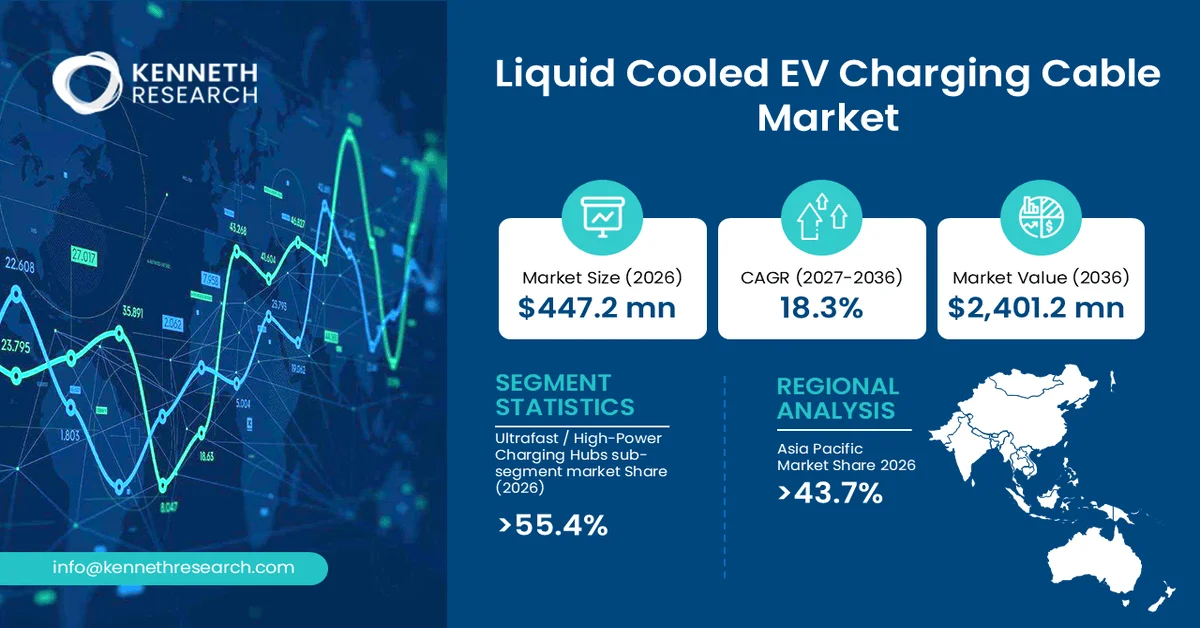
Liquid Cooled EV Charging Cable Market size was valued at USD 447.2 million in 2026 and is projected to reach USD 2,401.2 million by the end of 2036, rising at a CAGR of 18.3% during the forecast period, i.e., 2027-2036. In 2027, the industry size of the liquid cooled EV charging cable is estimated at USD 529.1 million.
The primary growth driver for the liquid cooled EV charging cable market is the expansion of high-power public charging infrastructure, requiring cables capable of managing elevated current and heat loads.
The liquid cooled EV charging cable market comprises cables engineered to transfer electrical power between high-power electric vehicle charging equipment and EVs while using a liquid-based cooling system to control conductor and cable temperatures. Unlike conventional air-cooled charging cables, liquid-cooled designs circulate a coolant through or around heat-generating components, enabling thermal management where charging currents are substantially higher.
Key characteristics include high current-carrying capability, thermal stability, flexible cable construction, charging-connector compatibility, insulation and protection against electrical and environmental stresses, and integration with charging systems designed for rapid energy delivery. The technology is particularly relevant to ultrafast charging applications, where sustained high-power operation can increase heat generation and constrain cable size, handling, and performance.
Key Liquid Cooled EV Charging Cable Market Insights Summary:
Key Takeaways: Market Trends & Insights
- Asia Pacific held the dominant regional position with a 43.7% market share in 2026, supported by strong EV manufacturing, charging infrastructure deployment, and technology investment
- Ultrafast / High-Power Charging Hubs represented the leading application segment with a 55.4% market share in 2026, driven by demand for rapid charging and advanced thermal management
- The global liquid cooled EV charging cable market was valued at USD 447.2 million in 2026 and is projected to reach USD 2,401.2 million by 2036
- The market is projected to expand at a CAGR of 18.3% during 2027–2036, reflecting rising demand for high-performance charging infrastructure
Market Drivers
- Expansion of ultra-fast and high-power charging infrastructure
- Rising EV charging performance requirements
- Increasing deployment of commercial and fleet charging networks
- Technological advancement in thermal management, connectors, and charging equipment
Challenges
- High system complexity and maintenance requirements
- Thermal reliability under sustained high-power operation
Liquid Cooled EV Charging Cable Market Overview & Supply Chain
Global adoption of liquid cooled EV charging cables is increasing as charging networks shift toward higher-power, faster energy delivery. These cables address the thermal-management constraints associated with high-current charging by circulating coolant through the cable assembly, supporting sustained power transfer while maintaining manageable cable dimensions and handling characteristics. The industrial relevance is reinforced by continued expansion of public charging infrastructure. The UK Department for Transport reported that 13,281 EV chargers were added to the public network in the year to 1 January 2026, demonstrating continued infrastructure deployment and creating demand for advanced charging components.
The liquid cooled EV charging cable market value chain begins with raw-material suppliers providing copper or other conductive materials, polymeric insulation, shielding materials, coolant-compatible components, protective jackets, connectors, and thermal-management inputs. Cable manufacturers then combine these materials through conductor fabrication, insulation, jacketing, connector integration, cooling-channel assembly, and performance testing. Specialized engineering and certification capabilities are important because the finished cable must satisfy electrical, mechanical, thermal, and interoperability requirements. Distribution typically moves through direct manufacturer relationships, electrical-equipment distributors, charging-equipment integrators, and infrastructure contractors. End users include charging-network operators, fleet depots, highway charging sites, commercial facilities, and other high-power charging installations.
Liquid Cooled EV Charging Cable Market: Growth Drivers & Challenges
Growth Drivers
- Expansion of ultra-fast charging infrastructure: The expansion of ultra-fast charging infrastructure is strengthening demand for liquid cooled EV charging cables because higher power transfer creates greater thermal loads within charging assemblies. Liquid cooling enables cables to manage heat more effectively while maintaining a practical cable diameter, flexibility, and handling profile for high-throughput charging environments. This supports charging operators seeking shorter vehicle dwell times without making charging equipment excessively bulky. Over time, the market is likely to move toward increasingly sophisticated thermal-management solutions, making liquid cooled cable technology more relevant to high-power charging infrastructure procurement.
- Rising EV charging performance requirements: Increasing expectations for rapid and convenient EV charging are encouraging charging-equipment manufacturers to adopt technologies capable of sustaining high electrical loads while preserving operational reliability. Liquid cooled cables address a key engineering constraint: conventional air-cooled cable designs can become heavier or less ergonomic as power requirements rise because additional conductive material may be needed to manage heat. By actively removing heat, liquid cooling can support compact cable architectures and improve usability at demanding charging sites. This creates an attractive value proposition for charging operators, vehicle manufacturers, and infrastructure integrators that want to increase charging performance without compromising connector handling.
Challenges
- High system complexity and maintenance requirements: Liquid-cooled charging cables introduce additional components beyond the electrical cable itself, including coolant pathways, circulation hardware, seals, and thermal-control elements. This increases the number of interfaces that must remain reliable throughout repeated charging cycles and environmental exposure. For charging operators, the resulting maintenance burden can complicate service planning because technicians must address both electrical and cooling-system conditions rather than treating the cable as a conventional passive component. Any coolant leakage, flow restriction, sealing degradation, or cooling-system malfunction can reduce charging availability and increase troubleshooting time. Commercially, this can raise total ownership costs and make liquid-cooled systems less attractive for operators prioritising simple, low-intervention infrastructure.
- Thermal reliability under sustained high-power operation: The fundamental engineering challenge is maintaining stable temperatures when charging systems repeatedly operate at elevated electrical loads. Heat generation increases with current, placing greater demands on the cable's conductor, insulation, connector interfaces, and cooling circuit. A liquid-cooled design therefore must maintain effective heat transfer while accommodating pressure, coolant compatibility, cable flexibility, and repeated mechanical handling. Poor coordination between these elements can create localised hot spots or accelerate material degradation, potentially affecting charging reliability and component life. For equipment manufacturers, this raises validation and design requirements because thermal performance cannot be evaluated independently from mechanical durability and electrical safety.
Liquid Cooled EV Charging Cable Market Size and Forecast:
| Report Attribute | Details |
|---|---|
| Base Year |
2026 |
| Forecast Period |
2027-2036 |
| CAGR |
18.3% |
| Base Year Market Size (2026) |
USD 447.2 million |
| Forecast Year Market Size (2036) |
USD 2,401.2 million |
| Regional Scope |
|
Liquid Cooled EV Charging Cable Market Segmentation Analysis:
Application Segment Analysis
In the application segment, the Ultrafast / High-Power Charging Hubs sub-segment is anticipated to capture the largest market share of 55.4% by the end of 2026.
Ultrafast / high-power charging hubs dominate the application segment because they require sustained high-current delivery, making thermal management a critical performance consideration. Liquid cooled cables allow charging operators to support higher power transfer while controlling cable temperature and maintaining manageable cable weight and flexibility. Demand is being reinforced by the expansion of highway and high-traffic charging infrastructure, where rapid vehicle turnaround is commercially important. China illustrates this adoption trend: according to China’s National Energy Administration, 35,000 charging piles had been installed in 98% of highway service areas by the end of 2024, demonstrating the broad deployment of charging infrastructure along major travel corridors. Supply-side development is also moving toward higher-power equipment, with charging manufacturers and infrastructure operators deploying supercharging systems designed for substantially faster energy delivery.
Vehicle Segment Analysis
The Passenger Vehicles is projected to grow as the second-largest segment in the liquid cooled EV charging cable market due to four converging demand drivers.
Passenger vehicles are projected to be the fastest-growing vehicle segment as EV adoption increasingly shifts from early adopters toward mainstream private mobility. Growing model availability, improving affordability, and stronger charging coverage are encouraging consumers to consider electric cars for everyday transportation, increasing the need for accessible and higher-performance charging infrastructure. On the supply side, automakers are broadening electric passenger-car portfolios, while charging-equipment manufacturers are developing higher-power systems capable of reducing charging downtime. Liquid cooled cables become particularly relevant where passenger vehicles increasingly use higher charging rates. Looking ahead, continued electrification of personal mobility should expand demand for thermally managed charging hardware, strengthening the passenger-vehicle segment's position in the market.
Our in-depth analysis of the global liquid cooled EV charging cable market includes the following segments:
|
Segment |
Sub-segment |
|
Power Capacity |
|
|
Application |
|
|
Vehicle |
|
|
Connector |
|
Liquid Cooled EV Charging Cable Market Regional Insights:
Asia Pacific Market Trends & Insights:
Asia Pacific liquid cooled EV charging cable market is projected to hold the largest revenue share of 43.7% by the end of 2026.
It is supported by a strong combination of EV manufacturing, charging-infrastructure deployment, technology investment, and policy support. China provides the region’s principal production and consumption base, while Japan contributes advanced automotive engineering and charging-technology capabilities. Government-backed infrastructure programmes across the region are encouraging investment in higher-performance charging systems, creating a favourable environment for liquid cooled cable adoption.
China remains the principal regional demand centre because of its extensive EV ecosystem, domestic manufacturing capabilities, and continued emphasis on high-power charging infrastructure. These conditions create opportunities for cable suppliers, charging-equipment manufacturers, and component producers.
Japan represents a technology-oriented market, with government programmes supporting charging infrastructure expansion and higher-power charging deployment. Its established automotive industry and focus on charging reliability provide a complementary growth opportunity for liquid cooled cable suppliers.
Europe Market Trends & Insights:
Europe represents a strong secondary market for liquid cooled EV charging cables, supported by expanding electric mobility, increasingly sophisticated public charging infrastructure, and sustained investment in transport electrification. Demand is shifting toward reliable, high-performance charging systems capable of serving passenger vehicles, commercial fleets, and long-distance travel corridors. The European Union’s Alternative Fuels Infrastructure Regulation is reinforcing this transition by establishing coordinated requirements for charging deployment, interoperability, user information, and payment systems across member states. The regulatory framework also supports higher-power charging along major transport corridors, creating a favourable environment for suppliers of advanced thermal-management components.
Germany is a key European market because of its established automotive manufacturing base, extensive charging-infrastructure ecosystem, and government-backed emphasis on faster charging availability. Recent policy measures are encouraging additional high-power charging at fuel stations and supporting commercial charging deployment, creating opportunities for specialised cable suppliers.
France offers complementary growth potential through national planning for publicly accessible charging infrastructure and continued integration of EV charging into transport and energy policy. Its emphasis on coordinated infrastructure development creates opportunities for charging-system manufacturers and component suppliers serving both domestic and cross-border mobility.
Leading Companies Operating in the Global Liquid Cooled EV Charging Cable Market:
Here is a list of upstream, downstream, and key players operating in the global liquid cooled EV charging cable market competitive ecosystem:
- Sinbon Electronics Co., Ltd. (Taiwan)
- Company Overview
- Business Strategy
- Key Product Offerings
- Financial Performance
- Key Performance Indicators
- Risk Analysis
- Recent Development
- Regional Presence
- SWOT Analysis
- Philatron Wire & Cable (United States)
- Kempower (Finland)
- TE Connectivity Ltd. (Switzerland)
Recent Developments
- In June 2022, Kempower launched a liquid-cooled Satellite charger capable of delivering 400kW of continuous charging power for heavy-duty vehicles, drawing upon the Kemppi Group's 70-year heritage in cooling welding cables. The system enables dynamic power distribution, allowing operators to prioritize liquid-cooled satellites to always receive full power while optimizing investment costs.
- In October 2025, Philatron Wire & Cable unveiled its next-generation custom silicone liquid-cooled EV cables at the CharIN North America Testival & Conference in Corona, California, featuring improved heat dissipation, reduced weight, and longer service life under demanding conditions. The ISO- and IATF-certified U.S. manufacturer also introduced extra-flexible subzero EV charging cables for extreme temperatures.
Frequently Asked Question
In 2026, the liquid cooled EV charging cable market exceeded USD 447.2 million.
The liquid cooled EV charging cable market is projected to reach USD 2,401.2 million by the end of 2036, expanding at a CAGR of 18.3% over the forecast period (2027-2036).
The major players in the market are Sinbon Electronics Co., Ltd., Philatron Wire & Cable, Kempower, TE Connectivity Ltd., and others.
In the Application segment, the Ultrafast / High-Power Charging Hubs sub-segment is anticipated to capture the largest market share of 55.4% in the future and exhibit lucrative growth opportunities during 2027-2036. This growth trajectory is largely attributed to the expansion of ultra-fast and high-power charging infrastructure.
Asia Pacific is projected to hold the largest market share of 43.7% by the end of 2026 and provide more business opportunities in the future. Extensive EV ecosystems in China and advanced automotive engineering capabilities in Japan are fostering the region's dominance.
Why Choose Kenneth Research ?
-
Insight with Impact : We don’t just gather data — we uncover stories, trends, and opportunities that fuel business growth.
-
Experts Who Get It : Our team speaks your industry’s language and knows what really matters to your customers and market.
-
Custom-Built for You : Forget one-size-fits-all. We craft research and consulting solutions as unique as your business vision.
-
Partners, Not Just Providers : We work with you, not for you — collaborating closely to turn insights into smart, strategic moves.
-
Results That Speak : Our work powers brands, startups, and industry leaders alike — with a track record of ideas that work in the real world.
Report ID: 1290 |
Published Date: 28 Sep 2026 |
Report Format: |
Delivery Timeline: 48-72 Business Hours

Copyright © 2025 Kenneth Research. All rights reserved. Terms of Use | Privacy Policy
