Report ID: 1351 |
Published Date: 10 Sep 2026 |
Report Format: |
Delivery Timeline: 48-72 Business Hours
Lidar Simulation Market Outlook:
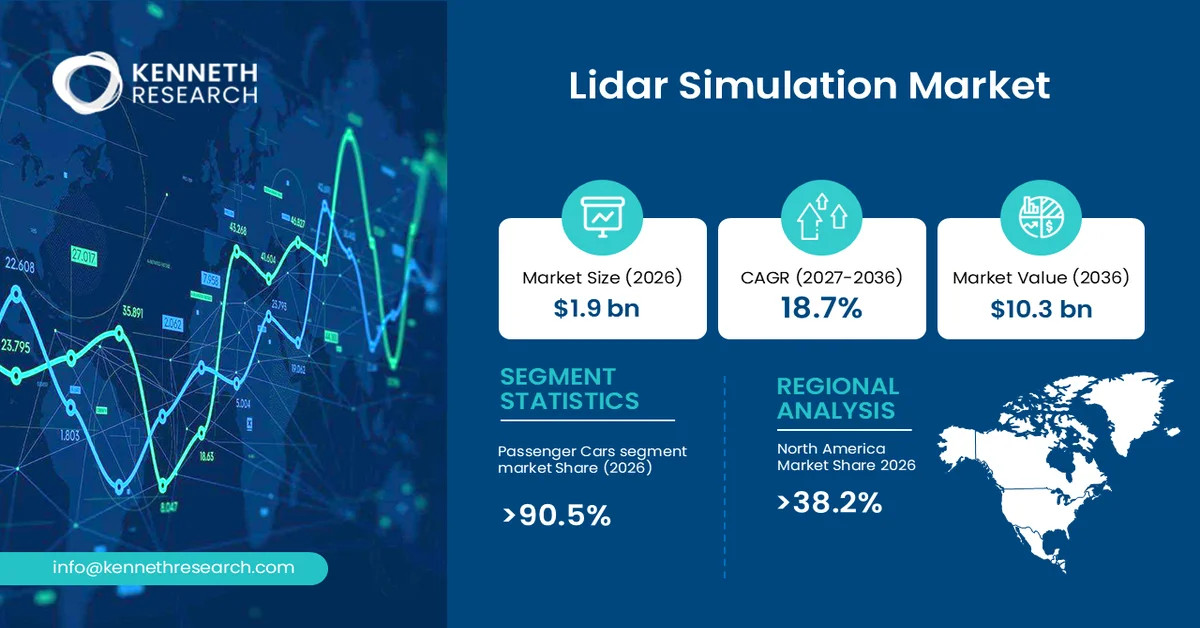
Lidar Simulation Market size was valued at USD 1.9 billion in 2026 and is projected to reach USD 10.3 billion by the end of 2036, rising at a CAGR of 18.7% during the forecast period, i.e., 2027-2036. In 2027, the industry size is expected to reach USD 2.2 billion.
The primary growth driver for the lidar simulation market is the increasing development and validation of autonomous vehicles and advanced driver-assistance systems.
The lidar simulation market comprises software platforms, virtual testing environments, sensor models, and simulation solutions used to replicate lidar sensing and perception in digitally generated environments. These solutions model how lidar systems emit, receive, and process laser signals under different environmental, vehicle, traffic, and road conditions.
Lidar simulation is increasingly used for passenger vehicles, commercial vehicles, autonomous mobility, robotics, and advanced driver-assistance systems. Simulation platforms can reproduce different road layouts, objects, weather conditions, lighting environments, traffic behaviors, and sensor configurations, allowing engineers to evaluate system performance across numerous scenarios.
Key Lidar Simulation Market Insights Summary:
Lidar Simulation Market - Key Takeaways: Market Trends & Insights
- Lidar Simulation Market is projected to grow from USD 1.9 billion in 2026 to USD 10.3 billion by 2036, expanding at a 18.7% CAGR during 2027–2036.
- North America accounted for the largest regional share at 38.2% in 2026, supported by autonomous-vehicle development, advanced driver-assistance systems, simulation technologies, and virtual testing initiatives.
- Passenger Cars led the Vehicle Type segment with a 90.5% share in 2026, driven by increasing integration of lidar-based perception, ADAS, and autonomous-driving functions.
- Short-Wave Infrared Spectrum is gaining importance within the Laser Wavelength segment because of its potential to support lidar simulation for challenging environmental conditions and advanced perception applications.
Market Drivers
- Increasing demand for virtual validation of autonomous vehicles
- Expansion of synthetic data and digital-twin technologies
- Rising adoption of software-in-the-loop and hardware-in-the-loop testing
- Growing need to test complex and safety-critical driving scenarios
Challenges
- Simulation-to-Real-World Accuracy Gap
- Complexity of Adverse-Weather Simulation
Lidar Simulation Market Overview & Supply Chain
The lidar simulation market is becoming increasingly important in automotive development as manufacturers and technology providers use virtual environments to develop, test, and validate lidar-based perception systems. Simulation allows engineering teams to reproduce diverse traffic scenarios, road environments, weather conditions, sensor configurations, and edge cases without relying exclusively on physical road testing.
The supply chain begins with software-development platforms, computing infrastructure, lidar sensor models, simulation engines, scenario-generation tools, and data-processing technologies. These inputs are integrated into simulation environments capable of modeling laser propagation, object interaction, sensor characteristics, environmental conditions, vehicle dynamics, and surrounding traffic. Platform providers then combine sensor simulation with synthetic-data generation, digital environments, artificial intelligence, and perception-algorithm testing.
Lidar Simulation Market: Growth Drivers & Challenges
Growth Drivers
- Increasing demand for virtual validation of autonomous vehicles: The increasing development of autonomous vehicles and advanced driver-assistance systems is driving demand for lidar simulation because manufacturers need to evaluate perception systems across extensive combinations of road, traffic, environmental, and sensor conditions. Physical testing alone can be costly, time-consuming, and difficult to use for rare or hazardous scenarios. Simulation enables engineers to recreate these conditions digitally and assess lidar-based perception before conducting physical-road validation.
- Expansion of synthetic data and digital-twin technologies: The growing adoption of synthetic data, digital twins, and virtual environments is creating another major opportunity for lidar simulation. These technologies allow developers to generate diverse sensor datasets without collecting every scenario physically, supporting perception-algorithm development and system validation. High-fidelity virtual environments can replicate roads, vehicles, pedestrians, infrastructure, weather, and other environmental variables while generating simulated lidar outputs.
Challenges
- Simulation-to-real-world accuracy gap: A major challenge for the lidar simulation market is the difficulty of reproducing real-world sensor behavior with sufficient physical and environmental fidelity. Lidar outputs depend on object materials, surface properties, sensor characteristics, viewing geometry, atmospheric conditions, and signal interactions. Simplified sensor models may therefore produce point clouds that differ from those generated by physical lidar systems. This gap can reduce the reliability of perception-algorithm validation and require developers to combine simulated datasets with real-world data.
- Complexity of adverse-weather simulation: Accurately simulating rain, fog, snow, dust, and other adverse conditions presents another significant restraint. These environments affect laser propagation through scattering, attenuation, and unwanted returns, making it difficult to generate synthetic lidar data that faithfully represents real sensor behavior. Simulation frameworks must account for changing atmospheric and surface conditions while maintaining realistic interactions between the sensor, environment, and vehicle.
Lidar Simulation Market Size and Forecast:
| Report Attribute | Details |
|---|---|
| Base Year |
2026 |
| Forecast Period |
2027-2036 |
| CAGR |
18.7% |
| Base Year Market Size (2026) |
USD 1.9 billion |
| Forecast Year Market Size (2036) |
USD 10.3 billion |
| Regional Scope |
|
Lidar Simulation Market Segmentation Analysis:
Vehicle Type Segment Analysis
The Passenger Cars segment accounted for the largest share of the lidar simulation market within the vehicle type segment, representing 90.5% in 2026.
The strong position of passenger cars is closely associated with the rapid development of advanced driver-assistance systems and autonomous-driving functions, which require extensive validation of perception systems under diverse road and traffic conditions. Lidar simulation allows automotive developers to recreate vehicle environments, road layouts, pedestrians, traffic participants, obstacles, and sensor interactions in controlled virtual scenarios.
Simulation is particularly valuable for passenger-car development because lidar-based perception must be evaluated across large numbers of operating conditions before deployment on public roads. Government-backed research is also reinforcing the role of simulation in automated-vehicle testing.
Laser Wavelength Segment Analysis
The Short-Wave Infrared Spectrum segment is gaining importance in the lidar simulation market because wavelength selection directly influences sensor behavior, target interaction, atmospheric performance, and the characteristics of simulated lidar returns. Simulation platforms need to accurately reproduce wavelength-dependent sensing conditions so that developers can evaluate sensor configurations and perception algorithms under representative operating environments.
Short-wave infrared wavelengths are particularly relevant to advanced sensing applications where developers require realistic modeling of laser propagation, reflections, material interactions, and environmental effects. In automotive development, these capabilities can help engineers assess how different surfaces and objects affect lidar returns and subsequently influence perception performance. High-fidelity wavelength modeling also supports the development of synthetic datasets for training and validating perception algorithms.
Our in-depth analysis of the global lidar simulation market includes the following segments:
|
Segment |
Sub-segment |
|
Lidar Type |
|
|
Method |
|
|
Laser Wavelength |
|
|
Vehicle Type |
|
|
Level of Autonomy |
|
|
Application |
|
Lidar Simulation Market Regional Insights:
North America Market Trends & Insights:
North America accounted for the largest regional share of the lidar simulation market, representing 38.2% in 2026.
The region benefits from strong investment in autonomous vehicles, advanced driver-assistance systems, artificial intelligence, sensor development, and virtual testing technologies.
In the U.S., government-backed research is strengthening the ecosystem for simulation-based validation of automated vehicles. The National Institute of Standards and Technology (NIST) is developing measurement tools that combine computer simulations with physical autonomous-vehicle testing, allowing automated-driving systems to be evaluated across extensive driving scenarios.
Canada is also positioned to benefit from increasing adoption of advanced vehicle simulation and sensing technologies. Its established automotive manufacturing and research base supports the development of autonomous and connected vehicle technologies, while proximity to the U.S. market facilitates cross-border collaboration in vehicle testing and engineering.
Asia-Pacific Market Trends & Insights:
Asia-Pacific is emerging as a significant growth region for the lidar simulation market, supported by expanding autonomous-driving development, automotive software innovation, robotics, smart mobility, and advanced sensor technologies.
Japan has a strong ecosystem for lidar simulation because automotive manufacturers, technology companies, research institutions, and government agencies are actively developing autonomous-driving technologies. Japan's Ministry of Economy, Trade and Industry and Ministry of Land, Infrastructure, Transport and Tourism identified simulation-environment development as an important component of their Mobility DX Strategy, alongside autonomous-driving demonstrations and software-defined vehicle development.
China represents another important market because of its large automotive manufacturing base, expanding intelligent-vehicle ecosystem, and increasing development of autonomous-driving technologies.
Leading Companies Operating in the Global Lidar Simulation Market:
Here is a list of upstream, downstream, and key players operating in the global lidar simulation market competitive ecosystem:
- Ansys (U.S)
- Company Overview
- Business Strategy
- Key Product Offerings
- Financial Performance
- Key Performance Indicators
- Risk Analysis
- Recent Development
- Regional Presence
- SWOT Analysis
- NVIDIA (U.S)
- MORAI (South Korea)
Recent Developments
- December 2024 –Ansys highlighted how Continental uses Ansys AVxcelerate Sensors to evaluate vehicle-perception challenges through virtual testing. The workflow supports realistic virtual test drives and allows scenarios involving obstacle detection, sensor interactions, and weather effects to be assessed in an HPC environment.
- January 2026: NVIDIA introduced the Alpamayo family of open AI models, simulation tools, and datasets for autonomous-vehicle development.
Frequently Asked Question
In 2026, the lidar simulation market exceeded USD 1.9 billion.
The lidar simulation market is projected to reach USD 10.3 billion by the end of 2036, expanding at a CAGR of 18.7% over the forecast period (2027–2036).
The major players in the market are Ansys, NVIDIA, MORAI, Applied Intuition, Cadence, and others.
In the vehicle type segment, the passenger cars sub-segment is anticipated to capture the largest market share of 90.5% in 2026 and exhibit lucrative growth opportunities during 2027–2036.
North America is projected to hold the largest market share of 38.2% by the end of 2036 and provide more business opportunities in the future.
Why Choose Kenneth Research ?
-
Insight with Impact : We don’t just gather data — we uncover stories, trends, and opportunities that fuel business growth.
-
Experts Who Get It : Our team speaks your industry’s language and knows what really matters to your customers and market.
-
Custom-Built for You : Forget one-size-fits-all. We craft research and consulting solutions as unique as your business vision.
-
Partners, Not Just Providers : We work with you, not for you — collaborating closely to turn insights into smart, strategic moves.
-
Results That Speak : Our work powers brands, startups, and industry leaders alike — with a track record of ideas that work in the real world.
Report ID: 1351 |
Published Date: 10 Sep 2026 |
Report Format: |
Delivery Timeline: 48-72 Business Hours

Copyright © 2025 Kenneth Research. All rights reserved. Terms of Use | Privacy Policy
