Report ID: 1375 |
Published Date: 17 Sep 2026 |
Report Format: |
Delivery Timeline: 48-72 Business Hours
LiDAR Market Outlook:
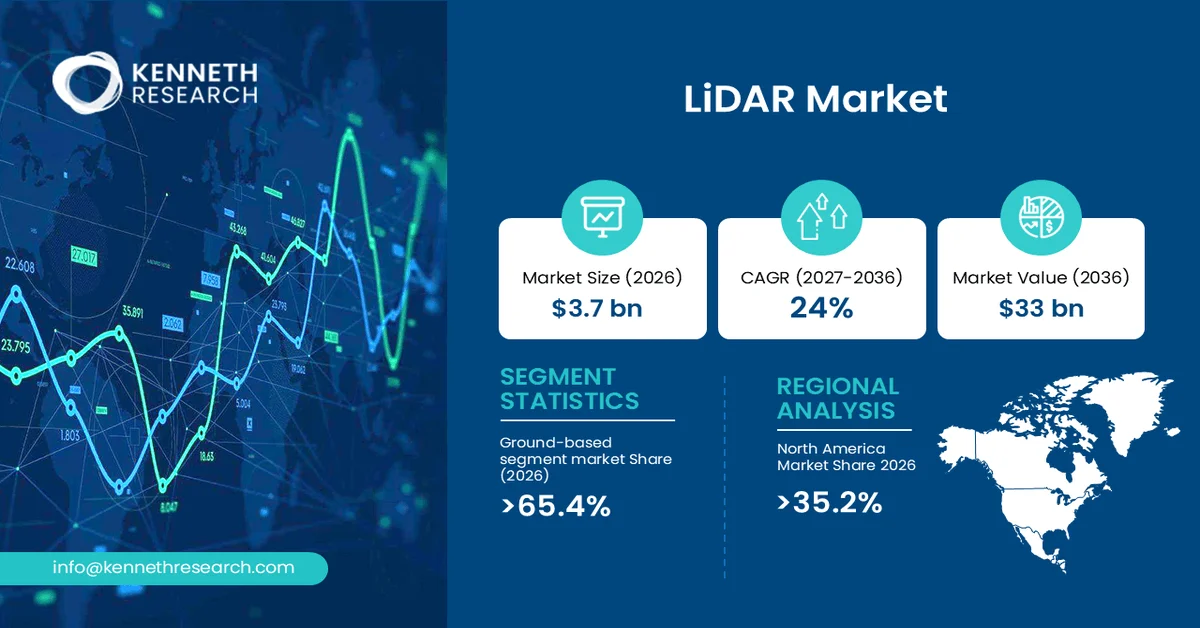
LiDAR Market size was valued at USD 3.7 billion in 2026 and is projected to reach USD 33 billion by the end of 2036, rising at a CAGR of 24.5% during the forecast period, i.e., 2027-2036. In 2027, the industry size of is LiDAR is estimated at USD 4.6 billion.
The primary growth driver for the LiDAR market is the increasing deployment of autonomous systems and high-precision 3D sensing across automotive, mapping, infrastructure, robotics, and industrial applications.
The LiDAR market comprises technologies and systems that use laser pulses to measure distances and construct detailed two-dimensional or three-dimensional representations of physical environments. LiDAR systems emit laser light toward objects and analyze the reflected signals to determine distance, position, elevation, and spatial characteristics.
LiDAR is increasingly integrated into autonomous vehicles, advanced driver assistance systems, robotics, surveying and mapping, infrastructure monitoring, environmental assessment, agriculture, defense, and industrial automation. The technology enables high-resolution perception and supports applications requiring accurate spatial information, particularly where conventional imaging technologies may have limitations.
Key LiDAR Market Insights Summary:
Key Takeaways: Market Trends & Insights
- LiDAR market is projected to grow from USD 3.7 billion in 2026 to USD 33 billion by 2036, expanding at a 24.5% CAGR during 2027-2036.
- North America accounted for the largest regional share at 35.2% in 2026, supported by autonomous mobility, geospatial mapping, infrastructure monitoring, and advanced sensing applications.
- Ground-based systems led the Installation segment with a 65.4% share in 2026, driven by surveying, mapping, infrastructure inspection, and terrestrial 3D data collection.
- Solid-state LiDAR is gaining importance within the Type segment due to its compact architecture, reduced dependence on moving components, scalability, and suitability for automotive and autonomous applications.
Market Drivers
- Increasing deployment of autonomous vehicles and advanced mobility systems
- Expansion of 3D mapping and infrastructure monitoring
- Rising adoption of robotics and automated industrial systems
- Growing demand for high-accuracy surveying, inspection, and environmental monitoring
Challenges
- Adverse weather and environmental interference
- High system complexity and integration requirements
LiDAR Market Overview & Supply Chain
The LiDAR market is gaining importance across autonomous mobility, surveying and mapping, infrastructure monitoring, robotics, industrial automation, environmental assessment, and defense applications. Its ability to generate precise spatial and depth information supports applications that require accurate object detection, terrain mapping, dimensional measurement, and navigation.
The supply chain begins with specialized photonic and electronic components, including laser diodes, VCSELs, photodetectors, MEMS components, optical assemblies, signal-processing electronics, and processors. These inputs are assembled into laser emitters, receivers, scanning mechanisms, optical modules, and complete LiDAR sensor systems. Hardware manufacturers then integrate these components with embedded processing and software for point-cloud generation, object detection, mapping, and perception. System integrators subsequently configure LiDAR units for vehicles, drones, robots, surveying platforms, industrial equipment, and fixed installations.
LiDAR Market: Growth Drivers & Challenges
Growth Drivers:
- Increasing deployment of autonomous vehicles and advanced mobility systems: The growing development of automated driving systems is increasing demand for LiDAR because vehicles require accurate environmental perception, object detection, depth measurement, and high-resolution spatial information. LiDAR can complement cameras and radar by generating detailed three-dimensional representations of surrounding objects and road environments, supporting perception and navigation in automated vehicles. Government-led transportation research continues to emphasize advanced sensing, mapping, and automated-vehicle integration.
- Expansion of 3d mapping and infrastructure monitoring: The increasing use of 3D mapping for transportation infrastructure, surveying, asset management, and environmental assessment is another major growth driver. LiDAR enables the collection of dense spatial data that can be converted into detailed point clouds and digital models. These capabilities support roadway assessment, terrain mapping, infrastructure inspection, construction planning, and digital-twin development.
Challenges:
- Adverse weather and environmental interference: Rain, fog, snow, dust, and airborne particles can interfere with laser propagation and reduce LiDAR sensing reliability. Atmospheric scattering and attenuation can introduce noise, reduce effective detection capability, and create incomplete or distorted point clouds. These limitations are particularly important for autonomous vehicles and outdoor mapping applications, where sensors must operate across changing environmental conditions. Research has shown that adverse weather can significantly affect LiDAR perception and create additional requirements for signal processing, denoising, sensor fusion, and system-level compensation.
- High system complexity and integration requirements: LiDAR deployment can involve substantial technical complexity because performance depends on laser sources, optical components, detectors, scanning architectures, processing electronics, software, calibration, and system integration. Mechanical scanning configurations may also introduce moving components that can create reliability and maintenance considerations in demanding operating environments. Furthermore, LiDAR systems can experience performance limitations when interacting with highly reflective, transparent, or poorly reflective surfaces, requiring application-specific sensor configurations and sophisticated processing techniques.
LiDAR Market Size and Forecast:
| Report Attribute | Details |
|---|---|
| Base Year |
2026 |
| Forecast Period |
2027-2036 |
| CAGR |
24.5% |
| Base Year Market Size (2026) |
USD 3.7 billion |
| Forecast Year Market Size (2036) |
USD 33 billion |
| Regional Scope |
|
LiDAR Market Segmentation Analysis:
Installation Segment Analysis
The ground-based segment accounted for the largest share of the LiDAR market within the installation segment, representing 65.4% in 2026. Ground-based LiDAR systems are widely suited to applications requiring detailed, localized, and repeatable three-dimensional measurements from terrestrial platforms. Their deployment supports surveying, topographic mapping, infrastructure inspection, construction monitoring, environmental assessment, transportation planning, and asset management. Unlike airborne installations, ground-based systems can be positioned at specific sites to capture detailed information about structures, terrain, roadways, facilities, and other physical assets.
The growing use of high-resolution elevation and spatial data further supports demand for ground-based LiDAR installations. Government agencies increasingly use terrestrial LiDAR for cadastral surveying, infrastructure planning, hazard assessment, and environmental monitoring.
Type Segment Analysis
The solid-state LiDAR segment is gaining strong traction within the LiDAR market as manufacturers and end users increasingly seek compact, reliable, and scalable sensing solutions. Unlike conventional mechanical systems, solid-state architectures minimize or eliminate moving components, supporting improved durability, simplified integration, and potentially lower maintenance requirements. These characteristics make the technology well suited to automotive perception, robotics, autonomous systems, industrial automation, and other applications where sensor size and reliability are important.
Solid-state LiDAR can employ technologies such as flash LiDAR, MEMS-based architectures, and electronically steered beam systems. Their development is particularly important for automotive applications because sensors must be integrated into vehicle designs while maintaining accurate three-dimensional perception.
Our in-depth analysis of the global LiDAR market includes the following segments:
|
Segment |
Sub-segment |
|
Type |
|
|
Installation |
|
|
Service |
|
|
Range |
|
|
Application |
|
LiDAR Market Regional Insights:
North America Market Trends & Insights:
North America accounted for the largest regional share of the LiDAR market, representing 35.2% in 2026.
The region benefits from strong adoption of LiDAR across autonomous mobility, surveying and mapping, infrastructure monitoring, defense, robotics, and industrial applications. The U.S. represents a major demand center because of its extensive deployment of 3D geospatial technologies, transportation research, autonomous-system development, and infrastructure mapping.
In the U.S., government investment in high-resolution three-dimensional mapping continues to support LiDAR utilization. The U.S. Geological Survey expanded its 3D Elevation Program in 2024 with more than $6 million in Inflation Reduction Act funding, supporting the collection of new topographic LiDAR data across 25 states for applications including flood-risk management, precision agriculture, infrastructure, and natural-resource management.
Canada is similarly strengthening its LiDAR-based geospatial infrastructure. Natural Resources Canada reported that more than 709,000 km² of new LiDAR-derived elevation data had been added to national products since May 2024, extending coverage to 244 of Canada's 250 largest cities and more than 95% of the population.
Asia-Pacific Market Trends & Insights:
Asia-Pacific is emerging as a major growth region for the LiDAR market, supported by expanding automotive automation, robotics, industrial manufacturing, surveying, infrastructure development, and smart-city initiatives. The region's strong electronics and semiconductor ecosystem also creates favorable conditions for the development and commercialization of advanced LiDAR components and systems.
Japan represents a technologically advanced market for LiDAR, with adoption extending across automotive systems, robotics, mapping, infrastructure monitoring, and disaster-management applications. The country's established automotive manufacturing ecosystem and strong capabilities in precision engineering support the integration of LiDAR into next-generation mobility and industrial systems.
China is a major regional market because of its large automotive manufacturing base, rapidly developing intelligent-vehicle ecosystem, and strong domestic LiDAR manufacturing capabilities.
Leading Companies Operating in the Global LiDAR Market:
Here is a list of upstream, downstream, and key players operating in the global LiDAR market competitive ecosystem:
- Hesai Technology (China)
- Company Overview
- Business Strategy
- Key Product Offerings
- Financial Performance
- Key Performance Indicators
- Risk Analysis
- Recent Development
- Regional Presence
- SWOT Analysis
- RoboSense (China)
- Innoviz Technologies (Istrael)
Recent Developments
- January 2026: Hesai Technology (NASDAQ: HSAI; HKEX: 2525), the global leader in LiDAR solutions, announced today that it will double its annual production capacity in 2026 — from 2 million units to over 4 million units — driven by accelerating demand for ADAS and robotics LiDAR.
- July 2026: RoboSense recorded 719,200 units in LiDAR sales in H1 2026, up 169.6% year over year, with robotics LiDAR sales surging 510.4% to 282,600 units.
Frequently Asked Question
In 2026, the LiDAR market exceeded USD 3.7 billion.
The LiDAR market is projected to reach USD 33 billion by the end of 2036, expanding at a CAGR of 24% cover the forecast period (2027-2036).
The major players in the market are Hesai Technology, RoboSense, Innoviz Technologies, Luminar Technologies, Ouster, and others.
In the installation segment, the ground-based sub-segment is anticipated to capture the largest market share of 65.4% in 2026 and exhibit lucrative growth opportunities during 2027-2036.
North America is projected to hold the largest market share of 35.2% by the end of 2026 and provide more business opportunities in the future.
Why Choose Kenneth Research ?
-
Insight with Impact : We don’t just gather data — we uncover stories, trends, and opportunities that fuel business growth.
-
Experts Who Get It : Our team speaks your industry’s language and knows what really matters to your customers and market.
-
Custom-Built for You : Forget one-size-fits-all. We craft research and consulting solutions as unique as your business vision.
-
Partners, Not Just Providers : We work with you, not for you — collaborating closely to turn insights into smart, strategic moves.
-
Results That Speak : Our work powers brands, startups, and industry leaders alike — with a track record of ideas that work in the real world.
Report ID: 1375 |
Published Date: 17 Sep 2026 |
Report Format: |
Delivery Timeline: 48-72 Business Hours

Copyright © 2025 Kenneth Research. All rights reserved. Terms of Use | Privacy Policy
