Report ID: 1358 |
Published Date: 10 Sep 2026 |
Report Format: |
Delivery Timeline: 48-72 Business Hours
Laser Triangulation Sensor Market Outlook:
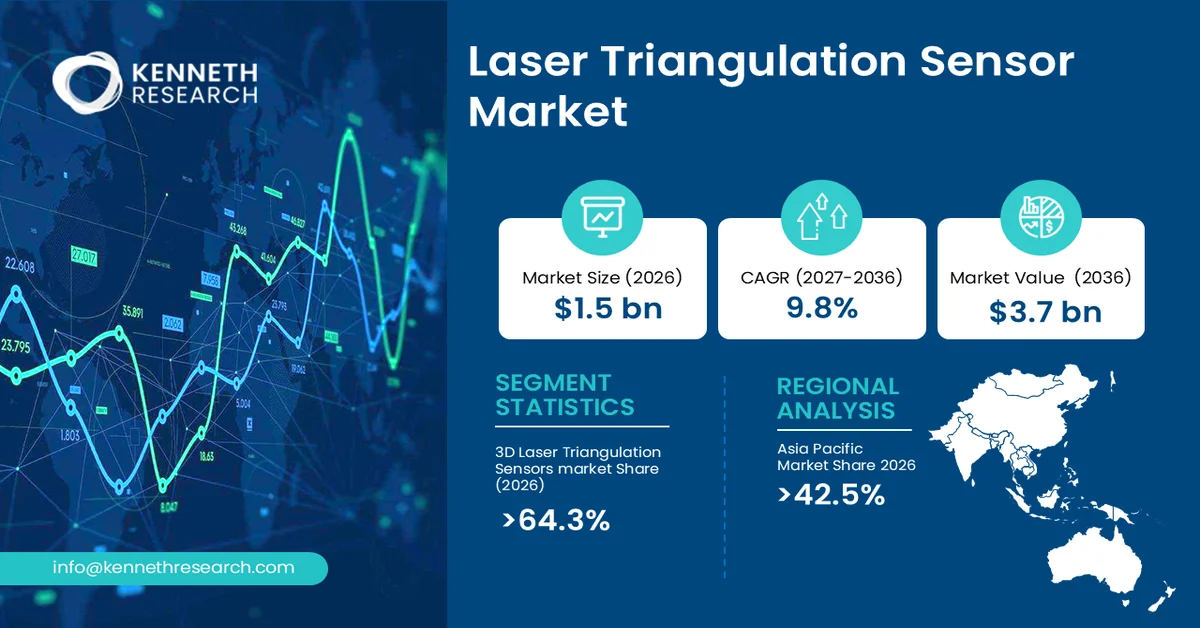
Laser Triangulation Sensor Market size was valued at USD 1.5 billion in 2026 and is projected to reach USD 3.7 billion by the end of 2036, rising at a CAGR of 9.8% during the forecast period, i.e., 2027–2036. In 2027, the industry size is expected to reach USD 1.6 billion.
The increasing adoption of automated and precision-driven manufacturing is a major growth driver for the laser triangulation sensor market. Manufacturers are increasingly requiring fast, non-contact measurement of dimensions, thickness, height, gaps, surface profiles, and component positioning.
The laser triangulation sensor market comprises optical measurement devices that use a laser source and optical detector to determine the distance, position, height, thickness, or surface profile of an object through triangulation principles. The sensor projects a laser spot or line onto a target surface, while a receiver detects the reflected light from a defined angle.
These sensors provide non-contact and wear-free measurement, making them suitable for applications where mechanical measurement could damage the product or limit measurement speed. They are used across industrial automation, automotive manufacturing, robotics, electronics and semiconductor production, quality inspection, logistics, and other precision-oriented operations. Depending on system architecture, laser triangulation sensors can perform point measurements or generate detailed surface profiles for three-dimensional inspection.
Key Laser Triangulation Sensor Market Insights Summary:
Key Takeaways: Market Trends & Insights
- Laser Triangulation Sensor Market is projected to grow from USD 1.5 billion in 2026 to USD 3.7 billion by 2036, expanding at a 9.8% CAGR during 2027–2036.
- Asia-Pacific accounted for the largest regional share at 42.5% in 2026, supported by strong manufacturing activity, industrial automation, precision engineering, and expanding adoption of machine-vision technologies across Japan and China.
- 3D Laser Triangulation Sensors are expected to remain the leading Type segment, accounting for 64.3% market share in 2026, driven by rising demand for three-dimensional surface profiling, dimensional inspection, and automated quality control.
- Short Range sensors are expected to maintain strong demand within the Range segment due to their suitability for high-precision measurement, positioning, thickness inspection, and surface-profile applications in automated manufacturing environments.
Market Drivers
- Increasing adoption of automated quality inspection and process control
- Expansion of 3D measurement and machine-vision applications
- Rising deployment of robotics and smart manufacturing systems
- Growing demand for high-speed, non-contact dimensional measurement
Challenges
- Surface Reflectivity and Material Compatibility
- Environmental and Calibration Constraints
Laser Triangulation Sensor Market Overview & Supply Chain
The laser triangulation sensor market is gaining importance across automated manufacturing, machine vision, robotics, automotive production, electronics, semiconductor processing, and precision inspection. These sensors enable non-contact measurement of distance, displacement, height, thickness, width, surface profile, and dimensional characteristics, making them suitable for applications requiring rapid and repeatable inspection. Their ability to perform measurements on moving objects also supports inline quality control and automated production processes.
The supply chain begins with suppliers of laser diodes, optical components, CMOS or other light-detection devices, electronic components, processors, housings, cables, and communication interfaces. Sensor manufacturers integrate these components into laser triangulation sensing heads, controllers, displacement sensors, and 2D/3D profiling systems. Manufacturers then calibrate and configure the equipment according to measurement range, resolution, surface characteristics, operating environment, and application requirements.
Laser Triangulation Sensor Market: Growth Drivers & Challenges
Growth Drivers
- Increasing Adoption of Automated Quality Inspection: The growing deployment of automated inspection and process-control systems is a major driver for the laser triangulation sensor market. Manufacturers are increasingly using non-contact measurement technologies to monitor dimensions, surface profiles, thickness, height, and component positioning during production. Laser triangulation sensors can perform high-speed measurements on stationary as well as moving components, enabling continuous inspection without interrupting manufacturing operations. Their compatibility with machine-vision platforms, robotic systems, and industrial controllers makes them suitable for smart manufacturing environments where measurement data must be captured and processed in real time.
- Expansion of 3d measurement and machine-vision applications:
The increasing use of three-dimensional measurement in manufacturing is creating additional opportunities for laser triangulation sensors. Unlike conventional point-based measurement approaches, laser-line triangulation systems can generate surface profiles that help identify dimensional deviations, warpage, defects, edges, and other geometric characteristics. This capability supports applications across automotive components, electronics, semiconductors, packaging, metals, plastics, and robotics.
Challenges
- Surface reflectivity and material compatibility: A major restraint for the laser triangulation sensor market is the sensitivity of measurement performance to the optical characteristics of the target surface. Highly reflective, mirror-like, transparent, dark, or unevenly finished materials can alter the reflected laser signal and result in missing points, unstable readings, or measurement deviations. Transparent materials can also produce multiple reflections because the laser interacts with different surfaces within the material. These limitations require careful sensor selection, positioning, calibration, wavelength selection, or additional signal-processing techniques, increasing system-integration complexity for manufacturers operating across diverse materials and production conditions.
- Environmental and calibration constraints: Laser triangulation sensors can also face performance limitations from ambient light, dust, smoke, vibration, temperature variation, and changes in sensor or target orientation. Industrial installations therefore require appropriate positioning, optical alignment, calibration, and environmental control to maintain measurement reliability. The triangulation geometry can create blind spots when portions of a component are hidden from the receiver, while changes in surface inclination can influence the detected laser profile.
Laser Triangulation Sensor Market Size and Forecast:
| Report Attribute | Details |
|---|---|
| Base Year |
2026 |
| Forecast Period |
2027-2036 |
| CAGR |
9.8% |
| Base Year Market Size (2026) |
USD 1.5 billion |
| Forecast Year Market Size (2036) |
USD 3.7 billion |
| Regional Scope |
|
Laser Triangulation Sensor Market Segmentation Analysis:
Type Segment Analysis
In the type segment, 3D Laser Triangulation Sensors accounted for the largest market share of 64.3% in 2026.
Their leading position is supported by the growing requirement for three-dimensional surface measurement, dimensional inspection, profile analysis, and automated quality control across industrial production environments. Unlike basic point-based measurement, 3D laser triangulation systems can capture detailed surface profiles and geometric information, enabling manufacturers to identify height variations, deformation, edges, gaps, surface defects, and dimensional deviations without physical contact. The automotive and electronics industries represent important application areas because modern production processes require accurate inspection of increasingly complex components.
Range Segment Analysis
In the range segment, the short range sub-segment is expected to maintain strong demand due to its suitability for high-precision displacement, dimensional, positioning, thickness, and surface-profile measurements in compact industrial environments. Short-range laser triangulation sensors are particularly valuable where measurement accuracy and rapid response are more important than covering large distances. Their non-contact operation allows manufacturers to inspect moving or sensitive components without affecting the production process.
Short-range configurations are widely applicable to automated production and inspection tasks, including component positioning, dimensional verification, surface profiling, thickness measurement, and vibration monitoring. The shorter measurement span can provide higher precision because the detector resolution is concentrated across a smaller measurement range. This characteristic makes short-range systems well suited to precision manufacturing and machine integration.
Our in-depth analysis of the global laser triangulation sensor market includes the following segments:
|
Segment |
Sub-segment |
|
Type |
|
|
Range |
|
|
Application |
|
Laser Triangulation Sensor Market Regional Insights:
Asia-Pacific Market Trends & Insights:
Asia-Pacific is the dominant region in the laser triangulation sensor market, accounting for 42.5% of the global market share in 2026.
The region's leadership is supported by its extensive manufacturing base, high adoption of industrial automation, and strong presence in automotive, electronics, semiconductor, robotics, and precision-engineering industries. Laser triangulation sensors are increasingly integrated into automated inspection, dimensional measurement, surface profiling, and production-control systems, creating sustained demand across advanced manufacturing environments.
Japan represents a major technology and manufacturing center, supported by its established precision-engineering, automotive, electronics, and industrial-automation industries. Japanese manufacturers have strong capabilities in sensing, measurement, robotics, and factory automation, creating a favorable environment for high-precision laser measurement technologies.
China is another critical market because of its large-scale manufacturing ecosystem and accelerating adoption of automated production and machine-vision technologies. China's manufacturing and industrial-equipment base provides extensive applications for non-contact measurement systems across automotive components, electronics, machinery, and other industrial products.
North America Market Trends & Insights:
North America represents a significant market for laser triangulation sensors, supported by the region's advanced manufacturing infrastructure, strong industrial automation adoption, and established presence of automotive, electronics, aerospace, semiconductor, and precision-engineering industries.
The U.S. is expected to remain the primary contributor because of its large industrial manufacturing base and increasing integration of machine vision, robotics, and automated quality-control systems. Laser triangulation technology is particularly relevant to automotive production, where sensors can be incorporated into automated inspection and component-positioning applications.
Canada also provides opportunities through its automotive manufacturing, advanced industrial, electronics, and technology sectors. LMI Technologies, headquartered in Canada, manufactures 3D laser line profile sensors based on triangulation technology and serves automotive, EV battery, consumer electronics, and semiconductor applications.
Leading Companies Operating in the Global Laser Triangulation Sensor Market:
Here is a list of upstream, downstream, and key players operating in the global laser triangulation sensor market competitive ecosystem:
- Micro-Epsilon (Germany)
- Company Overview
- Business Strategy
- Key Product Offerings
- Financial Performance
- Key Performance Indicators
- Risk Analysis
- Recent Development
- Regional Presence
- SWOT Analysis
- KEYENCE (Japan)
- SICK (Germany)
Recent Developments
- July 2026: Micro-Epsilon upgraded its optoNCDT 5500 laser triangulation sensor, increasing its measuring rate to 150 kHz across the full measuring range while improving repeatability, ambient-light resistance, and connectivity options.
- July 2025: SICK introduced the OD200 µm optical displacement sensor, a compact short-range measurement solution designed to provide fast and stable measurement on challenging surfaces.
Frequently Asked Question
In 2026, the laser triangulation sensor market exceeded USD 1.5 billion.
The Laser Triangulation Sensor Market is projected to reach USD 3.7 billion by the end of 2036, expanding at a CAGR of 9.8% over the forecast period (2027–2036).
The major players in the market are Micro-Epsilon, KEYENCE, SICK, LMI Technologies, Baumer, and others.
In the Type segment, the 3D Laser Triangulation Sensors sub-segment is anticipated to capture the largest market share of 64.3% in the future and exhibit lucrative growth opportunities during 2027–2036.
Asia-Pacific is projected to hold the largest market share of 42.5% by the end of 2036 and provide more business opportunities in the future.
Why Choose Kenneth Research ?
-
Insight with Impact : We don’t just gather data — we uncover stories, trends, and opportunities that fuel business growth.
-
Experts Who Get It : Our team speaks your industry’s language and knows what really matters to your customers and market.
-
Custom-Built for You : Forget one-size-fits-all. We craft research and consulting solutions as unique as your business vision.
-
Partners, Not Just Providers : We work with you, not for you — collaborating closely to turn insights into smart, strategic moves.
-
Results That Speak : Our work powers brands, startups, and industry leaders alike — with a track record of ideas that work in the real world.
Report ID: 1358 |
Published Date: 10 Sep 2026 |
Report Format: |
Delivery Timeline: 48-72 Business Hours
Copyright © 2025 Kenneth Research. All rights reserved. Terms of Use | Privacy Policy
