Report ID: 1420 |
Published Date: 25 Sep 2026 |
Report Format: |
Delivery Timeline: 48-72 Business Hours
Large-Scale Natural Refrigerant Heat Pump Market Outlook:
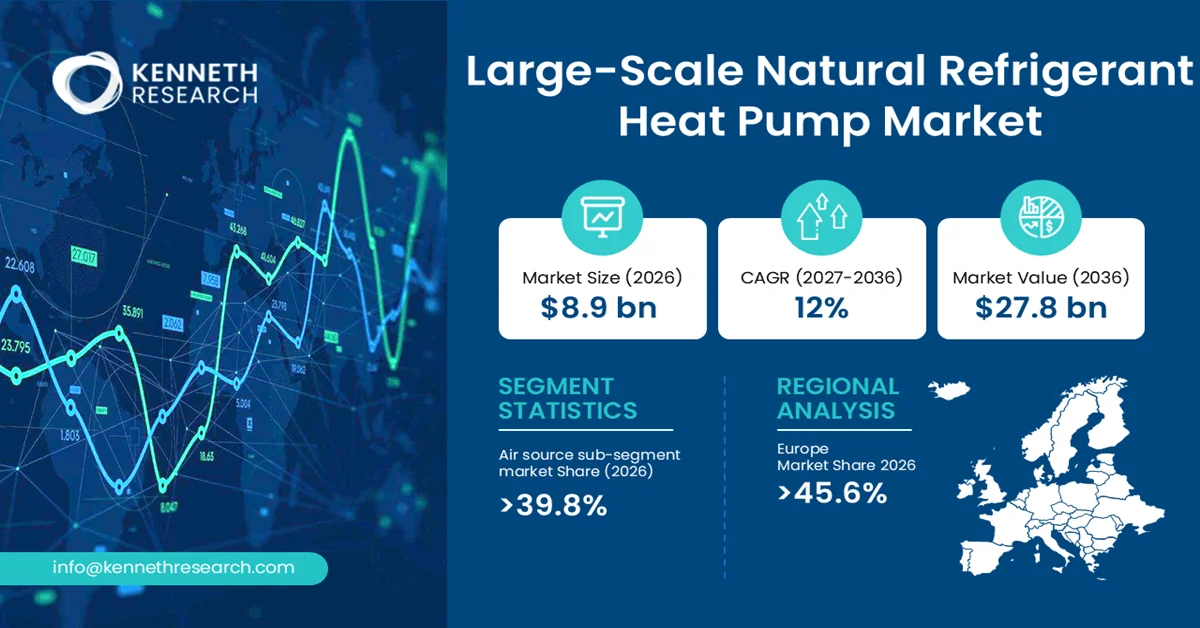
Large-Scale Natural Refrigerant Heat Pump Market size was valued at USD 8.9 billion in 2026 and is projected to reach USD 27.8 billion by the end of 2036, rising at a CAGR of 12% during the forecast period, i.e., 2027-2036. In 2027, the industry size of the large-scale natural refrigerant heat pump is estimated at USD 10 billion.
The primary growth driver is the accelerating transition toward low-emission heating and cooling systems, supported by tighter restrictions on high-global-warming-potential refrigerants. Natural refrigerants such as ammonia, carbon dioxide, and propane enable large-scale heat pumps to address industrial and commercial decarbonization requirements while supporting energy efficiency and reduced dependence on fossil-fuel-based heating.
Large-scale natural refrigerant heat pumps are industrial and commercial heating and cooling systems that use naturally occurring refrigerants, principally ammonia, carbon dioxide, hydrocarbons such as propane, or other non-fluorinated refrigerants, to transfer thermal energy between a source and a heat sink. These systems can extract heat from ambient air, ground, water, waste streams, or other available sources and upgrade it to useful temperatures for space heating, hot-water production, district heating, and industrial processes.
A defining characteristic is the combination of large thermal capacity with refrigerants that have comparatively low climate impact and established thermodynamic performance. System architecture varies according to the heat source, required temperature, operating environment, and application, with air-source and ground-source configurations representing important product-type categories.
Key Large-Scale Natural Refrigerant Heat Pump Market Insights Summary:
Key Takeaways: Market Trends & Insights
- Large-Scale Natural Refrigerant Heat Pump Market is valued at USD 8.9 billion in 2026 and is projected to reach USD 27.8 billion by 2036
- The market is expected to expand at a CAGR of 12% during 2027-2036
- Air source is the largest product type segment, accounting for 39.8% market share in 2026
- Europe leads the market with a 45.6% market share in 2026, supported by strong adoption across Germany and Sweden
- Ground Source is identified as the second and fastest-growing Product Type segment, supported by expanding industrial electrification and demand for efficient thermal systems
Market Drivers
- Regulatory transition toward lower-impact refrigerants
- Expansion of high-temperature industrial applications
- Integration of waste-heat recovery and industrial electrification
- Growing deployment of renewable-powered heating and thermal-energy systems
Challenges
- High capital requirements and project-specific engineering
- Electricity infrastructure and operating-economics constraints
Large-Scale Natural Refrigerant Heat Pumps Market Overview & Supply Chain
Adoption of large-scale natural refrigerant heat pumps is increasing as industries, utilities, and building operators seek electrified heating solutions that can reduce fossil-fuel dependence while meeting decarbonization requirements. Natural refrigerants such as carbon dioxide, ammonia, and hydrocarbons are increasingly relevant where operators require lower-impact refrigerant options alongside high-temperature or continuous-duty heating.
The value chain for large-scale natural refrigerant heat pumps begins with raw-material and component suppliers providing metals, refrigerant gases, compressors, heat exchangers, valves, pumps, controls, electrical equipment, insulation, and specialized materials. Natural refrigerants are sourced through chemical and industrial-gas supply networks, while critical components may be produced by specialized engineering manufacturers. Heat-pump manufacturers then integrate these components into engineered systems configured around required temperature levels, heat sources, capacity, and operating conditions. Distribution occurs through direct industrial sales, equipment distributors, engineering contractors, and system integrators. End users include manufacturing plants, food-processing facilities, chemical producers, commercial buildings, utilities, district-heating operators, and other large thermal-energy consumers.
Large-Scale Natural Refrigerant Heat Pumps Market: Growth Drivers & Challenges
Growth Drivers:
- Regulatory transition toward lower-impact refrigerants: Regulatory tightening around fluorinated greenhouse gases is accelerating the shift toward natural refrigerants in heat-pump applications. As governments introduce restrictions on high-global-warming-potential refrigerants, equipment manufacturers and industrial users have stronger incentives to redesign systems around alternatives such as carbon dioxide, ammonia, and hydrocarbons.
- Expansion of high-temperature industrial applications: Increasing demand for industrial decarbonization is broadening the addressable application base for large-scale heat pumps beyond conventional building heating. Industrial facilities require dependable thermal energy for processes such as drying, washing, evaporation, food processing, and steam generation, creating opportunities for high-temperature systems that can recover ambient or waste heat and convert it into useful process heat.
Challenges:
- High capital requirements and project-specific engineering: Large-scale natural refrigerant heat-pump projects can require substantial upfront investment because industrial systems frequently need customized heat-source integration, high-capacity compressors, heat exchangers, controls, electrical infrastructure, and site modifications. The root challenge is that many facilities cannot adopt standardized equipment without adapting the system to existing production processes, temperature requirements, and heat-recovery configurations.
- Electricity infrastructure and operating-economics constraints: Large-scale natural refrigerant heat pumps depend on reliable electricity supplies, making grid capacity and electricity-to-fossil-fuel price relationships important commercial considerations. Industrial sites may require grid upgrades or new connections before electrified heating equipment can be integrated at the required operating scale. The root issue is therefore broader than equipment availability: heat-pump economics are influenced by electricity tariffs, grid access, demand charges, and the ability to operate efficiently alongside existing industrial loads.
Large-Scale Natural Refrigerant Heat Pumps Market Size and Forecast:• North America (U.S. and Canada) • Asia Pacific (Japan, China, India, Indonesia, Malaysia, Australia, South Korea, Rest of Asia Pacific) • Europe (UK, Germany, France, Italy, Spain, Russia, NORDIC, Rest of Europe) • Latin America (Mexico, Argentina, Brazil, Rest of Latin America) • Middle East and Africa (Israel, GCC, North Africa, South Africa, Rest of the Middle East and Africa)
| Report Attribute | Details |
|---|---|
| Base Year |
2026 |
| Forecast Period |
2027-2036 |
| CAGR |
12% |
| Base Year Market Size (2026) |
USD 8.9 billion |
| Forecast Year Market Size (2036) |
USD 27.8 billion |
| Regional Scope |
|
Large-Scale Natural Refrigerant Heat Pumps Market Segmentation Analysis:
Product Type Segment Analysis
In the product type segment, air source sub-segment is anticipated to capture the largest market share of 39.8% by the end of 2026.
Air source is the leading product-type segment because it generally offers simpler site integration, broader geographic applicability, and lower installation complexity than ground-source configurations. Demand is supported by the ability to draw heat from ambient air without requiring drilling or extensive ground-loop infrastructure, making deployment more practical for commercial facilities, industrial sites, and distributed heating applications. Technology improvements are also expanding operating suitability in colder climates, while modular configurations allow manufacturers and system integrators to tailor capacity to different thermal loads. Supply-side manufacturers benefit from established compressor, heat-exchanger, controls, and refrigeration-component ecosystems, supporting greater equipment availability and serviceability.
Product Type Segment Analysis
The ground source is projected to grow as the second-largest segment in the large-scale natural refrigerant heat pump market due to four converging demand drivers.
Ground source is projected to grow as industrial and commercial users seek stable, efficient thermal performance that is less dependent on outdoor-air conditions. Ground-source heat pumps use relatively constant subsurface temperatures as a heat source and sink, supporting both heating and cooling and making the technology suitable for campuses, commercial facilities, district-scale networks, and other large applications. Adoption is also being encouraged by decarbonization strategies that value electrified heating combined with thermal storage characteristics. On the supply side, manufacturers and engineering firms are developing more integrated geothermal systems, while government-backed demonstration and technical programmes are improving project knowledge and installation capabilities. The U.S. Department of Energy reported that retrofitting around 70% of U.S. buildings with geothermal heat pumps could reduce electricity demand by as much as 13% by 2050, when combined with building-envelope improvements.
Our in-depth analysis of the Large-Scale Natural Refrigerant Heat Pumps market includes the following segments:
|
Segment |
Sub-segment |
|
Product Type |
|
|
Refrigerant Type |
|
|
Application |
|
|
End-User |
|
Large-Scale Natural Refrigerant Heat Pumps Market Regional Insights:
Europe Market Trends & Insights:
Europe large-scale natural refrigerant heat pump market is projected to hold the largest revenue share of 45.6% by the end of 2026.
It is supported by strong decarbonization policies, established heating infrastructure, and substantial industrial demand for efficient electrified thermal systems. The region combines mature heat-pump manufacturing capabilities with extensive district-heating networks and an active transition away from fossil-fuel heating.
Germany represents a major European demand center, supported by industrial activity, building decarbonization requirements, and policy efforts to expand renewable heating. Its large manufacturing base also creates opportunities for high-capacity systems serving industrial and commercial applications.
Sweden has particularly favorable conditions because of its established electrification culture, extensive district-heating infrastructure, and strong acceptance of heat-pump technologies. The European Commission specifically identifies Sweden among the EU markets with the highest heat-pump sales relative to population, reinforcing its importance for technology adoption and deployment expertise.
Asia Pacific Market Trends & Insights:
Asia Pacific is emerging as an important market for large-scale natural refrigerant heat pumps, supported by expanding industrial electrification, rising demand for efficient thermal systems, and government-led decarbonization programmes. Manufacturing-intensive economies are particularly relevant because heat pumps can recover industrial waste heat and provide process heating while reducing reliance on combustion-based systems.
China represents a key country market because of its extensive manufacturing base and increasingly coordinated policy support for heat-pump technology. National authorities are encouraging applications in sectors including petrochemicals, textiles, food processing, pharmaceuticals, and building materials, creating opportunities for industrial-scale systems and natural-refrigerant configurations.
Japan has a mature heat-pump ecosystem and strong policy emphasis on energy efficiency and non-fossil technologies. Its government continues to promote heat-pump water-heating technologies using carbon dioxide refrigerants, while its energy-efficiency strategy supports technology development and dissemination as part of the country's carbon-neutrality pathway.
Leading Companies Operating in the Global Large-Scale Natural Refrigerant Heat Pumps Market:
Here is a list of upstream, downstream, and key players operating in large-scale natural refrigerant heat pumps market competitive ecosystem:
- Solid Energy (Denmark)
- Company Overview
- Business Strategy
- Key Product Offerings
- Financial Performance
- Key Performance Indicators
- Risk Analysis
- Recent Development
- Regional Presence
- SWOT Analysis
- Snowman Group (China)
- Zudek (Italy)
- ARANER (Spain)
- Enerblue Srl (Italy)
Recent Developments
- In April 2026, Snowman Group unveiled a full-range industrial heat pump portfolio covering 40°C to 200°C at the China Refrigeration Expo.
The portfolio prioritizes natural refrigerants, including ammonia (R717) and CO₂ (R744), and leverages reciprocating, screw, and centrifugal compressor technologies for applications such as chemical processing, food and beverage, and industrial drying. The SPT Series Industrial CO₂ Transcritical Reciprocating Compressor, designed for harsh industrial environments with high-pressure stability, received high recognition from the expo's expert committee. - In April 2025, Enerblue Srl introduced an extended five-year warranty exclusively for its natural refrigerant-based product portfolio at the ISH 2025 trade show.
The warranty covers propane (R290) and CO₂ (R744) heat pumps and chillers, offered for a "very small fee" beyond the standard 18-month coverage. The company stated this reflects its confidence in the durability and reliability of its natural refrigerant technology for commercial and industrial applications.
Frequently Asked Question
In 2026, the large-scale natural refrigerant heat pump market exceeded USD 8.9 billion.
The large-scale natural refrigerant heat pump market is projected to reach USD 27.8 billion by the end of 2036, expanding at a CAGR of 12% over the forecast period (2027-2036).
The major players in the market are Solid Energy, Snowman Group, Zudek, ARANER, Enerblue Srl, and others.
In the product type segment, the air source sub-segment is anticipated to capture the largest market share of 39.8% in the future and exhibit lucrative growth opportunities during 2027-2036. This growth trajectory is largely attributed to simpler site integration and lower installation complexity.
Europe is projected to hold the largest market share of 45.6% by the end of 2026 and provide more business opportunities in the future. Continuous investments in Germany and Sweden, supported by decarbonization policies and established heating infrastructure, are fostering the region's dominance.
Why Choose Kenneth Research ?
-
Insight with Impact : We don’t just gather data — we uncover stories, trends, and opportunities that fuel business growth.
-
Experts Who Get It : Our team speaks your industry’s language and knows what really matters to your customers and market.
-
Custom-Built for You : Forget one-size-fits-all. We craft research and consulting solutions as unique as your business vision.
-
Partners, Not Just Providers : We work with you, not for you — collaborating closely to turn insights into smart, strategic moves.
-
Results That Speak : Our work powers brands, startups, and industry leaders alike — with a track record of ideas that work in the real world.
Report ID: 1420 |
Published Date: 25 Sep 2026 |
Report Format: |
Delivery Timeline: 48-72 Business Hours

Copyright © 2025 Kenneth Research. All rights reserved. Terms of Use | Privacy Policy
