Report ID: 1398 |
Published Date: 25 Sep 2026 |
Report Format: |
Delivery Timeline: 48-72 Business Hours
Kitting Automation Systems Market Outlook:
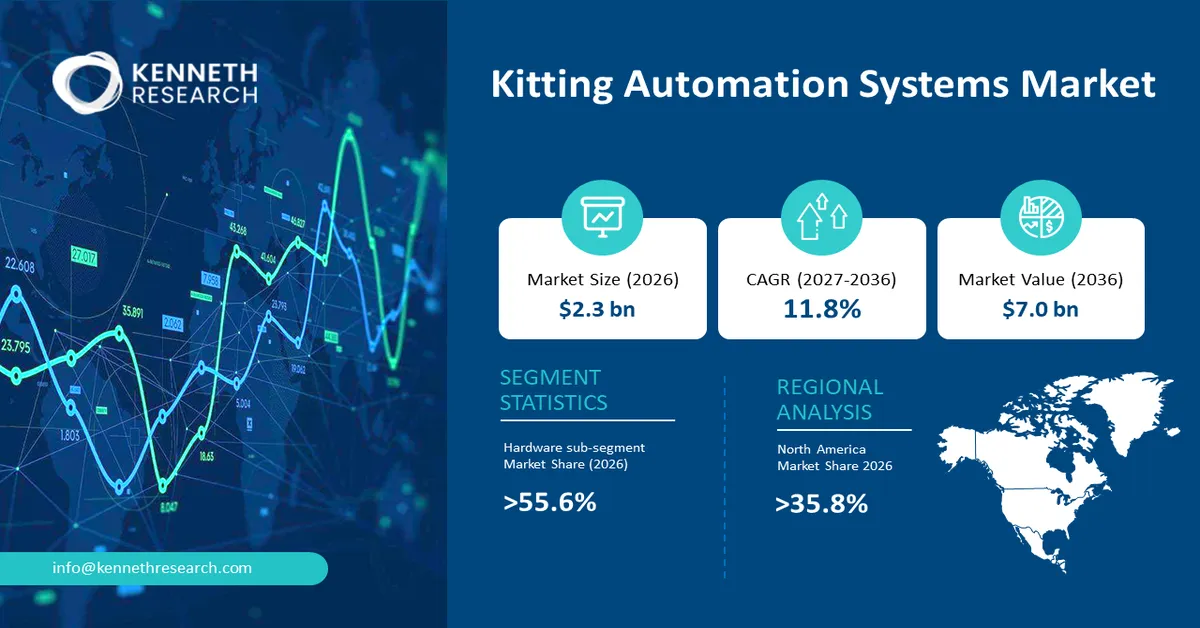
Kitting Automation Systems Market size was valued at USD 2.3 billion in 2026 and is projected to reach USD 7.0 billion by the end of 2036, rising at a CAGR of 11.8% during the forecast period, i.e., 2027-2036. In 2027, the industry size of the kitting automation systems is estimated at USD 2.6 billion.
The expansion of e-commerce and omnichannel retail is a primary growth driver for kitting automation systems, as retailers increasingly require faster, accurate, and scalable order preparation. Statistics Canada reported Canadian retail e-commerce revenue of $67.7 billion in 2023, highlighting sustained digital purchasing activity and the operational need for automated kit assembly and fulfilment processes.
Kitting automation systems are integrated equipment and software solutions designed to automatically collect, identify, combine, sequence, and package multiple individual components into a predefined kit or assembled unit. These systems are deployed across manufacturing, warehousing, distribution, healthcare, electronics, automotive, consumer goods, and retail operations where several parts or products must be consolidated before production, shipment, or customer fulfilment.
Key characteristics include automated material handling, robotic picking, machine vision, conveyor-based movement, component identification, programmable controls, and integration with warehouse management or enterprise resource planning systems. Depending on operational requirements, systems can support repetitive high-volume kitting as well as flexible workflows involving different component configurations.
Key Kitting Automation Systems Market Insights Summary:
Key Takeaways: Market Trends & Insights
- Market value is USD 2.3 billion in 2026, with the market projected to reach USD 7.0 billion by 2036
- The market is expected to expand at a CAGR of 11.8% during 2027-2036
- Hardware leads the Component segment with a 55.6% market share in 2026
- E-commerce and Retail is identified as the second and fastest analysis segment within the Application category
- North America dominates with a 35.8% market share in 2026, supported by the United States and Canada
Market Drivers
- Increasing Industrial Automation and Robotics Adoption
- Rising Demand for Flexible and High-Throughput Fulfilment
- Integration of Artificial Intelligence, Machine Vision, and Connected Control Systems
- Growing Need for Labor-Efficient and Error-Resistant Material Handling
Challenges
- Integration Complexity and Process Compatibility
- High Process Variability and Automation Limitations
Kitting Automation Systems Market Overview & Supply Chain
Adoption of kitting automation systems is increasing as manufacturers, retailers, logistics operators, and other industrial users seek greater process consistency, faster material handling, and reduced dependence on repetitive manual activities. The technology is particularly relevant to manufacturing and fulfilment environments where components must be accurately identified, consolidated, sequenced, and delivered to downstream operations.
The kitting automation systems value chain begins with suppliers of structural metals, electrical components, sensors, motors, controllers, machine-vision equipment, robotic modules, conveyors, software, and other automation inputs. System manufacturers and automation integrators combine these components into configured kitting platforms, incorporating mechanical assemblies, control architecture, robotics, sensing, and software interfaces according to customer requirements. Distribution occurs through direct sales, specialized automation integrators, engineering contractors, and industrial equipment channels, with installation and commissioning often forming part of the delivery model. End users include manufacturers, warehouses, distribution centers, retailers, e-commerce operators, healthcare organizations, and other facilities requiring systematic component consolidation.
Kitting Automation Systems Market: Growth Drivers & Challenges
Growth Drivers:
- Increasing industrial automation and robotics adoption: The broader shift toward robotics-led manufacturing is accelerating demand for automated material preparation, including kitting. Kitting automation systems can connect robotic picking, machine vision, conveyors, programmable controls, and inventory software to standardize the movement and consolidation of components. This reduces dependence on repetitive manual activities while improving process repeatability and enabling manufacturers to coordinate material delivery more closely with production schedules.
- Rising demand for flexible and high-throughput fulfilment: The expansion of customized manufacturing, omnichannel distribution, and complex product configurations is increasing the need for flexible component-handling processes. Conventional manual kitting can become difficult to manage when product combinations, order profiles, and production requirements change frequently. Automated systems can dynamically identify components, adjust workflows, coordinate sequencing, and route completed kits to the appropriate production or fulfilment stage.
Challenges:
- Integration complexity and process compatibility: Kitting automation systems must operate within existing manufacturing, warehouse, inventory, and enterprise-control environments, making integration a major restraint. The root cause is the diversity of legacy equipment, software interfaces, component formats, and workflow requirements across facilities. Automated kitting also has to accommodate variations in part geometry, supplier specifications, kit configurations, and production sequencing, limiting the feasibility of standardized installations.
- High process variability and automation limitations: High product variety and changing kit configurations can constrain the automation of kitting operations. The underlying challenge is that automated picking and handling equipment performs most effectively when components have predictable physical characteristics, consistent presentation, and clearly defined handling requirements. In environments involving irregular shapes, fragile parts, frequent product changes, or numerous component combinations, achieving reliable automated manipulation becomes substantially more difficult.
Kitting Automation Systems Market Size and Forecast:
| Report Attribute | Details |
|---|---|
| Base Year |
2026 |
| Forecast Period |
2027-2036 |
| CAGR |
11.8% |
| Base Year Market Size (2026) |
USD 2.3 billion |
| Forecast Year Market Size (2036) |
USD 7.0 billion |
| Regional Scope |
|
Kitting Automation Systems Market Segmentation Analysis:
Component Segment Analysis
In the component segment, hardware sub-segment is anticipated to capture the largest market share of 55.6% by the end of 2026.
Hardware dominates the kitting automation systems market because it provides the physical infrastructure required for automated picking, component movement, identification, positioning, and kit assembly. Demand is supported by manufacturers, warehouses, retailers, and fulfilment operators seeking to automate repetitive material-handling activities and improve process consistency. Statistics Canada reported that 10.6% of Canadian enterprises had adopted advanced material handling, supply chain, and logistics technologies in 2022, demonstrating established enterprise demand for technologies closely associated with automated material movement and handling. The segment also benefits from expanding use of conveyors, robotics, sensors, machine vision, controllers, automated storage systems, and other equipment that can be configured around specific kitting workflows.
Application Segment Analysis
The e-commerce and retail is projected to grow as the second-largest segment in the kitting automation systems market due to four converging demand drivers.
E-commerce and retail is projected to be the fastest-growing application segment because the shift toward digital purchasing is increasing the complexity and responsiveness requirements of fulfilment operations. Automated kitting can consolidate products into predefined bundles, promotional packages, subscription orders, and customer-specific combinations while reducing manual handling across fulfilment centers. Government data confirms continued expansion of online retail activity: Statistics Canada reported that Canadian retail e-commerce sales reached $67.7 billion in 2023, increasing 7.0% from the previous year. This sustained digital-sales environment encourages retailers and fulfilment operators to invest in automation capable of supporting variable order profiles and faster processing.
Our in-depth analysis of the kitting automation systems market includes the following segments:
|
Segment |
Sub-segment |
|
Component |
|
|
Application |
|
Kitting Automation Systems Market Regional Insights:
North America Market Trends & Insights:
North America kitting automation systems market is projected to hold the largest revenue share of 35.8% by the end of 2026.
Regional leadership is supported by a mature manufacturing base, high automation intensity, established logistics infrastructure, and continued investment in advanced production technologies. The region benefits from strong adoption across automotive, electronics, machinery, retail, and distribution operations, where automated component handling can improve production and fulfilment workflows.
The United States represents the principal country market within North America, supported by its extensive manufacturing, warehousing, e-commerce, and technology ecosystem. Its large installed automation base creates opportunities for integrated kitting solutions across production and fulfilment.
Canada complements regional demand through automotive, machinery, food processing, and other manufacturing applications. Canadian manufacturers' adoption of robotics and advanced material-handling technologies supports continued investment in automated workflows, while government-backed technology surveys provide evidence of ongoing industrial modernization. Together, the two countries provide a strong ecosystem of end users, automation suppliers, system integrators, and technology developers.
Asia Pacific Market Trends & Insights:
Asia Pacific is an important growth region for the kitting automation systems market, supported by extensive manufacturing activity, expanding e-commerce infrastructure, and accelerating investment in industrial digitalization. Demand is particularly relevant in electronics, automotive, machinery, consumer goods, and logistics, where high production complexity and increasingly responsive supply chains create opportunities for automated component preparation.
China represents a major opportunity because of its broad industrial manufacturing base and emphasis on intelligent manufacturing, robotics, and digital transformation. Government policy increasingly supports customized robotic solutions and integration with manufacturing systems, creating favorable conditions for automated kitting applications.
Japan offers strong potential through its advanced manufacturing ecosystem, established robotics capabilities, and government efforts to address workforce constraints through automation. Recent initiatives specifically seek to accelerate robotics adoption among regional businesses and strengthen practical implementation capabilities.
Leading Companies Operating in the Kitting Automation Systems Market:
Here is a list of upstream, downstream, and key players operating in kitting automation systems market competitive ecosystem:
- Daifuku Co., Ltd. (Japan)
- Company Overview
- Business Strategy
- Key Product Offerings
- Financial Performance
- Key Performance Indicators
- Risk Analysis
- Recent Development
- Regional Presence
- SWOT Analysis
- Honeywell Intelligrated (United States)
- Dematic (KION Group) (Germany)
- Swisslog (KUKA Group) (Switzerland/Germany)
- KNAPP AG (Austria)
- ABB Ltd. (Switzerland)
Recent Developments
- In July 2026, Honeywell Intelligrated announced its acquisition by American Industrial Partners (AIP), combining with Trew and Transnorm to create a leading warehouse automation provider. The combined organization, which generated over $1 billion in revenue in 2025 and employs 3,700 people worldwide, brings together conveyor, sortation, robotics, AS/RS, palletizing, software, and lifecycle services under common ownership.
- In April 2026, Daifuku Co., Ltd. completed construction of a new semiconductor production line facility to boost its cleanroom business capacity. The new 19,600 m² building, completed on April 3, 2026, at the Shiga Factory in Japan, increases domestic production capacity for semiconductor transport and storage systems by 30%. The facility features a 20-meter-high test line to simulate cleanroom environments, enabling faster development and reduced project delivery times for backend semiconductor automation systems.
Frequently Asked Question
In 2026, the kitting automation systems market exceeded USD 2.3 billion.
The kitting automation systems market is projected to reach USD 7.0 billion by the end of 2036, expanding at a CAGR of 11.8% over the forecast period (2027-2036).
The major players in the market are Daifuku Co., Ltd., Honeywell Intelligrated, Dematic (KION Group), Swisslog (KUKA Group), and others.
In the component segment, the Hardware sub-segment is anticipated to capture the largest market share of 55.6% in the future and exhibit lucrative growth opportunities during 2027-2036. This growth trajectory is largely attributed to increasing industrial automation and robotics adoption.
North America is projected to hold the largest market share of 35.8% by the end of 2026 and provide more business opportunities in the future. Continuous investments across the United States and Canada in manufacturing automation, robotics, and advanced material-handling technologies are fostering the region's dominance.
Why Choose Kenneth Research ?
-
Insight with Impact : We don’t just gather data — we uncover stories, trends, and opportunities that fuel business growth.
-
Experts Who Get It : Our team speaks your industry’s language and knows what really matters to your customers and market.
-
Custom-Built for You : Forget one-size-fits-all. We craft research and consulting solutions as unique as your business vision.
-
Partners, Not Just Providers : We work with you, not for you — collaborating closely to turn insights into smart, strategic moves.
-
Results That Speak : Our work powers brands, startups, and industry leaders alike — with a track record of ideas that work in the real world.
Report ID: 1398 |
Published Date: 25 Sep 2026 |
Report Format: |
Delivery Timeline: 48-72 Business Hours

Copyright © 2025 Kenneth Research. All rights reserved. Terms of Use | Privacy Policy
