Report ID: 1034 |
Published Date: 28 Sep 2026 |
Report Format: |
Delivery Timeline: 48-72 Business Hours
Kidney Cancer Diagnostics Market Outlook:
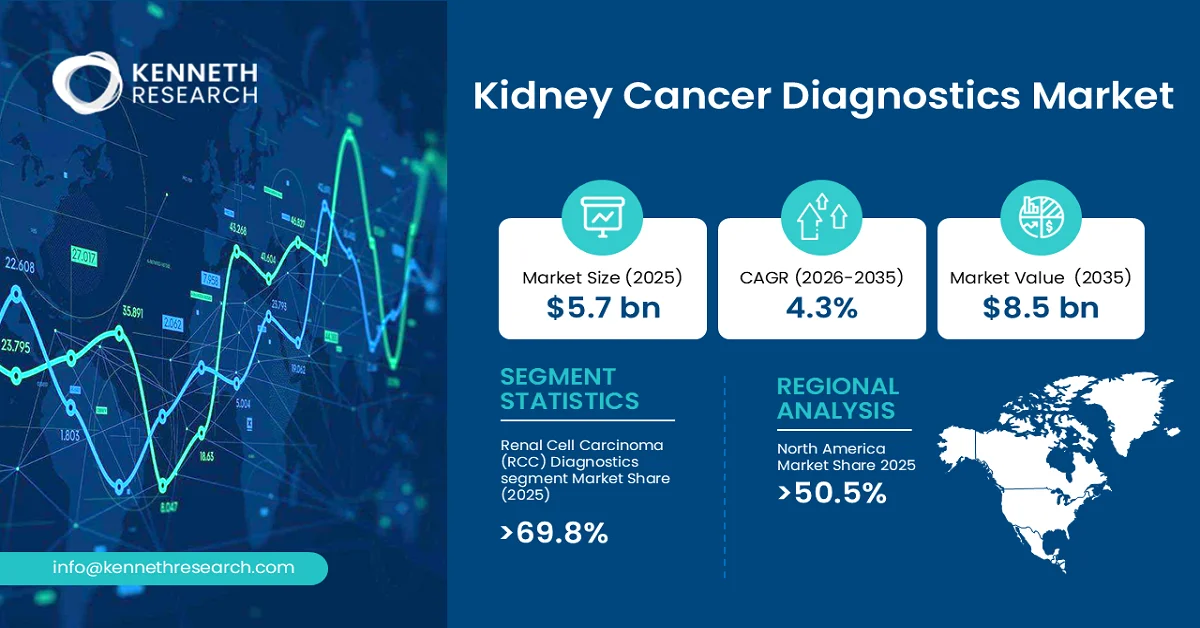
Kidney Cancer Diagnostics Market size was valued at USD 5.7 billion in 2025 and is projected to reach USD 8.5 billion by the end of 2035, rising at a CAGR of 4.3% during the forecast period, i.e., 2026–2035. In 2026, the industry size of kidney cancer diagnostics is estimated at USD 5.9 billion.
The primary growth driver for the kidney cancer diagnostics market is the increasing clinical emphasis on early detection supported by expanding utilization of advanced diagnostic imaging and standardized cancer surveillance programs. Government-backed cancer registries and screening initiatives continue to strengthen diagnostic infrastructure, improving timely identification, disease staging, and treatment planning for kidney cancer patients.
The kidney cancer diagnostics market comprises diagnostic products, technologies, and clinical services used to detect, classify, stage, and monitor malignant tumors originating in the kidneys. The market includes imaging-based diagnostics, laboratory diagnostics, molecular and biomarker testing, pathology solutions, biopsy-related diagnostics, and associated software platforms that support clinical decision-making across healthcare settings. These diagnostic approaches enable physicians to differentiate benign from malignant renal lesions, determine cancer subtype, evaluate disease progression, and guide personalized treatment strategies.
The market is characterized by continual advances in imaging resolution, molecular diagnostics, digital pathology, artificial intelligence-assisted image interpretation, and integrated diagnostic workflows that improve diagnostic accuracy and efficiency. Diagnostic solutions are widely utilized by hospitals, diagnostic laboratories, specialty cancer centers, and academic medical institutions for both initial diagnosis and ongoing patient management. From an industrial perspective, the kidney cancer diagnostics market plays an essential role within the broader oncology diagnostics ecosystem by supporting precision medicine, facilitating earlier intervention, improving clinical outcomes, and enabling evidence-based treatment selection.
Key Kidney Cancer Diagnostics Market Insights Summary:
Key Takeaways: Market Trends & Insights
- Kidney Cancer Diagnostics Market is projected to grow from USD 5.7 billion in 2025 to USD 8.5 billion by 2035, registering a 4.3% CAGR during 2026–2035
- Renal Cell Carcinoma Diagnostics dominated the cancer type segment with a 69.8% market share in 2025 due to its high clinical prevalence
- North America accounted for the largest regional share of 50.5% in 2025, supported by advanced diagnostic infrastructure and oncology care
- Imaging Diagnostics is projected to emerge as a key growth segment owing to increasing adoption of CT, MRI, and other advanced imaging technologies for kidney cancer detection
- Growing emphasis on precision oncology, molecular diagnostics, and early disease detection is expected to strengthen long-term market growth through 2035
Market Drivers
- Increasing adoption of artificial intelligence and digital pathology platforms in oncology diagnostics
- Growing investments in hospital diagnostic infrastructure and specialized cancer care centers
- Expansion of molecular diagnostics and liquid biopsy technologies
- Rising focus on early cancer detection and precision oncology initiatives
Challenges
- High capital investment and operational costs of advanced diagnostic technologies
- Complex regulatory approval and clinical validation requirements
Kidney Cancer Diagnostics Market Overview & Supply Chain
The adoption of kidney cancer diagnostics is increasing globally as healthcare systems prioritize earlier cancer detection, precision diagnostics, and evidence-based treatment planning. Continuous improvements in diagnostic imaging, molecular pathology, biomarker research, and digital pathology have enhanced the ability to identify renal malignancies at earlier stages and differentiate tumor subtypes more accurately. Governments are also strengthening national cancer control programs and expanding access to diagnostic infrastructure to improve patient outcomes.
The kidney cancer diagnostics market value chain begins with suppliers of laboratory reagents, antibodies, molecular assay components, imaging system hardware, contrast agents, pathology consumables, specialized software, and precision medical devices. These inputs are integrated by manufacturers producing diagnostic imaging equipment, in vitro diagnostic kits, molecular testing platforms, pathology instruments, biopsy devices, and digital diagnostic solutions under stringent quality and regulatory standards. Following production, products are distributed through medical device distributors, diagnostic equipment suppliers, laboratory service providers, and direct manufacturer networks that supply hospitals, cancer centers, diagnostic laboratories, and specialty clinics. Healthcare providers utilize these technologies to perform disease detection, tumor classification, staging, treatment selection, and patient monitoring. The principal stakeholders across the value chain include raw material suppliers, diagnostic equipment manufacturers, biotechnology companies, pathology laboratories, healthcare institutions, regulatory authorities, reimbursement agencies, research organizations, oncology specialists, radiologists, pathologists, and patients, all contributing to the continuous advancement and commercialization of kidney cancer diagnostic solutions.
Kidney Cancer Diagnostics Market: Growth Drivers & Challenges
Growth Drivers:
- Increasing Adoption of Advanced Diagnostic Imaging Technologies: The growing adoption of advanced diagnostic imaging technologies is a major driver of the kidney cancer diagnostics market. Modern imaging modalities, including multiphase computed tomography (CT), magnetic resonance imaging (MRI), and contrast-enhanced ultrasound, enable clinicians to detect renal masses with greater precision, improve tumor characterization, and support accurate disease staging before treatment. These technologies reduce diagnostic uncertainty and facilitate personalized therapeutic planning, thereby improving clinical outcomes. Continuous investments by healthcare providers in imaging infrastructure and digital diagnostic workflows are further expanding access to high-quality cancer diagnostics. Looking ahead, the integration of artificial intelligence, image analytics, and standardized diagnostic protocols is expected to enhance workflow efficiency, improve diagnostic consistency, and strengthen the role of imaging in precision oncology.
- Expanding Precision Oncology and Biomarker-Based Diagnostics: The increasing adoption of precision oncology is significantly strengthening demand for kidney cancer diagnostic solutions. Healthcare providers are incorporating molecular diagnostics, genomic profiling, immunohistochemistry, and biomarker-based testing to better classify renal tumors and support individualized treatment decisions. These diagnostic approaches enable clinicians to identify tumor-specific characteristics that guide targeted therapies and improve patient management throughout the care pathway. Simultaneously, ongoing research into novel biomarkers and companion diagnostics is expanding the clinical utility of diagnostic platforms while encouraging collaboration between diagnostic manufacturers, biotechnology companies, and healthcare institutions. As personalized medicine becomes more deeply integrated into routine oncology practice, diagnostic technologies capable of delivering rapid, accurate, and clinically actionable information are expected to experience sustained adoption, reinforcing innovation and long-term growth across the kidney cancer diagnostics market.
Challenges:
- High Capital Investment and Operational Costs of Advanced Diagnostic Technologies: The widespread adoption of advanced kidney cancer diagnostic technologies is constrained by the substantial capital investment required for sophisticated imaging systems, molecular diagnostic platforms, digital pathology infrastructure, and laboratory automation. Beyond equipment acquisition, healthcare providers must allocate significant resources toward installation, maintenance, software upgrades, quality assurance, and workforce training. These financial barriers are particularly pronounced for smaller hospitals, community healthcare facilities, and laboratories operating under constrained budgets. As a result, access to advanced diagnostic capabilities remains uneven, limiting the commercialization potential of premium diagnostic solutions in cost-sensitive markets. Manufacturers also face extended sales cycles and procurement challenges as healthcare institutions prioritize capital expenditures. Looking ahead, technological innovation focused on cost-efficient diagnostic platforms, cloud-enabled workflows, and scalable laboratory solutions is expected to improve affordability and support broader market penetration.
- Complex Regulatory Approval and Clinical Validation Requirements: The kidney cancer diagnostics market faces significant challenges due to increasingly rigorous regulatory approval processes and extensive clinical validation requirements for new diagnostic technologies. Manufacturers must demonstrate analytical accuracy, clinical performance, safety, reproducibility, and compliance with evolving regulatory standards before commercialization. These requirements often involve lengthy clinical studies, comprehensive documentation, and continuous post-market surveillance, increasing development costs and extending product launch timelines. Regulatory differences across international markets further complicate global commercialization strategies, requiring region-specific approvals and compliance frameworks. Delayed product introductions may reduce competitive advantage and slow the adoption of innovative diagnostic technologies by healthcare providers. In the coming years, companies investing in robust clinical evidence generation, harmonized regulatory strategies, and proactive quality management systems are expected to improve market access while strengthening long-term commercial competitiveness.
Kidney Cancer Diagnostics Market Size and Forecast:
| Report Attribute | Details |
|---|---|
| Base Year |
2025 |
| Forecast Year |
2026-2035 |
| CAGR |
4.3% |
| Base Year Market Size (2025) |
USD 5.7 billion |
| Forecast Year Market Size (2035) |
USD 8.5 billion |
| Regional Scope |
|
Kidney Cancer Diagnostics Market Segmentation Analysis:
Cancer Type Segment Analysis
In the cancer type segment, the renal cell carcinoma diagnostics sub-segment is anticipated to capture the largest market share of 69.8% by the end of 2025.
The renal cell carcinoma (RCC) diagnostics sub-segment dominates the kidney cancer diagnostics market because RCC represents the predominant form of kidney malignancy requiring comprehensive diagnostic evaluation across screening, diagnosis, staging, treatment planning, and disease monitoring. Increasing clinical emphasis on early diagnosis has accelerated the adoption of advanced imaging modalities, histopathology, immunohistochemistry, molecular testing, and biomarker-based diagnostics specifically designed for RCC assessment. Healthcare providers are integrating multimodal diagnostic workflows to improve diagnostic accuracy, support personalized treatment decisions, and monitor therapeutic response more effectively. On the supply side, continuous innovation in imaging technologies, pathology platforms, molecular diagnostic assays, and artificial intelligence-assisted diagnostic solutions has strengthened product availability and expanded clinical applications. Manufacturers are also investing in companion diagnostics and precision oncology platforms that address the evolving needs of RCC management. According to the U.S. National Cancer Institute's SEER Program, approximately 66% of kidney and renal pelvis cancers are diagnosed at the localized stage, where timely diagnostic evaluation is critical for favorable clinical outcomes. Looking ahead, continued advances in precision diagnostics, digital pathology, and integrated oncology workflows are expected to further reinforce the leadership of the RCC diagnostics segment.
Modality Segment Analysis
The imaging diagnostics is projected to grow as the second-largest segment in the kidney cancer diagnostics market due to four converging demand drivers.
The imaging diagnostics segment is projected to witness strong growth as it remains the cornerstone of kidney cancer detection, characterization, staging, and treatment planning. Computed tomography (CT), magnetic resonance imaging (MRI), ultrasound, and contrast-enhanced imaging techniques enable clinicians to accurately evaluate renal masses, assess tumor extent, and identify metastatic disease, making imaging indispensable throughout the patient care continuum. Healthcare providers are increasingly integrating advanced imaging technologies with artificial intelligence-assisted image analysis and standardized diagnostic protocols to improve diagnostic accuracy while reducing interpretation variability. On the supply side, manufacturers continue to develop high-resolution imaging systems, advanced software platforms, and contrast agents that enhance clinical performance and workflow efficiency. According to the U.S. National Cancer Institute (NCI), CT is widely used in cancer care to diagnose tumors, determine cancer stage, guide biopsy procedures, plan surgery or radiation therapy, evaluate treatment response, and detect disease recurrence, underscoring its critical role in oncology diagnostics. Looking ahead, continued innovation in multimodal imaging and AI-enabled diagnostics is expected to further accelerate the adoption of imaging diagnostics in kidney cancer management.
Our in-depth analysis of the global kidney cancer diagnostics market includes the following segments:
|
Segment |
Sub-segment |
|
Modality |
|
|
Cancer Type |
|
Kidney Cancer Diagnostics Market Regional Insights:
North America Market Trends & Insights:
North America kidney cancer diagnostics market is projected to hold the largest revenue share of 50.5% by the end of 2025.
North America accounted for 50.5% of the kidney cancer diagnostics market in 2025, making it the leading regional market. Its dominance is supported by advanced healthcare infrastructure, widespread adoption of high-precision diagnostic technologies, strong reimbursement frameworks, and continuous investments in oncology research and clinical diagnostics. The region benefits from well-established cancer screening and surveillance systems, extensive availability of imaging modalities, molecular diagnostics, and specialized pathology services that facilitate timely diagnosis and disease management. Regulatory oversight from agencies such as the U.S. Food and Drug Administration (FDA) and Health Canada has also encouraged the commercialization of innovative diagnostic technologies while maintaining high standards for safety and clinical performance.
The United States serves as the principal growth engine within the region due to its extensive network of tertiary hospitals, academic medical centers, specialized cancer institutes, and diagnostic laboratories that increasingly integrate molecular diagnostics, digital pathology, and artificial intelligence into oncology workflows. Continuous investments in precision medicine and diagnostic innovation further strengthen the country's competitive position.
Canada complements regional growth through its publicly funded healthcare system, expanding access to diagnostic imaging services, and sustained investments in cancer control initiatives. The country's emphasis on improving diagnostic capacity, supporting early disease detection, and enhancing access to specialized oncology care continues to reinforce North America's position as the leading regional market for kidney cancer diagnostics.
Europe Market Trends & Insights:
Europe is emerging as a significant region for the kidney cancer diagnostics market, supported by increasing demand for early cancer detection, expanding adoption of advanced diagnostic technologies, and continuous modernization of healthcare infrastructure. The region is witnessing greater utilization of high-resolution imaging systems, molecular diagnostics, digital pathology, and precision oncology solutions as healthcare providers strive to improve diagnostic accuracy and patient outcomes. Government-backed cancer control strategies, investments in research and innovation, and collaborative initiatives across healthcare systems are fostering the integration of advanced diagnostic workflows into routine clinical practice. In addition, the growing emphasis on personalized medicine, cross-border healthcare collaboration, and digital health transformation is creating favorable opportunities for diagnostic manufacturers. Continuous improvements in laboratory capabilities and the adoption of artificial intelligence-assisted diagnostics are expected to further strengthen the region's long-term growth potential.
Germany represents the leading contributor within the European market due to its highly developed healthcare infrastructure, extensive network of university hospitals, specialized oncology centers, and strong focus on clinical research. The country's investments in advanced imaging technologies, molecular diagnostics, and precision medicine continue to support innovation and the adoption of sophisticated kidney cancer diagnostic solutions.
United Kingdom complements regional growth through its well-established public healthcare system, national cancer strategies, and increasing investment in diagnostic capacity. Ongoing initiatives to improve early cancer diagnosis, expand access to advanced imaging and laboratory services, and accelerate the adoption of innovative diagnostic technologies are expected to reinforce the country's contribution to the kidney cancer diagnostics market over the forecast period.
Leading Companies Operating in the Global Kidney Cancer Diagnostics Market:
Here is a list of upstream, downstream, and key players operating in the global kidney cancer diagnostics market competitive ecosystem:
- F. Hoffmann-La Roche Ltd (Switzerland)
- Company Overview
- Business Strategy
- Key Product Offerings
- Financial Performance
- Key Performance Indicators
- Risk Analysis
- Recent Development
- Siemens Healthineers AG (Germany)
- Qiagen N.V. (Netherlands)
- Myriad Genetics, Inc. (United States)
- NeoGenomics Laboratories (United States)
- NanoString Technologies (United States)
Recent Developments
- In 2025, researchers at the Kidney Cancer Research Summit presented findings on FGD1 splice variant (FGD1-SV) as a novel liquid biopsy biomarker for ccRCC, demonstrating that FGD1-SV detection in patient plasma correlates with poorer clinical outcomes and increased risk of brain and bone metastasis, suggesting potential for personalized surveillance and staging strategies.
- In February 2025, Telix Pharmaceuticals announced that the U.S. FDA accepted its Biologics License Application (BLA) for TLX250-CDx (Zircaix®), a novel PET imaging agent for kidney cancer, and granted Priority Review with a PDUFA date of August 27, 2025. If approved, it would become the first commercially available imaging agent to non-invasively diagnose clear cell renal cell carcinoma (ccRCC), with Phase 3 ZIRCON study data showing 86% sensitivity and 87% specificity.
Frequently Asked Question
In 2025, the kidney cancer diagnostics market market exceeded USD 5.7 billion.
The kidney cancer diagnostics market market is projected to reach USD 8.5 billion by the end of 2035, expanding at a CAGR of 4.3% over the forecast period (2026–2035).
The major players in the market are F. Hoffmann-La Roche Ltd (Switzerland), Siemens Healthineers AG (Germany), Qiagen N.V. (Netherlands), Myriad Genetics, Inc. (United States), NeoGenomics Laboratories (United States), NanoString Technologies (United States), and others.
In the Cancer Type segment, the Renal Cell Carcinoma Diagnostics sub-segment is anticipated to capture the largest market share of 69.8% in the future and exhibit lucrative growth opportunities during 2026–2035. This growth trajectory is largely attributed to increasing adoption of advanced imaging technologies, molecular diagnostics, and precision oncology approaches that enable earlier detection and more accurate disease characterization.
North America is projected to hold the largest market share of 50.5% by the end of 2025 and provide more business opportunities in the future. Continuous investments in advanced diagnostic imaging, precision oncology, and cancer research across the United States and Canada are fostering the region's dominance.
Why Choose Kenneth Research ?
-
Insight with Impact : We don’t just gather data — we uncover stories, trends, and opportunities that fuel business growth.
-
Experts Who Get It : Our team speaks your industry’s language and knows what really matters to your customers and market.
-
Custom-Built for You : Forget one-size-fits-all. We craft research and consulting solutions as unique as your business vision.
-
Partners, Not Just Providers : We work with you, not for you — collaborating closely to turn insights into smart, strategic moves.
-
Results That Speak : Our work powers brands, startups, and industry leaders alike — with a track record of ideas that work in the real world.
Report ID: 1034 |
Published Date: 28 Sep 2026 |
Report Format: |
Delivery Timeline: 48-72 Business Hours

Copyright © 2025 Kenneth Research. All rights reserved. Terms of Use | Privacy Policy
