Report ID: 1444 |
Published Date: 29 Sep 2026 |
Report Format: |
Delivery Timeline: 48-72 Business Hours
Irrigation Automation Market Outlook:
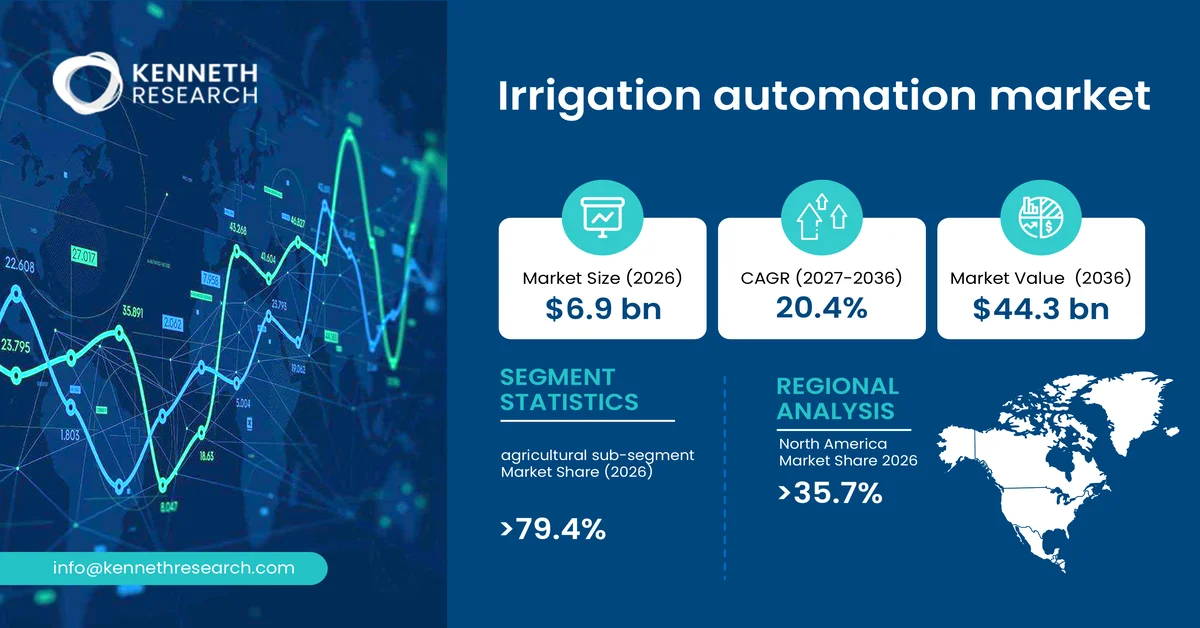
Irrigation automation market size was valued at USD 6.9 billion in 2026 and is projected to reach USD 44.3 billion by the end of 2036, rising at a CAGR of 20.4% during the forecast period, i.e., 2027–2036. In 2027, the industry size of the irrigation automation market is estimated at USD 8.3 billion.
A primary growth driver is the need to improve agricultural water management as irrigation places sustained pressure on water resources. Canada’s government reports that agriculture uses water predominantly for irrigation, highlighting the importance of efficient delivery and management. Automation enables sensor-based scheduling, remote control, and responsive application decisions across farms.
The irrigation automation market comprises technologies, equipment, software, and control systems that automate the monitoring, scheduling, distribution, and regulation of irrigation water. These solutions integrate field-level information with automated controls to determine when, where, and how much water should be applied, reducing dependence on manual intervention.
Key characteristics include the use of sensors, controllers, communication networks, remote-monitoring interfaces, automated valves, pumps, and decision-support systems. Depending on the application, automation can respond to soil moisture, crop conditions, weather information, evapotranspiration, or predefined irrigation schedules. Systems can be deployed across agricultural fields, greenhouses, nurseries, landscaping environments, and other managed growing areas.
Key Irrigation Automation Market Insights Summary:
Key Takeaways: Market Trends & Insights
- Irrigation automation market reached USD 6.9 billion in 2026 and is projected to reach USD 44.3 billion by 2036
- Irrigation automation market is expected to expand at a CAGR of 20.4% during 2027–2036
- Agricultural applications represented the leading segment with a 79.4% market share in 2026
- Drip irrigation is identified as the second and fastest-growing analysis segment, supported by increasing demand for precise and water-efficient irrigation
- North America led the market with a 35.7% market share in 2026, with the United States and Canada serving as key regional markets
Market Drivers
- Rising adoption of sensor-based and connected irrigation
- Increasing need for precision water management
- Expansion of digital agriculture and remote farm-management technologies
- Growing integration of automated irrigation with precision farming systems
Challenges
- High integration complexity across legacy irrigation infrastructure
- Uncertain return on investment for technology-intensive deployments
Irrigation Automation Market Overview & Supply Chain
Adoption of the irrigation automation market is increasing as agricultural producers seek greater control over water application, labor requirements, and field-level variability. Digital controllers, sensors, remote monitoring, variable-rate systems, and automated valves are strengthening the connection between irrigation infrastructure and precision agriculture. This technological transition is particularly relevant where drought, groundwater constraints, and variable rainfall increase the operational importance of precise irrigation management. USDA research identifies automation, soil-moisture monitoring, and precision irrigation as tools supporting more efficient agricultural water management.
The irrigation automation market value chain begins with raw-material and component suppliers providing plastics, metals, electronics, sensors, valves, pumps, controllers, communication modules, and power-management components. Equipment manufacturers then integrate these inputs into irrigation hardware, control units, sensing platforms, software, and connected management systems. System integrators and specialized irrigation engineering firms configure equipment according to crop, field, water-source, and infrastructure requirements. Distribution typically occurs through agricultural-equipment dealers, irrigation distributors, technology providers, and specialized channel partners, with installation and after-sales support forming an important service layer.
Irrigation Automation Market - Growth Drivers & Challenges
Growth Drivers
- Rising Adoption of Sensor-Based and Connected Irrigation: The growing integration of sensors, wireless connectivity, cloud platforms, and automated controls is accelerating adoption of the irrigation automation market. These technologies allow irrigation systems to move from fixed schedules toward data-driven decisions based on soil conditions, crop requirements, and field-level information. This improves operational responsiveness while reducing reliance on manual field inspection and intervention.
- Increasing Need for Precision Water Management: Growing pressure to manage water resources efficiently is encouraging agricultural operators to adopt technologies that can align irrigation more closely with crop demand. Automated irrigation systems can combine soil-moisture information, weather inputs, crop conditions, and irrigation equipment controls to improve the timing and location of water application. This capability is particularly relevant in regions facing drought variability, declining water availability, or competing demands for agricultural water.
Challenges
- High integration complexity across legacy irrigation infrastructure: The root cause is the fragmented nature of existing irrigation systems, where pumps, valves, sensors, controllers, connectivity networks, and farm-management platforms may not operate as an integrated architecture. This raises installation and commissioning complexity, particularly when automation must be retrofitted rather than designed into new systems. The commercial impact is longer deployment cycles, greater engineering requirements, and hesitation among operators concerned about disrupting ongoing irrigations.
- Uncertain return on investment for technology-intensive deployments: The root cause is that automation benefits depend heavily on farm conditions, system design, crop requirements, and the quality of supporting data. This makes business cases difficult to standardize. Consequently, suppliers face longer sales cycles and customers may defer upgrades when benefits are difficult to validate before deployment.
Irrigation Automation Market Size and Forecast:
| Report Attribute | Details |
|---|---|
| Base Year |
2026 |
| Forecast Year |
2027-2036 |
| CAGR |
20.4% |
| Base Year Market Size (2026) |
USD 6.9 billion |
| Forecast Year Market Size (2036) |
USD 44.3 billion |
| Regional Scope |
|
Irrigation Automation Market - Segment Analysis
Application Segment Analysis
In the application segment, agricultural sub-segment is anticipated to capture the largest market share of 79.4% by the end of 2026.
The agricultural application segment dominates because irrigation automation directly addresses the operational requirements of crop production, where precise water delivery, scheduling, and resource management are critical to maintaining yields under variable weather and water availability. Demand is reinforced by the large installed base of irrigated farmland and the need to improve application efficiency without compromising crop productivity. USDA data reported 54.9 million acres of irrigated agricultural land in the United States in 2022, demonstrating the substantial agricultural footprint requiring irrigation infrastructure and creating a broad addressable base for automation technologies. Adoption is increasingly moving toward pressurized and digitally managed irrigation as producers seek better control over water application and operating processes. On the supply side, technology providers can integrate sensors, controllers, pumps, valves, and monitoring platforms into increasingly connected farm-management systems.
Irrigation Segment Insights
The drip irrigation is projected to grow as the second-largest segment in the irrigation automation market due to four converging demand drivers.
Drip irrigation is projected to grow rapidly as agricultural producers increasingly prioritize precise water delivery, lower losses, and automation-compatible irrigation infrastructure. Demand is supported by the suitability of drip systems for targeted application, particularly where water availability is constrained and crops require controlled root-zone delivery. According to the U.S. Department of Agriculture’s 2023 Farm and Ranch Irrigation Survey, drip, trickle, and low-flow micro irrigation covered 6.4 million irrigated acres in open fields, demonstrating a substantial installed base for technologies that can be enhanced through automated control. Adoption is moving toward systems that combine low-flow distribution with sensors, programmable controllers, and remote monitoring, allowing irrigation schedules to respond more closely to field conditions. From the supply side, equipment manufacturers can integrate automation components directly with drip networks, while technology providers can add digital monitoring and control layers to existing installations.
Our in-depth analysis of the irrigation automation market includes the following segments:
|
Segment |
Sub-segment |
|
Automation |
|
|
Component |
|
|
Irrigation |
|
|
Application |
|
Irrigation Automation Market - Regional Analysis
North America Market Trends & Insights:
North America irrigation automation market is projected to hold the largest revenue share of 35.7% by the end of 2026.
It is supported by established irrigation infrastructure, large-scale commercial farming, and sustained investment in water-management technologies. The region’s leadership is reinforced by substantial irrigated agricultural activity and strong institutional attention to water efficiency.
The United States remains the principal regional market because of its extensive commercial agriculture sector, sophisticated irrigation infrastructure, and established adoption of mechanized farm technologies.
Canada provides an additional growth base, particularly across water-stressed agricultural areas. Agriculture and Agri-Food Canada notes that changing precipitation patterns are expected to increase reliance on irrigation, particularly across the Prairies and interior British Columbia, strengthening the case for automated water-management systems. Together, both markets provide a favorable environment for continued technology deployment, integration, and investment.
Asia Pacific Market Trends & Insights:
Asia Pacific is positioned for expanding demand for irrigation automation as agricultural producers face increasing pressure to improve water management, modernize farm operations, and integrate digital technologies into production systems. Industrial activity is increasingly centered on smart-farming platforms, precision irrigation, sensor-based monitoring, and connected control infrastructure.
China offers substantial commercial opportunities through its policy-driven smart-agriculture modernization agenda, particularly for suppliers of connected irrigation, farm-management, sensing, and automated control technologies.
India provides another important growth avenue as public programs increasingly link water-use efficiency with micro-irrigation and digital farming. Its irrigation modernization initiatives explicitly promote SCADA, IoT, pressurized networks, and micro-irrigation, creating opportunities for automation vendors, equipment manufacturers, and agricultural technology providers.
Irrigation Automation Market Competitive Landscape
Here is a list of upstream, downstream, and key players operating in irrigation automation market competitive ecosystem:
- Netafim Ltd. (Israel)
- Company Overview
- Business Strategy
- Key Product Offerings
- Financial Performance
- Key Performance Indicators
- Risk Analysis
- Recent Development
- Regional Presence
- SWOT Analysis
- Lindsay Corporation (United States)
- Valmont Industries, Inc. (United States)
- Jain Irrigation Systems Ltd. (India)
- Hunter Industries, Inc. (United States)
- The Toro Company (United States)
Recent Developments
- In January 2025, Lindsay Corporation completed the acquisition of a 49.9% minority interest in Pessl Instruments, a global provider of advanced agtech solutions.
The strategic investment strengthens Lindsay's position as a leading irrigation management and scheduling solution provider. Growers utilizing Lindsay's FieldNET™ and FieldNET Advisor™ platforms in conjunction with Pessl's METOS™ weather stations and soil moisture probes benefit from advanced agronomic solutions, enabling informed decisions that promote healthy crops and optimize water and fertilizer use. - In January 2025, Valmont® Industries, Inc. announced the consolidation of its four irrigation management platforms into a unified AgSense 365 app.
The company intends to merge AgSense®, Valley 365®, PrecisionKing, and PivoTrac® into a single next-evolution application. The consolidation represents over ten years of technological advancement and aims to reduce complexity for growers and dealers while positioning Valley for future technology advancements. AgSense 365 became publicly available in March 2025.
Frequently Asked Question
In 2026, the irrigation automation market exceeded USD 6.9 billion.
The irrigation automation market is projected to reach USD 44.3 billion by the end of 2036, expanding at a CAGR of 20.4% over the forecast period (2027-2036).
The major players in the market are Netafim Ltd., Lindsay Corporation, Valmont Industries, Inc., Jain Irrigation Systems Ltd., Hunter Industries, Inc., The Toro Company, and others.
In the application segment, the Agricultural sub-segment is anticipated to capture the largest market share of 79.4% in the future and exhibit lucrative growth opportunities during 2027-2036. This growth trajectory is largely attributed to increasing demand for precise water delivery and resource-efficient agricultural production.
North America is projected to hold the largest market share of 35.7% by the end of 2026 and provide more business opportunities in the future. Continuous investments in irrigation infrastructure, water-management technologies, and agricultural automation across the United States and Canada are fostering the region's dominance.
Why Choose Kenneth Research ?
-
Insight with Impact : We don’t just gather data — we uncover stories, trends, and opportunities that fuel business growth.
-
Experts Who Get It : Our team speaks your industry’s language and knows what really matters to your customers and market.
-
Custom-Built for You : Forget one-size-fits-all. We craft research and consulting solutions as unique as your business vision.
-
Partners, Not Just Providers : We work with you, not for you — collaborating closely to turn insights into smart, strategic moves.
-
Results That Speak : Our work powers brands, startups, and industry leaders alike — with a track record of ideas that work in the real world.
Report ID: 1444 |
Published Date: 29 Sep 2026 |
Report Format: |
Delivery Timeline: 48-72 Business Hours

Copyright © 2025 Kenneth Research. All rights reserved. Terms of Use | Privacy Policy
