Report ID: 1314 |
Published Date: 10 Sep 2026 |
Report Format: |
Delivery Timeline: 48-72 Business Hours
Interactive Display Market Outlook:
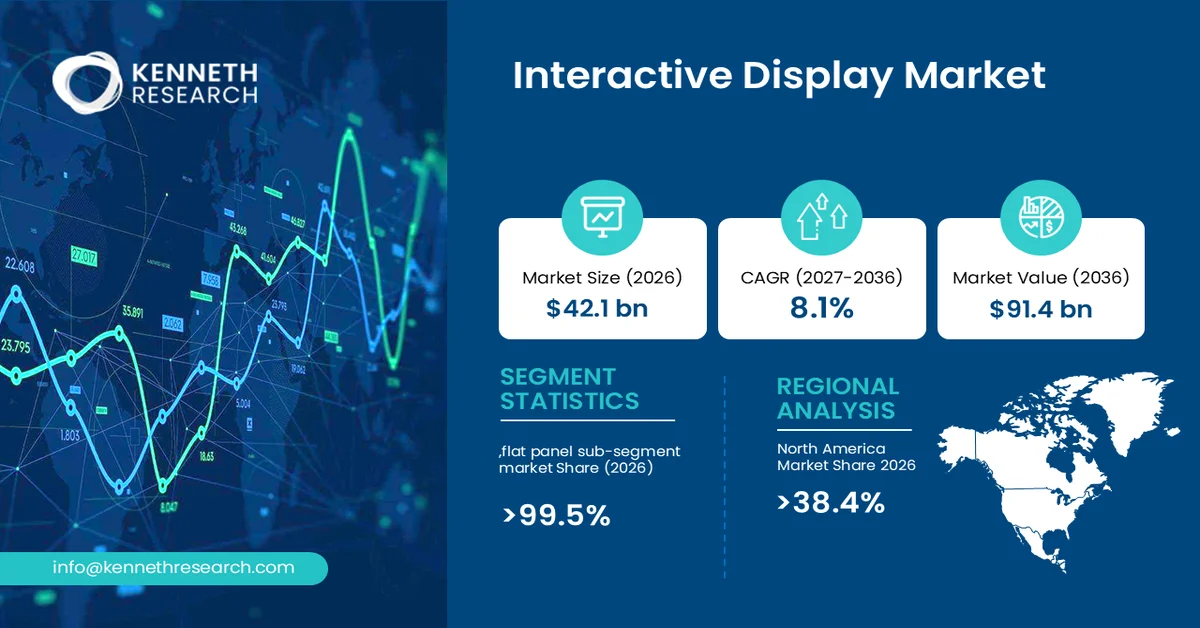
Interactive Display Market size was valued at USD 42.1 billion in 2026 and is projected to reach USD 91.4 billion by the end of 2036, rising at a CAGR of 8.1% during the forecast period, i.e., 2027–2036. In 2027, the industry size of the global interactive display is estimated at USD 45.3 billion.
The primary growth driver is the accelerating integration of digital technologies into education and workplace training.
Interactive display market refers to display systems that allow users to directly engage with digital content through touch, pen input, gestures, or other interactive interfaces. These systems combine visual presentation with interactive functionality, enabling users to access, manipulate, annotate, share, and navigate information directly on the display surface.
Key characteristics include large-format visual interfaces, touch or pen-based interaction, digital content presentation, connectivity with computing and collaboration platforms, and support for real-time participation. Interactive displays can be deployed as standalone systems or integrated into broader digital environments, making them adaptable to different operational requirements.
Key Interactive Display Market Insights Summary:
Key Takeaways: Market Trends & Insights
- Interactive Display Market reached USD 42.1 Billion in 2026
- Interactive Display Market is projected to reach USD 91.4 Billion by 2036 at a CAGR of 8.1% during 2027–2036
- Flat Panel dominated the Panel Type segment with a 99.5% market share in 2026
- North America led the market with a 38.4% market share in 2026
- LED-based Displays represent the fastest-growing technology segment, supported by advances in high-resolution visual systems and expanding institutional and commercial applications
Market Drivers
- Expansion of digital and technology-enabled education infrastructure
- Growth of connected collaboration and hybrid-work environments
- Increasing adoption of interactive technologies across healthcare and public-sector facilities
- Advancement of LED-based display technologies and high-resolution visual interfaces
Challenges
- Accessibility and compliance requirements
- Interoperability and ecosystem fragmentation
Interactive Display Market Overview & Supply Chain
Adoption of interactive display market solutions is increasing as organizations shift toward connected, digitally enabled environments that combine visual communication, collaboration, and real-time information access. The technology is relevant across corporate, education, public-sector, healthcare, and industrial settings because interactive displays can connect presentation, collaboration, and digital workflows within a shared interface. This transition is supported by broader enterprise digitization: Statistics Canada reported that 48% of Canadian businesses used cloud computing in 2023, demonstrating the expanding integration of connected digital infrastructure into business operations.
The interactive display market value chain begins with raw-material and component suppliers providing glass substrates, semiconductor components, display panels, touch-sensing layers, electronic circuits, metals, plastics, optical materials, and related inputs. Display and electronics manufacturers then integrate these components into finished interactive systems, combining display modules, touch interfaces, processing hardware, connectivity, speakers, software, and enclosure assemblies. Distribution typically involves original equipment manufacturers, system integrators, value-added resellers, distributors, and specialized technology channels that configure products for institutional and commercial requirements. End users include schools, universities, enterprises, healthcare organizations, government bodies, transportation facilities, retailers, and industrial operators.
Interactive Display Market: Growth Drivers & Challenges
Growth Drivers
- Digital transformation in education and institutional environments: The expansion of digitally enabled education and institutional environments is strengthening demand for interactive display market solutions. Interactive displays provide a shared interface for presenting multimedia content, annotating information, facilitating participation, and integrating connected teaching or collaboration tools. This makes them particularly relevant as educational institutions modernize classroom technology and seek more engaging, flexible learning environments.
- Integration of collaboration and connected workplace technologies: The increasing integration of collaboration software, cloud platforms, wireless connectivity, and hybrid-work infrastructure is creating additional demand for interactive display market solutions. Businesses increasingly require meeting environments that allow participants to share content, annotate documents, manage workflows, and communicate across physical and remote locations. Interactive displays can consolidate these functions into a common interface, reducing reliance on separate presentation and conferencing equipment.
Challenges
- Accessibility and compliance requirements: A major restraint is the increasing complexity of accessibility requirements for interactive technology deployed in public institutions and regulated environments. Interactive displays combine hardware, software, touch interfaces, embedded applications, and connected content, meaning non-compliance can originate from several components rather than the display panel alone. Government procurement guidance requires accessibility to be considered throughout the ICT acquisition lifecycle, including vendor evaluation, testing, and post-deployment validation.
- Interoperability and ecosystem fragmentation: Interoperability challenges can constrain adoption when interactive displays must operate across diverse operating systems, collaboration platforms, content formats, peripherals, and enterprise networks. The root cause is the fragmented technology ecosystem surrounding interactive displays, where hardware manufacturers, software developers, conferencing providers, and system integrators may use different interfaces and compatibility frameworks. For buyers, integration difficulties can create additional configuration work, technical support requirements, cybersecurity reviews, and dependence on specialist integrators.
Interactive Display Market Size and Forecast:
| Report Attribute | Details |
|---|---|
| Base Year |
2026 |
| Forecast Period |
2027-2036 |
| CAGR |
8.1% |
| Base Year Market Size (2026) |
USD 42.1 Billion |
| Forecast Year Market Size (2036) |
USD 91.4 Billion |
| Regional Scope |
|
Interactive Display Market Segmentation Analysis:
Panel Type Segment Analysis
In the panel type segment, flat panel sub-segment is anticipated to capture the largest market share of 99.5% by the end of 2026.
Flat Panel dominates the panel type segment because it provides the established hardware foundation for interactive classroom, meeting-room, training, and institutional applications. Demand is supported by the familiarity of flat-panel architectures, high-resolution visual presentation, integrated touch functionality, and compatibility with modern collaboration and content-management platforms. Adoption is also reinforced by the existing education technology ecosystem. From the supply side, manufacturers benefit from mature flat-panel production ecosystems, established component availability, standardized installation practices, and broad integrator expertise. These factors support competitive procurement and facilitate replacement of older classroom and workplace displays.
Technology Segment Analysis
The LED is projected to grow as the second-largest segment in the interactive display market due to four converging demand drivers.
LED-based displays are positioned for stronger growth within the technology segment as buyers increasingly prioritize high-brightness, energy-conscious, durable visual systems for education, corporate collaboration, retail, public information, control rooms, and large-format applications. LED architectures provide modular design flexibility, strong visibility, long operating potential, and suitability for installations where conventional display configurations may face size or brightness limitations. Government procurement policies are also reinforcing attention to display energy performance. The U.S. Department of Energy’s Federal Energy Management Program updated its acquisition guidance for displays and monitors in 2024 and requires federal agencies to purchase ENERGY STAR-certified or FEMP-designated products for covered categories, encouraging suppliers to emphasize energy efficiency in product design.
Our in-depth analysis of the interactive display market includes the following segments:
|
Segment |
Sub-segment |
|
Product |
|
|
Panel Size |
|
|
Panel Type |
|
|
Technology |
|
|
Vertical |
|
Interactive Display Market Regional Insights:
North America Market Trends & Insights:
North America interactive display market is projected to hold the largest revenue share of 38.4% by the end of 2026.
Regional leadership is supported by a mature technology ecosystem, strong enterprise digitization, established education technology infrastructure, and sustained investment in connected workplace and institutional systems. The region also benefits from established display manufacturing and distribution capabilities, sophisticated system integrators, and procurement environments that increasingly emphasize interoperability, accessibility, cybersecurity, and energy efficiency. Government-backed evidence reinforces the strength of the underlying digital environment: the U.S. Census Bureau reported that 68% of businesses adopted AI during 2021–2022, indicating substantial enterprise engagement with advanced digital technologies that can complement interactive display deployments.
In the United States, demand is supported by large enterprise, education, government, healthcare, and commercial technology deployments, alongside a broad supplier and integrator ecosystem.
Canada complements regional growth through expanding digital adoption among businesses and institutions. Together, the United States and Canada provide a favorable environment for continued investment, replacement cycles, software integration, and deployment of increasingly connected display systems.
Asia Pacific Market Trends & Insights:
Asia Pacific represents a strategically important secondary region for the interactive display market, supported by rapid digitalization across education, commercial facilities, public services, and enterprise environments. Demand is being encouraged by investments in connected classrooms, digital campuses, collaborative workplaces, and technology-enabled public infrastructure. Government initiatives are also strengthening the ecosystem.
In China, government-backed digital education programs are supporting wider adoption of smart classroom technologies and interactive learning environments, while the country’s extensive electronics manufacturing ecosystem provides advantages in component availability, product development, and system integration.
Japan is advancing education digitalization through its GIGA School initiatives, with the Ministry of Education, Culture, Sports, Science and Technology supporting ICT-enabled learning environments and further development of education data utilization. These initiatives create opportunities for interactive displays as institutions modernize classroom infrastructure and integrate devices, networks, digital content, and collaborative learning tools.
Leading Companies Operating in the Global Interactive Display Market:
Here is a list of upstream, downstream, and key players operating in the interactive display market competitive ecosystem:
- LG Display Co., Ltd. (South Korea)
- Company Overview
- Business Strategy
- Key Product Offerings
- Financial Performance
- Key Performance Indicators
- Risk Analysis
- Recent Development
- Regional Presence
- SWOT Analysis
- BOE Technology Group Co., Ltd. (China)
- Panasonic Corporation (Japan)
- ViewSonic Corporation (United States)
- Planar Systems, Inc. (United States)
Recent Developments
- In May 2026, LG Electronics launched its ultra-low-power "LG E-paper Display," a 32-inch QHD commercial display powered by electronic ink panel technology. The display consumes power only when updating content, features an ultra-low-power SoC and a high-capacity 72Wh battery, and weighs only 3.1 kilograms, making it suited for retail, hospitality, and corporate environments.
- In February 2025, Panasonic introduced a new range of professional LED displays at ISE 2025, featuring three all-in-one LED models available in 165, 137, and 110 inches with dual Intel SDM slots for seamless AVoIP integration. The company also expanded its interactive whiteboard lineup with the 75-inch 4K TH-75BQE1 and 65-inch Full HD TH-65BFE1 panels, supporting up to 10-point touch and digital whiteboard functionality for business and education.
Frequently Asked Question
In 2026, the interactive display market exceeded USD 42.1 Billion.
The interactive display market is projected to reach USD 91.4 Billion by the end of 2036, expanding at a CAGR of 8.1% over the forecast period (2027-2036).
The major players in the market are LG Display Co., Ltd., BOE Technology Group Co., Ltd., Panasonic Corporation, ViewSonic Corporation, Planar Systems, Inc., and others.
In the Panel Type segment, the Flat Panel sub-segment is anticipated to capture the largest market share of 99.5% in the future and exhibit lucrative growth opportunities during 2027-2036. This growth trajectory is largely attributed to increasing adoption across education, corporate collaboration, and institutional environments.
North America is projected to hold the largest market share of 38.4% by the end of 2036 and provide more business opportunities in the future. Continuous investments in connected workplace technologies, digital education infrastructure, and institutional technology modernization across the United States and Canada are fostering the region's dominance.
Why Choose Kenneth Research ?
-
Insight with Impact : We don’t just gather data — we uncover stories, trends, and opportunities that fuel business growth.
-
Experts Who Get It : Our team speaks your industry’s language and knows what really matters to your customers and market.
-
Custom-Built for You : Forget one-size-fits-all. We craft research and consulting solutions as unique as your business vision.
-
Partners, Not Just Providers : We work with you, not for you — collaborating closely to turn insights into smart, strategic moves.
-
Results That Speak : Our work powers brands, startups, and industry leaders alike — with a track record of ideas that work in the real world.
Report ID: 1314 |
Published Date: 10 Sep 2026 |
Report Format: |
Delivery Timeline: 48-72 Business Hours

Copyright © 2025 Kenneth Research. All rights reserved. Terms of Use | Privacy Policy
