Report ID: 1339 |
Published Date: 28 Sep 2026 |
Report Format: |
Delivery Timeline: 48-72 Business Hours
Inline Viscosity Sensor Market Outlook:
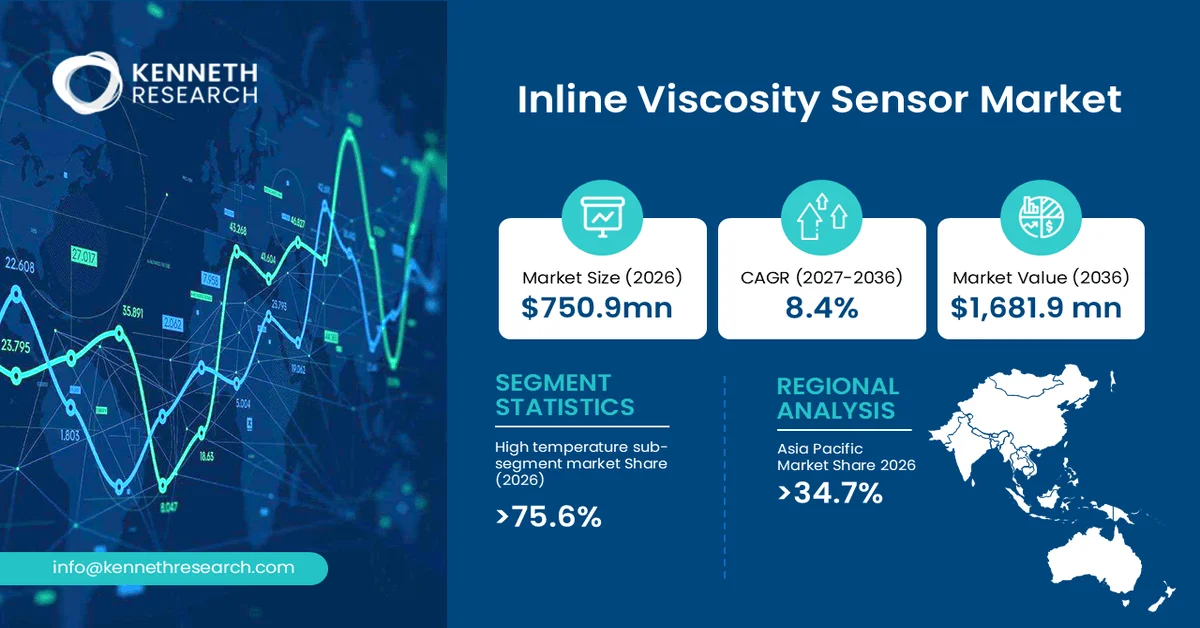
Inline Viscosity Sensor Market size was valued at USD 750.9 million in 2026 and is projected to reach USD 1,681.9 million by the end of 2036, rising at a CAGR of 8.4% during the forecast period, i.e., 2027-2036. In 2027, the industry size of the inline viscosity sensor is estimated at USD 813.8 million.
Growing demand for accurate, real-time fluid-property monitoring in industrial processes is driving adoption of inline viscosity sensors. NIST highlights the need for accurate viscosity characterization across varying temperatures, concentrations, and flow conditions, supporting sensor deployment where continuous measurement can strengthen process control, equipment operation, product consistency, and fluid-management decisions.
An inline viscosity sensor is an industrial measurement device installed directly within a fluid-processing line to determine a liquid’s resistance to flow continuously during operation. Unlike laboratory-based viscometers that require sample extraction, inline systems enable process operators to monitor viscosity without routinely interrupting production. Measurement technologies can use principles involving flow, pressure, vibration, acoustic response, or other physical interactions between the sensor and the process fluid.
Key characteristics include continuous or near-real-time measurement, compatibility with automated process-control systems, and the ability to operate under defined temperature, pressure, and flow conditions. Sensor selection depends on fluid properties, process configuration, measurement range, installation requirements, and the required level of measurement accuracy.
Key Inline Viscosity Sensor Market Insights Summary:
Key Takeaways: Market Trends & Insights
- The inline viscosity sensor market is valued at USD 750.9 million in 2026
- The market is projected to reach USD 1,681.9 million by 2036 at a CAGR of 8.4% during 2027-2036
- The high temperature segment leads the type category with a 75.6% market share in 2026
- Asia Pacific is the dominant regional market with a 34.7% market share in 2026
- Oil & Gas represents the second and fastest analysis segment within the End-Use Industry category
Market Drivers
- Expansion of real-time industrial sensing and process digitalization
- Increasing need for continuous process quality and equipment optimization
- Rising adoption of automated process-control and industrial IoT systems
- Growing demand for efficient fluid management across oil and gas, chemical, and manufacturing operations
Challenges
- Measurement accuracy under variable process conditions
- Integration complexity in brownfield industrial facilities
Inline Viscosity Sensor Market Overview & Supply Chain
Global adoption of inline viscosity sensors is increasing as manufacturers seek continuous, in-process measurement to improve process control, product consistency, equipment performance, and operational efficiency. The technology is particularly relevant to chemical processing, petroleum and energy operations, food and beverage production, pharmaceuticals, coatings, and other fluid-intensive industries where viscosity can change with temperature, composition, shear, and operating conditions. Increasing industrial digitalization is also strengthening demand for sensors capable of supplying real-time process data to automated control and monitoring systems.
The value chain of the inline viscosity sensor market begins with specialized raw-material and component suppliers providing metals, sensing elements, electronics, housings, seals, cabling, and communication components. Sensor manufacturers then integrate these inputs into measurement assemblies, combining sensing technology, signal conditioning, embedded electronics, firmware, calibration, and mechanical interfaces suitable for industrial installation. Manufacturing activities also include testing, calibration, quality assurance, and configuration for specific process environments. Distribution typically operates through direct sales, industrial instrumentation suppliers, automation distributors, system integrators, and specialized channel partners. End users include chemical manufacturers, refineries, oil and gas operators, pharmaceutical producers, food processors, coating manufacturers, and other process industries.
Inline Viscosity Sensor Market: Growth Drivers & Challenges
Growth Drivers:
- Expansion of real-time industrial sensing and process digitalization: The increasing integration of real-time sensing, automation, and digital process management is accelerating demand for inline viscosity measurement. Industrial operators increasingly require continuous fluid-property information rather than relying exclusively on periodic laboratory sampling, enabling faster process adjustments and more responsive quality management. Inline viscosity sensors can feed measurement data into supervisory control, distributed control, and analytics platforms, allowing viscosity changes to be assessed alongside temperature, pressure, flow, and composition.
- Increasing need for continuous process quality and equipment optimization: The need to maintain consistent fluid characteristics across demanding production environments is encouraging manufacturers to shift from intermittent sampling toward continuous measurement. Viscosity affects pumping requirements, mixing behavior, lubrication, coating performance, heat transfer, and formulation consistency, making timely detection of changes commercially important. Inline sensors can identify deviations while production is underway, enabling operators to adjust temperature, blending ratios, flow conditions, or other process parameters before quality problems become more extensive.
Challenges:
- Measurement accuracy under variable process conditions: A major restraint is maintaining reliable viscosity readings when process conditions change continuously. Viscosity is sensitive to temperature, flow behavior, pressure, fluid composition, entrained gases, and suspended particles, while non-Newtonian fluids can produce different apparent viscosity readings depending on shear conditions. Consequently, a sensor calibrated under controlled conditions may require application-specific validation before its readings can be confidently incorporated into process-control decisions. Installation geometry can also influence measurement representativeness, particularly where stagnant zones, uneven flow, or deposits occur.
- Integration complexity in brownfield industrial facilities: Integration with existing plant infrastructure can constrain deployment, particularly in facilities operating legacy automation, piping, and instrumentation architectures. Inline viscosity sensors must be mechanically compatible with process lines while also communicating effectively with PLCs, distributed control systems, supervisory platforms, and plant data infrastructure. Retrofitting can require process shutdowns, piping modifications, electrical work, software configuration, hazardous-area compliance checks, and coordination among instrumentation and automation teams.
Inline Viscosity Sensor Market Size and Forecast:
| Report Attribute | Details |
|---|---|
| Base Year |
2026 |
| Forecast Period |
2027-2036 |
| CAGR |
8.4% |
| Base Year Market Size (2026) |
USD 750.9 million |
| Forecast Year Market Size (2036) |
USD 1,681.9 million |
| Regional Scope |
|
Inline Viscosity Sensor Market - Segment Analysis
Type Segment Analysis
In the type segment, high temperature sub-segment is anticipated to capture the largest market share of 75.6% by the end of 2026.
The high-temperature segment dominates because viscosity measurement becomes particularly critical where fluids are processed under elevated thermal conditions that can materially alter flow behavior and product characteristics. Refineries, petrochemical facilities, chemical plants, metal processing operations, and other energy-intensive industries therefore require sensors capable of maintaining measurement reliability under demanding operating environments. The U.S. Department of Energy states that industrial process-heating applications span temperatures from 80°C to well above 1,000°C, covering applications such as petroleum refining, cement production, food processing, and automotive manufacturing.
End-User Segment Analysis
The oil & gas is projected to grow as the second-largest segment in the inline viscosity sensor market due to four converging demand drivers.
The oil & gas segment is positioned for continued growth as upstream, midstream, refining, and petrochemical operations require dependable monitoring of fluid properties under demanding operating conditions. Inline viscosity sensors can support crude characterization, blending control, lubricant monitoring, pipeline management, and refinery process optimization, reducing dependence on intermittent sampling. Demand is also supported by expanding gas and petrochemical activity in major Asian markets. On the supply side, sensor manufacturers are developing more robust instrumentation capable of handling temperature, pressure, contamination, and challenging process fluids while integrating with industrial automation systems. Going forward, the segment should benefit from greater process digitalization, tighter quality requirements, and increased emphasis on operational efficiency across complex oil and gas facilities.
Our in-depth analysis of the inline viscosity sensor market includes the following segments:
|
Segment |
Sub-segment |
|
Type |
|
|
End-User |
|
Inline Viscosity Sensor Market Regional Insights:
Asia Pacific Market Trends & Insights:
Asia Pacific inline viscosity sensor market is projected to hold the largest revenue share of 34.7% by the end of 2026.
Regional leadership is supported by the concentration of large-scale manufacturing, refining, petrochemical, chemical, food-processing, and industrial production activities across the region. These industries rely extensively on process instrumentation for monitoring fluid properties under demanding operating conditions.
China represents the region’s most important country market because of its extensive manufacturing base, refining capacity, chemical production, and expanding industrial automation ecosystem.
Japan contributes through its technologically advanced manufacturing sector, established process industries, and strong emphasis on precision instrumentation and production efficiency. Together, these markets create a substantial installed base for inline process-monitoring technologies. Future regional development is expected to remain closely linked to factory automation, process optimization, industrial digitalization, and investment in higher-performance instrumentation.
North America Market Trends & Insights:
North America represents a technologically mature market for inline process measurement, supported by extensive oil and gas, refining, chemicals, food processing, pharmaceuticals, and advanced manufacturing activity. Demand is strengthened by industrial operators seeking greater process visibility, automation, energy efficiency, and integration of measurement data into plant-control systems.
The United States is the principal country market, benefiting from its diversified process industries, established automation ecosystem, and significant investment in advanced manufacturing technologies.
Canada provides complementary opportunities through its energy, mining, chemicals, and manufacturing industries. Its regulatory modernization is particularly relevant to process monitoring: recent offshore oil and gas frameworks emphasize safer operations, environmental protection, resource management, and modern best practices. Together, the two countries offer opportunities for suppliers providing ruggedized, interoperable sensors supported by engineering, integration, and lifecycle services.
Leading Companies Operating in the Global Inline Viscosity Sensor Market:
Here is a list of upstream, downstream, and key players operating in the inline viscosity sensor market competitive ecosystem:
- Brookfield (AMETEK Inc.) (United States)
- Company Overview
- Business Strategy
- Key Product Offerings
- Financial Performance
- Key Performance Indicators
- Risk Analysis
- Recent Development
- Regional Presence
- SWOT Analysis
- Hydramotion Ltd. (United Kingdom)
- Sofraser S.A.S. (France)
- Cambridge Viscosity (PAC) (United States)
Recent Developments
- In May 2026, AMETEK Brookfield promoted its FAST In-Line Viscometer for continuous real-time viscosity monitoring in high-speed production lines. The rugged sensor features high-frequency micro-rotational technology with no moving parts, is unaffected by vibration, and operates at process temperatures up to 120°C. It supports vertical or horizontal installation and multi-station control for applications including printing inks, paints, coatings, adhesives, food processing, and industrial process control.
- In November 2025, Hydramotion launched the ViscoMelt inline polymer melt-flow sensor for plastics recycling, including PET applications. The plug-and-play unit uses the company's patented Scorpion sensor technology to deliver lab-level viscoelastic insights directly on the production line, relating to melt-flow index, intrinsic viscosity, and molecular weight. The compact, solid-state design has no moving parts, enabling easy maintenance and real-time quality control—particularly valuable for variable recycled feedstocks.
Frequently Asked Question
In 2026, the inline viscosity sensor market exceeded USD 750.9 million.
The inline viscosity sensor market is projected to reach USD 1,681.9 million by the end of 2036, expanding at a CAGR of 8.4% cover the forecast period (2027-2036).
The major players in the market are Brookfield (AMETEK Inc.), Hydramotion Ltd., Sofraser S.A.S., Cambridge Viscosity (PAC), and others.
In the type segment, the high temperature sub-segment is anticipated to capture the largest market share of 75.6% in the future and exhibit lucrative growth opportunities during 2027-2036. This growth trajectory is largely attributed to increasing demand for reliable viscosity measurement in demanding high-temperature industrial processes.
Asia Pacific is projected to hold the largest market share of 34.7% by the end of 2026 and provide more business opportunities in the future. Continuous investments in manufacturing, refining, petrochemical production, industrial automation, and advanced process-control technologies across China and Japan are fostering the region's dominance.
Why Choose Kenneth Research ?
-
Insight with Impact : We don’t just gather data — we uncover stories, trends, and opportunities that fuel business growth.
-
Experts Who Get It : Our team speaks your industry’s language and knows what really matters to your customers and market.
-
Custom-Built for You : Forget one-size-fits-all. We craft research and consulting solutions as unique as your business vision.
-
Partners, Not Just Providers : We work with you, not for you — collaborating closely to turn insights into smart, strategic moves.
-
Results That Speak : Our work powers brands, startups, and industry leaders alike — with a track record of ideas that work in the real world.
Report ID: 1339 |
Published Date: 28 Sep 2026 |
Report Format: |
Delivery Timeline: 48-72 Business Hours

Copyright © 2025 Kenneth Research. All rights reserved. Terms of Use | Privacy Policy
