Report ID: 1109 |
Published Date: 19 Aug 2026 |
Report Format: |
Delivery Timeline: 48-72 Business Hours
Ink Resin Market Outlook:
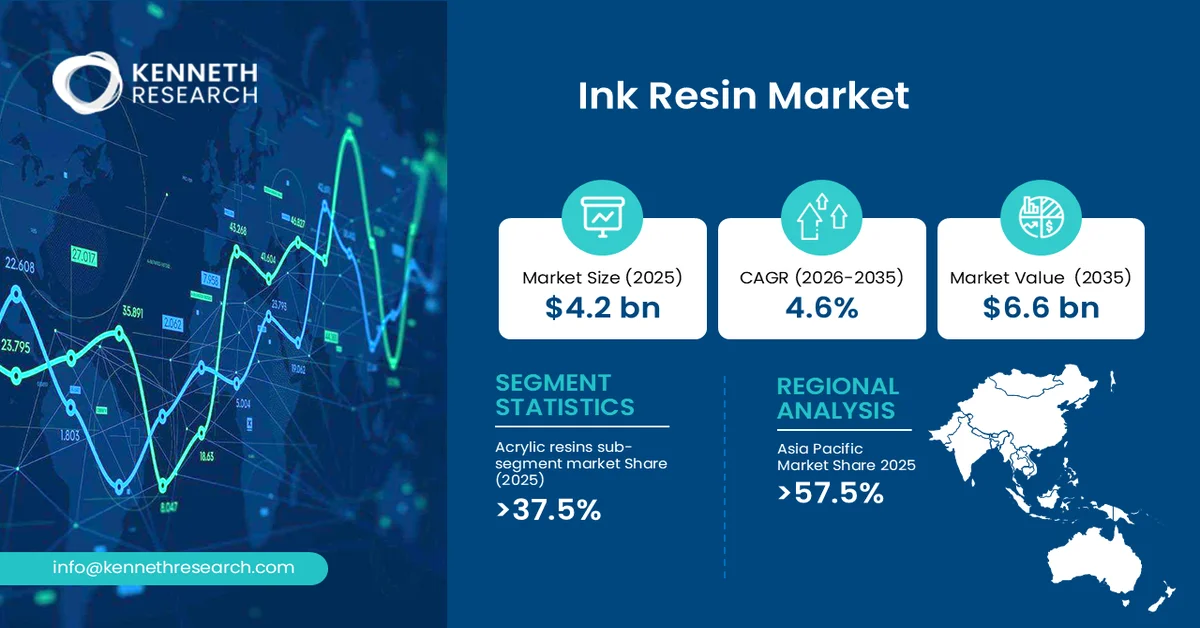
Ink Resin Market size was valued at USD 4.2 billion in 2025 and is projected to reach USD 6.6 billion by the end of 2035, rising at a CAGR of 4.6% during the forecast period, i.e., 2026-2035. In 2026, the industry size of the ink resin is estimated at USD 4.4 billion.
The primary growth driver for the ink resin market is rising demand for high-performance and sustainable printing solutions across packaging, publishing, and industrial applications. Increasing adoption of water-based and low-VOC ink technologies, supported by expanding packaged goods production and stricter environmental regulations, continues to accelerate demand for advanced ink resin formulations.
The ink resin market comprises polymeric binders used as the primary film-forming component in printing inks, providing adhesion, gloss, pigment dispersion, flexibility, chemical resistance, and durability across diverse substrates. Ink resins are formulated using materials such as acrylic, polyurethane, modified rosin, hydrocarbon, and alkyd chemistries to meet application-specific performance requirements in packaging, commercial printing, labels, textiles, and specialty graphics. Their compatibility with water-based, solvent-based, UV-curable, and other advanced ink technologies enables manufacturers to optimize print quality, drying characteristics, and substrate adhesion while complying with evolving environmental standards.
The market plays a critical role in the printing and packaging value chain by enabling high-quality graphics, product identification, branding, and regulatory labeling across consumer and industrial sectors. Growing demand for flexible packaging, digital printing, food-safe packaging materials, and environmentally compliant formulations has increased the importance of resin innovation. Manufacturers continue to develop high-performance resin systems that improve mechanical strength, color retention, abrasion resistance, and process efficiency, supporting the evolving requirements of packaging converters, commercial printers, and industrial end users.
Key Ink Resin Market Insights Summary:
Key Takeaways: Market Trends & Insights
- Ink Resin Market projected to grow from USD 4.2 billion in 2025 to USD 6.6 billion by 2035 at a 4.6% CAGR.
- Asia Pacific accounted for the largest regional share at 57.5% in 2025, supported by its strong packaging manufacturing base, integrated chemical supply chains, and expanding printing industry across Japan and China.
- Acrylic Resins represented the leading resin type segment with a 23.5% market share in 2025, driven by their superior adhesion, gloss retention, durability, and compatibility with water-based and specialty printing ink formulations.
- Water-based Ink technology is expected to witness robust growth over the forecast period owing to increasing environmental compliance requirements, rising adoption of sustainable packaging, and growing demand for low-emission printing solutions.
- The market is benefiting from continuous innovation in high-performance resin chemistries, increasing adoption of digital and sustainable printing technologies, and growing demand for premium packaging, labeling, and industrial printing applications.
Market Drivers
- Increasing demand for sustainable and recyclable packaging materials.
- Technological advancements in UV-curable and specialty resin formulations.
- Rising adoption of digital printing and customized packaging solutions.
- Growing demand for high-performance water-based and low-emission printing technologies.
Challenges
- Volatility in resin feedstock availability and raw material costs.
- Balancing sustainability requirements with high-performance printing demands.
Ink Resin Market Overview & Supply Chain
The global adoption of ink resins is increasing as packaging manufacturers, commercial printers, and industrial converters seek formulations that deliver superior adhesion, print quality, chemical resistance, and compliance with increasingly stringent environmental requirements. The transition toward water-based and other low-emission ink systems, combined with expanding demand for sustainable packaging, has accelerated resin innovation across the printing value chain. Regulatory emphasis on food-contact safety, recyclability, and circular economy objectives has further strengthened the importance of advanced resin technologies. According to Eurostat, 79.7 million tonnes of packaging waste were generated in the European Union in 2023, highlighting the scale of packaging production and the continued need for high-performance printing materials that support product identification, branding, and regulatory labeling across industries. This reinforces the strategic role of ink resins in modern packaging and printing applications.
The ink resin market value chain begins with the procurement of petrochemical- and bio-based feedstocks, including acrylic monomers, rosin derivatives, polyurethane intermediates, hydrocarbon resins, specialty additives, solvents, and performance modifiers supplied by chemical manufacturers. Resin producers formulate these raw materials into customized polymer systems designed to achieve targeted viscosity, adhesion, gloss, pigment dispersion, drying behavior, and resistance properties for specific printing technologies. Ink manufacturers subsequently blend the resins with pigments, waxes, additives, and other functional ingredients to produce finished printing inks tailored for packaging, publication, textile, label, and industrial printing applications. Distribution occurs through direct supply agreements, specialty chemical distributors, and regional formulation partners serving converters and printers worldwide. End users include packaging converters, commercial printing companies, label manufacturers, textile printers, publication houses, and industrial product manufacturers, while key stakeholders encompass raw material suppliers, resin manufacturers, ink formulators, equipment manufacturers, packaging companies, regulatory authorities, and brand owners collaborating to improve print performance, sustainability, and production efficiency.
Ink Resin Market: Growth Drivers & Challenges
Growth Drivers
- Rising transition toward sustainable water-based and low-emission printing technologies: Sustainability objectives across packaging and commercial printing are accelerating the adoption of advanced ink resin technologies that enable water-based and other low-emission ink formulations. Resin manufacturers are increasingly developing polymer systems with improved adhesion, pigment dispersion, abrasion resistance, and print durability while reducing dependence on conventional solvent-based chemistries. These innovations help printers comply with stricter environmental requirements without compromising production efficiency or print quality. The trend is also encouraging investments in next-generation acrylic and specialty resin platforms optimized for recyclable and paper-based packaging substrates. A notable example is DuPont's launch of its Artistri® PN1000 Series at drupa 2024, featuring low-viscosity water-based pigment inkjet inks for commercial printing and expanded water-based solutions for packaging applications, demonstrating continued industry investment in sustainable printing technologies. As regulatory expectations continue to evolve, demand for high-performance, environmentally compatible ink resins is expected to strengthen across packaging, labeling, and industrial printing.
- Expanding digital printing and high-performance packaging applications: The rapid evolution of digital printing technologies is creating new opportunities for specialized ink resin formulations capable of supporting higher print speeds, enhanced color consistency, and compatibility with diverse substrates. Brand owners increasingly require short production runs, variable data printing, premium graphics, and customized packaging, all of which depend on resin systems that deliver excellent adhesion, flexibility, chemical resistance, and fast curing characteristics. Advanced resin technologies also improve compatibility with flexible films, corrugated packaging, labels, and specialty materials, enabling converters to meet demanding customer specifications while maintaining operational efficiency. Continuous innovation in UV-curable, hybrid, and water-based resin chemistries is broadening the performance envelope of modern printing inks. As industrial automation and digital manufacturing continue expanding globally, resin suppliers are expected to focus on formulation versatility, process stability, and sustainable performance to support the next generation of printing applications.
Challenges:
- Volatility in resin feedstock availability and raw material costs: The ink resin industry remains highly sensitive to fluctuations in the availability and pricing of petrochemical- and bio-based feedstocks used to manufacture acrylic, polyurethane, hydrocarbon, rosin, and other specialty resin systems. Supply disruptions caused by refinery maintenance, geopolitical uncertainty, transportation constraints, or changing environmental regulations can rapidly affect production planning and procurement costs. Resin manufacturers often face compressed margins when cost increases cannot be immediately transferred to ink formulators or end users due to long-term supply agreements and competitive pricing pressures. This uncertainty also complicates product development, inventory management, and capacity planning. Looking ahead, companies are expected to diversify sourcing strategies, increase investment in alternative raw materials, and strengthen regional supply networks to reduce exposure to feedstock volatility while maintaining consistent product quality and supply reliability.
- Balancing sustainability requirements with high-performance printing demands: Manufacturers face increasing pressure to develop ink resins that satisfy evolving environmental regulations while delivering the mechanical and functional performance required for demanding printing applications. Customers expect excellent adhesion, gloss retention, abrasion resistance, chemical durability, fast curing, and compatibility with a wide range of substrates, yet achieving these characteristics with environmentally preferred formulations requires significant research, formulation expertise, and production investment. The transition to sustainable chemistries may also require reformulation of existing products, qualification with customers, and adjustments to manufacturing processes, extending commercialization timelines and increasing development costs. As regulatory expectations continue to evolve globally, companies that successfully combine sustainability with high-performance functionality will strengthen their competitive position, while slower innovators may encounter challenges in maintaining market relevance.
Ink Resin Market Size and Forecast:
| Report Attribute | Details |
|---|---|
| Base Year |
2025 |
| Forecast Year |
2026-2035 |
| CAGR |
4.6% |
| Base Year Market Size (2025) |
USD 4.2 billion |
| Forecast Year Market Size (2035) |
USD 6.6 billion |
| Regional Scope |
|
Ink Resin Market Segmentation Analysis:
Resin Type Segment Analysis
In the resin type segment, the acrylic resins sub-segment is anticipated to capture the largest market share of 23.5% by the end of 2025.
Acrylic resins dominate the ink resin market because they provide an optimal combination of adhesion, gloss retention, weatherability, pigment dispersion, and compatibility with multiple printing technologies. Their versatility allows ink manufacturers to formulate high-performance products for packaging, labels, commercial printing, flexible films, and specialty applications while meeting increasingly stringent environmental and performance requirements. Acrylic resin systems are particularly well suited for water-based formulations, supporting the industry's transition toward lower-emission printing solutions without compromising print quality or production efficiency. On the supply side, established manufacturing capabilities, broad raw material availability, and continuous innovation in acrylic polymer chemistry enable producers to offer customized formulations for diverse substrates and end-use requirements. Demand is further reinforced by the expanding packaging industry, which relies heavily on durable, high-quality printed graphics. According to Eurostat, paper and cardboard accounted for 40.3% of the European Union's total packaging waste generated in 2021, illustrating the extensive use of printed paper-based packaging that depends on high-performance ink systems incorporating acrylic resins. Looking ahead, continued innovation in sustainable resin technologies is expected to further strengthen the segment's leadership.
Technology Type Segment Analysis
The water-based ink segment is projected to witness strong growth as manufacturers, packaging converters, and brand owners increasingly prioritize environmentally responsible printing technologies without compromising print quality or operational efficiency. Water-based ink systems rely on specialized resin chemistries that provide excellent pigment dispersion, substrate adhesion, abrasion resistance, and drying performance while reducing dependence on conventional solvent-based formulations. Growing demand for paper-based packaging, food-contact applications, labels, and corrugated printing is accelerating the adoption of water-based technologies across commercial and industrial printing. From the supply perspective, resin producers continue to introduce advanced acrylic and hybrid polymer formulations that improve compatibility with high-speed flexographic and digital printing equipment. According to the U.S. Environmental Protection Agency (EPA), paper and paperboard products accounted for approximately 67.4 million tons of material generated in the United States in 2018, underscoring the extensive use of paper substrates that commonly utilize water-based printing technologies and continue to drive demand for compatible ink resin systems. Looking ahead, continued innovation in sustainable resin formulations and stricter environmental requirements are expected to further expand the adoption of water-based ink technologies.
Our in-depth analysis of the global ink resin market includes the following segments:
|
Segment |
Sub-segment |
|
Resin Type |
|
|
Technology |
|
|
Application |
|
|
Printing Process |
|
|
End User |
|
Ink Resin Market Regional Insights:
Asia Pacific Market Trends & Insights:
Asia Pacific accounted for 57.5% of the ink resin market in 2025, making it the dominant regional market due to its extensive manufacturing base, large-scale packaging production, expanding printing industry, and strong presence of resin and ink manufacturers.
The region benefits from integrated chemical supply chains, significant investments in flexible packaging, labels, consumer goods, and e-commerce packaging, all of which require high-performance printing inks formulated with advanced resin systems. Rapid industrialization, growing demand for packaged food, pharmaceuticals, and consumer products, together with supportive manufacturing policies and continuous capacity expansion, have strengthened regional competitiveness. The concentration of raw material suppliers, resin formulators, ink manufacturers, and packaging converters further enhances production efficiency and innovation, reinforcing Asia Pacific's leadership in the global ink resin value chain.
Among regional countries, Japan remains a major contributor through its advanced specialty chemical industry, high-quality printing technologies, and continuous innovation in sustainable packaging materials and functional resin formulations. According to the Japan Packaging Institute, the shipment value of packaging materials and containers reached ¥6,382 billion in 2024, reflecting the scale of packaging production that underpins demand for printing inks and resin technologies.
China complements regional growth with its extensive packaging manufacturing ecosystem, large printing industry, expanding e-commerce sector, and ongoing investments in environmentally compliant printing solutions. The country's integrated supply chain, broad manufacturing capacity, and increasing adoption of sustainable packaging continue to support robust demand for high-performance ink resins across commercial and industrial applications.
North America Market Trends & Insights:
North America represents a strategically important market for ink resins, supported by a mature packaging industry, advanced printing technologies, and continuous innovation in specialty chemicals. Demand is driven by the widespread use of printed packaging across food and beverage, pharmaceuticals, personal care, industrial products, and e-commerce logistics. Manufacturers are increasingly adopting high-performance resin systems that improve print durability, adhesion, chemical resistance, and compatibility with water-based, UV-curable, and digital ink technologies. Regulatory emphasis on environmental compliance and sustainable manufacturing is encouraging greater use of low-emission resin formulations, while investments in automation and digital printing equipment are creating opportunities for advanced ink chemistries. Collaboration between resin producers, ink formulators, packaging converters, and brand owners is accelerating product development aimed at enhancing print quality and supporting circular packaging objectives. As demand for customized, shorter-run, and high-value printing applications continues to expand, North America is expected to remain a key innovation hub for next-generation ink resin technologies.
The United States leads regional demand owing to its well-established chemical manufacturing sector, extensive packaging conversion capacity, and rapid adoption of digital and sustainable printing technologies across consumer and industrial markets. Continuous investment in research and development, coupled with the presence of major resin and ink manufacturers, supports the commercialization of advanced polymer formulations tailored to evolving packaging requirements.
Canada complements regional growth through its expanding sustainable packaging initiatives, modern commercial printing industry, and increasing adoption of environmentally responsible ink technologies. The country's emphasis on resource efficiency, recycling, and high-quality packaging production is encouraging greater use of innovative resin systems that meet both performance and regulatory expectations, strengthening North America's position in the global ink resin value chain.
Leading Companies Operating in the Global Ink Resin Market:
Here is a list of upstream, downstream, and key players operating in the global ink resin market competitive ecosystem:
- BASF SE(Germany)
- Company Overview
- Business Strategy
- Key Product Offerings
- Financial Performance
- Key Performance Indicators
- Risk Analysis
- Recent Development
- Regional Presence
- SWOT Analysis
- Lawter(United States)
- Eternal Materials Co., Ltd.(Taiwan)
- Hubergroup (UK)
Recent Developments
- May 2026: Hubergroup Print Solutions introduced the next generation of conventional offset inks featuring a newly developed resin technology designed to enhance print performance and sustainability.
- May 2024: DuPont Launched the Artistri® PN1000 Series of low-viscosity water-based pigment inkjet inks and expanded its water-based printing portfolio during drupa 2024.
Frequently Asked Question
In 2025, the ink resin market exceeded USD 4.2 billion.
The ink resin market is projected to reach USD 6.6 billion by the end of 2035, expanding at a CAGR of 4.6% over the forecast period (2026-2035).
The major players in the market are BASF SE, Lawter, Covestro AG, DIC Corporation, allnex, Eternal Materials Co., Ltd., Synthomer plc, Indulor Chemie GmbH, and others.
In the resin type segment, the acrylic resins sub-segment is anticipated to capture the largest market share of 23.5% in the future and exhibit lucrative growth opportunities during 2026-2035. This growth trajectory is largely attributed to increasing demand for sustainable water-based printing formulations and their excellent adhesion, durability, and compatibility across diverse printing applications.
Asia Pacific is projected to hold the largest market share of 57.5% by the end of 2025 and provide more business opportunities in the future. Continuous investments in advanced printing technologies, packaging manufacturing, and specialty resin production across Japan and China are fostering the region's dominance.
Why Choose Kenneth Research ?
-
Insight with Impact : We don’t just gather data — we uncover stories, trends, and opportunities that fuel business growth.
-
Experts Who Get It : Our team speaks your industry’s language and knows what really matters to your customers and market.
-
Custom-Built for You : Forget one-size-fits-all. We craft research and consulting solutions as unique as your business vision.
-
Partners, Not Just Providers : We work with you, not for you — collaborating closely to turn insights into smart, strategic moves.
-
Results That Speak : Our work powers brands, startups, and industry leaders alike — with a track record of ideas that work in the real world.
Report ID: 1109 |
Published Date: 19 Aug 2026 |
Report Format: |
Delivery Timeline: 48-72 Business Hours

Copyright © 2025 Kenneth Research. All rights reserved. Terms of Use | Privacy Policy
