Report ID: 1295 |
Published Date: 01 Sep 2026 |
Report Format: |
Delivery Timeline: 48-72 Business Hours
Industrial Wax Market Outlook:
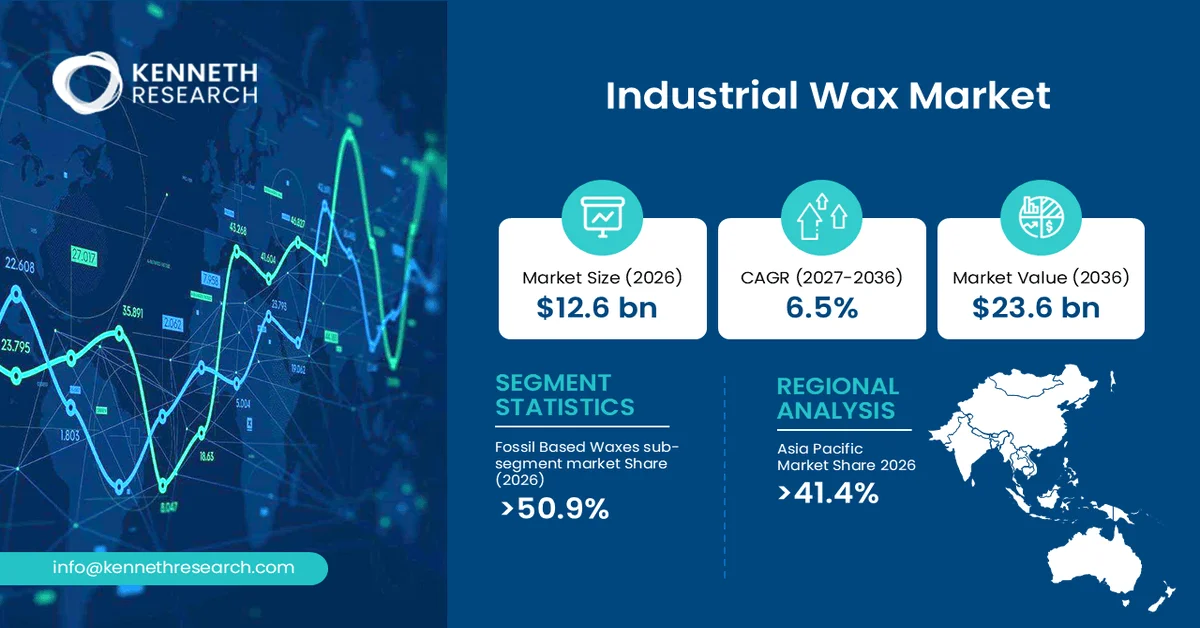
Industrial Wax Market size was valued at USD 12.6 billion in 2026 and is projected to reach USD 23.6 billion by the end of 2036, rising at a CAGR of 6.5% during the forecast period, i.e., 2027-2036. In 2027, the industry size of the industrial wax is estimated at USD 13.4 billion.
The primary growth driver is sustained availability of petroleum-derived feedstocks from large refining systems, supporting paraffin and related hydrocarbon wax production. U.S. operable atmospheric distillation capacity totaled 18.2 million barrels per calendar day in January 2026, underscoring the continuing scale of the refining base supplying wax-producing streams for industrial conversion.
The industrial wax market comprises wax materials manufactured, refined, blended, or formulated for use as functional ingredients, processing aids, coatings, binders, release agents, lubricants, and surface modifiers across industrial value chains. The product group includes petroleum-derived waxes, particularly paraffin and microcrystalline grades, alongside synthetic and other wax chemistries used where controlled physical performance is required.
Key characteristics include solid or semi-solid behavior at ambient conditions, defined melting or congealing behavior, water-repellent properties, chemical resistance, surface-finishing capability, and compatibility with diverse formulations. Wax selection varies according to purity, hardness, viscosity, oil content, thermal behavior, and the performance requirements of the end application.
Key Industrial Wax Market Insights Summary:
Key Takeaways: Market Trends & Insights
- Global industrial wax market is projected to grow from USD 12.6 billion in 2026 to USD 23.6 billion by 2036
- The market is expected to expand at a CAGR of 6.5% during 2027-2036
- Fossil Based Waxes account for 50.9% market share in 2026, making them the leading Type segment
- Packaging is identified as the second and fastest-growing analysis segment by Application
- Asia Pacific dominates with a 41.4% market share in 2026, with China and Japan representing the key country markets
Market Drivers
- Rising demand for high-performance packaging materials
- Expansion of specialty and application-specific wax formulations
- Increasing integration of waxes into plastics and chemical manufacturing
- Growing requirements for surface protection, processing efficiency, and material performance
Challenges
- Petroleum feedstock volatility and refinery-supply exposure
- Environmental compliance and substitution pressure
Industrial Wax Market Overview & Supply Chain
Global adoption of industrial waxes is increasing as manufacturers seek functional materials that provide moisture resistance, lubrication, surface protection, barrier performance, thermal stability, and process control across packaging, coatings, adhesives, candles, rubber, and other industrial applications. Demand is also supported by the continued integration of hydrocarbon-derived materials into chemical and manufacturing value chains, particularly where waxes serve as performance-enhancing additives or processing aids.
The industrial wax value chain begins with raw-material sourcing, primarily from petroleum refining and related hydrocarbon streams, alongside natural and synthetic feedstocks used for differentiated product formulations. Producers process and refine these inputs through separation, purification, blending, and formulation operations to achieve targeted melting behavior, hardness, viscosity, color, and application performance. Finished waxes then move through distributors, specialty chemical suppliers, and direct industrial procurement channels, with logistics requirements varying according to product form and customer specifications. Downstream users include packaging converters, manufacturers of coatings, adhesives, candles, rubber products, construction materials, and other industrial goods.
Industrial Wax Market: Growth Drivers & Challenges
Growth Drivers
- Expansion of downstream manufacturing and petrochemical-linked industries: Industrial wax demand is closely tied to the expansion of manufacturing sectors that use waxes as processing aids, protective coatings, lubricants, release agents, and barrier materials. Growth in plastics, chemicals, automotive components, electrical equipment, and consumer-goods manufacturing creates additional opportunities for wax formulations that improve processing efficiency and finished-product performance.
- Increasing demand for functional performance across diverse applications: Industrial waxes continue to gain relevance because a single material family can deliver multiple functional properties across different manufacturing processes. Depending on formulation and grade, waxes can provide water repellency, surface protection, friction modification, gloss, release characteristics, and controlled viscosity. This versatility enables manufacturers to incorporate waxes into formulations where performance requirements are becoming more specialized. In packaging, coatings, adhesives, rubber processing, candles, and other applications, producers can select or modify wax grades to achieve specific processing and finished-product characteristics. The diversification of end uses reduces dependence on any single application and supports broader opportunities for specialty grades.
Challenges
- Petroleum feedstock volatility and refinery-supply exposure: A major restraint is the industrial wax industry's dependence on petroleum-derived feedstocks and refinery economics. Traditional paraffin and microcrystalline wax production relies on refining streams whose availability can change when refiners alter operating rates, product priorities, or capacity portfolios. This creates procurement uncertainty for wax manufacturers and downstream converters, particularly where customers require consistent grades and long-term supply commitments. Commercially, producers face difficulty maintaining stable margins when input costs move unpredictably, while buyers may encounter higher inventory requirements or pressure to renegotiate contracts. The issue is especially relevant for smaller processors with limited purchasing leverage and fewer alternative suppliers.
- Environmental compliance and substitution pressure: Environmental scrutiny creates a structural challenge for conventional petroleum-based waxes, particularly in applications where customers are increasingly evaluating material sustainability, recyclability, emissions, and end-of-life characteristics. Compliance requirements can affect formulation choices, manufacturing processes, documentation, testing, and customer qualification, increasing the cost and complexity of supplying regulated applications. The commercial impact is not limited to direct compliance expenditure: producers may also need to invest in cleaner processing technologies, develop alternative formulations, and support customers with additional technical and regulatory documentation. At the same time, bio-based and synthetic alternatives can gain consideration when they provide an acceptable balance of performance and environmental attributes.
Industrial Wax Market Size and Forecast:
| Report Attribute | Details |
|---|---|
| Base Year |
2026 |
| Forecast Period |
2027-2036 |
| CAGR |
6.5% |
| Base Year Market Size (2026) |
USD 12.6 billion |
| Forecast Year Market Size (2036) |
USD 23.6 billion |
| Regional Scope |
|
Industrial Wax Market Segmentation Analysis:
Type Segment Analysis
In the type segment, the Fossil Based Waxes sub-segment is anticipated to capture the largest market share of 50.9% by the end of 2026.
Fossil based waxes remain the leading type segment because of their established performance profile, broad availability, and compatibility with high-volume industrial processes. Paraffin and related petroleum-derived waxes offer predictable melting behavior, moisture resistance, surface protection, lubrication, and formulation stability, making them suitable for packaging, coatings, adhesives, candles, rubber processing, and other applications. Their established production infrastructure also supports consistent quality and comparatively straightforward integration into existing manufacturing systems. Demand is reinforced by the continuing use of petroleum-derived materials as industrial feedstocks. The U.S. Energy Information Administration identifies waxes as a distinct petroleum-product category and reports U.S. petroleum product supplied for waxes in its current product-supply dataset, demonstrating their continuing presence within the petroleum processing and downstream materials system.
Application Segment Analysis
The packaging is projected to grow as the second-largest segment in the industrial wax market due to four converging demand drivers.
Packaging is projected to be a high-growth application for industrial waxes because manufacturers increasingly require materials that improve moisture resistance, seal integrity, surface protection, printability, release behavior, and barrier performance. Wax additives are used across paperboard coatings, flexible packaging, corrugated materials, hot-melt systems, and related packaging formulations, allowing converters to tailor finished products to demanding food, consumer-goods, and industrial applications. The scale of downstream manufacturing provides a strong demand foundation: the U.S. Census Bureau reported $15,938,854 thousand in sales, value of shipments, or revenue for plastics packaging film and sheet manufacturing in 2023. This indicates substantial activity within a downstream packaging segment where waxes can function as formulation and processing aids.
Our in-depth analysis of the global industrial wax market includes the following segments:
|
Segment |
Sub-segment |
|
Type |
|
|
Application |
|
Industrial Wax Market Regional Insights:
Asia Pacific Market Trends & Insights:
Asia Pacific industrial wax market is projected to hold the largest revenue share of 41.4% by the end of 2026.
Asia Pacific remains the dominant regional market, supported by its extensive manufacturing base, integrated petrochemical infrastructure, expanding packaging and plastics industries, and concentration of downstream industrial consumers. Regulatory initiatives encouraging higher-value manufacturing, industrial upgrading, and resource efficiency should continue influencing investment decisions across the regional supply chain.
China is expected to remain the principal country market, supported by integrated refining, chemical production, packaging, automotive, electronics, and consumer-goods manufacturing.
Japan represents a mature but technologically advanced market, where specialty chemicals, precision manufacturing, packaging, and high-performance materials create demand for consistent, application-specific wax grades. Japan's Ministry of Economy, Trade and Industry maintains official production and import data for chemical substances, providing an established regulatory framework for chemical-material supply chains.
North America Market Trends & Insights:
North America represents an important secondary market for industrial waxes, supported by a diversified manufacturing base, established petrochemical infrastructure, sophisticated packaging and converting industries, and demand for performance-oriented materials. Industrial wax consumption is distributed across packaging, coatings, adhesives, rubber processing, candles, construction-related products, and specialty formulations, creating a broad downstream customer base. In the United States, industrial activity and manufacturing modernization continue to create opportunities for wax suppliers that can provide consistent specifications, application support, and reliable domestic or regional supply.
The United States remains the principal country market because of its extensive industrial manufacturing ecosystem and diverse base of chemical, packaging, automotive, construction, and consumer-product manufacturers.
Canada offers complementary opportunities through its established manufacturing and resource industries, with cross-border trade supporting regional supply-chain integration. Suppliers able to meet technical specifications, regulatory requirements, and sustainability expectations should be well positioned to capture incremental demand in both countries.
Leading Companies Operating in the Global Industrial Wax Market:
Here is a list of upstream, downstream, and key players operating in the industrial wax market competitive ecosystem:
- Numaligarh Refinery Limited (India)
- Company Overview
- Business Strategy
- Key Product Offerings
- Financial Performance
- Key Performance Indicators
- Risk Analysis
- Recent Development
- Regional Presence
- SWOT Analysis
- The International Group, Inc. (Canada)
- HCI Wax (a division of HCI, Inc.) (United States)
- Kerax Limited (United Kingdom)
Recent Developments
- In January 2026, The International Group, Inc. (IGI Wax) joined the European Candle Manufacturers Association (ECMA) as an associate member. The Canada-based supplier of base waxes, formulated wax blends, and additives serves customers across North America and global markets.
- In August 2025, Kerax Limited CEO Ian Appleton was installed as Master of the Worshipful Company of Wax Chandlers, one of London's oldest livery companies with origins dating back to 1371. The role places him at the head of a historic institution that has received a Royal Charter from King Richard III and maintains around 130 members including experts in the modern wax industry.
Frequently Asked Question
In 2026, the industrial wax market exceeded USD 12.6 billion.
The industrial wax market is projected to reach USD 23.6 billion by the end of 2036, expanding at a CAGR of 6.5% over the forecast period (2027-2036).
The major players in the market are Numaligarh Refinery Limited, The International Group, Inc., HCI Wax (a division of HCI, Inc.), Kerax Limited, and others.
In the Type segment, the Fossil Based Waxes sub-segment is anticipated to capture the largest market share of 50.9% in the future and exhibit lucrative growth opportunities during 2027-2036. This growth trajectory is largely attributed to established performance characteristics and broad use across industrial applications.
Asia Pacific is projected to hold the largest market share of 41.4% by the end of 2036 and provide more business opportunities in the future. Continuous industrial and manufacturing activity in China and Japan is fostering the region's dominance.
Why Choose Kenneth Research ?
-
Insight with Impact : We don’t just gather data — we uncover stories, trends, and opportunities that fuel business growth.
-
Experts Who Get It : Our team speaks your industry’s language and knows what really matters to your customers and market.
-
Custom-Built for You : Forget one-size-fits-all. We craft research and consulting solutions as unique as your business vision.
-
Partners, Not Just Providers : We work with you, not for you — collaborating closely to turn insights into smart, strategic moves.
-
Results That Speak : Our work powers brands, startups, and industry leaders alike — with a track record of ideas that work in the real world.
Report ID: 1295 |
Published Date: 01 Sep 2026 |
Report Format: |
Delivery Timeline: 48-72 Business Hours

Copyright © 2025 Kenneth Research. All rights reserved. Terms of Use | Privacy Policy
