Report ID: 1190 |
Published Date: 26 Aug 2026 |
Report Format: |
Delivery Timeline: 48-72 Business Hours
Industrial Automation Service Market Outlook:
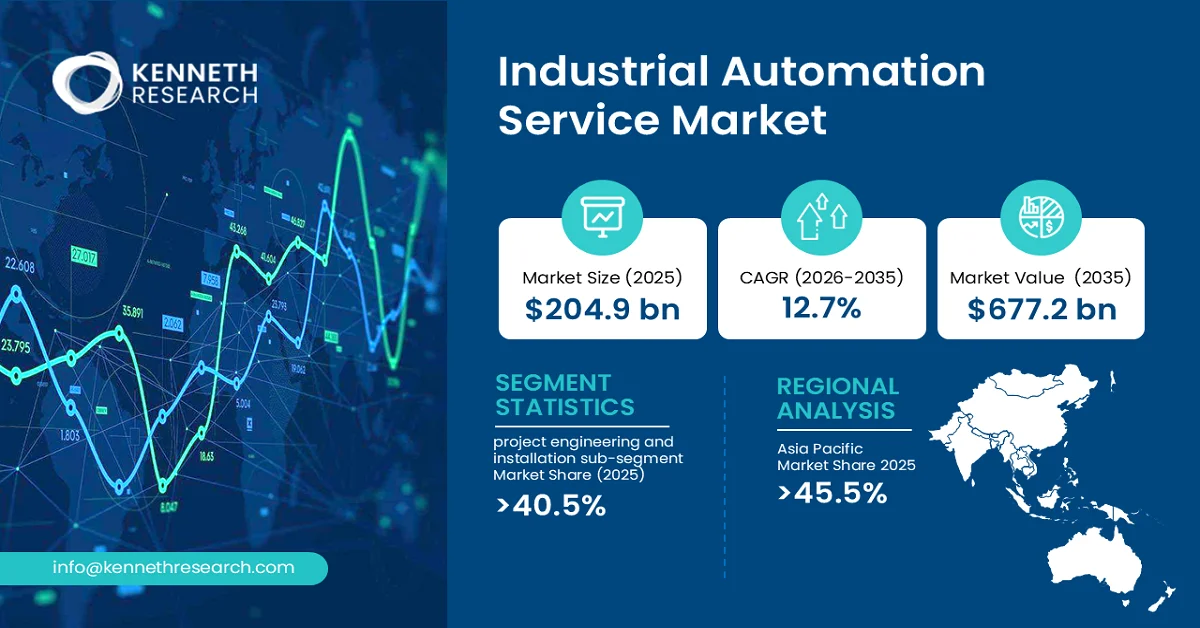
Industrial Automation Service Market size was valued at USD 204.9 billion in 2025 and is projected to reach USD 677.2 billion by the end of 2035, expanding at a CAGR of 12.7% during the forecast period, i.e., 2026-2035. In 2026, the industry size of the industrial automation service is estimated at USD 230.9 billion.
The primary growth driver of the industrial automation service market is the increasing adoption of automated production systems to improve operational efficiency, process consistency, productivity, and resource utilization.
The industrial automation service market comprises professional engineering, integration, installation, programming, commissioning, maintenance, consulting, and technical support services used to design, deploy, operate, and upgrade automated industrial systems.
Key characteristics include project-based engineering, system integration, control-system programming, equipment installation, testing, commissioning, troubleshooting, modernization, and ongoing technical support. Industrial automation services can be applied across discrete manufacturing, process industries, utilities, transportation, energy, food and beverage, pharmaceuticals, chemicals, and other industrial environments.
Key Industrial Automation Service Market Insights Summary:
Key Takeaways: Market Trends & Insights
- Industrial Automation Service Market is projected to grow from USD 204.9 billion in 2025 to USD 677.2 billion by 2035, registering a 12.7% CAGR during the forecast period.
- Asia Pacific accounted for the largest regional share at 45.5% in 2025, supported by expanding manufacturing automation, smart-factory initiatives, and industrial modernization across Japan and China.
- Project Engineering and Installation is the leading Service Type segment, accounting for 40.5% in 2025, driven by increasing demand for automation system design, integration, installation, testing, and commissioning.
- Programmable Logic Controllers (PLC) are expected to remain a key Product Type, supported by factory modernization, replacement of legacy control systems, and increasing integration of connected industrial technologies.
Market Drivers
- Increasing automation across manufacturing industries.
- Growing demand for smart and connected industrial operations.
- Rising investment in Industry 4.0 and digital manufacturing.
- Increasing modernization of legacy industrial control systems.
Challenges
- High initial investment and integration complexity.
- Shortage of specialized automation skills.
Industrial Automation Service Market Overview & Supply Chain
Industrial automation service adoption is increasing as manufacturers seek greater productivity, process consistency, operational visibility, and resilience amid changing labor and production requirements. Automation is increasingly relevant across discrete and process manufacturing because engineering, integration, commissioning, maintenance, and modernization services are required to deploy and sustain automated production environments. The U.S. Census Bureau reported that 52% of manufacturing workers were potentially exposed to advanced technologies used for automation, demonstrating the significant role of automation technologies within industrial production.
The industrial automation service market value chain begins with automation hardware, control-system, software, sensor, robotics, networking, and electrical-equipment suppliers that provide the technical inputs required for industrial projects. Service providers then conduct requirements assessment, system architecture, project engineering, equipment integration, programming, installation, testing, and commissioning. Following deployment, maintenance providers support troubleshooting, preventive maintenance, upgrades, cybersecurity, optimization, and lifecycle modernization. Distribution occurs through direct procurement, system integrators, technology partners, and specialized industrial service providers.
Industrial Automation Service Market: Growth Drivers & Challenges
Growth Drivers:
- Increasing automation across manufacturing industries: The expansion of automated production is increasing demand for engineering, system integration, installation, commissioning, and maintenance services. Manufacturers are investing in automation to improve productivity, reduce process variability, and manage increasingly complex production environments, creating recurring requirements for specialized service providers. The U.S. Department of Commerce notes that India’s advanced manufacturing sector is undergoing a transformation driven by government investment in automation, robotics, and Industry 4.0 technologies, with opportunities extending across automotive, aerospace, ICT, and pharmaceutical manufacturing.
- Growing demand for smart and connected industrial operations: Manufacturers are increasingly moving beyond basic automation toward connected production environments that combine control systems, industrial software, sensors, data platforms, and advanced analytics. This transition is creating additional demand for service providers capable of integrating automation equipment with digital infrastructure and upgrading existing production systems. Automation service companies increasingly support customers through system architecture, PLC and SCADA programming, connectivity, commissioning, optimization, and ongoing maintenance.
Challenges:
- High initial investment and integration complexity: High upfront investment and the complexity of integrating automation technologies with existing production infrastructure remain major restraints for industrial automation services. Automation projects often require engineering design, control-system configuration, equipment integration, software development, installation, testing, commissioning, and workforce training. These requirements become particularly challenging in brownfield facilities where legacy equipment must operate alongside newer digital systems.
- Shortage of specialized automation skills: The shortage of personnel with expertise across industrial controls, PLC programming, robotics, industrial networking, software integration, and digital manufacturing can constrain the deployment and maintenance of automated systems. Modern automation projects increasingly require multidisciplinary capabilities rather than traditional electrical or mechanical expertise alone. This creates pressure on service providers to recruit, train, and retain engineers capable of integrating operational technology with increasingly connected digital platforms.
Industrial Automation Service Market Size and Forecast:
| Report Attribute | Details |
|---|---|
| Base Year |
2025 |
| Forecast Year |
2026-2035 |
| CAGR |
12.7% |
| Base Year Market Size (2025) |
USD 204.9 billion |
| Forecast Year Market Size (2035) |
USD 677.2 billion |
| Regional Scope |
|
Industrial Automation Service Market Segmentation Analysis:
Service Type Segment Analysis
In the service type segment, the project engineering and installation sub-segment is anticipated to capture the largest market share of 40.5% in 2025.
Its leading position is supported by the increasing complexity of industrial automation projects, where manufacturers require specialized expertise to design control architectures, integrate equipment, install automation systems, program controllers, and commission complete production environments. The U.S. Department of Commerce reports that India’s manufacturing sector is experiencing increasing adoption of automation, robotics, IoT, artificial intelligence, and data analytics as companies transition toward more technology-driven production.
Demand for engineering and installation services is particularly strong during new plant development, production-line expansion, brownfield modernization, and automation upgrades.
Product Type Segment Analysis
The Programmable Logic Controller (PLC) segment is projected to grow as manufacturers modernize control architectures and integrate connected automation across production environments. PLCs remain fundamental to industrial control because they provide programmable control of machinery, production lines, process equipment, and safety-related operations. The U.K. Health and Safety Executive identifies PLCs as part of Industrial Automation and Control Systems used across industrial facilities, alongside DCS and SCADA systems.
Demand is being supported by factory modernization, replacement of legacy control equipment, increasing integration of sensors and industrial networks, and the transition toward connected production environments. Service providers benefit because PLC deployment requires programming, system integration, installation, testing, commissioning, troubleshooting, and ongoing maintenance. On the supply side, automation specialists are expanding capabilities around PLC programming, control-system integration, remote monitoring, and lifecycle support.
Our in-depth analysis of the global industrial automation service market includes the following segments:
|
Segment |
Sub-segment |
|
Service Type |
|
|
Product Type |
|
|
End User |
|
Industrial Automation Service Market Regional Insights:
Asia - Pacific Market Trends & Insights:
Asia Pacific accounted for 45.5% of the industrial automation service market in 2025, making it the dominant region.
Regional leadership is supported by extensive manufacturing activity, accelerating industrial modernization, expanding smart-factory initiatives, and strong adoption of automation technologies. China and Japan have established industrial ecosystems spanning automotive, electronics, machinery, chemicals, and other manufacturing sectors, creating sustained demand for engineering, integration, installation, commissioning, and maintenance services. China’s National Bureau of Statistics reported that manufacturing value added increased by 6.1% in 2024, while production of industrial robots increased by 14.2%, reflecting continued industrial automation investment and technology adoption.
Japan remains a technologically advanced automation market, supported by sophisticated manufacturing capabilities and government initiatives promoting digital transformation and advanced manufacturing technologies. Japan's Ministry of Economy, Trade and Industry continues to promote manufacturing technology development through national manufacturing policy and technology programs.
China represents a major source of demand because of its extensive manufacturing base and rapid development of intelligent production capabilities. The country's continued expansion of equipment and high-technology manufacturing supports demand for automation engineering, system integration, and lifecycle services.
North America Market Trends & Insights:
North America is an important market for industrial automation services, supported by advanced manufacturing capabilities, ongoing factory modernization, automation investment, and the growing integration of robotics, artificial intelligence, and connected production technologies. The U.S. benefits from a mature industrial technology ecosystem and established engineering and system-integration capabilities, while Canada is strengthening its advanced manufacturing base through government-backed automation initiatives
U.S. remains the principal contributor to regional demand, supported by its extensive manufacturing base, advanced automation ecosystem, and continued federal focus on strengthening domestic advanced manufacturing capabilities. NIST's 2024 Manufacturing USA strategic plan emphasizes robotics, advanced manufacturing technology, resilient supply chains, and workforce development.
Canada is also expanding its automation capabilities through public-private initiatives and Industry 4.0 programs. Government-backed projects have supported automation solutions, robotics, digitalization, and smart manufacturing adoption, creating opportunities for engineering, integration, installation, and lifecycle support services.
Leading Companies Operating in the Global Industrial Automation Service Market:
Here is a list of upstream, downstream, and key players operating in the global industrial automation service market competitive ecosystem:
- Rockwell Automation (United States)
- Company Overview
- Business Strategy
- Key Product Offerings
- Financial Performance
- Key Performance Indicators
- Risk Analysis
- Recent Development
- Regional Presence
- SWOT Analysis
- ABB(Switzerland)
- Siemens(Germany)
- Schneider Electric(France)
Recent Developments
- July 2026 —Rockwell Automation and Cisco announced a strategic collaboration in India, launching a Full-Stack Software-Defined Manufacturing reference design and a Software-Defined Manufacturing Demo Pod at Rockwell’s Gurugram facility.
- June 2026 —ABB launched Automation Extended, a modernization approach that enables industrial customers to add AI, advanced analytics, condition monitoring, and predictive-maintenance capabilities to existing automation platforms without disrupting core control operations.
Frequently Asked Question
In 2025, the industrial automation service market exceeded USD 204.9 billion.
The industrial automation service market is projected to reach USD 677.2 billion by the end of 2035, expanding at a CAGR of 12.7% over the forecast period (2026–2035).
The major players in the market are Siemens, Rockwell Automation, ABB, Schneider Electric, Honeywell, and others.
In the service type segment, the project engineering and installation sub-segment is anticipated to capture the largest market share of 40.5% in the future and exhibit lucrative growth opportunities during 2026-2035.
Asia Pacific is projected to hold the largest market share of 45.5% by the end of 2035 and provide more business opportunities in the future.
Why Choose Kenneth Research ?
-
Insight with Impact : We don’t just gather data — we uncover stories, trends, and opportunities that fuel business growth.
-
Experts Who Get It : Our team speaks your industry’s language and knows what really matters to your customers and market.
-
Custom-Built for You : Forget one-size-fits-all. We craft research and consulting solutions as unique as your business vision.
-
Partners, Not Just Providers : We work with you, not for you — collaborating closely to turn insights into smart, strategic moves.
-
Results That Speak : Our work powers brands, startups, and industry leaders alike — with a track record of ideas that work in the real world.
Report ID: 1190 |
Published Date: 26 Aug 2026 |
Report Format: |
Delivery Timeline: 48-72 Business Hours

Copyright © 2025 Kenneth Research. All rights reserved. Terms of Use | Privacy Policy
