Report ID: 1306 |
Published Date: 11 Sep 2026 |
Report Format: |
Delivery Timeline: 48-72 Business Hours
In-Vehicle Nox Sensor Market Outlook:
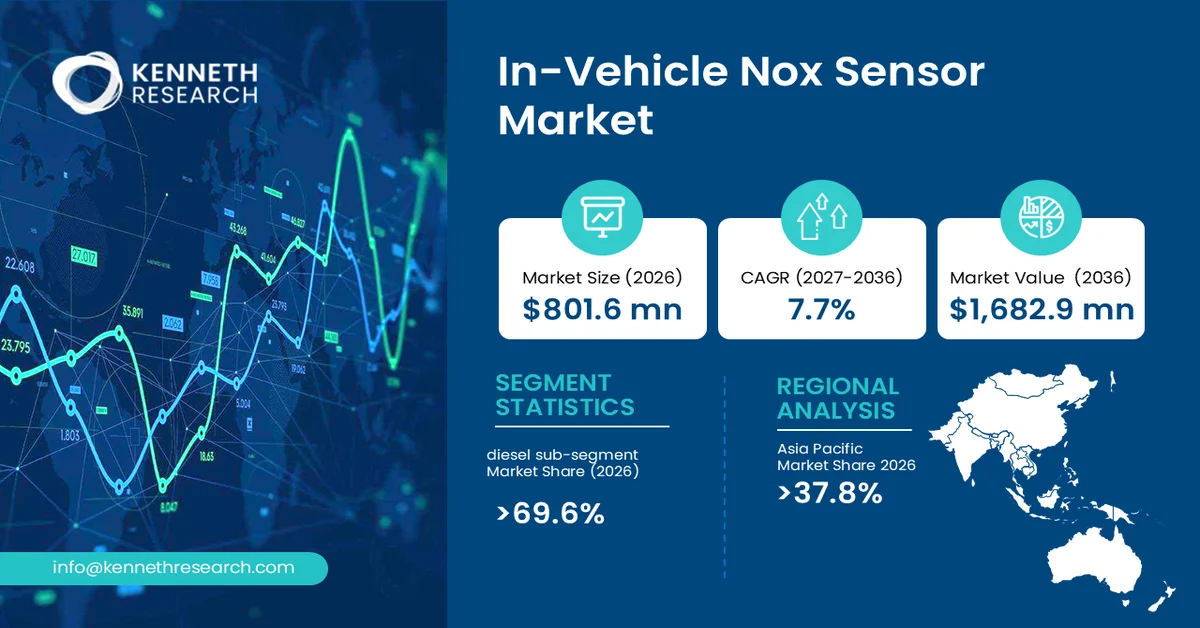
In-Vehicle Nox Sensor Market size was valued at USD 801.6 million in 2026 and is projected to reach USD 1,682.9 million by the end of 2036, rising at a CAGR of 7.7% during the forecast period, i.e., 2027–2036. In 2027, the industry size of the global in-vehicle nox sensor market is estimated at USD 863.2 million.
The primary growth driver is the tightening of vehicle emission regulations, which increases requirements for accurate, continuous NOx monitoring. The European Union’s Euro 7 framework strengthens pollutant-emission controls and introduces more comprehensive compliance requirements, encouraging automakers to integrate advanced sensing technologies capable of supporting emission-control systems and real-world monitoring.
The in-vehicle nox sensor market comprises sensors and associated sensing technologies installed in vehicles to detect and measure nitrogen oxides (NOx) within the exhaust stream. These devices provide emissions-related information to vehicle control systems, supporting the monitoring and management of exhaust after-treatment technologies such as selective catalytic reduction (SCR).
Key characteristics include measurement capability under varying engine loads, temperatures, operating conditions, and exhaust compositions. Sensors are designed to deliver reliable signals to electronic control units, enabling vehicle systems to evaluate NOx conditions and support appropriate emissions-control responses. Their integration is particularly relevant to vehicles equipped with internal combustion engines and advanced exhaust after-treatment systems.
Key In-Vehicle Nox Sensor Market Insights Summary:
Key Takeaways: Market Trends & Insights
- In-vehicle nox sensor market reached USD 801.6 million in 2026
- In-vehicle nox sensor market is projected to reach USD 1,682.9 million by 2036 at a CAGR of 7.7%
- Diesel leads the Fuel segment with a 69.6% market share in 2026
- Asia Pacific dominates the regional landscape with a 37.8% market share in 2026
- Commercial Vehicle is projected as the second fastest-growing segment, supported by emissions compliance, fleet modernization, and advanced after-treatment systems
Market Drivers
- Tighter vehicle-emission regulations and compliance requirements
- Increasing integration of advanced exhaust after-treatment systems
- Expansion of commercial-vehicle emissions-control technologies
- Advancement of sensor electronics, diagnostics, and vehicle-control architectures
Challenges
- Sensor Durability Under Harsh Exhaust Conditions
- High Integration and Replacement Complexity
In-Vehicle Nox Sensor Market Overview & Supply Chain
Adoption of in-vehicle nox sensor market technologies is increasing globally as vehicle manufacturers face stronger requirements to control and monitor nitrogen-oxide emissions from combustion-powered vehicles. NOx sensing is increasingly important for engine-control and exhaust after-treatment systems, particularly where manufacturers must demonstrate emissions performance under increasingly representative operating conditions. The regulatory emphasis on cleaner road transport is also strengthening the role of accurate, continuous emissions monitoring within vehicle architectures.
The in-vehicle nox sensor market value chain begins with specialized raw materials and electronic inputs, including sensing elements, ceramic substrates, electrodes, protective materials, semiconductor components, wiring, connectors, and housings. Component suppliers provide these inputs to sensor manufacturers, which undertake element fabrication, electronic integration, calibration, protective assembly, and quality testing. Manufacturers then supply sensors directly or through automotive component distributors and system integrators to vehicle original equipment manufacturers and exhaust after-treatment suppliers. Integration typically occurs within engine-management and emissions-control architectures, where sensors interface with electronic control units and related exhaust-treatment systems. End users include passenger-vehicle manufacturers, commercial-vehicle manufacturers, fleet operators, and aftermarket service channels.
In-Vehicle Nox Sensor Market - Growth Drivers & Challenges
Growth Drivers
- Tighter Emission Regulations and Compliance Requirements: Stricter vehicle-emission regulations are strengthening demand for in-vehicle nox sensor market technologies because manufacturers require dependable NOx measurement to manage exhaust after-treatment performance and demonstrate compliance. Regulatory frameworks increasingly extend emissions-control requirements across broader operating conditions and vehicle lifecycles, raising the technical importance of accurate sensing within engine-management architectures. In the United States, the Environmental Protection Agency finalized heavy-duty engine and vehicle standards in 2022, with stronger requirements beginning with model year 2027.
- Increasing Integration of Advanced Exhaust After-Treatment Systems: The increasing sophistication of exhaust after-treatment systems is another growth driver for the in-vehicle nox sensor market. Modern combustion-powered vehicles increasingly rely on coordinated engine controls, selective catalytic reduction systems, and electronic monitoring to manage nitrogen-oxide emissions under changing operating conditions. This raises the importance of sensors that can provide reliable feedback to electronic control units and help manufacturers maintain effective emissions-control performance.
Challenges
- Sensor Durability Under Harsh Exhaust Conditions: A major restraint is the difficulty of maintaining NOx sensor reliability in the high-temperature, chemically aggressive exhaust environment. Sensors must operate alongside exhaust after-treatment systems where temperature, moisture, contaminants, thermal cycling, and vibration can affect sensing elements, electronics, connectors, and signal stability. This creates a demanding validation and quality-control burden for suppliers and vehicle manufacturers.
- High Integration and Replacement Complexity: Another restraint is the technical complexity of integrating NOx sensors into increasingly sophisticated engine and exhaust-control architectures. Sensor operation depends on correct positioning, electrical communication, temperature conditions, calibration, and coordination with electronic control units and after-treatment components. A failure or inconsistent signal can therefore affect emissions-control diagnostics and system operation rather than remaining an isolated component issue.
In-Vehicle Nox Sensor Market Size and Forecast:
| Report Attribute | Details |
|---|---|
| Base Year |
2026 |
| Forecast Year |
2027-2036 |
| CAGR |
7.7% |
| Base Year Market Size (2026) |
USD 801.6 million |
| Forecast Year Market Size (2036) |
USD 1,682.9 million |
| Regional Scope |
|
In-Vehicle Nox Sensor Market - Segment Analysis
Fuel Segment Analysis
In the fuel segment, diesel sub-segment is anticipated to capture the largest market share of 69.6% by the end of 2026.
The diesel segment leads because diesel powertrains continue to require sophisticated NOx control and monitoring, particularly across vehicles using selective catalytic reduction and other exhaust after-treatment technologies. Demand is supported by the operational intensity of diesel vehicles and the need to maintain emissions performance under varied driving conditions. The U.S. Department of Energy reports that diesel vehicles averaged 17,500 annual miles in 2022, indicating substantial utilization and continued relevance of diesel-powered vehicles. This high operating intensity increases the importance of dependable emissions-control components, including NOx sensors.
Vehicle Type Segment Analysis
The commercial vehicle is projected to grow as the second-largest segment in the in-vehicle nox sensor market due to four converging demand drivers.
The commercial vehicle segment is projected to grow as freight, delivery, utility, and vocational fleets continue adopting sophisticated emissions-control architectures. Commercial vehicles typically operate for longer periods and under demanding load conditions, increasing the need for dependable NOx monitoring and closed-loop control of exhaust after-treatment systems. Regulatory tightening is also reinforcing sensor requirements across heavy-duty platforms. On the supply side, sensor manufacturers and Tier 1 suppliers are developing increasingly integrated sensing and diagnostic solutions for demanding duty cycles. Going forward, commercial-vehicle adoption should remain supported by emissions compliance, fleet modernization, and continued deployment of advanced after-treatment systems, although electrification will progressively alter the segment mix.
Our in-depth analysis of the in-vehicle nox sensor market includes the following segments:
|
Segment |
Sub-segment |
|
Type |
|
|
Gas |
|
|
Function |
|
|
Fuel |
|
|
Vehicle Type |
|
In-Vehicle Nox Sensor Market - Regional Analysis
Asia Pacific Market Trends & Insights:
Asia Pacific in-vehicle nox sensor market is projected to hold the largest revenue share of 37.8% by the end of 2026.
It is supported by its extensive automotive manufacturing base, large vehicle parc, expanding commercial-vehicle production, and continued investment in emissions-control technologies.
China represents the region’s strongest industrial anchor, benefiting from extensive vehicle manufacturing capacity, a large domestic vehicle population, and continued development of advanced automotive technologies.
Japan remains strategically important through its mature automotive OEM and component ecosystem, engineering capabilities, and established focus on vehicle efficiency and emissions performance. Together, these markets support regional supply-chain depth and technology adoption.
North America Market Trends & Insights:
North America remains an important market for the in-vehicle nox sensor market because of its established automotive manufacturing base, substantial commercial-vehicle activity, mature emissions-control infrastructure, and increasingly stringent environmental requirements. Demand is supported by OEM investment in advanced engine and exhaust-management systems, while fleet operators continue to prioritize regulatory compliance, reliability, and vehicle uptime.
The United States represents the region’s principal industrial market, supported by a broad commercial-vehicle ecosystem, established Tier 1 supplier networks, and rigorous federal emissions requirements. Its regulatory environment continues to encourage advanced emissions-management technologies across applicable combustion-powered platforms.
Canada provides a complementary opportunity through its integrated North American automotive supply chain and national emissions framework. Government policy is progressively strengthening air-pollution controls for road vehicles, while transportation remains an important source of NOx emissions.
In-Vehicle Nox Sensor Market Competitive Landscape
Here is a list of upstream, downstream, and key players operating in the in-vehicle nox sensor market competitive ecosystem:
- NGK Insulators, Ltd. (Niterra) (Japan)
- Company Overview
- Business Strategy
- Key Product Offerings
- Financial Performance
- Key Performance Indicators
- Risk Analysis
- Recent Development
- Regional Presence
- SWOT Analysis
- MCT Technic (China)
- STMicroelectronics (Switzerland)
- Sensata Technologies, Inc. (United States)
Recent Developments
- In March 2026, NGK Insulators received the prestigious 72nd Okouchi Memorial Prize for Production for the development and early mass production of a porous protective layer for its thick-film laminated zirconia NOx sensor. The world's first high-precision automotive NOx sensor, it measures NOx concentration in exhaust gas at ppm-level in real time and is critical for controlling exhaust purification systems under Europe's Real Driving Emissions (RDE) standards. NGK addressed the challenge of thermal shock by establishing a plasma spray porous protective layer in 2017 and enhancing water resistance with a dual-layer structure in 2022, enabling stable performance under extreme conditions.
- In January 2026, STMicroelectronics was featured in an article on Mouser Electronics' website regarding Euro 7 emissions testing, positioning its Stellar E1 microcontroller and DCP0606Y power management ICs as key solutions for precision NOx sensor data synchronization, deterministic sensing, and stable power delivery during real-driving emissions (RDE) test procedures. The company's automotive-grade components ensure accurate measurement and robust communications for emissions compliance testing starting in 2027.
Frequently Asked Question
In 2026, the in-vehicle nox sensor market exceeded USD 801.6 million.
The in-vehicle nox sensor market is projected to reach USD 1,682.9 million by the end of 2036, expanding at a CAGR of 7.7% over the forecast period (2027-2036).
The major players in the market are NGK Insulators, Ltd. (Niterra), MCT Technic, STMicroelectronics, Sensata Technologies, Inc., and others.
In the Fuel segment, the Diesel sub-segment is anticipated to capture the largest market share of 69.6% in the future and exhibit lucrative growth opportunities during 2027-2036. This growth trajectory is largely attributed to increasingly stringent vehicle-emission regulations and compliance requirements.
Asia Pacific is projected to hold the largest market share of 37.8% by the end of 2026 and provide more business opportunities in the future. Continuous investments in automotive manufacturing, emissions-control technologies, and vehicle production across China and Japan are fostering the region's dominance.
Why Choose Kenneth Research ?
-
Insight with Impact : We don’t just gather data — we uncover stories, trends, and opportunities that fuel business growth.
-
Experts Who Get It : Our team speaks your industry’s language and knows what really matters to your customers and market.
-
Custom-Built for You : Forget one-size-fits-all. We craft research and consulting solutions as unique as your business vision.
-
Partners, Not Just Providers : We work with you, not for you — collaborating closely to turn insights into smart, strategic moves.
-
Results That Speak : Our work powers brands, startups, and industry leaders alike — with a track record of ideas that work in the real world.
Report ID: 1306 |
Published Date: 11 Sep 2026 |
Report Format: |
Delivery Timeline: 48-72 Business Hours

Copyright © 2025 Kenneth Research. All rights reserved. Terms of Use | Privacy Policy
