Report ID: 1389 |
Published Date: 25 Sep 2026 |
Report Format: |
Delivery Timeline: 48-72 Business Hours
Hydrogen Market Outlook:
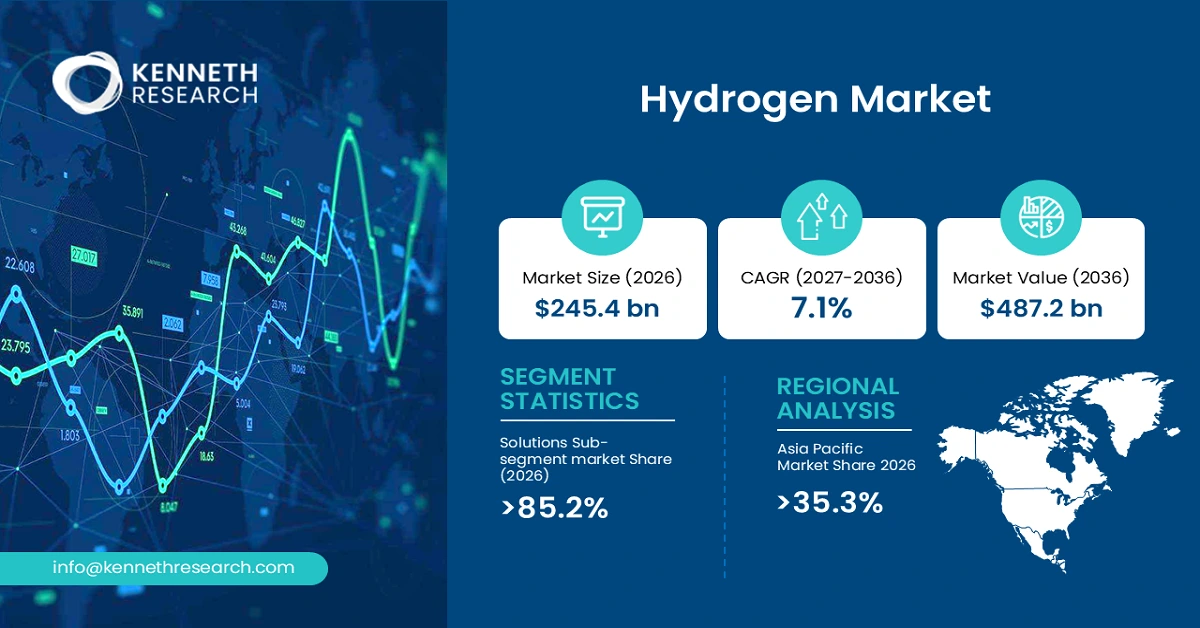
Hydrogen Market size was valued at USD 245.4 billion in 2026 and is projected to reach USD 487.2 billion by the end of 2036, rising at a CAGR of 7.1% during the forecast period, i.e., 2027–2036. In 2027, the industry size of the hydrogen market is estimated at USD 262.8 billion.
A key growth driver for the hydrogen market is the continued demand for hydrogen as an industrial feedstock, particularly in refining and chemical production.
The hydrogen market encompasses the production, processing, storage, transportation, distribution, and utilization of hydrogen across industrial, energy, transportation, and other applications. Hydrogen can be produced through multiple technologies and feedstocks, including natural-gas-based processes such as steam methane reforming, coal-based production, and water electrolysis. Based on production pathway and associated emissions, hydrogen is commonly differentiated into categories such as grey, blue, and green hydrogen.
The market includes hydrogen producers, technology providers, infrastructure operators, distributors, and end users across refining, chemicals, fertilizers, steel, mobility, power generation, and other industries. Existing hydrogen demand remains concentrated in established industrial applications, while new applications are developing as governments and industries implement policies and projects intended to increase the use of low-emissions hydrogen.
Key Hydrogen Market Insights Summary:
Key Takeaways: Market Trends & Insights
- Hydrogen Market projected to grow from USD 245.4 billion in 2026 to USD 487.2 billion by 2036 at a 7.1% CAGR.
- Asia-Pacific accounted for the largest regional share at 35.3% in 2026, supported by strong hydrogen demand and continued development of hydrogen infrastructure and applications in Japan and China.
- Grey Hydrogen is expected to remain the leading hydrogen type segment with an 85.2% market share in 2026, supported by its established use across refining, chemicals, ammonia, and methanol production.
- Steam Methane Reforming will continue to maintain a significant position in hydrogen production due to its mature technology, established industrial infrastructure, and extensive application across traditional hydrogen-consuming industries.
Market Drivers
- Rising industrial demand for hydrogen in refining, chemicals, ammonia, and methanol production
- Expansion of hydrogen applications across transportation, power generation, steel, and synthetic fuels
- Government policies and industrial decarbonization initiatives supporting hydrogen deployment
- Development of hydrogen storage, transportation, distribution, and international trade infrastructure
Challenges
- Cost competitiveness of low-emissions hydrogen
- Insufficient infrastructure and uncertain demand
Hydrogen Market - Market Overview & Supply Chain
The hydrogen market is supported by established demand from refining, ammonia, methanol, and other industrial applications, while emerging uses in mobility, power generation, steelmaking, and synthetic fuels are creating additional opportunities.
Hydrogen production remains predominantly based on fossil fuels, particularly natural gas and coal, while low-emissions hydrogen is gradually expanding through electrolysis and fossil-fuel-based production combined with carbon capture.
The hydrogen supply chain begins with feedstock and energy suppliers, which provide natural gas, coal, renewable electricity, and other inputs required for different production pathways. These inputs move to hydrogen production facilities, where technologies such as steam methane reforming, coal gasification, and water electrolysis convert the feedstock or electricity into hydrogen.
Following production, hydrogen is processed, purified, compressed, liquefied, or converted into carriers such as ammonia depending on the transportation and end-use requirements.
Hydrogen Market: Growth Drivers & Challenges
Growth Drivers
- Rising Industrial Demand for Hydrogen: Hydrogen demand is expanding primarily through established industrial applications, particularly refining, ammonia, methanol, and other chemical processes where hydrogen functions as a feedstock or processing agent. According to the International Energy Agency (IEA), global hydrogen demand surpassed 100 million tonnes in 2025, with industry and refining accounting for almost all consumption. This established demand creates a strong foundation for producers to expand capacity, improve distribution networks, and invest in production technologies.
- Expansion of Hydrogen Applications Across Emerging Sectors: The expansion of hydrogen into new applications is creating additional long-term growth opportunities beyond traditional industrial consumption. Hydrogen is increasingly being considered for heavy-duty transportation, shipping, power generation, steel production, synthetic fuels, and other difficult-to-decarbonize activities where direct electrification can be challenging.
Challenges
- Cost Competitiveness of Low-Emissions Hydrogen: The primary restraint is the cost gap between low-emissions hydrogen and established fossil-based production. Producing low-emissions hydrogen requires significant investment in renewable electricity, electrolysers, carbon-management systems, or other specialized infrastructure, while existing grey hydrogen benefits from mature technologies and established industrial supply chains. This cost differential makes it difficult for producers to secure competitive offtake agreements, particularly when downstream users cannot fully pass higher hydrogen costs through their products.
- Insufficient Infrastructure and Uncertain Demand: Hydrogen deployment is constrained by the limited availability of dedicated transportation, storage, distribution, and handling infrastructure, combined with uncertainty over long-term demand. Hydrogen projects often require coordinated investment across production facilities, pipelines, storage systems, ports, and end-user infrastructure, creating substantial execution and commercial risks when individual projects cannot secure firm offtake commitments.
Hydrogen Market Size and Forecast:
| Report Attribute | Details |
|---|---|
| Base Year |
2026 |
| Forecast Year |
2025-2037 |
| CAGR |
7.1% |
| Base Year Market Size (2026) |
USD 245.4 billion |
| Forecast Year Market Size (2037) |
USD 487.2 billion |
| Regional Scope |
|
Hydrogen Market Segmentation Analysis:
Hydrogen Type Segment Analysis
In the Hydrogen Type segment, the Grey Hydrogen sub-segment is anticipated to capture the largest market share of 85.2% in 2026.
Grey hydrogen is produced predominantly from fossil fuels without measures to capture the associated carbon emissions, making it the established production pathway across major industrial hydrogen-consuming sectors. Its extensive use in refining, ammonia, methanol, and other chemical applications provides producers with established feedstock arrangements, production infrastructure, operating expertise, and distribution networks. The established infrastructure surrounding grey hydrogen supports its continued commercial relevance, particularly where users prioritize dependable supply and cost competitiveness.
Production Technology Type Segment Analysis
In the Production Technology segment, the steam methane reforming (SMR) sub-segment is anticipated to maintain a significant position in the hydrogen market because of its established industrial infrastructure, mature technology, and extensive use in refining and chemical production. SMR converts natural gas into hydrogen through a high-temperature catalytic process and remains a widely deployed production pathway for conventional hydrogen. The established availability of natural-gas infrastructure, operating expertise, and hydrogen-consuming industrial facilities provides SMR with a strong commercial foundation. Its scalability and compatibility with existing industrial systems also support continued deployment.
Our in-depth analysis of the global hydrogen market includes the following segments:
|
Segment |
Sub-segment |
|
Hydrogen Type |
|
|
Production Technology |
|
|
End Use Application |
|
Hydrogen Market Regional Insights:
Asia Pacific Market Trends & Insights:
Asia-Pacific is anticipated to capture the largest regional share of 35.3% in the hydrogen market, supported by its large industrial base, established hydrogen consumption, expanding energy infrastructure, and growing government support for hydrogen deployment.
Japan represents a major hydrogen market in Asia-Pacific because of its focus on developing hydrogen supply chains for industrial and energy applications. Government-backed policies are supporting hydrogen imports, power-sector applications, and development of international supply relationships.
China is a major contributor to Asia-Pacific hydrogen demand and production because of its extensive industrial base and rapidly developing hydrogen technologies. The country has become the leading market for electrolysis deployment, supported by large-scale projects and comparatively low technology costs.
North America Market Trends & Insights:
North America is emerging as an important hydrogen market, supported by its established industrial base, extensive energy infrastructure, and development of low-emissions hydrogen projects. The United States and Canada are both advancing hydrogen production and infrastructure initiatives, with opportunities concentrated around existing industrial and refining demand as well as emerging applications.
The United States represents the larger hydrogen development ecosystem in the region, with project activity spanning low-emissions hydrogen production, carbon capture and storage, electrolyzer deployment, and industrial applications. Existing refining and chemical industries provide established hydrogen demand, while new projects are increasingly linked to decarbonization initiatives and export opportunities.
Canada is also strengthening its position through hydrogen and clean-energy development, supported by its natural-resource base, renewable electricity potential, carbon-management capabilities, and industrial infrastructure.
Leading Companies Operating in the Hydrogen Market:
Here is a list of upstream, downstream, and key players operating in the global hydrogen market competitive ecosystem:
- Linde plc (U.K.)
- Company Overview
- Business Strategy
- Key Product Offerings
- Financial Performance
- Key Performance Indicators
- Risk Analysis
- Recent Development
- Regional Presence
- SWOT Analysis
- Air Liquide (France)
- Shell (U.S.)
- Air Liquide S.A. (France)
- TotalEnergies SE (France)
- Hyundai E&C (South Korea)
Recent Developments
- In August 2026, Air Liquide advanced construction of its ELYgator project in the Netherlands, a large-scale electrolyzer investment of more than €500 million designed to produce renewable and low-carbon hydrogen.
- In November 2025, Shell Energy Europe Limited secured power supply agreements for its renewable hydrogen electrolyzer in Germany. The project forms part of Shell's development of renewable hydrogen production at the Rheinland Energy and Chemicals Park.
Frequently Asked Question
In 2026, the hydrogen market exceeded USD 245.4 billion.
The hydrogen market is projected to reach USD 487.2 billion by the end of 2036, expanding at a CAGR of 7.1% over the forecast period (2027-2036).
The major players in the market are Linde plc, Air Liquide, Air Products and Chemicals, Inc., Shell plc, thyssenkrupp nucera AG & Co. KGaA, and others.
In the hydrogen type segment, the grey Hydrogen sub-segment is anticipated to capture the largest market share of 85.2% in the future and exhibit lucrative growth opportunities during 2027-2036.
Asia-Pacific is projected to hold the largest market share of 35.3% by the end of 2026 and provide more business opportunities in the future.
Why Choose Kenneth Research ?
-
Insight with Impact : We don’t just gather data — we uncover stories, trends, and opportunities that fuel business growth.
-
Experts Who Get It : Our team speaks your industry’s language and knows what really matters to your customers and market.
-
Custom-Built for You : Forget one-size-fits-all. We craft research and consulting solutions as unique as your business vision.
-
Partners, Not Just Providers : We work with you, not for you — collaborating closely to turn insights into smart, strategic moves.
-
Results That Speak : Our work powers brands, startups, and industry leaders alike — with a track record of ideas that work in the real world.
Report ID: 1389 |
Published Date: 25 Sep 2026 |
Report Format: |
Delivery Timeline: 48-72 Business Hours

Copyright © 2025 Kenneth Research. All rights reserved. Terms of Use | Privacy Policy
