Report ID: 1148 |
Published Date: 24 Aug 2026 |
Report Format: |
Delivery Timeline: 48-72 Business Hours
Hydrocarbon Resins Market Outlook:
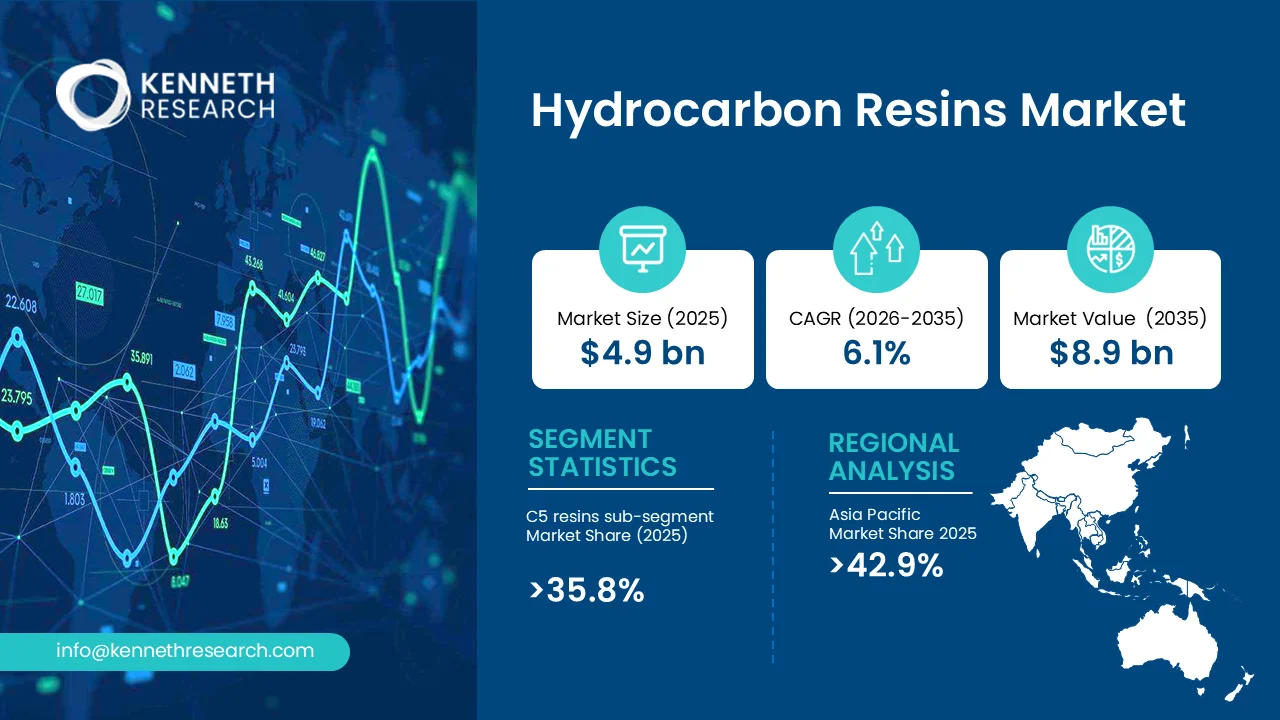
Hydrocarbon Resins Market size was valued at USD 4.9 billion in 2025 and is projected to reach USD 8.9 billion by the end of 2035, rising at a CAGR of 6.1% during the forecast period, i.e., 2026-2035. In 2026, the industry size of the hydrocarbon resins is estimated at USD 5.2 billion.
The primary growth driver for the hydrocarbon resins market is increasing demand from adhesive, sealant, and tire manufacturing industries, where hydrocarbon resins enhance tack, compatibility, and processability. Expanding industrial production, infrastructure development, automotive manufacturing, and packaging applications continue to strengthen consumption across both mature and emerging economies.
Hydrocarbon Resins are synthetic thermoplastic polymers produced through the polymerization of petroleum-derived hydrocarbon feedstocks, including C5, C9, and dicyclopentadiene (DCPD) fractions generated during steam cracking and refining operations. These resins are primarily used as performance-enhancing additives rather than standalone materials, improving adhesion, tack, cohesion, viscosity control, compatibility, and thermal stability in numerous industrial formulations.
Their chemical versatility allows manufacturers to tailor resin properties for specific end-use requirements across adhesives, sealants, coatings, inks, rubber compounding, tire manufacturing, road-marking materials, and pressure-sensitive applications. Depending on feedstock composition and hydrogenation level, hydrocarbon resins can deliver enhanced color stability, weather resistance, oxidation resistance, and processing performance for demanding industrial environments.
The hydrocarbon resins market is strategically important because these materials serve as enabling ingredients across multiple manufacturing value chains, supporting consistent product performance and production efficiency. Growing industrialization, expansion of packaging and transportation sectors, advances in specialty chemicals, and increasing demand for high-performance formulated products continue to reinforce the market's significance across global manufacturing and industrial supply chains.
Key Hydrocarbon Resins Market Insights Summary:
Key Takeaways: Market Trends & Insights
- Hydrocarbon Resins Market is projected to grow from USD 5.2 billion in 2026 to USD 8.9 billion by 2035 at a CAGR of 6.1%
- C5 Resins led the Type segment with a 35.8% market share in 2025 driven by strong demand from adhesives, sealants, rubber compounding, and tire manufacturing
- Asia Pacific accounted for the largest regional share of 42.9% in 2025 supported by robust petrochemical production, integrated manufacturing capabilities, and expanding industrial demand across China and India
- Automotive is projected to be the fastest-growing end-user industry owing to increasing adoption of advanced adhesives, lightweight materials, and specialty resin applications in vehicle manufacturing
- Growing investments in specialty chemical production, infrastructure development, packaging, and high-performance industrial applications continue to strengthen long-term demand for hydrocarbon resins across global manufacturing value chains
Market Drivers
- Increasing demand from adhesive and packaging applications
- Expansion of automotive manufacturing and lightweight material adoption
- Rising infrastructure and construction activities
- Advancements in specialty resin technologies and hydrogenated resin development
Challenges
- Feedstock price volatility and supply chain uncertainty
- Increasing environmental compliance and sustainability requirements
Hydrocarbon Resins Market Overview & Supply Chain
Global adoption of hydrocarbon resins is increasing because manufacturers are prioritizing high-performance materials that improve adhesion, tack, compatibility, and processing efficiency across adhesives, coatings, rubber compounds, tires, inks, and sealants. As industrial production becomes more sophisticated, end users increasingly require resin formulations capable of delivering consistent performance under demanding operating conditions while supporting evolving sustainability and quality standards. Hydrocarbon resins also benefit from continued investments in petrochemical production, which strengthen the availability of feedstocks and enable advanced resin manufacturing. This industrial relevance is reinforced by the fact that the International Energy Agency reported that global primary chemicals production reached 719 million tonnes in 2022, highlighting the scale of the upstream chemical industry that supports downstream specialty materials such as hydrocarbon resins.
The hydrocarbon resins industry begins with petroleum-derived feedstocks obtained from refinery and steam-cracking operations, where C5, C9, and dicyclopentadiene fractions are recovered as key raw materials. These feedstocks undergo polymerization, hydrogenation where required, quality testing, and formulation to produce resin grades tailored for different industrial applications. Manufacturers then supply products through chemical distributors, specialty material suppliers, and direct industrial contracts that serve regional and international markets. Downstream demand is generated by producers of hot-melt adhesives, pressure-sensitive adhesives, sealants, paints, coatings, printing inks, rubber compounds, tire components, road-marking materials, and specialty construction products. Major stakeholders across the value chain include petroleum refiners, petrochemical producers, hydrocarbon resin manufacturers, additive formulators, logistics providers, distributors, industrial converters, original equipment manufacturers, and end-user industries that integrate these resins into high-performance manufactured products.
Hydrocarbon Resins Market: Growth Drivers & Challenges
Growth Drivers:
- Increasing demand from adhesive and packaging applications: Hydrocarbon resins are increasingly adopted as performance-enhancing tackifiers in hot-melt adhesives, pressure-sensitive adhesives, and packaging formulations because they improve adhesion strength, compatibility, viscosity control, and thermal performance. The rapid expansion of e-commerce, consumer goods, food packaging, hygiene products, and industrial assembly processes has strengthened demand for advanced adhesive systems that require reliable resin additives. As manufacturers seek higher production efficiency and durable bonding performance, hydrocarbon resins are becoming integral to adhesive formulations across multiple industries.
- Expansion of automotive manufacturing and lightweight material adoption: The automotive industry continues to stimulate demand for hydrocarbon resins through their extensive use in tire compounds, sealants, sound-dampening materials, coatings, and structural adhesive formulations. Vehicle manufacturers increasingly rely on advanced bonding technologies to reduce mechanical fastening, improve manufacturing efficiency, and support lightweight vehicle designs. Hydrocarbon resins enhance tack, compatibility, and processing characteristics, enabling adhesive systems that meet stringent durability and performance requirements across conventional and electrified vehicles. In parallel, suppliers are developing specialized hydrogenated and modified resin grades that offer improved weatherability, heat resistance, and color stability for demanding automotive applications. As vehicle platforms become more material-intensive and manufacturers emphasize durability, production efficiency, and design flexibility, hydrocarbon resins are expected to become even more important within automotive supply chains, supporting long-term innovation in mobility and industrial manufacturing.
Challenges:
- Feedstock price volatility and supply chain uncertainty: Hydrocarbon resin production depends heavily on petroleum-derived feedstocks such as C5, C9, and dicyclopentadiene fractions obtained from refining and steam-cracking operations. Variations in crude oil markets, changes in refinery operating rates, petrochemical capacity adjustments, and geopolitical disruptions can significantly affect the availability and pricing of these feedstocks. Such volatility creates uncertainty for resin manufacturers attempting to maintain stable production costs and long-term supply agreements. Commercially, fluctuating raw material expenses reduce pricing visibility for both producers and downstream customers, making contract negotiations more complex and compressing operating margins. End-use industries may also experience procurement delays or seek alternative materials when price instability persists. Looking ahead, companies are expected to strengthen supplier diversification, improve inventory planning, and optimize manufacturing flexibility to reduce exposure to feedstock-related disruptions while maintaining competitive product offerings.
- Increasing environmental compliance and sustainability requirements: Hydrocarbon resin manufacturers face growing pressure to align production processes and product portfolios with evolving environmental regulations, sustainability objectives, and customer expectations. Industrial buyers increasingly evaluate raw material sourcing, emissions performance, product safety, and lifecycle characteristics when selecting specialty chemical suppliers. Conventional petroleum-based resin production may require additional investments in cleaner manufacturing technologies, energy efficiency improvements, emissions control systems, and product innovation to satisfy changing regulatory frameworks across different regions. These compliance requirements can increase development costs, extend product qualification timelines, and complicate market entry for smaller manufacturers with limited technical resources. From a commercial perspective, companies that fail to adapt risk losing business opportunities with sustainability-focused customers. Over the longer term, continued investment in hydrogenated resins, lower-emission manufacturing practices, and more sustainable feedstock strategies is expected to become an important competitive differentiator across the industry.
Hydrocarbon Resins Market Size and Forecast:
| Report Attribute | Details |
|---|---|
| Base Year |
2025 |
| Forecast Year |
2026-2035 |
| CAGR |
6.1% |
| Base Year Market Size (2025) |
USD 4.9 billion |
| Forecast Year Market Size (2035) |
USD 8.9 billion |
| Regional Scope |
|
Hydrocarbon Resins Market Segmentation Analysis:
Type Segment Analysis
In the type segment, the C5 resins sub-segment is anticipated to capture the largest market share of 35.8% by the end of 2025.
Their excellent compatibility with elastomers and synthetic polymers enables manufacturers to formulate high-performance hot-melt and pressure-sensitive adhesives used extensively in packaging, hygiene products, construction materials, and industrial assembly. Consistent demand from these downstream industries continues to strengthen the position of C5 resins as the leading product category. On the supply side, C5 feedstocks are readily available as by-products of steam cracking, allowing producers to manufacture these resins at commercial scale while offering multiple grades tailored to different performance requirements. Demand is further supported by the expansion of adhesive manufacturing capacity. According to the U.S. Census Bureau, the United States had 539 employer establishments in the Adhesive Manufacturing industry (NAICS 325520) in 2023, reflecting a substantial downstream manufacturing base that consumes tackifier resins such as C5 hydrocarbon resins. Looking ahead, increasing adoption of advanced adhesive technologies, lightweight automotive materials, and high-performance packaging solutions is expected to reinforce the segment's leadership.
End-User Industry Segment Analysis
The automotive is projected to grow as the second-largest segment in the hydrocarbon resins market due to four converging demand drivers.
The automotive end-user industry is projected to experience strong growth in the hydrocarbon resins market as vehicle manufacturers increasingly adopt advanced adhesive systems, tire compounds, sealants, vibration-damping materials, and protective coatings to improve vehicle performance and manufacturing efficiency. Hydrocarbon resins enhance tack, cohesion, and compatibility in these formulations, enabling durable bonding solutions that support lightweight vehicle architectures and more efficient assembly processes. The transition toward electric vehicles further expands the use of specialty adhesives and polymer-based materials in battery systems and vehicle interiors, creating additional demand for high-performance resin technologies. Supply-side growth is supported by continuous investments in specialty resin development, including hydrogenated grades with improved thermal stability and weather resistance for demanding automotive applications. This outlook aligns with broader automotive production trends. According to the International Energy Agency, nearly 14 million electric cars were sold globally in 2023, with China, Europe, and the United States accounting for about 95% of sales, reinforcing the expansion of advanced automotive manufacturing that relies on high-performance adhesive and sealing materials.
Our in-depth analysis of the global hydrocarbon resins market includes the following segments:
|
Segment |
Sub-segment |
|
Type |
|
|
Application |
|
|
End-User Industry |
|
Hydrocarbon Resins Market Regional Insights:
Asia Pacific Market Trends & Insights:
Asia Pacific hydrocarbon resins market is projected to hold the largest revenue share of 42.9% by the end of 2025.
The region's dominance is underpinned by its extensive petrochemical production base, well-established refining infrastructure, and large downstream manufacturing industries that consume hydrocarbon resins in adhesives, tires, rubber products, coatings, printing inks, and sealants. Strong investments in chemical manufacturing capacity, expanding industrial output, and integrated supply chains enable cost-efficient production and broad product availability across domestic and export markets. Regional governments continue to support industrial modernization, manufacturing competitiveness, and infrastructure development, creating favorable conditions for specialty chemical production.
China serves as the primary growth engine within the region due to its integrated refining and petrochemical complexes, extensive specialty chemical manufacturing capabilities, and strong demand from automotive, packaging, construction, and industrial sectors. Continuous investments in downstream chemical value chains further strengthen domestic resin production and export competitiveness.
India is emerging as another important market, supported by expanding manufacturing activity, increasing infrastructure investment, growing automotive production, and rising demand for adhesives, coatings, and construction materials. The country's focus on industrial development and domestic manufacturing is encouraging greater consumption of specialty chemicals, while investments in refining and petrochemical capacity are improving feedstock availability. Together, China and India provide a robust combination of production capability and downstream demand, reinforcing Asia Pacific's position as the leading regional market for hydrocarbon resins.
North America Market Trends & Insights:
North America represents a strategically important market for hydrocarbon resins due to its mature manufacturing ecosystem, advanced chemical processing capabilities, and sustained demand from high-value industrial sectors. Consumption is driven by applications in adhesives, sealants, coatings, printing inks, rubber products, and tire manufacturing, where consistent product performance and formulation reliability are essential. The region benefits from an integrated petrochemical value chain, enabling stable access to hydrocarbon feedstocks and supporting innovation in specialty resin production. Government initiatives promoting domestic manufacturing, infrastructure modernization, advanced transportation technologies, and supply chain resilience continue to encourage investment across the chemicals and industrial materials sectors. In addition, increasing emphasis on sustainable manufacturing practices and the development of lower-emission specialty materials is creating opportunities for resin producers to introduce advanced hydrogenated and application-specific formulations. These factors position North America as a key market for product innovation and long-term industrial growth.
The United States is the principal contributor to regional demand, supported by its extensive petrochemical industry, well-developed adhesive and coatings manufacturing base, and strong automotive, packaging, and construction sectors. Ongoing investments in specialty chemicals, research and development, and advanced manufacturing technologies further enhance the country's competitive position.
Canada complements the regional market through its integrated refining and petrochemical operations, reliable industrial infrastructure, and expanding demand from construction, transportation, and packaging industries. The country's focus on sustainable industrial development and cross-border supply chain integration with the United States supports efficient distribution of specialty chemical products, strengthening North America's role as an important market for hydrocarbon resins.
Leading Companies Operating in the Global Hydrocarbon Resins Market:
Here is a list of upstream, downstream, and key players operating in the global hydrocarbon resins market competitive ecosystem:
- Eastman Chemical Company (United States)
- Company Overview
- Business Strategy
- Key Product Offerings
- Financial Performance
- Key Performance Indicators
- Risk Analysis
- Recent Development
- Regional Presence
- SWOT Analysis
- ExxonMobil Corporation (United States)
- Neville Chemical Company (United States)
- Idemitsu Kosan Co., Ltd. (Japan)
Recent Developments
- In 2025, Michelin ResiCare launched the DragonFly project, a €44.7 million initiative to industrialize the production of an innovative bio-based molecule and accelerate the transition toward safer and more sustainable resins . The project, funded under the France 2030 plan, aims to reduce greenhouse gas emissions by 60% and eliminate Substances of Very High Concern from resin formulations, with a 400-tonne-per-year industrial demonstrator scheduled for completion by 2029.
- In 2025, Teckrez reported a sharp rise in U.S. tackifier imports, with C5 resin imports from Asia projected to surge by 260% following domestic plant closures. Korean and Chinese producers are becoming increasingly dominant players in the U.S. market, reshaping procurement strategies and increasing exposure to global freight and geopolitical risk.
Frequently Asked Question
In 2025, the hydrocarbon resins market exceeded USD 4.9 billion.
The hydrocarbon resins market is projected to reach USD 8.9 billion by the end of 2035, expanding at a CAGR of 6.1% over the forecast period (2026-2035).
The major players in the market are Eastman Chemical Company (United States), ExxonMobil Corporation (United States), Neville Chemical Company (United States), Idemitsu Kosan Co., Ltd. (Japan), and others.
In the type segment, the C5 resins sub-segment is anticipated to capture the largest market share of 35.8% in the future and exhibit lucrative growth opportunities during 2026-2035. This growth trajectory is largely attributed to increasing demand from adhesive, packaging, rubber compounding, and tire manufacturing applications, where C5 resins provide excellent tack, compatibility, and processing performance.
Asia Pacific is projected to hold the largest market share of 42.9% by the end of 2025 and provide more business opportunities in the future. Continuous investments in petrochemical production, manufacturing expansion, and downstream specialty chemical industries across China and India are fostering the region's dominance.
Why Choose Kenneth Research ?
-
Insight with Impact : We don’t just gather data — we uncover stories, trends, and opportunities that fuel business growth.
-
Experts Who Get It : Our team speaks your industry’s language and knows what really matters to your customers and market.
-
Custom-Built for You : Forget one-size-fits-all. We craft research and consulting solutions as unique as your business vision.
-
Partners, Not Just Providers : We work with you, not for you — collaborating closely to turn insights into smart, strategic moves.
-
Results That Speak : Our work powers brands, startups, and industry leaders alike — with a track record of ideas that work in the real world.
Report ID: 1148 |
Published Date: 24 Aug 2026 |
Report Format: |
Delivery Timeline: 48-72 Business Hours

Copyright © 2025 Kenneth Research. All rights reserved. Terms of Use | Privacy Policy
