Report ID: 1139 |
Published Date: 21 Aug 2026 |
Report Format: |
Delivery Timeline: 48-72 Business Hours
Hydrocarbon Ink Resin Market Outlook:
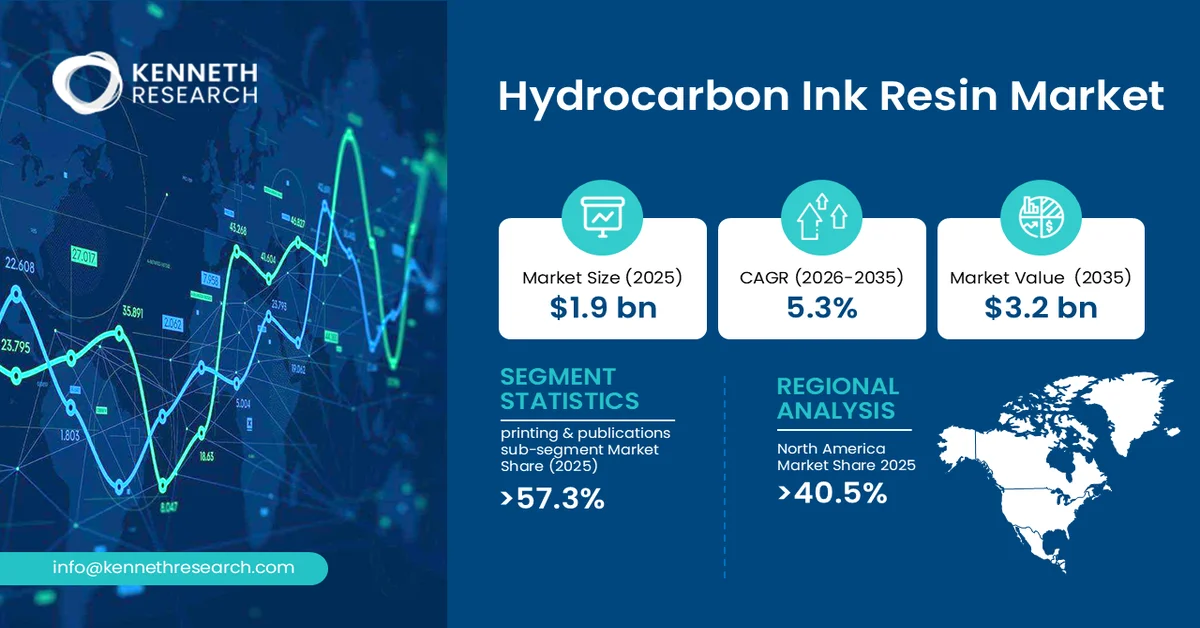
Hydrocarbon Ink Resin Market size was valued at USD 1.9 billion in 2025 and is projected to reach USD 3.2 billion by the end of 2035, rising at a CAGR of 5.3% during the forecast period, i.e., 2026-2035. In 2026, the industry size of the hydrocarbon ink resin is estimated at USD 2 billion.
The primary growth driver for the hydrocarbon ink resin market is sustained demand from commercial printing and packaging applications, particularly flexographic and publication printing. The U.S. Environmental Protection Agency recognizes flexography as one of the principal industrial printing processes, reflecting its continued importance across manufacturing and packaging value chains.
The hydrocarbon ink resin market comprises petroleum-derived resin materials formulated as essential binders in printing inks. These resins provide critical performance attributes, including pigment dispersion, gloss, adhesion, printability, drying behavior, and compatibility with multiple substrates. Hydrocarbon ink resins are widely incorporated into formulations for offset, flexographic, gravure, and other conventional printing processes, where they help achieve consistent print quality and production efficiency.
From an industrial perspective, hydrocarbon ink resins are integral to the manufacture of inks used across packaging, publishing, labeling, commercial printing, and specialty graphics. Their ability to balance viscosity, color development, and surface performance makes them suitable for high-volume printing operations requiring reliable throughput and durable printed outputs. The market also supports evolving requirements for productivity, regulatory compliance, and substrate compatibility as printing technologies continue to advance.
The market is strategically important because printing remains a core manufacturing activity encompassing multiple production processes, including lithography, flexography, gravure, letterpress, and screen printing, each relying on specialized ink formulations tailored to application and performance requirements.
Key Hydrocarbon Ink Resin Market Insights Summary:
Key Takeaways: Market Trends & Insights
- The Hydrocarbon Ink Resin Market is projected to grow from USD 2 billion in 2026 to USD 3.2 billion by 2035, registering a CAGR of 5.3% during the forecast period
- Printing & Publications remains the leading application segment, accounting for 57.3% of the market in 2025, supported by sustained demand for commercial printing, packaging, and publication inks
- Flexographic is expected to witness the fastest growth among printing processes due to increasing adoption in flexible packaging, labels, and high-speed industrial printing applications
- North America led the global market with a 40.5% share in 2025, driven by the strong presence of printing, packaging, petrochemical, and specialty chemical industries across the United States and Canada
- Asia Pacific is expected to offer significant future growth opportunities, with China and Japan strengthening regional demand through expanding packaging production, advanced manufacturing capabilities, and continuous investments in printing technologies
Market Drivers
- Expansion of Sustainable Packaging and Advanced Printing Technologies
- Rising Demand for High-Performance Printing Across Industrial Applications
- Continuous Innovation in Resin Chemistry for Enhanced Print Performance
- Increasing Industrialization and Packaging Manufacturing Across Emerging Economies erials
Challenges
- Increasing Regulatory Pressure on Petrochemical-Based Materials
- Volatility in Petrochemical Feedstock Supply and Production Costs
Hydrocarbon Ink Resin Market Overview & Supply Chain
The adoption of hydrocarbon ink resins is increasing globally as packaging production, commercial printing, and industrial labeling continue to require high-performance ink systems with reliable adhesion, gloss, pigment dispersion, and print consistency. Hydrocarbon resins remain essential for conventional printing technologies because they support efficient press performance and compatibility with diverse substrates. Regulatory attention toward industrial emissions is also encouraging manufacturers to optimize resin formulations while maintaining production efficiency. Industry relevance remains strong, with the U.S. Environmental Protection Agency estimating that 97% of all printing activities are categorized into five principal printing processes—lithography, gravure, flexography, letterpress, and screen printing.
The hydrocarbon ink resin market value chain begins with the procurement of petroleum-derived hydrocarbon feedstocks, aromatic compounds, catalysts, and performance additives sourced from the petrochemical industry. These raw materials are polymerized, refined, and modified into resin grades designed to meet specific ink performance requirements, including adhesion, viscosity, drying characteristics, and gloss. Resin manufacturers collaborate closely with printing ink formulators, who blend hydrocarbon resins with pigments, solvents, waxes, and specialty additives to develop application-specific inks. The finished inks are distributed through chemical distributors, regional suppliers, and direct industrial sales channels to converters, commercial printers, packaging manufacturers, label producers, and publication printers. Downstream demand is driven by industries such as food and beverage packaging, consumer goods, pharmaceuticals, logistics, publishing, and industrial labeling. Major stakeholders across the value chain include petrochemical producers, resin manufacturers, ink formulators, equipment manufacturers, packaging converters, regulatory authorities, and industrial end users seeking consistent print performance and manufacturing efficiency.
Hydrocarbon Ink Resin Market: Growth Drivers & Challenges
Growth Drivers:
- Expansion of sustainable packaging and advanced printing technologies: The increasing adoption of sustainable packaging and high-performance printing technologies is a major driver for the hydrocarbon ink resin market. Brand owners and packaging converters continue to seek ink systems that deliver superior print quality while supporting evolving sustainability objectives, encouraging resin manufacturers to develop advanced formulations with improved substrate compatibility and operational efficiency. Hydrocarbon ink resins remain important for flexographic and conventional printing because they provide balanced adhesion, gloss, pigment dispersion, and drying performance across high-speed production lines.
- Rising demand for high-performance printing across industrial applications: The continued expansion of industrial packaging, product labeling, publication printing, and commercial graphics is reinforcing demand for hydrocarbon ink resins. Manufacturers increasingly require ink formulations capable of maintaining color consistency, rapid drying, abrasion resistance, and reliable adhesion across diverse substrates, including paper, films, and corrugated materials. Hydrocarbon resins address these requirements by improving ink stability and press productivity, making them valuable for high-volume printing operations. Advances in printing equipment and automation are also encouraging the adoption of resin formulations that support faster production speeds while minimizing downtime and waste. Looking ahead, increasing customization of packaging, greater use of specialty labels, and higher quality expectations from consumer goods manufacturers are likely to drive further investment in performance-oriented resin technologies. These trends will encourage ongoing formulation improvements, strengthening the role of hydrocarbon ink resins within industrial printing ecosystems.
Challenges:
- Increasing regulatory pressure on petrochemical-based materials: Hydrocarbon ink resins are primarily derived from petroleum-based feedstocks, making the industry increasingly vulnerable to tightening environmental regulations related to volatile organic compound emissions, chemical safety, recyclability, and sustainable material selection. Compliance requires manufacturers to invest in research, reformulate products, validate new raw materials, and meet varying regional regulatory requirements. These activities increase development costs and lengthen commercialization timelines. Printing ink producers also face challenges in maintaining product performance while reducing environmental impacts, creating additional technical complexity throughout the value chain. Over the long term, regulatory expectations are expected to become more stringent, encouraging continuous innovation but also increasing competitive pressure on suppliers that rely heavily on conventional hydrocarbon resin technologies.
- Volatility in petrochemical feedstock supply and production costs: The hydrocarbon ink resin market remains closely linked to global petrochemical supply chains, exposing manufacturers to fluctuations in raw material availability, transportation costs, refinery operations, and energy prices. Variations in feedstock pricing directly influence resin production costs, making long-term procurement and pricing strategies more difficult for both resin producers and ink formulators. Cost volatility can compress profit margins, complicate customer contracts, and reduce investment flexibility for product development. Supply chain disruptions may also affect production schedules and inventory planning, particularly for manufacturers serving multiple regional markets. As customers increasingly seek stable pricing and reliable supply, companies will need to diversify sourcing strategies, strengthen supplier relationships, and improve operational resilience to remain competitive.
Hydrocarbon Ink Resin Market Size and Forecast:
| Report Attribute | Details |
|---|---|
| Base Year |
2025 |
| Forecast Year |
2026-2035 |
| CAGR |
5.3% |
| Base Year Market Size (2025) |
USD 1.9 billion |
| Forecast Year Market Size (2035) |
USD 3.2 billion |
| Regional Scope |
|
Hydrocarbon Ink Resin Market Segmentation Analysis:
Application Segment Analysis
In the application segment, the printing & publications sub-segment is anticipated to capture the largest market share of 57.3% by the end of 2025.
The printing & publications segment dominates the hydrocarbon ink resin market because it represents the largest and most established application area for conventional printing inks, where hydrocarbon resins provide essential properties such as pigment dispersion, gloss, adhesion, and controlled drying. Demand is supported by continued requirements for books, newspapers, magazines, catalogs, commercial advertising materials, labels, and packaging inserts that rely on high-volume printing operations. On the supply side, resin manufacturers have developed specialized hydrocarbon resin grades compatible with offset, gravure, and flexographic printing, enabling ink formulators to meet diverse substrate and production requirements while maintaining cost efficiency.
Process Segment Analysis
The flexographic is projected to grow as the second-largest segment in the hydrocarbon ink resin market due to four converging demand drivers.
The flexographic segment is projected to grow as packaging manufacturers increasingly prioritize high-speed, cost-efficient, and versatile printing processes capable of handling paper, flexible films, corrugated board, labels, and other packaging substrates. Hydrocarbon ink resins play a critical role in flexographic inks by providing balanced adhesion, gloss, pigment dispersion, and drying performance required for consistent production quality. Demand is being reinforced by the expansion of consumer packaged goods, e-commerce packaging, food and beverage labeling, and pharmaceutical packaging, all of which require durable and high-throughput printing solutions. On the supply side, resin producers are introducing advanced formulations with improved substrate compatibility and enhanced processing characteristics to support modern flexographic presses. The U.S. Environmental Protection Agency states that more than 90% of flexographic applications are in the packaging and specialty products industries, highlighting the process's close alignment with expanding packaging demand.
Our in-depth analysis of the global hydrocarbon ink resin market includes the following segments:
|
Segment |
Sub-segment |
|
Grade |
|
|
Form |
|
|
Packaging |
|
|
Process |
|
|
Application |
|
Hydrocarbon Ink Resin Market Regional Insights:
North America Market Trends & Insights:
North America hydrocarbon ink resin market is projected to hold the largest revenue share of 40.5% by the end of 2025.
The region's dominance is supported by its well-established printing, packaging, and petrochemical industries, along with advanced manufacturing capabilities and continuous investments in packaging innovation. Strong demand from food and beverage, pharmaceuticals, consumer goods, and industrial labeling sustains the consumption of hydrocarbon ink resins across conventional printing processes. The presence of integrated resin producers, ink formulators, and packaging converters strengthens regional supply chain resilience while enabling rapid commercialization of advanced resin technologies. Industrial activity further reinforces regional leadership. According to the U.S. Census Bureau, manufacturing establishments shipped commodities worth USD 7.1 trillion in 2022, highlighting the scale of the manufacturing ecosystem that supports demand for industrial packaging and printing materials.
The United States represents the largest contributor to regional demand owing to its extensive commercial printing, packaging conversion, specialty chemicals, and petrochemical manufacturing base. Ongoing investments in packaging modernization, high-value consumer goods production, and industrial automation continue to stimulate demand for high-performance hydrocarbon ink resins across flexographic, offset, and gravure printing applications. The country's strong innovation ecosystem also supports the development of resin formulations that balance print quality, productivity, and regulatory compliance.
Canada complements regional growth through its advanced printing and packaging manufacturing sector, supported by integrated paper, pulp, and chemical industries. Canadian manufacturers continue to invest in production efficiency and sustainable packaging solutions, creating steady demand for specialty printing inks and resin technologies. Close trade integration between the United States and Canada further enhances raw material availability, cross-border supply chains, and regional competitiveness for hydrocarbon ink resin manufacturers.
Asia Pacific Market Trends & Insights:
Asia Pacific represents the secondary regional market for hydrocarbon ink resins, supported by rapid industrialization, expanding packaging production, and growing demand for commercial and specialty printing. The region benefits from a strong manufacturing ecosystem spanning consumer goods, electronics, food and beverage, pharmaceuticals, and e-commerce, all of which require high-quality printed packaging and labeling. Rising investments in modern printing equipment, packaging conversion facilities, and specialty chemical manufacturing are encouraging the adoption of advanced ink resin formulations that improve print quality and production efficiency. Governments across the region continue to promote domestic manufacturing, industrial modernization, and sustainable packaging practices, creating favorable conditions for investments in printing and packaging value chains. As brand owners increasingly focus on premium packaging, product differentiation, and efficient production, demand for hydrocarbon ink resins is expected to expand through innovation in flexographic, gravure, and offset printing applications.
China is the largest contributor to regional demand due to its extensive packaging, commercial printing, and petrochemical manufacturing industries. The country's integrated supply chain, large-scale export-oriented manufacturing base, and continuous investment in advanced printing technologies support strong consumption of hydrocarbon ink resins across packaging, labels, and industrial graphics.
Japan complements regional growth through its highly developed specialty chemicals and precision manufacturing sectors. Japanese manufacturers emphasize high-performance printing materials, consistent product quality, and process innovation, driving demand for advanced resin formulations used in premium packaging, publication printing, and industrial applications. The country's focus on technological advancement and sustainable manufacturing is expected to further strengthen the adoption of value-added hydrocarbon ink resin products.
Leading Companies Operating in the Global Hydrocarbon Ink Resin Market:
Here is a list of upstream, downstream, and key players operating in the global hydrocarbon ink resin market competitive ecosystem:
- BASF SE (Germany)
- Company Overview
- Business Strategy
- Key Product Offerings
- Financial Performance
- Key Performance Indicators
- Risk Analysis
- Recent Development
- Regional Presence
- SWOT Analysis
- Eastman Chemical Company (United States)
- Neville Chemical Company (United States)
- Resin Chemicals Co., Ltd. (China)
Recent Developments
- In January 2025, Eastman and Axilone launched Cristal™ One Renew IM812, a recycled and recyclable crystal-clear resin for luxury cosmetics packaging. The resin is composed of up to 100% certified recycled content (via mass balance) and has received RecyClass Recyclability Approval for compatibility with PET bottle recycling processes in Europe.
- In September 2025, Tangshan Saiou Chemical Co., Ltd. , a Chinese manufacturer of hydrocarbon resins for printing inks, highlighted the growing use of petroleum-based resins in ink formulations to improve viscosity, stability, and adhesion across various substrates including paper, plastics, and metals.
Frequently Asked Question
In 2025, the hydrocarbon ink resin market exceeded USD 1.9 billion.
The hydrocarbon ink resin market is projected to reach USD 3.2 billion by the end of 2035, expanding at a CAGR of 5.3% over the forecast period (2026-2035).
The major players in the market are BASF SE (Germany), Eastman Chemical Company (United States), Neville Chemical Company (United States), Resin Chemicals Co., Ltd. (China), and others.
In the application segment, the printing & publications sub-segment is anticipated to capture the largest market share of 57.3% in the future and exhibit lucrative growth opportunities during 2026-2035. This growth trajectory is largely attributed to sustained demand for high-performance printing inks across commercial printing, publication, and packaging applications.
North America is projected to hold the largest market share of 40.5% by the end of 2025 and provide more business opportunities in the future. Continuous investments in printing, packaging, petrochemical manufacturing, and advanced resin technologies across the United States and Canada are fostering the region's dominance.
Why Choose Kenneth Research ?
-
Insight with Impact : We don’t just gather data — we uncover stories, trends, and opportunities that fuel business growth.
-
Experts Who Get It : Our team speaks your industry’s language and knows what really matters to your customers and market.
-
Custom-Built for You : Forget one-size-fits-all. We craft research and consulting solutions as unique as your business vision.
-
Partners, Not Just Providers : We work with you, not for you — collaborating closely to turn insights into smart, strategic moves.
-
Results That Speak : Our work powers brands, startups, and industry leaders alike — with a track record of ideas that work in the real world.
Report ID: 1139 |
Published Date: 21 Aug 2026 |
Report Format: |
Delivery Timeline: 48-72 Business Hours

Copyright © 2025 Kenneth Research. All rights reserved. Terms of Use | Privacy Policy
