Report ID: 1104 |
Published Date: 18 Aug 2026 |
Report Format: |
Delivery Timeline: 48-72 Business Hours
Hospital Beds Market Outlook:
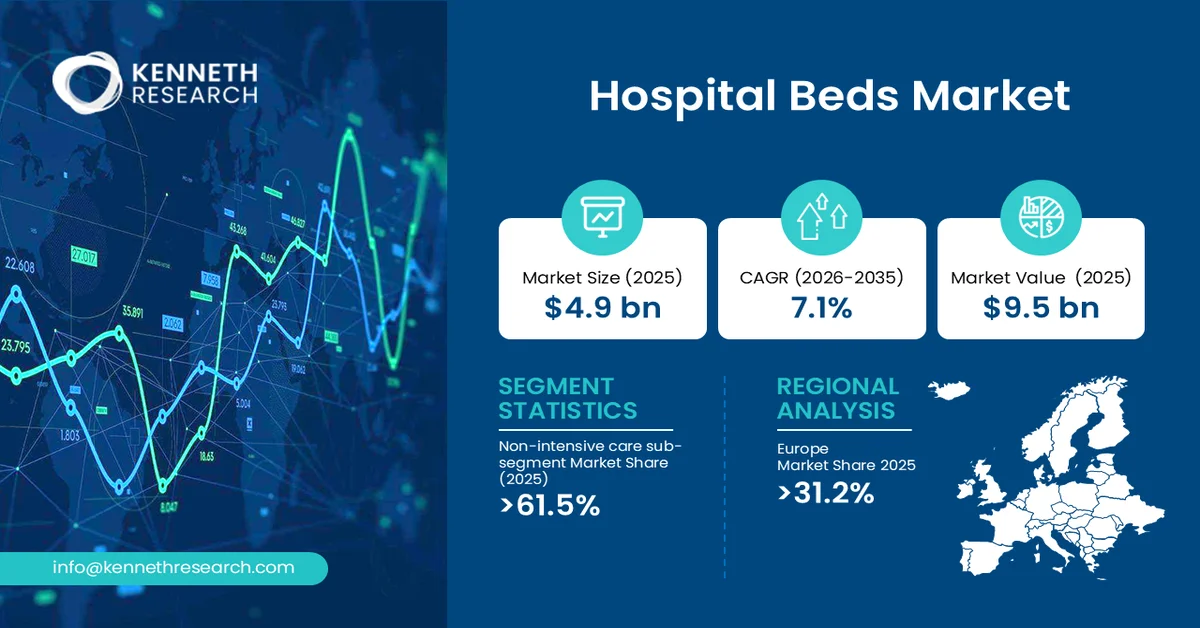
Hospital Beds Market size was valued at USD 4.9 billion in 2025 and is projected to reach USD 9.5 billion by the end of 2035, rising at a CAGR of 7.1% during the forecast period, i.e., 2026-2035. In 2026, the industry size of the hospital beds is estimated at USD 5.2 billion.
The primary growth driver for the hospital beds market is the continued expansion and modernization of healthcare infrastructure to meet rising inpatient care demand, aging populations, and emergency preparedness requirements. OECD data indicate that maintaining adequate hospital bed capacity remains a strategic priority for strengthening healthcare system resilience and ensuring timely patient care.
The hospital beds market comprises the manufacturing, distribution, and deployment of beds designed for inpatient healthcare facilities, including general wards, intensive care units, long-term care settings, rehabilitation centers, and specialty hospitals. These beds are engineered to support patient treatment, recovery, monitoring, mobility, and caregiver accessibility while complying with clinical safety and ergonomic standards. Hospital beds include manual, semi-electric, and fully electric configurations, with advanced models integrating features such as electronic positioning, pressure redistribution, patient monitoring compatibility, and infection-control designs.
The market serves a critical role within healthcare delivery by enabling efficient inpatient capacity management, improving patient comfort, and supporting clinical workflows across acute and non-acute care environments. Demand is influenced by hospital expansion projects, healthcare infrastructure investments, demographic shifts, chronic disease prevalence, and increasing requirements for technologically advanced patient care equipment. According to the OECD, hospital beds are defined as inpatient beds that are regularly maintained, staffed, and immediately available for use, encompassing acute, rehabilitative, long-term, and specialty care facilities. This makes hospital beds an essential infrastructure component for healthcare systems, directly supporting service accessibility, operational readiness, and quality of patient care.
Key Hospital Beds Market Insights Summary:
Key Takeaways: Market Trends & Insights
- Hospital Beds Market projected to grow from USD 4.9 billion in 2025 to USD 9.5 billion by 2035 at a CAGR of 7.1%
- Non-Intensive Care remained the leading application segment with a 61.5% share in 2025 driven by sustained demand for general inpatient care
- Europe accounted for the largest regional share of 31.2% in 2025 supported by advanced healthcare infrastructure and continued hospital modernization
- Hospitals are expected to remain the fastest-growing end-user segment owing to increasing investments in smart patient care technologies and healthcare facility expansion
- Asia Pacific is positioned as the key growth region supported by expanding healthcare infrastructure, rising domestic medical device manufacturing, and increasing adoption of advanced hospital beds
Market Drivers
- Growing global aging population increasing demand for long-term and acute inpatient care.
- Rising prevalence of chronic diseases requiring prolonged hospitalization and rehabilitation.
- Expansion of healthcare infrastructure and inpatient capacity.
- Rising adoption of smart and ergonomic patient care solutions.
Challenges
- High capital investment and budgetary constraints.
- Complex regulatory compliance and product certification requirements.
Hospital Beds Market Overview & Supply Chain
The global adoption of hospital beds is increasing as healthcare systems expand inpatient capacity, modernize clinical infrastructure, and strengthen preparedness for aging populations and future public health emergencies. Demand is further supported by the transition toward electrically adjustable beds, pressure-relief technologies, digital patient monitoring compatibility, and ergonomic designs that improve both patient outcomes and caregiver efficiency. Governments are also prioritizing investments in hospital infrastructure to improve healthcare accessibility and operational resilience. According to the OECD's Health at a Glance 2025, OECD countries had an average of 4.2 hospital beds per 1,000 population in 2023, underscoring the continued strategic importance of maintaining adequate inpatient capacity across developed healthcare systems. This sustained emphasis on hospital infrastructure is reinforcing procurement of advanced hospital beds across acute, rehabilitation, and long-term care facilities.
The hospital beds industry value chain begins with the procurement of raw materials and components, including structural steel, aluminum alloys, engineered plastics, electric actuators, motors, electronic control systems, casters, foam mattresses, antimicrobial fabrics, and sensor modules. Component manufacturers supply these materials to bed manufacturers, where engineering, assembly, safety testing, quality assurance, and regulatory compliance are integrated into production processes. Manufacturers also collaborate with medical technology suppliers to incorporate advanced positioning systems, connectivity features, and patient monitoring interfaces. Finished products are distributed through direct sales channels, medical equipment distributors, procurement organizations, and healthcare infrastructure contractors. Installation, maintenance, servicing, and replacement-part suppliers provide ongoing lifecycle support after deployment. The principal end users include hospitals, ambulatory surgical centers, rehabilitation facilities, long-term care institutions, and specialty clinics. Key stakeholders across the value chain include raw material suppliers, component manufacturers, original equipment manufacturers (OEMs), logistics providers, healthcare providers, government procurement agencies, regulatory authorities, and after-sales service organizations, all contributing to reliable healthcare infrastructure delivery.
Hospital Beds Market: Growth Drivers & Challenges
Growth Drivers:
- Expansion of healthcare infrastructure and inpatient capacity: The continuous expansion and modernization of healthcare infrastructure remain a fundamental growth driver for the hospital beds market. Governments are investing in new hospitals, specialty treatment centers, and healthcare facility upgrades to improve access to quality inpatient care and strengthen health system resilience. These initiatives directly increase demand for general ward, intensive care, and specialty hospital beds equipped with enhanced safety, mobility, and patient-monitoring capabilities. Infrastructure investments also encourage healthcare providers to replace aging equipment with electrically adjustable and digitally integrated beds that improve clinical efficiency and patient outcomes. As healthcare systems increasingly prioritize preparedness for demographic changes, chronic disease management, and emergency response, procurement strategies are shifting toward technologically advanced hospital furniture. According to the World Health Organization (WHO), close to one billion people in low- and lower-middle-income countries are served by health-care facilities without reliable electricity or with no electricity access, highlighting the substantial need for healthcare infrastructure upgrades that also support the deployment of modern hospital beds.
- Rising adoption of smart and ergonomic patient care solutions: Healthcare providers are increasingly adopting intelligent and ergonomically designed hospital beds to improve patient safety, caregiver productivity, and operational efficiency. Modern beds incorporate features such as automated positioning, pressure redistribution, fall prevention systems, integrated weighing functions, and compatibility with digital patient monitoring platforms. These capabilities reduce manual handling requirements, support faster clinical interventions, and enhance patient comfort during prolonged hospitalization. The ongoing digital transformation of healthcare facilities is further encouraging procurement of connected medical equipment capable of integrating with hospital information systems and smart ward environments. Manufacturers are responding by developing modular, customizable, and energy-efficient bed platforms that address diverse clinical requirements across acute, rehabilitation, and long-term care settings. As hospitals continue pursuing workflow optimization and patient-centered care models, demand for technologically advanced hospital beds is expected to accelerate, fostering innovation throughout the healthcare equipment ecosystem.
Challenges:
- High capital investment and budgetary constraints: The adoption of advanced hospital beds is often constrained by the substantial capital investment required for procurement, installation, and long-term maintenance. Modern electrically operated and digitally integrated beds involve higher acquisition costs than conventional models and frequently require complementary investments in power infrastructure, information technology integration, staff training, and preventive maintenance programs. Public healthcare systems and smaller private healthcare providers operating under fixed capital budgets may delay equipment replacement cycles, prioritizing other critical clinical assets instead. This purchasing behavior reduces procurement volumes and extends the lifespan of older hospital beds, slowing the transition to technologically advanced products. For manufacturers, prolonged sales cycles and price-sensitive procurement processes can compress margins and intensify competitive bidding. Although healthcare infrastructure modernization is expected to continue, cost optimization, lifecycle value, and financing flexibility will remain essential considerations influencing purchasing decisions across healthcare institutions.
- Complex regulatory compliance and product certification requirements: Manufacturers operating in the hospital beds market face increasingly stringent regulatory requirements governing product safety, electrical performance, biocompatibility, infection prevention, and quality management. Compliance obligations differ across countries, requiring extensive product testing, technical documentation, certification, and periodic regulatory updates before commercialization. These requirements increase product development timelines and create additional operational costs associated with design validation and quality assurance. Companies introducing innovative features such as integrated sensors, connected monitoring capabilities, or automated patient positioning systems must also address evolving cybersecurity and interoperability expectations. Smaller manufacturers may experience greater challenges in meeting diverse international regulatory standards while maintaining competitive pricing and innovation. As healthcare regulations continue to evolve alongside technological advancements, successful market participants will need robust compliance strategies, continuous product validation, and efficient regulatory management to sustain long-term commercial growth.
Hospital Beds Market Size and Forecast:
| Report Attribute | Details |
|---|---|
| Base Year |
2025 |
| Forecast Year |
2026-2035 |
| CAGR |
7.1% |
| Base Year Market Size (2025) |
USD 4.9 billion |
| Forecast Year Market Size (2035) |
USD 9.5 billion |
| Regional Scope |
|
Hospital Beds Market Segmentation Analysis:
Application Segment Analysis
In the application segment, the non-intensive care sub-segment is anticipated to capture the largest market share of 61.5% by the end of 2025.
The non-intensive care segment dominates the hospital beds market because general inpatient wards account for the majority of hospital admissions and patient stays across healthcare systems. These beds are widely used for post-operative recovery, chronic disease management, maternity care, rehabilitation, and routine medical treatment, making them essential across public and private healthcare facilities. Hospitals continue to prioritize investments in non-intensive care beds to improve patient throughput, optimize ward utilization, and accommodate growing inpatient volumes. On the supply side, manufacturers benefit from consistent procurement cycles driven by hospital expansion projects, replacement of aging equipment, and demand for electrically adjustable and ergonomically designed beds. Product innovation is increasingly focused on enhancing patient comfort, infection control, caregiver safety, and digital compatibility while maintaining cost efficiency for high-volume deployments.
End User Segment Analysis
The hospitals is projected to grow as the second-largest segment in the hospital beds market due to four converging demand drivers.
The hospitals segment is projected to experience sustained growth because hospitals remain the primary setting for inpatient treatment, surgical procedures, emergency care, intensive monitoring, and post-acute recovery. Rising demand for advanced clinical services, coupled with the modernization of healthcare infrastructure, is encouraging hospitals to invest in technologically advanced beds that enhance patient safety, improve caregiver efficiency, and support digital healthcare workflows. Healthcare providers are increasingly replacing conventional beds with electrically operated and smart-enabled models to meet evolving clinical and operational requirements. On the supply side, manufacturers are expanding product portfolios with modular designs, integrated monitoring compatibility, infection-control features, and ergonomic functionalities tailored to diverse hospital departments. Procurement is also being supported through long-term partnerships between manufacturers, healthcare providers, and public purchasing agencies. According to the OECD Health at a Glance 2025, over two-thirds of OECD countries reported between 3 and 8 hospital beds per 1,000 population in 2023, reflecting the continued importance of hospitals as the cornerstone of inpatient healthcare delivery and infrastructure planning. Looking ahead, ongoing hospital expansion, digital transformation initiatives, and the replacement of aging clinical equipment are expected to further strengthen demand from this end-user segment.
Our in-depth analysis of the global hospital beds market includes the following segments:
|
Segment |
Sub-segment |
|
Type |
|
|
Usage |
|
|
Application |
|
|
End User |
|
Hospital Beds Market Regional Insights:
Europe Market Trends & Insights:
Europe hospital beds market is projected to hold the largest revenue share of 31.2% by the end of 2025.
The region benefits from stringent medical device regulations, structured reimbursement frameworks, and sustained capital expenditure on healthcare facilities. Healthcare providers across Europe are actively replacing aging hospital equipment with technologically advanced beds that improve patient safety, infection prevention, and caregiver efficiency. The presence of globally recognized hospital bed manufacturers, extensive clinical research capabilities, and coordinated public procurement programs further strengthens regional production and adoption. According to Eurostat, the European Union recorded 511 hospital beds per 100,000 inhabitants in 2023, highlighting the region's robust inpatient healthcare capacity and its continued commitment to maintaining high standards of hospital infrastructure.
Germany remains the largest contributor within the European market due to its extensive hospital network, advanced manufacturing capabilities, and continuous investments in healthcare technology. The country's healthcare institutions consistently upgrade patient care infrastructure by adopting electrically operated and digitally integrated hospital beds that support clinical efficiency and improved patient outcomes.
France also represents a significant market, supported by a comprehensive public healthcare system, ongoing hospital modernization initiatives, and strong emphasis on patient-centered care. Both countries benefit from established procurement mechanisms, high-quality manufacturing ecosystems, and rigorous regulatory standards that encourage the adoption of innovative hospital bed solutions. Looking ahead, continued investments in healthcare infrastructure, increasing demand for technologically advanced medical equipment, and the modernization of inpatient facilities are expected to reinforce Europe's leadership in the hospital beds market over the forecast period.
Asia Pacific Market Trends & Insights:
Asia Pacific is emerging as a high-growth region in the hospital beds market due to rapid healthcare infrastructure development, expanding hospital networks, and increasing access to institutional healthcare services. Governments across the region are prioritizing investments in new hospitals, specialty medical centers, and rural healthcare facilities to address growing healthcare needs driven by urbanization, aging populations, and the rising burden of chronic diseases. The region is also experiencing strong industrial activity, supported by expanding medical device manufacturing capabilities, cost-competitive production, and increasing adoption of technologically advanced hospital equipment. Healthcare providers are progressively replacing conventional hospital beds with electric and smart-enabled models that improve patient safety, operational efficiency, and caregiver productivity. In addition, policy initiatives promoting healthcare modernization and domestic medical device production are creating favorable conditions for sustained industry expansion. As healthcare systems continue to evolve, demand for advanced hospital beds is expected to accelerate across both developed and emerging economies within the region.
China represents the largest opportunity within Asia Pacific due to its extensive healthcare infrastructure expansion, large hospital network, and strong domestic medical device manufacturing ecosystem. Ongoing investments in hospital construction, digital healthcare technologies, and modernization of public healthcare facilities continue to support procurement of advanced hospital beds across multiple levels of care.
Japan also remains a strategically important market, supported by its aging population, high clinical standards, and emphasis on improving long-term and acute inpatient care. Healthcare institutions in Japan increasingly prioritize technologically sophisticated hospital beds that enhance patient comfort, reduce caregiver workload, and integrate with digital healthcare systems. The combination of China's manufacturing strength and Japan's advanced healthcare environment positions Asia Pacific as a key region for future innovation, production, and adoption within the hospital beds market.
Leading Companies Operating in the Global Hospital Beds Market:
Here is a list of upstream, downstream, and key players operating in the global hospital beds market competitive ecosystem:
- LINET Group (Europe)
- Company Overview
- Business Strategy
- Key Product Offerings
- Financial Performance
- Key Performance Indicators
- Risk Analysis
- Recent Development
- Regional Presence
- SWOT Analysis
- Paramount Bed (Japan)
- Hill-Rom (United States)
- Stiegelmeyer GmbH & Co. KG (Germany)
- Trinodal (Turkey)
- France Bed (Japan)
- Ankitech (India)
Recent Developments
- November 2024: Reuters reported that Aster DM Healthcare agreed to merge with Blackstone-backed Quality Care India, creating one of India's largest hospital networks with more than 10,000 beds. The merged entity also announced plans to add approximately 3,500 additional beds by FY2027, reflecting sustained investment in hospital infrastructure.
- February 2025: Reuters reported that Apollo Hospitals Enterprise reaffirmed plans to add 3,512 new hospital beds over the next three to four years, supported by rising occupancy rates and increasing demand for specialty healthcare services across India.
Frequently Asked Question
In 2025, the hospital beds market exceeded USD 4.9 billion.
The hospital beds market is projected to reach USD 9.5 billion by the end of 2035, expanding at a CAGR of 7.1% over the forecast period (2026-2035).
The major players in the market are LINET Group (Europe), Paramount Bed (Japan), Hill-Rom (United States), Stiegelmeyer GmbH & Co. KG (Germany), Trinodal (Turkey), France Bed (Japan), Ankitech (India), and others.
In the application segment, the Non-Intensive Care sub-segment is anticipated to capture the largest market share of 61.5% in the future and exhibit lucrative growth opportunities during 2026-2035. This growth trajectory is largely attributed to continued investments in healthcare infrastructure and sustained demand for general inpatient care across hospitals.
Europe is projected to hold the largest market share of 31.2% by the end of 2035 and provide more business opportunities in the future. Continuous investments in healthcare infrastructure and hospital modernization across Germany and France are fostering the region's dominance.
Why Choose Kenneth Research ?
-
Insight with Impact : We don’t just gather data — we uncover stories, trends, and opportunities that fuel business growth.
-
Experts Who Get It : Our team speaks your industry’s language and knows what really matters to your customers and market.
-
Custom-Built for You : Forget one-size-fits-all. We craft research and consulting solutions as unique as your business vision.
-
Partners, Not Just Providers : We work with you, not for you — collaborating closely to turn insights into smart, strategic moves.
-
Results That Speak : Our work powers brands, startups, and industry leaders alike — with a track record of ideas that work in the real world.
Report ID: 1104 |
Published Date: 18 Aug 2026 |
Report Format: |
Delivery Timeline: 48-72 Business Hours

Copyright © 2025 Kenneth Research. All rights reserved. Terms of Use | Privacy Policy
