Report ID: 1013 |
Published Date: 29 Jul 2026 |
Report Format: |
Delivery Timeline: 48-72 Business Hours
Home Improvement Market Outlook:
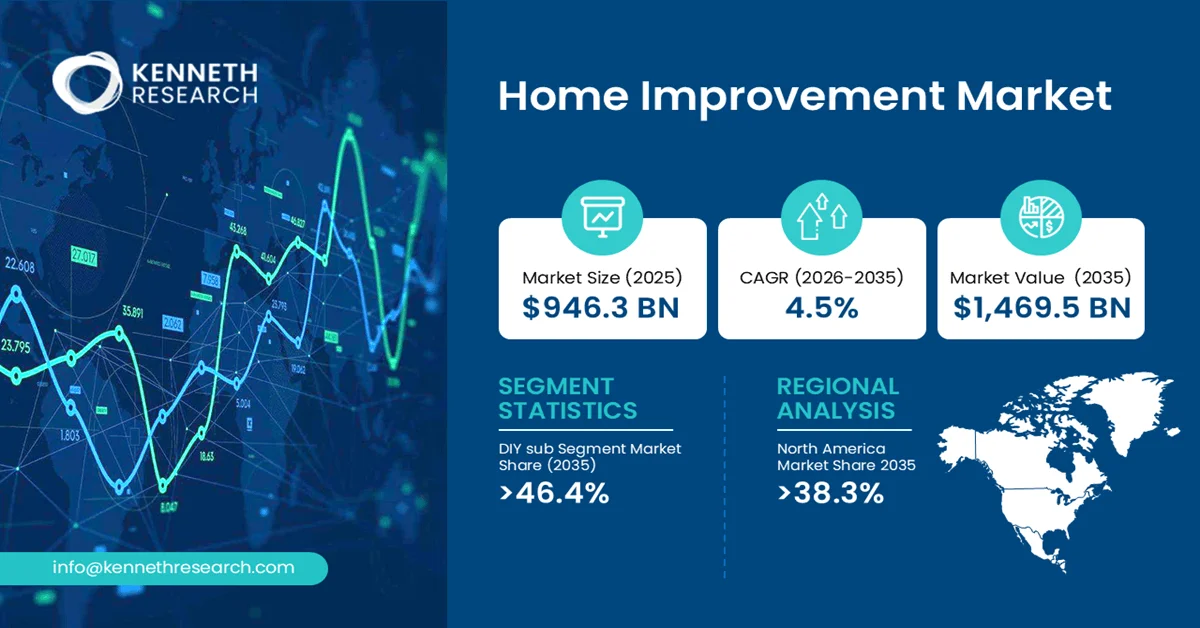
Home Improvement Market size was valued at USD 946.3 billion in 2025 and is projected to reach USD 988.8 billion in 2026. In addition, the home improvement industry is further expected to be worth USD 1,469.5 billion by the end of 2035, rising at a CAGR of 4.5% during the forecast period, i.e., 2026-2035.
The primary growth driver of the market is the increasing investment in residential renovation and modernization projects driven by aging housing stock, rising home equity, energy-efficiency upgrades, and smart-home adoption. Homeowners are increasingly improving existing properties instead of relocating, creating sustained demand for renovation products, materials, and services globally.
The home improvement market comprises products, materials, technologies, and services used to renovate, remodel, repair, upgrade, and maintain residential properties. The market encompasses interior and exterior improvements, including kitchen remodeling, bathroom upgrades, flooring, roofing, insulation, lighting, landscaping, smart-home installations, and energy-efficiency enhancements. It serves homeowners, contractors, renovation specialists, building material suppliers, and retail distributors. The sector plays a critical role in residential asset preservation, property value enhancement, housing sustainability, and modernization of existing housing infrastructure.
Key Home Improvement Market Insights Summary:
Key Takeaways: Market Trends & Insights
- In the project segment, the DIY sub-segment is anticipated to capture the revenue share of 46.4% during 2026-2035
- North America home improvement market is projected to hold the largest revenue share of 38.3% by the end of 2035
- Japan held an estimated 6.2% share of the global home improvement market in 2025
- The major players in the market are Sherwin-Williams, Saint-Gobain, A.O. Smith Corporation, Husqvarna Group, and others.
Market Drivers
- Rising Demand for Energy-Efficient Residential Upgrades
- Expansion of Smart Home and Connected Living Ecosystems
- Growing Residential Remodeling and Property Value Enhancement Activities
- Increasing Availability of Omnichannel Home Improvement Products and Services
Challenges
- Skilled Labor Shortages and Contractor Capacity Constraints
- Inflationary Pressure and Project Affordability Concerns
Home Improvement Market Overview & Supply Chain
The home improvement market’s value chain begins with suppliers of raw materials and inputs, including lumber, engineered wood, metals, cement, glass, plastics, insulation materials, paints, coatings, adhesives, fixtures, and electronic components used in smart-home products. These inputs are sourced from forestry companies, mining operators, chemical manufacturers, and industrial material producers. Manufacturers then convert these materials into finished products such as flooring, roofing systems, cabinetry, windows, doors, lighting solutions, appliances, plumbing fixtures, and home automation systems through specialized production and assembly processes.
Distribution occurs through a combination of wholesalers, building material distributors, home improvement retailers, e-commerce platforms, and professional contractor networks. Efficient logistics and inventory management are critical to ensuring product availability across residential renovation projects. End users include homeowners, property managers, residential developers, and renovation contractors. Major stakeholders throughout the value chain comprise raw material suppliers, product manufacturers, technology providers, distributors, retailers, installation service providers, contractors, regulatory bodies, and sustainability certification organizations that collectively influence product standards, innovation, and market adoption.
Home Improvement Market: Growth Drivers & Challenges
Growth Drivers:
- Rising Demand for Energy-Efficient Residential Upgrades: The growing emphasis on energy conservation, sustainability, and long-term cost savings is accelerating demand for energy-efficient home improvement solutions. Homeowners are increasingly investing in insulation systems, energy-efficient windows and doors, advanced HVAC upgrades, roofing improvements, and smart energy management technologies to reduce energy consumption and improve residential performance. According to the International Energy Agency (IEA), buildings account for approximately 30% of global final energy consumption and 26% of global energy-related emissions from operations, underscoring the importance of residential efficiency upgrades in achieving sustainability objectives. This trend is expected to support long-term innovation and investment across the home improvement value chain.
- Expansion of Smart Home and Connected Living Ecosystems: The increasing integration of connected technologies into residential environments is creating substantial opportunities for the home improvement industry. Consumers are adopting smart lighting systems, intelligent thermostats, connected security solutions, automated window coverings, voice-controlled devices, and integrated home management platforms to improve convenience, safety, and operational efficiency. As digital lifestyles become more prevalent, home improvement projects are increasingly incorporating technology-enabled upgrades alongside traditional renovation activities. Looking ahead, advances in artificial intelligence, Internet of Things (IoT) connectivity, predictive maintenance, and interoperable smart-home platforms are expected to further transform residential improvement strategies. As consumers prioritize convenience, personalization, and connected living experiences, technology-driven home upgrades will remain a significant catalyst for industry expansion.
Challenges:
- Skilled Labor Shortages and Contractor Capacity Constraints: A persistent shortage of skilled tradespeople, including electricians, plumbers, carpenters, roofers, and renovation specialists, remains a significant restraint on the home improvement market. The challenge stems from an aging workforce, insufficient entry of younger workers into trade professions, and increasing demand for specialized installation services associated with modern renovation projects. As home improvement activities become more technologically advanced, the need for workers capable of installing smart-home systems, energy-efficient equipment, and integrated building solutions continues to grow. The shortage affects project timelines, service availability, and labor costs across the industry.
- Inflationary Pressure and Project Affordability Concerns: Rising costs associated with building materials, transportation, financing, and professional services continue to create affordability challenges for homeowners considering renovation projects. Economic uncertainty and elevated household expenses often encourage consumers to postpone discretionary upgrades, prioritize essential repairs, or reduce project scope. This dynamic is particularly impactful for large-scale remodeling activities that require substantial upfront investment. From an industry perspective, affordability pressures can lead to fluctuating demand patterns, increased price sensitivity, and more cautious purchasing behavior. Manufacturers and retailers may experience slower adoption of premium products, while contractors face greater pressure to balance competitive pricing with profitability.
Home Improvement Market Size and Forecast:
| Report Attribute | Details |
|---|---|
| Base Year |
2025 |
| Forecast Year |
2026-2035 |
| CAGR |
4.5% |
| Base Year Market Size (2025) |
USD 946.3 billion |
| Forecast Year Market Size (2035) |
USD 1,469.5 billion |
| Regional Scope |
|
Home Improvement Market Segmentation Analysis:
Project Segment Analysis
The DIY sub-segment, part of the project segment, is anticipated to garner the largest share of 46.4% in the home improvement market by the end of 2035.
The aspects of growing consumer interest in cost-effective renovation solutions, increasing accessibility of home improvement products, and widespread availability of digital learning resources. From a supply-side perspective, manufacturers and retailers continue to introduce easy-to-install products, modular solutions, and comprehensive project kits designed specifically for non-professional users. Government-backed energy-efficiency initiatives are also encouraging homeowners to undertake upgrade projects. According to the U.S. Environmental Protection Agency’s ENERGY STAR program, more than 190,000 ENERGY STAR-certified homes and apartments were built in 2023, demonstrating sustained demand for residential efficiency improvements and consumer engagement with home enhancement solutions.
End use Segment Analysis
The kitchen improvements sub-segment, which is under the end use segment, is projected to hold a considerable share during the forecast period.
Kitchens continue to serve as multifunctional spaces for cooking, dining, working, and social interaction, based on which homeowners are prioritizing upgrades that improve convenience, storage capacity, and overall living experiences. Demand is being further supported by the adoption of energy-efficient appliances, smart kitchen technologies, premium cabinetry, advanced lighting systems, and sustainable materials. Industry adoption trends indicate a shift toward connected kitchens featuring intelligent appliances, touchless fixtures, and integrated energy management solutions. On the supply side, manufacturers are introducing modular cabinetry, customizable storage systems, and easy-to-install renovation products that simplify remodeling projects while reducing installation complexity.
Our in-depth analysis of the global home improvement market includes the following segments:
|
Segment |
Sub-segment |
|
Project |
|
|
End use |
|
|
Resident |
|
|
Distribution Channel |
|
Home Improvement Market Regional Insights:
North America Market Trends & Insights:
North America maintains its position as the dominant region in the global home improvement market, capturing 38.3% of total market value by 2035.
Its leadership position is highly attributed to its mature housing sector, high consumer spending on residential upgrades, well-established contractor networks, and widespread adoption of energy-efficient and smart-home solutions. The region benefits from a robust ecosystem of building material manufacturers, home improvement retailers, technology providers, and professional renovation service companies. A key indicator of regional strength is the scale of residential improvement expenditure. According to data derived from the U.S. Bureau of Economic Analysis (BEA), U.S. residential fixed investment in home improvements reached approximately USD 402.6 billion in 2024, reflecting the substantial level of renovation activity that supports regional market leadership.
The U.S. represents the largest contributor to the home improvement market demand in the overall regional, supported by extensive remodeling activity, strong homeownership levels, and growing adoption of smart-home and energy-efficiency upgrades. The presence of large retail chains, specialized contractors, and advanced distribution networks further strengthens market penetration. Millennial households (aged 30-45) are entering peak home improvement spending years, while federal energy efficiency incentives continue to influence retrofit decisions. The integration of smart home technologies—connected thermostats, lighting, security, and appliances, is further elevating project values.
The home improvement market in Canada demonstrates consistent activity concentrated in metropolitan Vancouver, Toronto, and Montreal. Statistics Canada’s Residential Renovation Price Index (RRPI) tracks price changes across 37 distinct renovation project types and 15 Census Metropolitan Areas, confirming sustained renovation demand. The market is characterized by aging condominium and detached housing stock that are undergoing systematic upgrades, alongside government-mandated energy efficiency programs and climate adaptation retrofits addressing extreme weather resilience. Key project categories include kitchen and bath remodeling, exterior replacements, and energy efficiency installations.
Asia Pacific Market Trends & Insights:
The Asia Pacific is demonstrated as the fastest-growing region within the home improvement.
The growth is fueled by rapid urbanization, rising disposable incomes, evolving housing preferences, and increasing adoption of modern residential technologies. Demand for home improvement products and services is expanding as homeowners seek enhanced living standards, energy-efficient solutions, smart-home integration, and aesthetically upgraded residential spaces. Future opportunities are expected to arise from increasing renovation of aging residential properties, growing adoption of connected-home technologies, and rising consumer awareness of sustainability-focused home upgrades.
The China-based home improvement market is driven by urbanization rates and a decades-long housing construction boom that has created a large inventory of homes now entering their first major renovation cycle. Government-led old community renovation programs, announced in the 14th Five-Year Plan (2021-2025), target the systematic upgrade of pre-2000 residential buildings, focusing on plumbing, electrical safety, elevator installation, and energy efficiency improvements. Industrial activity is concentrated in Guangdong, Zhejiang, and Jiangsu provinces, which are major manufacturing hubs for sanitary ware, lighting, flooring, and furniture. Future opportunities include premiumization as middle-class households shift from basic repairs to aspirational kitchen and bath remodeling.
Japan's home improvement market is characterized by an aging housing stock before stricter seismic standards were enacted. This creates sustained demand for seismic retrofitting, foundation reinforcement, and building integrity assessments. Government initiatives, including MLIT's Child-rearing Eco-Home Support Program and Advanced Window Renovation 2024, subsidize insulation, high-efficiency windows, and energy equipment upgrades. Market demand is further influenced by an aging population, which drives barrier-free renovations and bathroom conversions from traditional soaking tubs to accessible walk-in showers. Industrial activity includes precision manufacturing of smart toilet systems, modular bathroom units, and space-saving storage solutions tailored to Japan's compact urban dwellings.
Leading Companies Operating in the Global Home Improvement Market:
The home improvement market is characterized by the presence of diversified building material manufacturers, home improvement retailers, home furnishing companies, appliance providers, and smart-home technology suppliers competing through product innovation, omnichannel distribution, sustainability initiatives, and customer experience enhancement. Market participants are increasingly focusing on energy-efficient solutions, digital commerce platforms, connected-home technologies, and supply chain optimization to strengthen their competitive positions. Companies with extensive distribution networks, strong brand recognition, and integrated product ecosystems continue to maintain a competitive advantage across global markets.
Here is a list of key players operating in the global home improvement market:
|
Company |
Specialty |
HQ |
Position |
|
The Home Depot |
Home improvement retail and contractor solutions |
United States |
Leader |
|
Lowe's Companies, Inc. |
Residential renovation products and services |
United States |
Leader |
|
Kingfisher plc |
DIY retail and home renovation solutions |
United Kingdom |
Major |
|
Masco Corporation |
Plumbing fixtures and decorative building products |
United States |
Major |
|
Whirlpool Corporation |
Kitchen and home appliances |
United States |
Major |
|
IKEA |
Modular furniture and home improvement solutions |
Sweden |
Major |
|
Sherwin-Williams |
Paints, coatings, and finishing solutions |
United States |
Major |
|
Saint-Gobain |
Construction materials and insulation products |
France |
Major |
|
A.O. Smith Corporation |
Water heating and treatment systems |
United States |
Niche |
|
Husqvarna Group |
Landscaping and outdoor improvement equipment |
Sweden |
Niche |
Recent Developments
- In December 2025, QuinStreet Inc. announced a definitive agreement to acquire SIREN GROUP AG, operating as HomeBuddy, a digital marketplace platform connecting homeowners with home services professionals
- In August 2025, Lowe's Companies, Inc. announced an $8.8 billion agreement to acquire Foundation Building Materials (FBM), a leading North American distributor of interior building products.
- In June 2025, The Home Depot, through its wholly owned specialty trade distribution subsidiary SRS Distribution Inc., entered into a definitive agreement to acquire GMS Inc., a leading North American specialty building products distributor, for an enterprise value of approximately $5.5 billion ($4.3 billion equity value).
Frequently Asked Question
In 2025, the home improvement market exceeded USD 946.3 billion.
The home improvement market is projected to reach USD 1,469.5 billion by the end of 2035, expanding at a CAGR of 4.5% over the forecast period (2026-2035).
The major players in the market are The Home Depot, Lowe's, Masco Corporation, Fortune Brands Innovations, Sekisui House, Andersen Corporation, JELD-WEN Inc., Kohler Co., Mohawk Industries, Owens Corning, and others.
In the project segment, the DIY sub-segment is anticipated to capture the largest market share of 46.4% in the future and exhibit lucrative growth opportunities during 2026-2035. This growth trajectory is largely attributed to the sustained proliferation of digital instructional content and labor cost inflation widening the cost differential between self-executed and professionally installed projects.
North America is projected to hold the largest market share of 38.3% by the end of 2035 and provide more business opportunities in the future. Sustained renovation spending in the U.S., supported by elevated home equity levels exceeding $17 trillion in tappable equity, and consistent activity across Canada's metropolitan corridors, is fostering the region's dominance.
Why Choose Kenneth Research ?
-
Insight with Impact : We don’t just gather data — we uncover stories, trends, and opportunities that fuel business growth.
-
Experts Who Get It : Our team speaks your industry’s language and knows what really matters to your customers and market.
-
Custom-Built for You : Forget one-size-fits-all. We craft research and consulting solutions as unique as your business vision.
-
Partners, Not Just Providers : We work with you, not for you — collaborating closely to turn insights into smart, strategic moves.
-
Results That Speak : Our work powers brands, startups, and industry leaders alike — with a track record of ideas that work in the real world.
Report ID: 1013 |
Published Date: 29 Jul 2026 |
Report Format: |
Delivery Timeline: 48-72 Business Hours

Copyright © 2025 Kenneth Research. All rights reserved. Terms of Use | Privacy Policy
