Report ID: 1103 |
Published Date: 18 Aug 2026 |
Report Format: |
Delivery Timeline: 48-72 Business Hours
Hearing Loop Market Outlook:
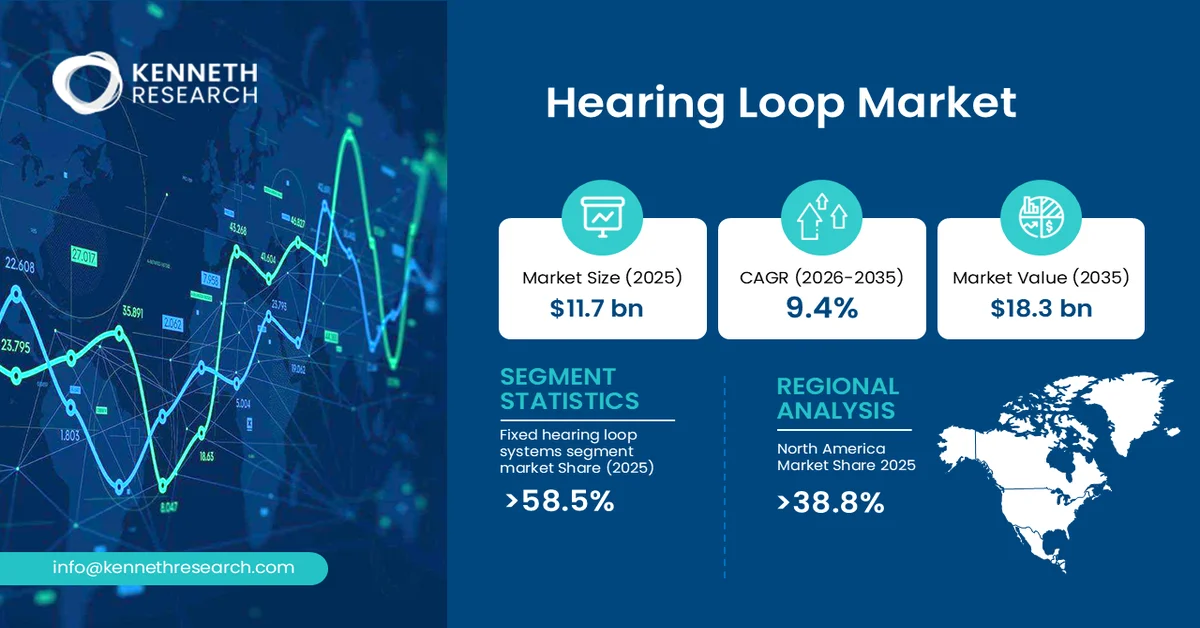
Hearing Loop Market size was valued at USD 11.7 billion in 2025 and is projected to reach USD 18.3 billion by the end of 2035, rising at a CAGR of 9.4% during the forecast period, i.e., 2026-2035. In 2026, the industry size of the hearing loop is estimated at USD 12.8 billion.
The primary growth driver for the hearing loop market is the rising emphasis on inclusive communication infrastructure in public and commercial environments. Growing government-backed hearing care initiatives and accessibility policies are encouraging the installation of hearing loop systems in transport hubs, healthcare facilities, educational institutions, and public venues to improve speech intelligibility for people with hearing loss.
The hearing loop market comprises the development, manufacturing, installation, and maintenance of induction loop systems designed to transmit clear audio signals directly to hearing aids and cochlear implants equipped with telecoils. These systems minimize background noise and reverberation by delivering electromagnetic signals from sound sources such as microphones, public address systems, and audiovisual equipment directly to compatible hearing devices. Hearing loop solutions are available as fixed installations for permanent venues and portable systems for temporary or mobile applications, supporting accessibility across diverse environments.
The market plays an important role in improving communication accessibility across healthcare facilities, educational institutions, transportation terminals, government buildings, workplaces, hospitality venues, and entertainment locations. As organizations increasingly prioritize compliance with accessibility standards and inclusive public services, hearing loop systems have become an essential assistive listening technology that complements broader digital accessibility initiatives. Their industrial relevance extends across infrastructure development, commercial building modernization, public sector investments, and smart facility projects, where reliable speech transmission and equitable access to information are becoming integral components of user-centered building design and service delivery.
Key Hearing Loop Market Insights Summary:
Key Takeaways: Market Trends & Insights
- The hearing loop market is projected to grow from USD 11.7 billion in 2025 to USD 18.3 billion by 2035, registering a CAGR of 9.4% during the forecast period (2026-2035)
- Fixed Hearing Loop Systems led the product type segment with a 58.5% share in 2025, driven by widespread deployment across permanent public and commercial facilities
- North America accounted for the largest regional share of 34.8% in 2025, supported by strong investments in accessible infrastructure across the United States and Canada
- The public infrastructure application segment is expected to witness robust growth due to increasing adoption of hearing loop systems in transportation hubs, government buildings, healthcare facilities, and educational institutions
- The market is being supported by rising implementation of inclusive communication technologies and accessibility-focused infrastructure development across healthcare, public services, and commercial buildings
Market Drivers
- Expansion of accessibility regulations across public infrastructure and commercial buildings
- Increasing modernization of healthcare and educational communication systems
- Growing deployment of hearing assistance technologies in transportation hubs and civic facilities
- Advancements in digital audio processing and integrated assistive listening solutions
Challenges
- High installation complexity and retrofitting costs in existing infrastructure
- Competition from alternative assistive listening technologies
Hearing Loop Market Overview & Supply Chain
The adoption of hearing loop systems is increasing globally as governments, transport authorities, healthcare providers, and commercial building owners place greater emphasis on accessible communication environments. These systems enable direct audio transmission to telecoil-enabled hearing devices, improving speech clarity in locations where background noise and reverberation can hinder communication. Their integration into public infrastructure aligns with broader accessibility initiatives, inclusive building design, and modernization of public facilities. Technological improvements in audio processing, compatibility with digital public address systems, and integration with smart building infrastructure are further expanding deployment opportunities across transportation, education, healthcare, and civic facilities. Industry relevance is reinforced by the growing demand for assistive technologies worldwide. According to the World Health Organization, more than 2.5 billion people currently need one or more assistive products, highlighting the increasing importance of accessible technologies, including hearing assistance solutions, within national healthcare and public infrastructure strategies.
The hearing loop market value chain begins with the procurement of electronic components and conductive materials, including copper loop cables, amplifiers, microphones, signal processors, connectors, and control modules sourced from specialized electronics suppliers. Manufacturers integrate these components into fixed and portable hearing loop systems while ensuring compliance with accessibility, electrical safety, and electromagnetic compatibility standards. System integrators and engineering contractors customize installations according to building layouts and acoustic requirements, particularly for healthcare facilities, educational institutions, transportation terminals, auditoriums, commercial buildings, and government infrastructure. Distribution occurs through authorized distributors, audiovisual solution providers, accessibility specialists, and electrical contractors, who also provide installation, calibration, testing, and maintenance services. End users include public authorities, hospitals, universities, corporate offices, hospitality operators, cultural venues, and transport agencies seeking accessible communication environments. Major stakeholders comprise component manufacturers, hearing loop equipment suppliers, building developers, system integrators, accessibility consultants, facility management providers, regulatory bodies, procurement agencies, and organizations representing individuals with hearing loss.
Hearing Loop Market: Growth Drivers & Challenges
Growth Drivers:
- Expansion of national hearing care and assistive technology programs: The growing integration of hearing care into national public health strategies is creating sustained demand for hearing loop systems across healthcare facilities, public infrastructure, education, and community spaces. Governments are increasingly recognizing hearing accessibility as an essential component of inclusive service delivery, encouraging investments in assistive listening technologies that improve communication for individuals with hearing impairment. This trend is accelerating procurement of hearing loop installations in publicly funded projects and modernization programs. The long-term effect extends beyond healthcare, influencing transportation, government buildings, cultural venues, and commercial developments that seek to improve accessibility compliance and user experience. According to the World Health Organization, more than 700 million people are projected to require hearing rehabilitation by 2050, reinforcing the need for accessible hearing support technologies and related infrastructure worldwide.
- Integration of hearing loop systems into smart and inclusive building infrastructure: The increasing adoption of smart buildings and digitally connected public infrastructure is strengthening the role of hearing loop systems as part of modern building design. Architects, engineering firms, and facility owners are incorporating assistive listening technologies during new construction and renovation projects to improve accessibility while minimizing future retrofit costs. Integration with digital public address systems, conference technologies, emergency communication networks, and audiovisual platforms enhances operational efficiency and user experience across commercial and institutional environments. As organizations prioritize universal design principles, hearing loop systems are evolving from optional accessibility features into core communication infrastructure. This transition is expected to encourage greater collaboration between building technology providers, accessibility consultants, and system integrators, creating long-term opportunities for innovation, standardized deployment practices, and broader adoption across both public and private infrastructure projects.
Challenges:
- High installation complexity and retrofitting costs in existing infrastructure: One of the most significant restraints affecting the hearing loop market is the complexity of installing induction loop systems in existing buildings that were not originally designed to accommodate assistive listening infrastructure. Retrofitting often requires modifications to flooring, wiring layouts, electrical systems, and audio distribution networks while ensuring minimal disruption to ongoing operations. Buildings with reinforced concrete, metal structures, or complex architectural designs may require customized engineering solutions to achieve consistent signal coverage, increasing project timelines and implementation costs. These technical challenges can discourage facility owners from adopting permanent hearing loop systems, particularly when capital budgets are constrained. Commercially, suppliers face longer sales cycles and greater dependence on engineering expertise rather than standardized product deployment. As infrastructure modernization continues globally, manufacturers and installers are expected to focus on flexible system architectures and simplified installation methods that reduce retrofit complexity.
- Competition from alternative assistive listening technologies: The hearing loop market also faces increasing competitive pressure from alternative assistive listening technologies, including radio frequency, infrared, Bluetooth-based, and network-enabled audio transmission systems. Many organizations evaluate multiple accessibility solutions based on building layout, user preferences, compatibility with existing audiovisual infrastructure, and long-term maintenance requirements. Rapid innovation in wireless audio technologies has expanded the range of options available to facility operators, particularly in environments where flexible or temporary installations are preferred over permanent induction loop systems. This competitive landscape requires hearing loop manufacturers to continuously improve interoperability, audio quality, installation efficiency, and lifecycle support to remain attractive in procurement decisions. From a commercial perspective, pricing pressure and product differentiation are becoming increasingly important, while future market growth will depend on demonstrating the unique accessibility, reliability, and regulatory advantages of hearing loop technology within evolving communication ecosystems.
Hearing Loop Market Size and Forecast:
| Report Attribute | Details |
|---|---|
| Base Year |
2025 |
| Forecast Year |
2026-2035 |
| CAGR |
9.4% |
| Base Year Market Size (2025) |
USD 11.7 billion |
| Forecast Year Market Size (2035) |
USD 18.3 billion |
| Regional Scope |
|
Hearing Loop Market Segmentation Analysis:
Product Type Segment Analysis
In the product type segment, the fixed hearing loop systems sub-segment is anticipated to capture the largest market share of 58.5% by the end of 2025.
Fixed hearing loop systems dominate the hearing loop market because they provide permanent, highly reliable assistive listening infrastructure for locations that require continuous accessibility, including hospitals, transportation terminals, educational institutions, government buildings, places of worship, conference centers, and entertainment venues. Their ability to integrate directly with public address systems and building audio networks enables consistent, high-quality sound transmission for telecoil-equipped hearing devices without requiring users to borrow additional receivers. Demand is further supported by the increasing emphasis on inclusive building design, long-term infrastructure modernization, and accessibility compliance in both public and commercial facilities. On the supply side, manufacturers continue to enhance system performance through improved amplifiers, digital signal processing, and simplified installation solutions, making fixed systems suitable for projects of varying sizes. According to the U.S. National Institute on Deafness and Other Communication Disorders (NIDCD), about 28.8 million U.S. adults could benefit from using hearing aids, reinforcing the growing need for permanent assistive listening infrastructure in public environments. Looking ahead, wider adoption of universal accessibility standards and smart building integration is expected to further strengthen demand for fixed hearing loop installations.
Application Segment Analysis
The public infrastructure is projected to grow as the second-largest segment in the hearing loop market due to four converging demand drivers.
The public infrastructure segment is projected to witness strong growth as governments and public authorities continue prioritizing inclusive communication environments across transportation terminals, government offices, healthcare facilities, educational institutions, cultural venues, and civic buildings. Increasing investment in accessibility upgrades, combined with the modernization of public address and emergency communication systems, is creating favorable conditions for integrating hearing loop technology into both new developments and renovation projects. Facility operators are also recognizing the operational benefits of providing seamless assistive listening without requiring visitors to borrow additional equipment, improving accessibility while reducing administrative complexity. On the supply side, manufacturers are expanding portfolios with scalable loop amplifiers, advanced signal processing, and solutions that integrate with digital building management and audiovisual systems, making deployment more efficient across large public facilities. Demand is further supported by demographic trends. According to the u.s. centers for disease control and prevention (cdc), in 2021, 39.5% of adults aged 85 years and older used a hearing aid, highlighting the increasing need for accessible listening infrastructure in public environments serving aging populations. Looking ahead, continued investment in universal accessibility and smart public infrastructure is expected to reinforce long-term growth for this application segment.
Our in-depth analysis of the global hearing loop market includes the following segments:
|
Segment |
Sub-segment |
|
Product Type |
|
|
Application |
|
|
End-Use |
|
|
Technology |
|
Hearing Loop Market Regional Insights:
North America Market Trends & Insights:
North America hearing loop market is projected to hold the largest revenue share of 34.8% by the end of 2025.
The region benefits from established regulatory frameworks promoting equal access in public and commercial environments, encouraging deployment of hearing loop systems across healthcare facilities, transportation hubs, educational institutions, government buildings, and cultural venues. Continuous modernization of public infrastructure, growing investment in smart buildings, and increasing integration of advanced audiovisual technologies further support regional leadership. The presence of specialized manufacturers, system integrators, and accessibility consultants also strengthens supply capabilities, enabling efficient implementation and long-term maintenance of hearing loop installations across diverse end-use sectors.
The United States remains the largest contributor to regional demand, supported by large-scale infrastructure modernization, accessibility-focused procurement, and a well-developed ecosystem of assistive technology providers.
Canada is also experiencing steady adoption through investments in inclusive public services, healthcare facilities, transit infrastructure, and community spaces designed to improve communication accessibility. Regional demand is reinforced by the prevalence of hearing-related disabilities. According to the U.S. Centers for Disease Control and Prevention (CDC), 15.7% of U.S. adults aged 18 years and older reported having any difficulty hearing in 2024, underscoring the importance of accessible listening technologies across public and commercial settings. As both countries continue investing in inclusive infrastructure and digital building upgrades, North America is expected to retain its leadership position in the market.
Europe Market Trends & Insights:
Europe represents a strategically important region for the hearing loop market, supported by a strong commitment to accessible public services, inclusive infrastructure, and advanced building modernization initiatives. Demand is being driven by the integration of assistive listening technologies into healthcare facilities, educational institutions, transportation networks, government buildings, cultural venues, and commercial developments. The region's emphasis on universal accessibility, coupled with continuous renovation of public infrastructure and growing adoption of smart building technologies, is encouraging wider deployment of permanent hearing loop installations. Manufacturers and system integrators also benefit from established technical standards, high-quality engineering capabilities, and collaboration with accessibility consultants during both new construction and refurbishment projects. Looking ahead, opportunities are expected to expand through digital transformation of public facilities, sustainable building programs, and greater incorporation of inclusive communication technologies into long-term infrastructure planning.
The United Kingdom remains one of Europe's most mature markets for hearing loop systems, supported by widespread awareness of assistive listening technologies, established accessibility practices, and continued investment in public venues, transport facilities, healthcare institutions, and educational campuses.
Germany is witnessing growing adoption as infrastructure modernization, industrial engineering expertise, and smart building integration create favorable conditions for advanced assistive communication solutions. Increasing collaboration among technology providers, construction firms, and public authorities is supporting deployment across commercial and institutional projects. As both countries continue prioritizing inclusive environments and digital infrastructure, they are expected to remain key contributors to the region's long-term market development.
Leading Companies Operating in the Global Hearing Loop Market:
Here is a list of upstream, downstream, and key players operating in the global hearing loop market competitive ecosystem:
- Ampetronic (United Kingdom)
- Company Overview
- Business Strategy
- Key Product Offerings
- Financial Performance
- Key Performance Indicators
- Risk Analysis
- Recent Development
- Regional Presence
- SWOT Analysis
- Williams AV, LLC (United States)
- Univox Audio (United Kingdom)
- Audio Directions (United States)
- Bo Edin AB (Sweden)
- C-TEC (Computionics Limited) (United Kingdom)
Recent Developments
- March 2025: Connected Places Catapult, in partnership with Network Rail and Innovate UK, selected an assistive listening solution using Auracast™ broadcast audio for deployment at Bristol Temple Meads Station. The project aims to improve accessibility for passengers with hearing loss and demonstrates the evolution of traditional hearing loop infrastructure toward hybrid assistive listening technologies.
- July 2025: Bristol Temple Meads Station completed the first public transport installation of the Auri™ Auracast assistive listening system, allowing passengers to receive station announcements directly through compatible hearing aids, cochlear implants, earbuds, and smartphones. The deployment represents a significant advancement in public audio accessibility.
Frequently Asked Question
In 2025, the hearing loop market exceeded USD 11.7 billion.
The hearing loop market is projected to reach USD 18.3 billion by the end of 2035, expanding at a 9.4% CAGR over the forecast period (2026-2035).
The major players in the market are Ampetronic (United Kingdom), Williams AV, LLC (United States), Univox Audio (United Kingdom), Audio Directions (United States), Bo Edin AB (Sweden), C-TEC (Computionics Limited) (United Kingdom), and others.
In the product type segment, the fixed hearing loop systems sub-segment is anticipated to capture the largest market share of 58.5% in the future and exhibit lucrative growth opportunities during 2026-2035. This growth trajectory is largely attributed to increasing adoption of permanent assistive listening infrastructure across public buildings, healthcare facilities, educational institutions, and transportation hubs.
North America is projected to hold the largest market share of 34.8% by the end of 2025 and provide more business opportunities in the future. Continuous investments in accessible public infrastructure, smart building modernization, and hearing assistance solutions across the United States and Canada are fostering the region's dominance.
Why Choose Kenneth Research ?
-
Insight with Impact : We don’t just gather data — we uncover stories, trends, and opportunities that fuel business growth.
-
Experts Who Get It : Our team speaks your industry’s language and knows what really matters to your customers and market.
-
Custom-Built for You : Forget one-size-fits-all. We craft research and consulting solutions as unique as your business vision.
-
Partners, Not Just Providers : We work with you, not for you — collaborating closely to turn insights into smart, strategic moves.
-
Results That Speak : Our work powers brands, startups, and industry leaders alike — with a track record of ideas that work in the real world.
Report ID: 1103 |
Published Date: 18 Aug 2026 |
Report Format: |
Delivery Timeline: 48-72 Business Hours

Copyright © 2025 Kenneth Research. All rights reserved. Terms of Use | Privacy Policy
