Report ID: 1012 |
Published Date: 28 Sep 2026 |
Report Format: |
Delivery Timeline: 48-72 Business Hours
Ground Surveillance Radar Systems Market Outlook:
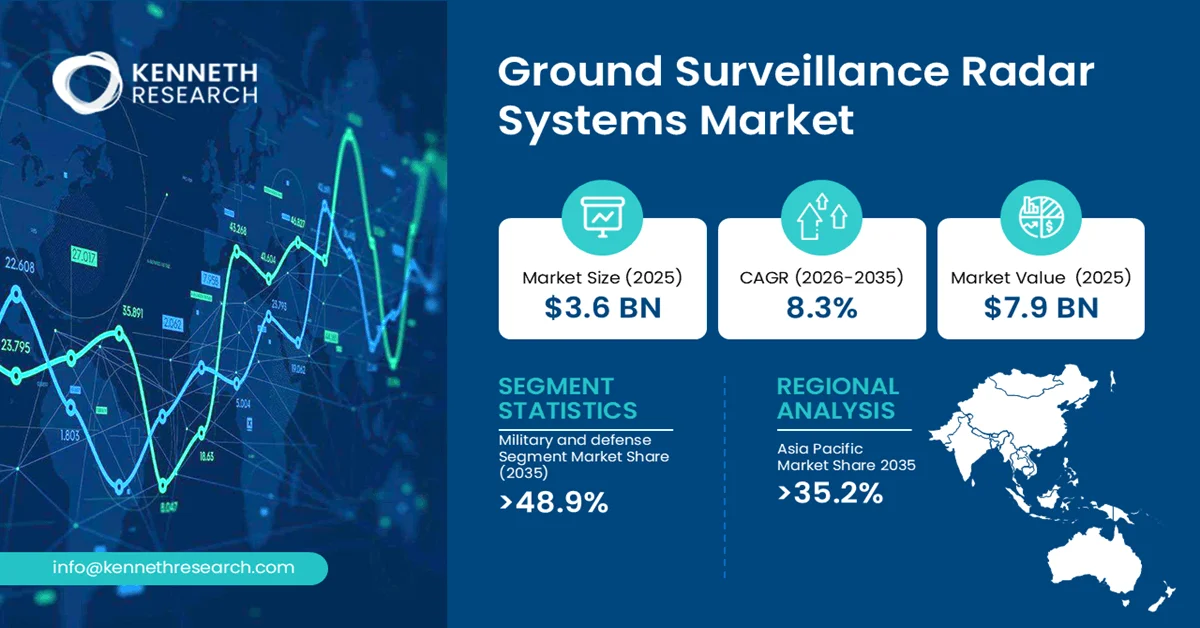
The global ground surveillance radar systems market size was valued at USD 3.6 billion in 2025 and is projected to reach USD 3.9 billion in 2026. In addition, the ground surveillance radar systems industry is further expected to be worth USD 7.9 billion by the end of 2035, rising at a CAGR of 8.3% during the forecast period, i.e., 2026-2035.
The primary growth driver of the Ground Surveillance Radar Systems Market is the increasing global emphasis on border security, military modernization, and persistent surveillance capabilities. Governments are investing in advanced radar technologies to strengthen threat detection, improve situational awareness, and support intelligence, surveillance, and reconnaissance (ISR) operations across diverse operational environments.
Ground surveillance radar systems are advanced sensing technologies designed to detect, track, and monitor moving and stationary objects on land. These systems utilize radio frequency signals to identify personnel, vehicles, and potential threats across varying distances and environmental conditions. Ground surveillance radars are widely deployed in military operations, border security, critical infrastructure protection, battlefield reconnaissance, and homeland security applications. Their ability to provide continuous monitoring, long-range detection, all-weather functionality, and real-time target tracking makes them a critical component of modern surveillance and defense architectures.
Key Ground Surveillance Radar Systems Market Insights Summary:
Key Takeaways: Market Trends & Insights
- In the application segment, the military and defense sub-segment is anticipated to capture the revenue share of 48.9% during 2026-2035
- The Asia Pacific ground surveillance radar systems market is projected to hold the largest revenue share of 35.2% by the end of 2035
- The major players in the market are RTX Corporation, Thales Group, Saab AB, Leonardo S.p.A., Israel Aerospace Industries, and others
Market Drivers
- Rising investments in border security and homeland surveillance infrastructure
- Increasing adoption of AI-enabled radar analytics and sensor fusion technologies
- Growing military modernization and battlefield situational awareness programs
- Expanding protection requirements for critical infrastructure and strategic assets
Challenges
- High Procurement, Integration, and Lifecycle Maintenance Costs
- Electronic Warfare Vulnerabilities and Operational Complexity
Ground Surveillance Radar Systems Market Overview & Supply Chain
The ground surveillance radar systems market value chain originates with input sources, comprising specialized electronic components, including gallium nitride (GaN) and gallium arsenide (GaAs) semiconductors for power amplification, high-frequency microwave circuit boards, signal processors (FPGAs, DSPs), precision mechanical components for antenna positioning, and enclosure materials for environmental hardening. These components are sourced from tier-two suppliers, with significant concentration among U.S., Europe, Japan, and increasingly China-based semiconductor foundries.
The manufacturing and integration stage encompasses antenna array fabrication, transmit/receive module assembly, power supply integration, and signal processing software development. Prime defense contractors conduct final system integration and factory acceptance testing, with notable export controls governing transfer of sensitive radar technologies. Distribution routes typically involve direct government-to-contractor procurement through defense ministries, with authorized distributors serving homeland security and critical infrastructure customers. End users include military ground forces, border patrol agencies, coast guards, and critical infrastructure operators.
Ground Surveillance Radar Systems Market: Growth Drivers & Challenges
Growth Drivers:
- Increasing Border Security Investments and Surveillance Modernization: Growing concerns regarding unauthorized border crossings, cross-border crime, infiltration activities, and critical infrastructure vulnerabilities are accelerating investments in advanced ground surveillance radar systems worldwide. The growing emphasis on border monitoring is evident in government enforcement activity. According to the U.S. Customs and Border Protection (CBP), its personnel conducted approximately 4,267 nationwide enforcement encounters between ports of entry each day during 2024, underscoring the scale of surveillance and border-security operations requiring advanced monitoring technologies. These evolving security requirements are expected to drive sustained procurement of next-generation radar systems over the coming decade while encouraging technological innovation across the defense surveillance ecosystem.
- Integration of Artificial Intelligence and Multi-Sensor Surveillance Networks: The incorporation of artificial intelligence, machine learning algorithms, and multi-sensor fusion capabilities is significantly enhancing the operational effectiveness of ground surveillance radar systems. Modern defense and security agencies increasingly require surveillance platforms capable of automatically classifying targets, reducing false alarms, prioritizing threats, and supporting rapid decision-making. AI-enabled radar systems improve detection accuracy while enabling operators to process large volumes of surveillance data more efficiently. This technological evolution is expanding the applicability of ground surveillance radars across military installations, border security operations, critical infrastructure protection, and homeland security missions.
Challenges:
- High Procurement, Integration, and Lifecycle Maintenance Costs: Ground surveillance radar systems require significant capital investment due to their sophisticated hardware architecture, advanced signal processing capabilities, software integration requirements, and stringent defense-grade performance standards. The challenge becomes more pronounced when radar platforms must be integrated with existing command-and-control systems, intelligence networks, and multi-sensor surveillance environments. Looking ahead, while technological advancements are expected to improve system efficiency and modularity, cost pressures will remain a critical purchasing consideration. Vendors that develop scalable, interoperable, and cost-effective radar solutions are likely to gain a competitive advantage in future procurement programs.
- Electronic Warfare Vulnerabilities and Operational Complexity: As military and security environments become increasingly digitized, ground surveillance radar systems face growing exposure to electronic warfare tactics, signal interference, cyber threats, and spectrum congestion. These operational challenges can affect detection accuracy, situational awareness, and mission reliability, particularly in contested environments. Over the long term, the market will increasingly favor radar systems capable of maintaining performance under electronic attack conditions while supporting secure integration within broader defense and security networks.
Ground Surveilling Radar Systems Market Size and Forecast:
| Report Attribute | Details |
|---|---|
| Base Year |
2025 |
| Forecast Year |
2026-2035 |
| CAGR |
8.3% |
| Base Year Market Size (2025) |
USD 3.6 billion |
| Forecast Year Market Size (2035) |
USD 7.9 billion |
| Regional Scope |
|
Ground Surveillance Radar Systems Market Segmentation Analysis:
Application Segment Analysis
The military and defense segment is anticipated to garner the largest share of 48.9% in the ground surveillance radar systems market by the end of 2035.
The segment’s leadership is primarily driven by increasing investments in battlefield surveillance, border monitoring, force protection, reconnaissance operations, and intelligence-gathering activities. Modern military organizations require persistent situational awareness across diverse operational environments, making ground surveillance radar systems a critical component of integrated defense architectures. The demand is further reinforced by sustained defense spending worldwide. According to the U.S. Department of Defense, the FY 2025 defense budget request totaled approximately USD 849.8 billion, including USD 167 billion allocated for procurement activities, reflecting continued investment in advanced military capabilities and surveillance technologies. These modernization initiatives are expected to support long-term adoption of ground surveillance radar systems across defense organizations globally.
Type Segment Analysis
The short-range ground surveillance radar systems segment is projected to hold a considerable share in the ground surveillance radar systems market during the forecast period.
The segment’s development is attributed to increasing demand for perimeter security, border monitoring, military base protection, and critical infrastructure surveillance. These radar systems are particularly valued for their ability to provide high-precision target detection over localized areas while offering rapid deployment, mobility, and cost-effective operation. Security agencies and defense organizations are increasingly adopting short-range radar platforms to enhance situational awareness in environments where continuous monitoring and quick response capabilities are essential. Industry adoption is expanding as military forces, law enforcement agencies, and infrastructure operators seek integrated surveillance solutions capable of working alongside electro-optical sensors, thermal imaging devices, and unmanned systems.
Our in-depth analysis of the global ground surveillance radar systems market includes the following segments:
|
Segment |
Sub-segment |
|
Application |
|
|
Type |
|
|
Component |
|
Ground Surveillance Radar Systems Market Regional Insights:
Asia Pacific Market Trends & Insights:
The Asia Pacific is projected to be the dominant region in the global ground surveillance radar systems market, capturing 35.2% of the total market value by 2035.
The region’s leadership is supported by sustained defense modernization initiatives, increasing investments in border surveillance infrastructure, growing military procurement programs, and rising geopolitical security concerns. A key indicator of this momentum is China's continued investment in military modernization. According to the March 2025 State Council article, the country announced a 7.2-percent increase in its 2025 national defense budget. In addition, it is planned that defense expenditure this year will be 1.784665 trillion yuan (about 249 billion U.S. dollars), according to a draft budget report submitted to the national legislature for deliberation.
China stands as the region's most significant market and the world's second-largest military spender, with official defense allocations demonstrating sustained, predictable growth. Beijing proposed a 2026 defense budget of approximately CNY 1.9 trillion (USD 275 billion), representing a 7% increase over the 2025 allocation of CNY 1.78 trillion, marking the 11th consecutive year of single-digit growth in China's defense spending. This consistent year-on-year expansion reflects China's strategic prioritization of indigenous radar technology development, with state-owned enterprises including China Electronics Technology Group Corporation (CETC) fielding increasingly sophisticated ground surveillance systems for both People's Liberation Army operations and border security applications.
Japan represents a sophisticated and strategically vital market within the Asia Pacific region, supported by its Self-Defense Forces (SDF) modernization programs and persistent regional security concerns, including North Korea-based missile launches and China-specific maritime activity in the East China Sea. Japan's military expenditure rose by 9.7% to reach $62.2 billion in 2025, equivalent to 1.4% of GDP. This accelerated spending trajectory reflects Japan's National Defense Program Guidelines, which prioritize integrated ISR architectures including ground-based radar, for continuous territorial air and maritime surveillance. Beyond homeland defense, Japan has demonstrated export capability and intent, having approved the transfer of air defense radar systems to other nations, expanding its defense industrial base beyond domestic procurement.
North America Market Trends & Insights:
North America is considered the fastest-growing region in the ground surveillance radar systems market.
This is supported by strong demand from defense, homeland security, border protection, and critical infrastructure security applications. The region benefits from a highly developed defense ecosystem, advanced technological capabilities, and continuous investments in intelligence, surveillance, and reconnaissance (ISR) modernization programs. Military agencies and security organizations are increasingly deploying advanced radar systems to enhance situational awareness, improve threat detection, and strengthen operational effectiveness across land borders, military installations, transportation networks, and critical national assets.
The U.S. represents the largest national market within North America and the single most significant country market globally, characterized by unparalleled defense spending, technological leadership, and a mature procurement infrastructure. The U.S. Department of Defense operates the world's most extensive ground surveillance radar inventory, supporting force protection at domestic installations, forward operating bases across multiple combatant commands, and border security missions. Key modernization programs include the Sentinel A4, which replaces obsolete traveling wave tube technology with state-of-the-art digital AESA radar.
Canada, while smaller in absolute market size compared to the U.S., maintains a distinctive market profile shaped by its Arctic sovereignty imperatives, NORAD modernization commitments, and alignment with regional defense frameworks. The Canadian Armed Forces operate ground surveillance radar systems for domestic security, coastal monitoring, and support to continental defense missions under the binational North American Aerospace Defense Command (NORAD) structure. Canada's vast, sparsely populated northern territory presents unique surveillance challenges where persistent, all-weather ground radar capabilities complement satellite and aerial ISR assets.
Leading Companies Operating in the Ground Surveillance Radar Systems Market:
The ground surveillance radar systems market is characterized by the presence of established defense technology providers competing through radar performance enhancement, surveillance accuracy, electronic warfare resilience, and system integration capabilities. Leading companies are focusing on advanced radar architectures, artificial intelligence-enabled target recognition, sensor fusion technologies, and interoperability with broader command-and-control ecosystems. Strategic priorities across the industry include defense modernization programs, government contract acquisitions, indigenous technology development, and expansion of integrated intelligence, surveillance, and reconnaissance (ISR) solutions.
Here is a list of key players operating in the global ground surveillance radar systems market:
|
Company |
Specialty |
HQ |
Position |
|
Lockheed Martin |
Integrated defense systems and surveillance solutions |
U.S. |
Leader |
|
Northrop Grumman |
Advanced radar and ISR technologies |
U.S. |
Leader |
|
RTX Corporation |
Ground-based radar and air defense systems |
U.S. |
Leader |
|
Thales Group |
Surveillance radar and security technologies |
France |
Major |
|
Saab AB |
Ground surveillance and battlefield awareness systems |
Sweden |
Major |
|
Leonardo S.p.A. |
Multi-domain radar and defense electronics |
Italy |
Major |
|
Israel Aerospace Industries |
Border surveillance and tactical radar solutions |
Israel |
Major |
|
HENSOLDT |
Sensor fusion and surveillance radar technologies |
Germany |
Major |
|
Bharat Electronics Limited |
Military radar and homeland security systems |
India |
Niche |
Recent Developments
- In May 2026, Thales officially delivered two GM403 radars to the Indonesia-based Air Force amid an official ceremony at Halim airbase in Jakarta, highlighting its deep commitment to delivering strategic air surveillance projects for the benefit of the Indonesian Ministry of Defence, alongside strategic partner PT Len Industri.
- In March 2026, Blighter received a contract to supply its ground surveillance radars and BlighterNexus AI-assisted software, along with Blighter’s B400 series lowpower to an undisclosed Eastern European Army to protect the country’s national borders.
Frequently Asked Question
In 2025, the ground surveillance radar systems market exceeded USD 3.6 billion.
The ground surveillance radar systems market is projected to reach USD 7.9 billion by the end of 2035, expanding at a CAGR of 8.3% over the forecast period (2026-2035).
The major players in the market are Lockheed Martin, Northrop Grumman, RTX Corporation, Thales Group, Saab AB, Leonardo S.p.A., Israel Aerospace Industries, HENSOLDT, Bharat Electronics Limited, Indra Sistemas, and others.
In the application segment, the military and defense sub-segment is anticipated to capture the largest market share of 48.9% in the future and exhibit lucrative growth opportunities during 2026-2035. This growth trajectory is largely attributed to increasing investments in military modernization, battlefield surveillance, and intelligence, surveillance, and reconnaissance (ISR) capabilities.
The Asia Pacific is projected to hold the largest market share of 35.2% by the end of 2035 and provide more business opportunities in the future. Continuous investments in defense modernization, border surveillance infrastructure, and indigenous radar technology development across China and Japan are fostering the region's dominance.
Why Choose Kenneth Research ?
-
Insight with Impact : We don’t just gather data — we uncover stories, trends, and opportunities that fuel business growth.
-
Experts Who Get It : Our team speaks your industry’s language and knows what really matters to your customers and market.
-
Custom-Built for You : Forget one-size-fits-all. We craft research and consulting solutions as unique as your business vision.
-
Partners, Not Just Providers : We work with you, not for you — collaborating closely to turn insights into smart, strategic moves.
-
Results That Speak : Our work powers brands, startups, and industry leaders alike — with a track record of ideas that work in the real world.
Report ID: 1012 |
Published Date: 28 Sep 2026 |
Report Format: |
Delivery Timeline: 48-72 Business Hours

Copyright © 2025 Kenneth Research. All rights reserved. Terms of Use | Privacy Policy
