Report ID: 1175 |
Published Date: 26 Aug 2026 |
Report Format: |
Delivery Timeline: 48-72 Business Hours
Grid-scale Battery Storage Market Outlook:
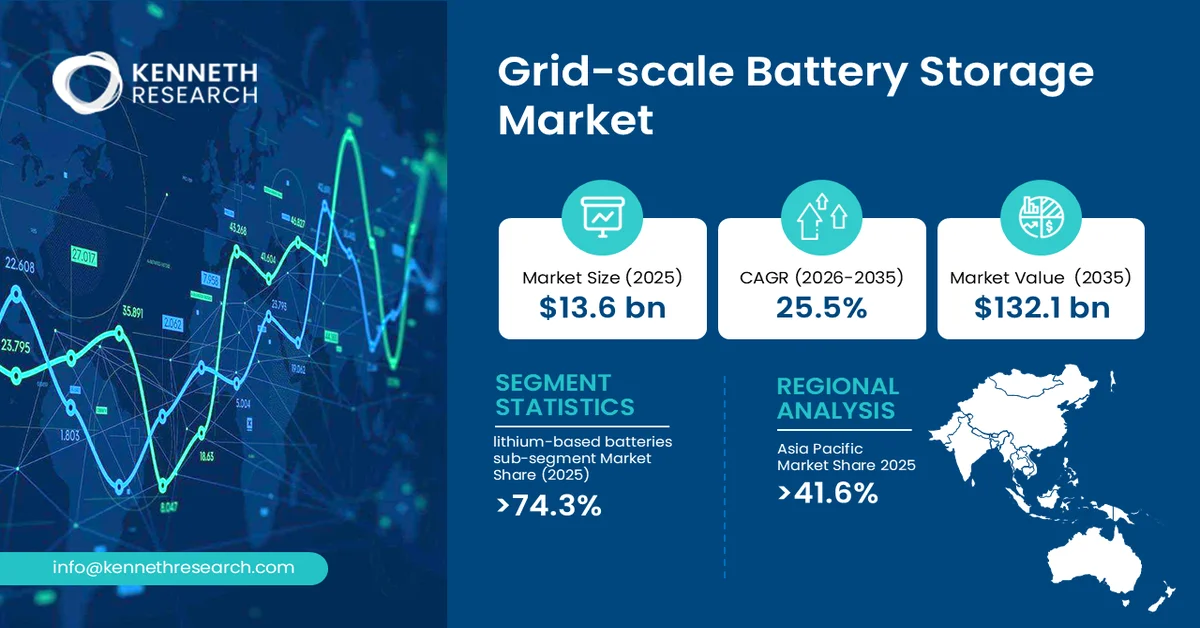
Grid-scale Battery Storage Market size was valued at USD 13.6 billion in 2025 and is projected to reach USD 132.1 billion by the end of 2035, rising at a CAGR of 25.5% during the forecast period, i.e., 2026-2035. In 2026, the industry size of the grid-scale battery storage is estimated at USD 17.1 billion.
The primary growth driver for the grid-scale battery storage market is the accelerating integration of variable renewable power into electricity grids. Grid-scale batteries provide rapid-response flexibility, allowing operators to store surplus electricity and dispatch it when renewable generation declines or demand rises.
The grid-scale battery storage market encompasses large-scale battery energy storage systems deployed to store electricity and deliver it to power grids when required. These systems typically combine battery cells, power-conversion equipment, thermal management, control software, safety systems, and grid-integration equipment
Key characteristics include rapid response, flexible dispatch, energy shifting, frequency regulation, peak-demand management, renewable-energy integration, and grid resilience. Lithium-based battery technologies are particularly relevant because of their established commercial ecosystem and suitability for large stationary storage installations.
Key Grid-scale battery storage Market Insights Summary:
Key Takeaways: Market Trends & Insights
- Grid-scale battery storage market projected to grow from USD 13.6 billion in 2025 to USD 132.1 billion by 2035 at a 25.5% CAGR.
- Asia Pacific accounted for the largest regional share at 41.6% in 2025, supported by rapid renewable-energy deployment, large-scale battery manufacturing, grid modernization, and strong storage investments across Japan and China.
- Lithium-based batteries are expected to remain the leading Type segment with a 74.3% market share, supported by their established manufacturing ecosystem, fast-response capabilities, and suitability for frequent grid applications.
- Renewable Integration is expected to remain a major application opportunity as utilities increasingly deploy battery systems to balance variable solar and wind generation, reduce curtailment, and improve grid flexibility.
Market Drivers
- Accelerating renewable energy integration
- Growing need for grid flexibility and reliability
- Advancements in battery technology and energy-management systems
- Expansion of electricity-intensive loads and grid modernization
Challenges
- Supply chain vulnerabilities and material dependence
- Safety, permitting, and siting requirements
Grid-scale Battery Storage Market Overview & Supply Chain
Global adoption of grid-scale battery storage is increasing as electricity systems integrate more renewable generation and require faster, more flexible resources to balance supply and demand. Utility-scale batteries can absorb electricity when generation exceeds immediate demand and discharge it during periods of system stress, while also supporting frequency regulation, congestion management, renewable integration, and capacity adequacy.
The grid-scale battery storage value chain begins with extraction and processing of lithium, nickel, graphite, manganese, copper, and other battery materials, followed by production of cathodes, anodes, electrolytes, separators, cells, modules, and packs. System manufacturers integrate these battery components with inverters, thermal-management equipment, battery-management systems, safety systems, transformers, and control software. Project developers and engineering, procurement, and construction providers then configure complete storage installations and connect them to transmission or distribution networks. Distribution primarily occurs through direct project procurement, system-integrator partnerships, and specialized energy-infrastructure channels.
Grid-scale Battery Storage Market: Growth Drivers & Challenges
Growth Drivers:
- Accelerating renewable energy integration: The increasing penetration of solar and wind power is creating stronger demand for grid-scale battery storage because variable generation requires flexible resources that can balance electricity supply and demand. Batteries can absorb surplus renewable electricity and discharge it during periods of high demand or lower renewable output, while also providing frequency regulation and other grid-support services. The International Energy Agency identifies utility-scale batteries as a versatile flexibility resource for integrating wind and solar generation and supporting security of supply.
- Growing need for grid flexibility and reliability: Power systems are becoming more complex as electricity demand rises, generation becomes increasingly decentralized, and new loads such as electric vehicles, heat pumps, and data centers place additional pressure on networks. Grid-scale batteries provide rapid-response flexibility that can help manage peak demand, stabilize system frequency, defer certain network upgrades, and improve the utilization of existing grid infrastructure. The IEA highlights battery storage as an increasingly important source of short-term flexibility, particularly in systems experiencing rising shares of variable renewable generation.
Challenges:
- Supply chain vulnerabilities and material dependence: Grid-scale battery deployment remains exposed to supply-chain risks because lithium-based systems depend on globally distributed sources of critical minerals, battery components, cells, power electronics, and other specialized equipment. Concentration of manufacturing and processing capacity can create procurement uncertainty, price volatility, and project-delivery risks for developers and utilities. The U.S. Department of Energy identifies dependence on foreign-manufactured components as a vulnerability for battery energy storage systems and recommends strengthening domestic manufacturing capabilities and supply-chain resilience.
- Safety, permitting, and siting requirements: Safety and permitting requirements can create development constraints for grid-scale battery projects, particularly for lithium-based systems. Thermal events, fire-response requirements, emergency planning, environmental considerations, and community acceptance can increase project-development complexity and require coordination among developers, utilities, regulators, planning authorities, and emergency-response organizations. The UK Department for Energy Security and Net Zero has established dedicated guidance covering the health and safety lifecycle of grid-scale electrical energy storage systems, reflecting the need for robust standards across design, planning, installation, operation, and decommissioning.
Grid-scale Battery Storage Market Size and Forecast:
| Report Attribute | Details |
|---|---|
| Base Year |
2025 |
| Forecast Year |
2026-2035 |
| CAGR |
25.5% |
| Base Year Market Size (2025) |
USD 13.6 billion |
| Forecast Year Market Size (2035) |
USD 132.1 billion |
| Regional Scope |
|
Grid-scale battery storage market Segmentation Analysis:
Type Segment Analysis
In the type segment, the lithium-based batteries sub-segment is anticipated to capture the largest market share of 74.3% by the end of 2025.
Its leadership is supported by high energy density, rapid response capability, established manufacturing infrastructure, and suitability for frequent charge-discharge cycles required in grid applications. Lithium-based systems are increasingly deployed for renewable integration, peak management, frequency regulation, and energy arbitrage, making them adaptable to multiple utility requirements. The U.S. Energy Information Administration reported that most U.S. utility-scale battery energy storage systems use lithium-ion batteries, reflecting the technology's established position in large-scale grid applications.
Application Segment Analysis
The renewable integration application segment is projected to grow as utilities increasingly require flexible resources to accommodate variable solar and wind generation. Grid-scale batteries can store surplus renewable electricity and discharge it when generation declines or demand increases, improving renewable utilization while reducing curtailment and supporting grid stability. The U.S. Energy Information Administration identifies renewable-energy storage as an important battery application because stored electricity from wind and solar can be retained until it is needed by the grid. Adoption is also supported by the growing development of renewable-plus-storage projects, where batteries are co-located with generation assets to improve dispatchability and optimize grid connections.
Our in-depth analysis of the global grid-scale battery storage market includes the following segments:
|
Segment |
Sub-segment |
|
Type |
|
|
Application |
|
|
Grid Service |
|
|
Ownership |
|
|
Battery Chemistry |
|
Grid-scale Battery Storage Market Regional Insights:
Asia Pacific Market Trends & Insights:
Asia Pacific is the dominant region in the grid-scale battery storage market, accounting for 41.6% in 2025.
Regional leadership is supported by rapid renewable-energy expansion, large electricity networks, strong battery manufacturing capabilities, and government-backed storage policies. China is a particularly important regional growth engine, with national authorities actively promoting large-scale energy storage as part of the transition toward a more flexible power system. China's National Energy Administration reported that new energy storage capacity reached 1.36 billion kW/3.51 billion kWh by the end of 2025, highlighting the country's substantial deployment momentum.
Japan represents a technologically advanced storage market, supported by its focus on energy security, renewable integration, grid resilience, and sophisticated electricity infrastructure. Its established battery industry and need to balance variable renewable generation create opportunities for utility-scale storage developers and technology providers.
China remains the region's principal market, supported by extensive renewable deployment, domestic battery manufacturing, grid modernization, and strong policy backing. The National Development and Reform Commission and National Energy Administration have established a dedicated 2025–2027 action plan to accelerate large-scale new energy storage deployment and expand applications across power-generation and grid-side projects
North America Market Trends & Insights:
North America represents a strategically important region for the grid-scale battery storage market, supported by rapid renewable deployment, grid modernization, rising electricity demand, and increasing requirements for flexible power-system resources. Utilities and power developers are deploying large-scale batteries to balance variable generation, manage peak demand, strengthen reliability, and optimize renewable assets. Government programs and utility procurement initiatives are also creating opportunities for storage developers and technology providers.
The U.S. is the principal contributor to regional growth, supported by expanding renewable generation, sophisticated electricity markets, and strong investment in utility-scale storage. California has also emerged as a major storage market, with state authorities highlighting battery storage as an important resource for integrating wind and solar generation and maintaining grid reliability.
Canada offers additional opportunities through grid modernization, renewable-power development, and increasing interest in storage for system flexibility and reliability. Provincial utilities are evaluating battery projects as alternatives or complements to conventional grid infrastructure, creating opportunities for both utility-scale and long-duration storage technologies.
Leading Companies Operating in the Grid-scale battery storage market:
Here is a list of upstream, downstream, and key players operating in the global grid-scale battery storage market competitive ecosystem:
- Tesla(United States)
- Company Overview
- Business Strategy
- Key Product Offerings
- Financial Performance
- Key Performance Indicators
- Risk Analysis
- Recent Development
- Regional Presence
- SWOT Analysis
- Sungrow(China)
- Fluence(United States)
- Wärtsilä(Finland)
Recent Developments
- June 2026 –Tesla continued expanding its grid-scale energy-storage portfolio through the rollout of its next-generation Megapack products and expansion of manufacturing capacity.
- December 2025 –Sungrow announced the commencement of construction of the Pelican Point Battery Energy Storage System in South Australia, using its grid-forming storage technology. The project is designed to strengthen a renewable-rich electricity network and provide fast-response grid support.
Frequently Asked Question
In 2025, the grid-scale battery storage market exceeded USD 13.6 billion.
The grid-scale battery storage market is projected to reach USD 132.1 billion by the end of 2035, expanding at a CAGR of 25.5% over the forecast period (2026–2035).
The major players in the market are Tesla, Sungrow, Fluence, Wärtsilä, CATL, and others.
In the Type segment, the Lithium-based batteries sub-segment is anticipated to capture the largest market share of 74.3% in the future and exhibit lucrative growth opportunities during 2026–2035. This growth trajectory is largely attributed to the increasing deployment of lithium-based systems for renewable integration, grid balancing, and energy management.
Asia Pacific is projected to hold the largest market share of 41.6% by the end of 2025 and provide more business opportunities in the future.
Why Choose Kenneth Research ?
-
Insight with Impact : We don’t just gather data — we uncover stories, trends, and opportunities that fuel business growth.
-
Experts Who Get It : Our team speaks your industry’s language and knows what really matters to your customers and market.
-
Custom-Built for You : Forget one-size-fits-all. We craft research and consulting solutions as unique as your business vision.
-
Partners, Not Just Providers : We work with you, not for you — collaborating closely to turn insights into smart, strategic moves.
-
Results That Speak : Our work powers brands, startups, and industry leaders alike — with a track record of ideas that work in the real world.
Report ID: 1175 |
Published Date: 26 Aug 2026 |
Report Format: |
Delivery Timeline: 48-72 Business Hours

Copyright © 2025 Kenneth Research. All rights reserved. Terms of Use | Privacy Policy
