Report ID: 1108 |
Published Date: 19 Aug 2026 |
Report Format: |
Delivery Timeline: 48-72 Business Hours
Graphene Nanocomposite Market Outlook:
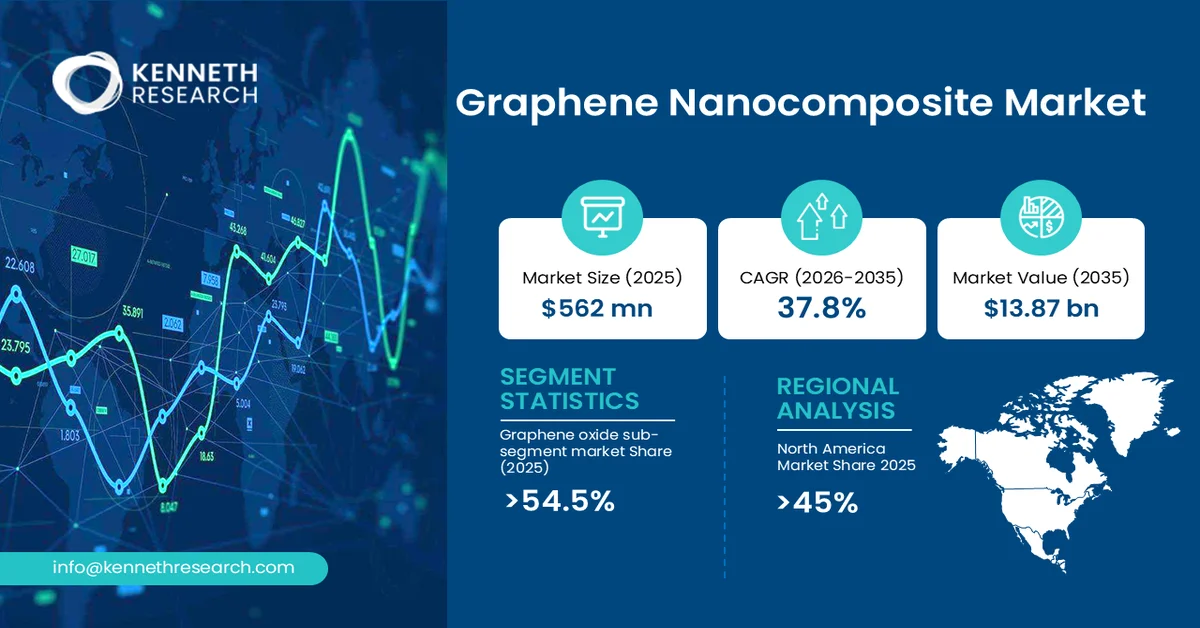
Graphene Nanocomposite Market size was valued at USD 562 million in 2025 and is projected to reach USD 13.87 billion by the end of 2035, rising at a CAGR of 37.8% during the forecast period, i.e., 2026-2035. In 2026, the industry size of the graphene nanocomposite is estimated at USD 774.4 million.
The primary growth driver of the graphene nanocomposite market is the accelerating demand for lightweight, high-strength, and multifunctional materials across advanced manufacturing industries. Growing commercialization of graphene-enhanced products, expanding investments in nanotechnology research, and increasing adoption in electronics, automotive, aerospace, and energy storage applications continue to strengthen long-term market expansion.
The graphene nanocomposite market comprises advanced composite materials in which graphene-based nanomaterials, including graphene oxide, reduced graphene oxide, graphene nanoplatelets, and related derivatives, are incorporated into polymer, metal, ceramic, or hybrid matrices to enhance material performance. These nanocomposites are engineered to deliver superior mechanical strength, electrical and thermal conductivity, chemical resistance, barrier properties, and durability compared with conventional composite materials.
Graphene nanocomposites are distinguished by their exceptional strength-to-weight ratio, excellent flexibility, enhanced heat dissipation capabilities, and improved structural integrity. The compatibility of graphene with multiple matrix materials enables manufacturers to tailor product characteristics according to specific industrial performance requirements, making these materials suitable for demanding engineering environments.
Key Graphene Nanocomposite Market Insights Summary:
Key Takeaways: Market Trends & Insights
- Graphene Nanocomposite Market projected to grow from USD 562 million in 2025 to USD 13.87 billion by 2035 at a 37.8% CAGR.
- North America accounted for the largest regional share at 45% in 2025, supported by strong advanced materials research, semiconductor manufacturing, and commercialization of nanotechnology across the U.S. and Canada.
- Graphene oxide is expected to remain the leading product type segment with a 54.5% market share, driven by its excellent dispersibility, multifunctional properties, and broad applicability across polymer, ceramic, and metal nanocomposites.
- Electronics will continue to be one of the fastest-growing application segments due to increasing demand for advanced conductive materials in semiconductors, flexible electronics, energy storage systems, sensors, and high-performance electronic components.
- The market is benefiting from rising commercialization of graphene-enabled products, expanding investments in advanced materials manufacturing, growing electric vehicle and energy storage deployment, and continuous innovation in multifunctional lightweight composite technologies.
Market Drivers
- Increasing investment in advanced nanomaterials research and commercialization initiatives.
- Growing adoption of lightweight composite materials in aerospace and defense manufacturing.
- Expanding commercialization of electric vehicles and advanced battery technologies.
- Rising integration of multifunctional materials across high-performance manufacturing.
Challenges
- Limited cost-effective large-scale production and quality consistency
- Complex integration into existing manufacturing processes
Graphene Nanocomposites Market Overview & Supply Chain
The adoption of graphene nanocomposites is increasing globally as industries seek advanced materials capable of delivering superior mechanical performance, electrical conductivity, thermal management, corrosion resistance, and weight reduction in a single material system. Their growing relevance spans electric mobility, semiconductor manufacturing, renewable energy systems, aerospace structures, medical technologies, and next-generation industrial equipment. Governments are also prioritizing advanced materials as strategic technologies supporting industrial competitiveness and resilient manufacturing ecosystems. In its 2024 Advanced Materials for Industrial Leadership communication, the European Commission identified advanced materials as essential for renewable energy, batteries, semiconductors, medical devices, aerospace, and defense applications while outlining a coordinated strategy to accelerate research, manufacturing, and industrial deployment across the European Union, reinforcing the long-term outlook for graphene nanocomposite adoption.
The graphene nanocomposite value chain begins with the procurement of high-purity graphite, specialty chemicals, polymer resins, metals, ceramics, and processing additives sourced from mining companies, chemical producers, and advanced material suppliers. These inputs undergo graphene synthesis through methods such as chemical oxidation, exfoliation, or chemical vapor deposition before being compounded with matrix materials using specialized dispersion and processing technologies to achieve targeted material properties. Manufacturers perform quality validation, functional testing, and application-specific customization before supplying finished nanocomposites to component manufacturers and original equipment manufacturers (OEMs). Distribution is supported by specialty chemical distributors, advanced material suppliers, and direct industrial sales channels serving global manufacturing hubs. End users include electronics manufacturers, automotive producers, aerospace companies, energy storage developers, healthcare device manufacturers, industrial equipment suppliers, and construction material companies. Key stakeholders across the ecosystem include raw material suppliers, graphene producers, compounders, research institutions, technology developers, OEMs, regulatory bodies, and industrial distributors.
Graphene Nanocomposite Market: Growth Drivers & Challenges
Growth Drivers:
- Expanding commercialization of electric vehicles and advanced battery technologies: The rapid commercialization of electric vehicles and high-performance energy storage systems is creating sustained demand for graphene nanocomposites. These materials improve battery components, lightweight structural parts, thermal management systems, electromagnetic shielding, and conductive composites, enabling manufacturers to enhance efficiency and product performance simultaneously. As battery technologies evolve toward higher energy density and improved durability, graphene-reinforced materials are becoming increasingly attractive for next-generation mobility platforms. The expansion of electric mobility also encourages greater investment in advanced materials research, manufacturing capabilities, and application-specific product development. According to the International Energy Agency, global electric car sales exceeded 17 million in 2024, representing continued acceleration in EV adoption and reinforcing demand for lightweight, conductive, and durable advanced materials throughout the automotive value chain. This trend is expected to stimulate broader commercialization of graphene nanocomposites across mobility and energy applications.
- Rising integration of multifunctional materials across high-performance manufacturing: Manufacturers across aerospace, electronics, industrial equipment, medical devices, and defense sectors are increasingly seeking multifunctional materials capable of delivering mechanical reinforcement, thermal conductivity, electrical performance, and chemical resistance within a single engineered solution. Graphene nanocomposites satisfy these requirements while supporting product miniaturization, durability, and operational efficiency. Continuous advances in graphene dispersion technologies and scalable composite processing have improved manufacturing consistency, encouraging wider industrial adoption. As industries emphasize lightweight engineering, longer product lifecycles, and sustainable manufacturing, graphene nanocomposites are becoming integral to next-generation product design strategies. Continued collaboration among material developers, research institutions, component manufacturers, and OEMs is expected to accelerate innovation, reduce commercialization barriers, and expand the use of graphene nanocomposites across emerging applications, strengthening long-term market development.
Challenges:
- Limited cost-effective large-scale production and quality consistency: A major restraint facing the graphene nanocomposite market is the difficulty of achieving cost-effective, large-scale production while maintaining consistent graphene quality. Variations in layer thickness, purity, defect density, and dispersion characteristics can significantly influence the mechanical, thermal, and electrical performance of finished nanocomposites. Manufacturers must therefore implement stringent quality control measures and specialized processing techniques, increasing production complexity and operational costs. These challenges make it difficult for suppliers to deliver standardized materials suitable for high-volume industrial applications, particularly in sectors with strict performance specifications such as aerospace, electronics, and healthcare. Commercially, inconsistent material performance can delay product qualification, increase development timelines, and discourage widespread adoption among risk-averse manufacturers. Future improvements in scalable production technologies, process automation, and internationally recognized material standards are expected to gradually reduce these barriers and improve market accessibility.
- Complex integration into existing manufacturing processes: The integration of graphene nanocomposites into established manufacturing environments remains a significant commercial challenge because conventional production lines are often designed for traditional composite materials rather than nanoscale reinforcements. Achieving uniform graphene dispersion, maintaining compatibility with existing matrix materials, and optimizing processing parameters frequently require modifications to equipment, production workflows, and quality assurance procedures. These requirements increase implementation costs and extend product development cycles for manufacturers considering commercial adoption. Industries operating under highly regulated or performance-critical environments may also require extensive validation before incorporating graphene-based materials into finished products, further slowing deployment. From a commercial perspective, these integration challenges can reduce return on investment and delay purchasing decisions. Continued advancements in standardized processing methods, compatible manufacturing technologies, and application-specific formulations are expected to simplify industrial implementation over the long term.
Graphene Nanocomposites Market Size and Forecast:
| Report Attribute | Details |
|---|---|
| Base Year |
2025 |
| Forecast Year |
2026-2035 |
| CAGR |
37.8% |
| Base Year Market Size (2025) |
USD 562 million |
| Forecast Year Market Size (2035) |
USD 13.87 billion |
| Regional Scope |
|
Graphene Nanocomposite Market Segmentation Analysis:
Product Type Segment Analysis
In the product type segment, the graphene oxide sub-segment is anticipated to capture the largest market share of 54.5% by the end of 2025.
Graphene oxide dominates the graphene nanocomposite market because it offers an optimal combination of scalability, processability, and compatibility with diverse composite matrices. Its oxygen-containing functional groups enable excellent dispersion in polymers, ceramics, and metal matrices, making it easier to manufacture high-performance nanocomposites than many alternative graphene materials. Current demand is driven by increasing utilization in conductive coatings, energy storage devices, electronics, filtration systems, biomedical materials, and structural composites requiring enhanced mechanical and thermal properties. On the supply side, continuous improvements in graphene oxide synthesis and functionalization techniques have strengthened commercial availability while enabling manufacturers to tailor material properties for application-specific requirements. The European Commission identifies advanced materials as fundamental to innovation in energy, electronics, construction, and mobility, highlighting that demand for materials with novel properties is projected to increase significantly as the European Union advances its green and digital transitions. This policy environment supports continued industrial adoption of graphene oxide-based nanocomposites across multiple high-value sectors, with further commercialization expected as manufacturing technologies mature and production efficiencies improve.
Application Type Segment Analysis
The electronics application segment is projected to experience robust growth as manufacturers increasingly require materials that combine lightweight construction with superior electrical conductivity, thermal management, electromagnetic interference shielding, and mechanical durability. Graphene nanocomposites are being incorporated into flexible electronics, printed circuits, sensors, wearable devices, advanced semiconductor packaging, batteries, and next-generation communication equipment to improve device efficiency and operational reliability. On the supply side, ongoing advancements in graphene production technologies, precision compounding, and scalable manufacturing processes are enabling suppliers to develop application-specific materials that meet stringent electronics industry requirements. Government support for semiconductor manufacturing and electronics innovation is also strengthening demand. The U.S. Department of Commerce reports that CHIPS for America has allocated more than $32 billion in proposed funding across 16 states to expand domestic semiconductor manufacturing and research capabilities, reinforcing investment across the broader electronics ecosystem where advanced materials play a critical role. Continued expansion of artificial intelligence hardware, high-performance computing, and connected devices is expected to further accelerate the adoption of graphene nanocomposites in electronic applications.
Our in-depth analysis of the global graphene nanocomposite market includes the following segments:
|
Segment |
Sub-segment |
|
Product Type |
|
|
Matrix Type |
|
|
Application |
|
|
Manufacturing Process |
|
|
End user |
|
Graphene Nanocomposite Market Regional Insights:
North America Market Trends & Insights:
North America accounted for 45% of the graphene nanocomposite market in 2025, making it the leading regional market.
The region's dominance is supported by its mature advanced materials ecosystem, strong commercialization of nanotechnology, extensive investment in semiconductor manufacturing, aerospace innovation, electric mobility, and high-value industrial manufacturing. Well-established research infrastructure, close collaboration between universities and industry, and favorable intellectual property frameworks continue to accelerate the transition of graphene-based technologies from laboratory research to commercial production. Public and private investment in advanced manufacturing further strengthens regional competitiveness by encouraging the development of high-performance materials for electronics, defense, healthcare, and energy storage applications. According to the U.S. National Science Foundation, U.S. domestic research and development performance totaled USD 937 billion in 2023 and is estimated to reach USD 993 billion in 2024, demonstrating the scale of innovation investment that supports advanced materials development and commercialization across North America.
The United States serves as the regional hub for graphene nanocomposite innovation due to its concentration of advanced materials companies, semiconductor manufacturers, aerospace contractors, national laboratories, and research institutions that continuously develop and commercialize graphene-enabled technologies. Strong collaboration between industry and academia accelerates product development and industrial adoption across multiple sectors.
Canada complements regional leadership through its expertise in nanotechnology research, advanced manufacturing, and sustainable materials innovation. The country benefits from a robust research ecosystem and strategic partnerships between universities, technology developers, and industrial manufacturers, supporting commercialization in electronics, clean energy, automotive, and aerospace applications. Together, these strengths position North America as the principal center for graphene nanocomposite research, manufacturing, and high-value industrial deployment.
Europe Market Trends & Insights:
Asia Pacific is projected to remain one of the fastest-growing regions in the graphene nanocomposite market, supported by rapid industrialization, expanding electronics manufacturing, increasing electric vehicle production, and growing investments in advanced materials research. The region benefits from extensive manufacturing capabilities, well-established supply chains, and a strong presence of producers specializing in electronics, batteries, automotive components, and industrial materials. Governments across Asia Pacific continue to promote innovation through national strategies focused on advanced manufacturing, semiconductor development, clean energy technologies, and sustainable industrial transformation. These initiatives encourage collaboration between research institutions and industrial manufacturers, accelerating the commercialization of graphene-based materials. Growing demand for lightweight engineering materials, high-performance energy storage solutions, smart electronic devices, and next-generation infrastructure is expected to create significant opportunities for graphene nanocomposite producers. Continuous improvements in production technologies and increasing investment in high-value manufacturing are likely to further strengthen the region's role in the global graphene nanocomposite value chain.
Japan is a leading contributor to regional growth through its expertise in advanced materials engineering, precision manufacturing, electronics, automotive technologies, and research-driven product innovation. Strong collaboration between industrial manufacturers, academic institutions, and technology developers continues to accelerate the development of high-performance graphene nanocomposite applications for energy storage, electronic components, healthcare devices, and mobility solutions.
China plays a central role in regional expansion because of its extensive manufacturing base, large-scale electronics production, rapidly growing electric vehicle ecosystem, and significant investment in nanotechnology commercialization. The country's integrated industrial supply chain, expanding advanced materials manufacturing capabilities, and emphasis on innovation enable the large-scale production and application of graphene nanocomposites across electronics, industrial equipment, renewable energy, construction, and transportation sectors. These strengths position Asia Pacific as a key growth region for future commercialization and industrial adoption.
Leading Companies Operating in the Global Graphene Nanocomposite Market:
Here is a list of upstream, downstream, and key players operating in the global graphene nanocomposite market competitive ecosystem:
- Haydale Graphene Industries(United kingdom)
- Company Overview
- Business Strategy
- Key Product Offerings
- Financial Performance
- Key Performance Indicators
- Risk Analysis
- Recent Development
- Regional Presence
- SWOT Analysis
- NanoXplore Inc.(Canada)
- Directa Plus S.p.A.(Italy)
- G6 Materials Corp.(Canada)
Recent Developments
- January 2025: Directa Plus announced a multi-year commercial supply agreement for its graphene-enhanced materials for performance textile applications.
- October 2024: OCSiAl opened its European graphene nanotube production facility in Serbia, including synthesis, dispersion, and research operations.
- January 2026: Haydale Graphene Industries officially rebranded to Haydale, reflecting a broader strategic focus on advanced materials and clean technologies.
Frequently Asked Question
In 2025, the graphene nanocomposite market exceeded USD 562 million.
The graphene nanocomposite market is projected to reach USD 13.87 billion by the end of 2035, expanding at a CAGR of 37.8% over the forecast period (2026-2035).
The major players in the market are Haydale Graphene Industries, NanoXplore Inc., Directa Plus S.p.A., G6 Materials Corp., Thomas Swan & Co. Ltd., First Graphene Ltd., Graphenea, Avanzare Innovación Tecnológica, and others.
In the product type segment, the graphene oxide sub-segment is anticipated to capture the largest market share of 54.5% in the future and exhibit lucrative growth opportunities during 2026-2035. This growth trajectory is largely attributed to its excellent compatibility with multiple matrix materials, scalable processing, and expanding adoption in electronics, energy storage, and high-performance composite applications.
North America is projected to hold the largest market share of 45% by the end of 2025 and provide more business opportunities in the future. Continuous investments in advanced materials innovation, semiconductor manufacturing, and high-value industrial applications across the U.S. and Canada are fostering the region's dominance.
Why Choose Kenneth Research ?
-
Insight with Impact : We don’t just gather data — we uncover stories, trends, and opportunities that fuel business growth.
-
Experts Who Get It : Our team speaks your industry’s language and knows what really matters to your customers and market.
-
Custom-Built for You : Forget one-size-fits-all. We craft research and consulting solutions as unique as your business vision.
-
Partners, Not Just Providers : We work with you, not for you — collaborating closely to turn insights into smart, strategic moves.
-
Results That Speak : Our work powers brands, startups, and industry leaders alike — with a track record of ideas that work in the real world.
Report ID: 1108 |
Published Date: 19 Aug 2026 |
Report Format: |
Delivery Timeline: 48-72 Business Hours

Copyright © 2025 Kenneth Research. All rights reserved. Terms of Use | Privacy Policy
