Report ID: 1146 |
Published Date: 24 Aug 2026 |
Report Format: |
Delivery Timeline: 48-72 Business Hours
Graphene Composite Market Outlook:
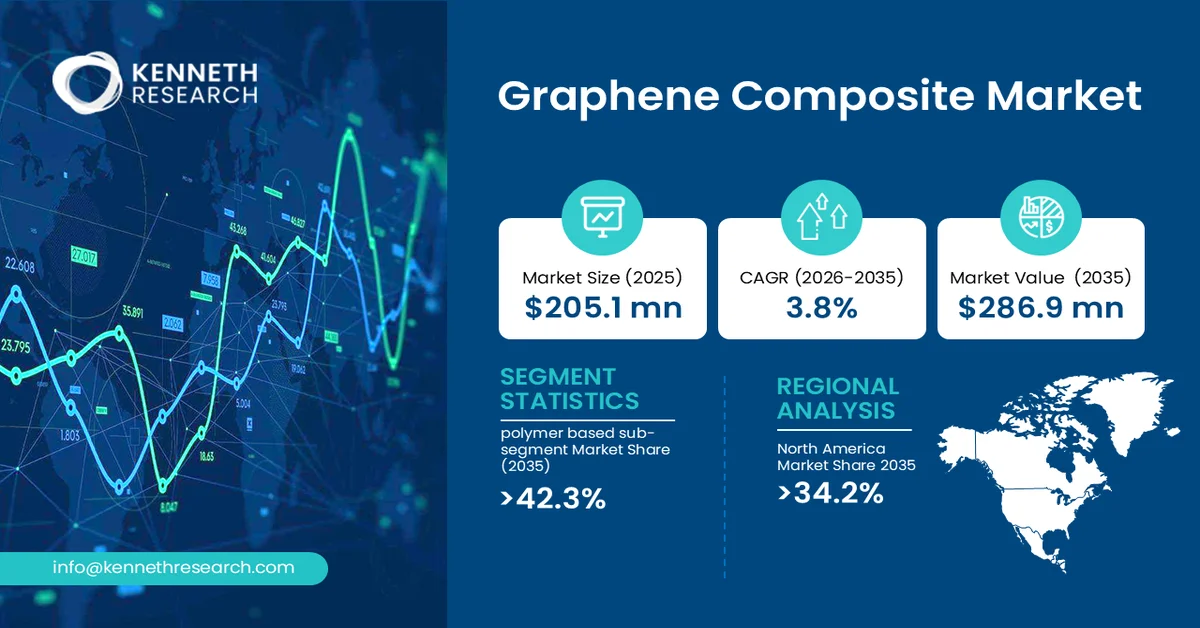
Graphene Composite Market size was valued at USD 205.1 million in 2025 and is projected to reach USD 286.9 million by the end of 2035, rising at a CAGR of 3.8% during the forecast period, i.e., 2026-2035. In 2026, the industry size of the graphene composite is estimated at USD 212.9 million.
The primary growth driver of the graphene composite market is the increasing commercialization of graphene-enabled advanced materials for lightweight, high-strength, and conductive applications. Expanding investments in graphene innovation, pilot-scale manufacturing, and industrial commercialization are accelerating adoption across electronics, automotive, aerospace, energy storage, and advanced manufacturing industries.
The graphene composite market comprises engineered materials in which graphene is incorporated into a base material such as polymers, metals, ceramics, or hybrid matrices to enhance mechanical, thermal, electrical, and barrier properties. These composites combine the exceptional characteristics of graphene—including high tensile strength, excellent electrical conductivity, thermal stability, corrosion resistance, and lightweight performance—with conventional engineering materials to produce multifunctional products suited for demanding industrial environments.
Graphene composites are widely utilized where improved durability, structural efficiency, conductivity, and weight reduction are critical performance requirements. Their versatility enables deployment in electronic components, energy storage systems, transportation, aerospace structures, protective coatings, construction materials, and industrial equipment. The ability to tailor composite formulations for specific applications makes graphene composites valuable across both high-volume manufacturing and specialized engineering sectors.
Key Graphene Composite Market Insights Summary:
Key Takeaways: Market Trends & Insights
- Graphene Composite Market projected to grow from USD 205.1 million in 2025 to USD 286.9 million by 2035 at a 3.8% CAGR
- North America is projected to account for the largest regional share of 34.2% by 2035, supported by advanced materials research, strong manufacturing capabilities, and increasing commercialization of graphene technologies
- Polymer Based is expected to remain the leading Product Type segment with a 42.3% market share, driven by its lightweight properties, superior mechanical performance, and compatibility with conventional manufacturing processes
- The Electronics end-use segment is projected to witness significant growth owing to increasing demand for graphene composites in thermal management, conductive components, flexible electronics, and next-generation semiconductor applications
- The market is benefiting from expanding commercialization of graphene-enabled materials, growing adoption of lightweight multifunctional composites, and increasing investments in advanced manufacturing and industrial innovation initiatives
Market Drivers
- Rising adoption of graphene composites in aerospace and defense lightweight structural applications.
- Growing use of graphene-reinforced materials in advanced energy storage, thermal management, and next-generation electronics.
Challenges
- Complex large-scale manufacturing and material quality consistency.
- Integration barriers with conventional manufacturing processes.
Graphene Composite Market Overview & Supply Chain
The global adoption of graphene composites is accelerating as industries seek materials that combine lightweight construction with exceptional mechanical strength, electrical conductivity, thermal management, and corrosion resistance. These performance advantages are driving integration across advanced electronics, electric mobility, aerospace structures, renewable energy systems, and industrial manufacturing. Continuous improvements in graphene production technologies and supportive public research initiatives are further strengthening commercialization. The European Commission highlights the growing industrial maturity of graphene through the Graphene Flagship, which has brought together over 200 scientific and industrial partners across Europe to accelerate the transition of graphene technologies from research to commercial products. This collaborative ecosystem has significantly enhanced innovation, pilot-scale manufacturing, and industrial deployment of graphene-enabled materials, reinforcing the strategic importance of graphene composites in next-generation manufacturing.
The graphene composite industry value chain begins with the sourcing of graphite, graphene oxide, reduced graphene oxide, and other carbon-based feedstocks, alongside matrix materials such as polymers, metals, ceramics, and specialty resins supplied by chemical and advanced material producers. Material manufacturers process graphene using techniques including chemical vapor deposition, liquid-phase exfoliation, or chemical reduction before integrating it into composite formulations through compounding, dispersion, or advanced manufacturing processes. Fabricated composite materials are then converted into sheets, coatings, structural components, electronic parts, battery materials, or engineered products by component manufacturers and original equipment manufacturers. Distribution occurs through specialty material suppliers, industrial distributors, and direct business-to-business supply agreements serving multiple industries. End users include aerospace, automotive, electronics, energy storage, construction, and industrial equipment manufacturers. Major stakeholders encompass raw material suppliers, graphene producers, composite manufacturers, research institutions, technology developers, equipment suppliers, regulatory organizations, and industrial OEMs collaborating to commercialize advanced composite solutions.
Graphene Composite Market: Growth Drivers & Challenges
Growth Drivers:
- Expanding demand for high-performance materials in electric mobility and advanced manufacturing: The growing emphasis on lightweight, durable, and energy-efficient materials is accelerating the adoption of graphene composites across electric mobility and advanced manufacturing applications. Graphene reinforcement enhances mechanical strength, thermal conductivity, electrical performance, and fatigue resistance while reducing component weight, making it attractive for batteries, structural components, thermal management systems, and electronic assemblies. As manufacturers pursue higher efficiency and improved product reliability, graphene composites are becoming an important enabling material for next-generation designs. Continued investment in industrial-scale graphene production and application-specific material development is expected to broaden commercial deployment over the coming years. The industrial impact extends beyond transportation into aerospace, renewable energy, and precision engineering, where advanced material performance directly influences operational efficiency and product longevity. As an example of the growing electric mobility ecosystem supporting advanced materials demand, the International Energy Agency reported that global electric car sales exceeded 17 million in 2024, reinforcing the need for innovative lightweight and thermally efficient materials across vehicle platforms.
- Increasing commercialization of graphene-enabled technologies across multiple industries: The commercialization of graphene technologies is transitioning from research-focused development to large-scale industrial implementation, creating sustained opportunities for graphene composite manufacturers. Advances in scalable graphene production, improved dispersion techniques, and compatibility with conventional manufacturing processes have reduced technical barriers to adoption. Industries are increasingly incorporating graphene composites into electronic devices, protective coatings, industrial equipment, aerospace structures, and energy storage solutions to improve durability, conductivity, and lifecycle performance. Collaboration among material suppliers, research organizations, equipment manufacturers, and end users is accelerating product qualification and commercialization. Future developments in additive manufacturing, multifunctional materials, and sustainable engineering are expected to expand the range of applications requiring graphene-enhanced composites. As manufacturing processes mature and production costs continue to improve, graphene composites are likely to become an increasingly integral component of advanced industrial material portfolios worldwide.
Challenges:
- Increasing commercialization of graphene-enabled technologies across multiple industries: The commercialization of graphene technologies is transitioning from research-focused development to large-scale industrial implementation, creating sustained opportunities for graphene composite manufacturers. Advances in scalable graphene production, improved dispersion techniques, and compatibility with conventional manufacturing processes have reduced technical barriers to adoption. Industries are increasingly incorporating graphene composites into electronic devices, protective coatings, industrial equipment, aerospace structures, and energy storage solutions to improve durability, conductivity, and lifecycle performance. Collaboration among material suppliers, research organizations, equipment manufacturers, and end users is accelerating product qualification and commercialization. Future developments in additive manufacturing, multifunctional materials, and sustainable engineering are expected to expand the range of applications requiring graphene-enhanced composites. As manufacturing processes mature and production costs continue to improve, graphene composites are likely to become an increasingly integral component of advanced industrial material portfolios worldwide.
- Integration barriers with conventional manufacturing processes: Despite the performance advantages of graphene composites, integrating these advanced materials into existing industrial manufacturing systems remains a considerable challenge. Many production facilities are designed around conventional composite materials and require process modifications to accommodate graphene-enhanced formulations. Achieving uniform dispersion, maintaining compatibility with existing resins or matrices, and adapting processing parameters often require specialized expertise and additional validation. These technical adjustments can disrupt established manufacturing workflows, increase production lead times, and necessitate investment in new equipment or process development. From a commercial perspective, manufacturers may postpone adoption until implementation risks and production uncertainties are minimized. Over the long term, advances in formulation technologies, standardized processing techniques, and equipment compatibility are expected to reduce integration complexity, enabling wider deployment of graphene composites across diverse industrial applications.
Graphene Composite Market Size and Forecast:
| Report Attribute | Details |
|---|---|
| Base Year |
2025 |
| Forecast Year |
2026-2035 |
| CAGR |
3.8% |
| Base Year Market Size (2025) |
USD 205.1 million |
| Forecast Year Market Size (2035) |
USD 286.9 million |
| Regional Scope |
|
Graphene Composite Market Segmentation Analysis:
Product Type Segment Analysis
In the product type segment, the polymer based sub-segment is anticipated to capture the largest market share of 42.3% by the end of 2035.
The polymer-based sub-segment dominates the graphene composite market due to its ability to combine graphene's exceptional mechanical, electrical, and thermal properties with the processing flexibility, low weight, and cost-effectiveness of polymer matrices. These composites are increasingly preferred in automotive, aerospace, electronics, energy storage, and industrial manufacturing because they deliver improved durability, corrosion resistance, thermal management, and structural performance without significantly increasing component weight. Growing demand for multifunctional materials that can be manufactured using established polymer processing techniques has further strengthened adoption across high-volume industries. On the supply side, the widespread availability of engineering polymers, advances in graphene dispersion technologies, and compatibility with conventional extrusion, injection molding, and additive manufacturing processes have enabled manufacturers to scale production more efficiently than alternative composite systems. The National Institute of Standards and Technology highlights that polymer composites are increasingly valued not only for their high strength-to-weight ratio and corrosion resistance but also for emerging electronic, thermal, chemical, and barrier properties, supporting their expanding use in advanced industrial applications. Continued innovation in recyclable thermoplastic composites and multifunctional polymer systems is expected to further reinforce the segment's leadership.
Electronic Segment Analysis
The electronics segment is projected to witness strong growth as manufacturers increasingly seek advanced materials that improve electrical conductivity, thermal dissipation, electromagnetic interference shielding, and mechanical durability while supporting device miniaturization. Graphene composites are being incorporated into flexible electronics, printed circuits, sensors, batteries, semiconductor packaging, and thermal interface materials because they enhance performance without substantially increasing weight or component size. Industry adoption is also being driven by the rapid evolution of consumer electronics, electric mobility, telecommunications infrastructure, and intelligent industrial systems, all of which require high-performance materials capable of operating under demanding conditions. From the supply side, improvements in graphene production techniques, composite processing technologies, and collaborations between material developers and electronics manufacturers are facilitating broader commercial availability of application-specific graphene composite solutions. According to the U.S. Census Bureau, U.S. manufacturers' shipments of computers and electronic products continued to represent a substantial component of the nation's manufacturing output in the Annual Survey of Manufactures, reflecting sustained industrial demand from the electronics sector that supports the adoption of advanced functional materials such as graphene composites. Looking ahead, continued advances in flexible electronics, high-density semiconductor packaging, wearable devices, and next-generation energy storage technologies are expected to further accelerate the use of graphene composites across the electronics value chain.
Our in-depth analysis of the global graphene composite market includes the following segments:
|
Segment |
Sub-segment |
|
Product Type |
|
|
End use |
|
Graphene Composite Market Regional Insights:
North America Market Trends & Insights:
North America is projected to account for 34.2% of the graphene composite market by 2035, maintaining its position as the leading regional market.
The region's dominance is supported by its mature advanced materials ecosystem, robust research infrastructure, strong commercialization capabilities, and sustained investments in high-value manufacturing industries. Demand for graphene composites is reinforced by widespread adoption across aerospace, automotive, electronics, defense, and clean energy applications, where lightweight, high-performance materials are increasingly essential. In addition, supportive public funding for advanced manufacturing, materials science, and industrial innovation has accelerated the transition of graphene technologies from laboratory research to commercial production. According to the U.S. National Science Foundation (NSF), the requested FY2025 federal investment for advanced manufacturing totaled USD 386.67 million, highlighting continued government support for next-generation manufacturing technologies that underpin the commercialization of advanced composite materials. This favorable innovation environment strengthens North America's competitive position across the graphene composite value chain.
The United States leads regional growth through its extensive network of research institutions, advanced manufacturing programs, aerospace and defense industries, and commercialization initiatives focused on nanomaterials and functional composites. Continuous collaboration between academia, government agencies, and industrial manufacturers supports the development of scalable graphene-enabled solutions for high-performance applications.
Canada complements regional leadership through its established expertise in graphene research, abundant graphite resources, and expanding advanced materials sector. Canadian universities, technology developers, and industrial manufacturers continue to collaborate on commercial graphene applications for transportation, energy storage, electronics, and infrastructure, strengthening the regional supply chain and fostering innovation-driven industrial adoption.
Europe Market Trends & Insights:
Asia Pacific is emerging as one of the most dynamic regions for the graphene composite market, supported by expanding industrial production, rapid technological advancement, and increasing investments in advanced materials. Strong demand from electronics manufacturing, electric mobility, renewable energy, aerospace, and industrial equipment sectors is encouraging the integration of graphene composites into next-generation products. Governments across the region continue to promote innovation through advanced manufacturing strategies, nanotechnology research programs, and collaborations between academia and industry. The presence of an extensive manufacturing base, well-established supply chains, and growing capabilities in specialty materials production enables companies to accelerate commercialization and reduce production lead times. Looking ahead, opportunities are expected to expand as manufacturers pursue lightweight, durable, and multifunctional materials that improve product performance, energy efficiency, and sustainability. Continued investments in graphene processing technologies and application-specific product development are likely to strengthen the region's position within the global advanced materials ecosystem.
Japan remains a key contributor through its leadership in precision manufacturing, advanced electronics, automotive engineering, and materials science. Japanese companies continue to emphasize high-performance functional materials for semiconductor technologies, energy storage systems, and mobility solutions, creating favorable conditions for the adoption of graphene composites.
China is driving regional momentum through its large-scale manufacturing capabilities, expanding graphene production capacity, and significant investments in advanced materials commercialization. The country's extensive electronics, electric vehicle, renewable energy, and industrial manufacturing sectors provide a broad application base for graphene composites, while ongoing collaboration among research institutions, manufacturers, and technology developers is accelerating product innovation and industrial deployment across multiple end-use industries.
Leading Companies Operating in the Global Graphene Composite Market:
Here is a list of upstream, downstream, and key players operating in the global graphene composite market competitive ecosystem:
- Directa Plus S.p.A(Italy)
- Company Overview
- Business Strategy
- Key Product Offerings
- Financial Performance
- Key Performance Indicators
- Risk Analysis
- Recent Development
- Regional Presence
- SWOT Analysis
- Haydale PLC(United Kingdom)
- NanoXplore Inc.(Canada)
- Graphmatech AB(Sweden)
- XG Sciences, Inc.(United States)
Recent Developments
- June 2025: NanoXplore announced the commercial launch of its next-generation graphene-enhanced thermoplastic solutions for lightweight industrial and transportation applications.
- October 2024: Haydale announced a collaboration to accelerate commercialization of graphene-functionalized composite materials for industrial applications.
- September 2024: Directa Plus announced continued expansion of its graphene-based composite product portfolio for industrial and engineering applications.
Frequently Asked Question
In 2025, the graphene composite market exceeded USD 205.1 million.
The graphene composite market is projected to reach USD 286.9 million by the end of 2035, expanding at a CAGR of 3.8% over the forecast period (2026-2035).
The major players in the market are Directa Plus S.p.A., Haydale PLC, NanoXplore Inc., Graphmatech AB, XG Sciences, and others.
In the product type segment, the polymer based sub-segment is anticipated to capture the largest market share of 42.3% in the future and exhibit lucrative growth opportunities during 2026-2035. This growth trajectory is largely attributed to increasing demand for lightweight, high-strength, and electrically conductive composite materials across automotive, aerospace, electronics, and energy storage applications.
North America is projected to hold the largest market share of 34.2% by the end of 2035 and provide more business opportunities in the future. Continuous investments in advanced materials research, graphene commercialization, and high-value manufacturing across the U.S. and Canada are fostering the region's dominance.
Why Choose Kenneth Research ?
-
Insight with Impact : We don’t just gather data — we uncover stories, trends, and opportunities that fuel business growth.
-
Experts Who Get It : Our team speaks your industry’s language and knows what really matters to your customers and market.
-
Custom-Built for You : Forget one-size-fits-all. We craft research and consulting solutions as unique as your business vision.
-
Partners, Not Just Providers : We work with you, not for you — collaborating closely to turn insights into smart, strategic moves.
-
Results That Speak : Our work powers brands, startups, and industry leaders alike — with a track record of ideas that work in the real world.
Report ID: 1146 |
Published Date: 24 Aug 2026 |
Report Format: |
Delivery Timeline: 48-72 Business Hours

Copyright © 2025 Kenneth Research. All rights reserved. Terms of Use | Privacy Policy
