Report ID: 1307 |
Published Date: 10 Sep 2026 |
Report Format: |
Delivery Timeline: 48-72 Business Hours
Graphene Chip Market Outlook:
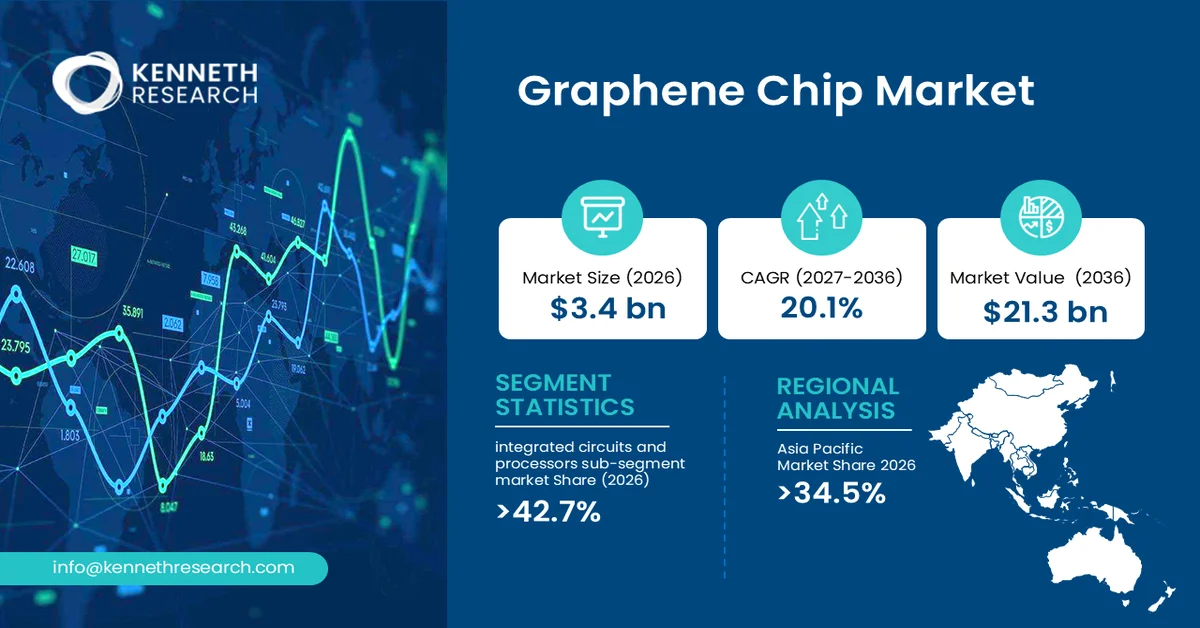
Graphene Chip Market size was valued at USD 3.4 billion in 2026 and is projected to reach USD 21.3 billion by the end of 2036, rising at a CAGR of 20.1% during the forecast period, i.e., 2027–2036. In 2027, the industry size of the global graphene chip market is estimated at USD 4.1 billion.
The primary growth driver is the semiconductor industry’s pursuit of higher-performance, smaller, and more efficient electronic architectures. Graphene’s high electrical conductivity, carrier mobility, thin structure, and compatibility with semiconductor fabrication processes support its development for advanced interconnects, transistors, sensors, memory devices, and other next-generation chip applications.
The graphene chip market comprises the development, manufacture, integration, and commercialization of semiconductor chips and electronic components that incorporate graphene as an active material, conductive layer, interconnect, substrate-related element, or functional component. Graphene is a two-dimensional carbon material characterized by high electrical conductivity, high carrier mobility, mechanical strength, thermal performance, and an exceptionally thin structure. These properties make it relevant to advanced electronic architectures where conventional materials face performance, miniaturization, or heat-management constraints.
Graphene-based chip technologies can include applications spanning integrated circuits, processors, memory devices, sensors, photonic components, and high-speed electronic systems. Government-backed research has also demonstrated the feasibility of integrating graphene-on-wafer technologies with established semiconductor manufacturing processes, supporting potential industrial adoption rather than limiting graphene chips to laboratory-scale development.
Key Graphene Chip Market Insights Summary:
Key Takeaways: Market Trends & Insights
- Graphene Chip Market is valued at USD 3.4 Billion in 2026 and is projected to reach USD 21.3 Billion by 2036 with a CAGR of 20.1% during 2027-2036
- Integrated Circuits and Processors hold the largest share within the Product Type segment with 42.7% market share in 2026
- Asia Pacific is the dominant region with a 34.5% market share in 2026, supported by semiconductor manufacturing and advanced electronics capabilities in China and Japan
- Consumer Electronics is the second and fastest analysis segment, driven by demand for compact, efficient, and high-performance electronic devices
- North America is the secondary region, with the United States and Canada supporting graphene chip opportunities through semiconductor research, manufacturing development, and advanced technology ecosystems
Market Drivers
- Rising demand for high-performance semiconductor architectures
- Expansion of advanced electronics and miniaturized devices
- Increasing development of graphene-enabled semiconductor manufacturing processes
- Growing adoption of two-dimensional materials for specialized electronic and sensing applications
Challenges
- Difficulties in Achieving Semiconductor-Grade Manufacturing Consistency
- Integration Constraints with Established Semiconductor Manufacturing Ecosystems
Graphene Chip Market Overview & Supply Chain
Graphene Chip Market adoption is increasing as semiconductor manufacturers and technology developers seek materials capable of supporting higher-performance, miniaturized, and energy-conscious electronic architectures. Graphene’s electrical conductivity, carrier mobility, atomic-scale thickness, and compatibility with semiconductor processing make it relevant to transistors, interconnects, sensors, and advanced electronic components. Its potential extends across computing, communications, sensing, and other applications where device performance and material efficiency are strategic priorities. Government policy is also reinforcing semiconductor manufacturing ecosystems and encouraging investment in advanced technologies. In 2023, the U.S. Department of Commerce stated that the CHIPS and Science Act provided $50 billion to revitalize the U.S. semiconductor industry, including manufacturing and research and development support, highlighting the strategic importance of semiconductor innovation and supply-chain resilience.
The graphene chip value chain begins with raw-material and input suppliers, providing carbon feedstocks, silicon carbide substrates, chemicals, gases, dielectric materials, metals, and other inputs required for graphene synthesis and semiconductor fabrication. Graphene producers and materials specialists then manufacture graphene through processes such as chemical vapor deposition, epitaxial growth, or other controlled synthesis techniques, with quality, purity, layer uniformity, and defect management influencing downstream performance. Chip manufacturers and foundries integrate graphene into wafers, electronic structures, interconnects, sensors, or other device architectures through deposition, patterning, lithography, etching, and packaging processes.
Graphene Chip Market: Growth Drivers & Challenges
Growth Drivers
- Rising demand for high-performance semiconductor architectures: The increasing requirement for faster, smaller, and more energy-efficient electronic architectures is encouraging research and development involving graphene-based chip technologies. Graphene offers high carrier mobility, strong electrical conductivity, atomic-scale thickness, and the ability to function within structures produced using semiconductor lithography. These characteristics make it relevant to advanced transistors, interconnects, sensors, and other components where conventional materials face performance and scaling constraints.
- Expansion of advanced electronics and miniaturized devices: The proliferation of advanced electronics is creating demand for materials that can deliver improved functionality within increasingly compact device architectures. Graphene's two-dimensional structure enables engineers to investigate extremely thin conductive and electronic layers, making it attractive for applications where device dimensions, electrical performance, heat management, and integration density are important. Its flexibility in electronic properties also supports experimentation with different device configurations and hybrid material structures. As electronics manufacturers expand capabilities across computing, communications, sensing, automotive systems, and connected devices, graphene can complement conventional semiconductor materials rather than necessarily replacing them outright.
Challenges
- Difficulties in achieving semiconductor-grade manufacturing consistency: A major restraint is the difficulty of producing graphene with consistent electronic properties while maintaining compatibility with established semiconductor manufacturing processes. Variations in defects, grain boundaries, contamination, wrinkles, and substrate interactions can alter carrier behavior and device performance. NIST research identifies substrate-induced charge variations that can reduce carrier mobility, illustrating how graphene’s performance can be affected by its manufacturing environment. These issues increase process-control requirements and can complicate wafer-level integration, testing, and yield optimization.
- Integration constraints with established semiconductor manufacturing ecosystems: Graphene must operate alongside mature silicon-based manufacturing infrastructure, creating integration challenges that extend beyond the material itself. Semiconductor fabrication depends on tightly controlled deposition, lithography, etching, cleaning, packaging, and inspection processes, while graphene can be sensitive to processing conditions and interactions with surrounding materials. NIST notes that increasing device complexity and new-material integration are creating significant measurement and process-control challenges across semiconductor manufacturing.
Graphene Chip Market Size and Forecast:
| Report Attribute | Details |
|---|---|
| Base Year |
2026 |
| Forecast Period |
2027-2036 |
| CAGR |
20.1% |
| Base Year Market Size (2026) |
USD 3.4 Billion |
| Forecast Year Market Size (2036) |
USD 21.3 Billion |
| Regional Scope |
|
Graphene Chip Market Segmentation Analysis:
Product Type Segment Analysis
In the product type segment, integrated circuits and processors sub-segment is anticipated to capture the largest market share of 42.7% by the end of 2026.
Integrated Circuits and Processors lead the product-type segment because they directly address the semiconductor industry's demand for greater computing performance, efficient data processing, and increasingly sophisticated electronic architectures. Their broad deployment across computing, communications, automotive electronics, industrial systems, and connected devices creates a substantial addressable base for graphene-enabled technologies. The U.S. Department of Commerce reported that demand for chips critical to artificial-intelligence systems increased notably during the second half of 2023, reinforcing the industry's shift toward higher-performance processing architectures. Graphene is particularly relevant to this transition because its electrical and material characteristics support investigation into high-speed transistors, interconnects, and other advanced circuit structures.
End-User Industry Segment Analysis
The consumer electronics is projected to grow as the second-largest segment in the graphene chip market due to four converging demand drivers.
Consumer Electronics is projected to grow as an important end-user industry because smartphones, tablets, computers, displays, wearable devices, and connected products increasingly require compact, efficient, and high-performance semiconductor components. This broad device ecosystem supports continued demand for improved processors, sensors, memory, connectivity, and power-management components, creating potential application pathways for graphene-enabled chips. Industry adoption is also being supported by manufacturers’ focus on thinner devices, higher processing capability, thermal management, and energy efficiency. On the supply side, graphene developers can increasingly target specialized functions within established electronics architectures rather than requiring immediate replacement of conventional silicon.
Our in-depth analysis of the graphene chip market includes the following segments:
|
Segment |
Sub-segment |
|
Product Type |
|
|
Material Type |
|
|
Manufacturing Technology |
|
|
End-User |
|
Graphene Chip Market Regional Insights:
Asia Pacific Market Trends & Insights:
Asia Pacific graphene chip market is projected to hold the largest revenue share of 34.5% by the end of 2026.
It is supported by its deep semiconductor manufacturing base, extensive electronics ecosystem, advanced component supply chains, and sustained investment in next-generation materials. The region combines large-scale production capacity with substantial consumption across computing, communications, automotive electronics, and consumer devices.
China is positioned as a principal regional production and consumption hub, supported by extensive electronics manufacturing infrastructure, domestic semiconductor development, and vertically connected supply networks.
Japan complements this position through its established strengths in semiconductor materials, electronic components, precision manufacturing, and advanced industrial technologies. Japan’s Ministry of Economy, Trade and Industry reported continued improvement in electronic components and devices production during 2024, reinforcing the country’s role within the regional technology supply chain.
North America Market Trends & Insights:
North America represents a strategically important secondary region for the Graphene Chip Market, supported by strong demand for advanced semiconductors across artificial intelligence, communications, automotive electronics, aerospace, defense, and high-performance computing. The region benefits from established semiconductor design capabilities, research institutions, advanced packaging expertise, and an expanding domestic manufacturing ecosystem. Government initiatives are reinforcing this industrial base by encouraging domestic fabrication, research, workforce development, and supply-chain resilience.
The United States remains the principal North American technology and manufacturing hub, supported by substantial semiconductor R&D activity, domestic fabrication expansion, and government-backed ecosystem development.
Canada complements the regional landscape through semiconductor research, design, advanced packaging, and commercialization capabilities. The Government of Canada reported that its semiconductor sector includes more than 500 homegrown and multinational companies, alongside research laboratories and commercial facilities, creating a broad platform for emerging semiconductor materials and technologies. This ecosystem provides Canada with opportunities to participate in graphene-related research, specialized components, and advanced semiconductor applications.
Leading Companies Operating in the Global Graphene Chip Market:
Here is a list of upstream, downstream, and key players operating in graphene chip market competitive ecosystem:
- Paragraf (United Kingdom)
- Company Overview
- Business Strategy
- Key Product Offerings
- Financial Performance
- Key Performance Indicators
- Risk Analysis
- Recent Development
- Regional Presence
- SWOT Analysis
- 2D Photonics (Italy/United Kingdom)
- Adisyn Ltd (2D Generation) (Australia)
- Graphenea S.A. (Spain)
- NanoXplore Inc. (Canada)
Recent Developments
- In May 2026, Paragraf launched the PMF2000 Graphene Field Effect Transistor (GFET), the first device to come from its newly established large-wafer manufacturing facility in Huntingdon, UK—described as the world's first dedicated graphene foundry. The contamination-free graphene-on-silicon device is designed for molecular sensing applications in healthcare, agritech, chemical processing, and industrial monitoring, and can be ordered in high volumes without design changes.
- In 2026, Graphenea completed the WOW-2D project (Wafer-on-Wafer heterogeneous integration) with partners including the University of Granada, Polytechnical University of Madrid, and the Institute of Microelectronics of Barcelona. The consortium established a manufacturing workflow for integrating graphene into Photonic Integrated Circuits (PICs), using wafer-scale processes compatible with CMOS fabrication to enable scalable production of 2D-photonic systems.
Frequently Asked Question
In 2026, the graphene chip market exceeded USD 3.4 Billion.
The graphene chip market is projected to reach USD 21.3 Billion by the end of 2036, expanding at a CAGR of 20.1% over the forecast period (2027-2036).
The major players in the market are Paragraf, 2D Photonics, Adisyn Ltd (2D Generation), Graphenea S.A., NanoXplore Inc., and others.
In the Product Type segment, the Integrated Circuits and Processors sub-segment is anticipated to capture the largest market share of 42.7% in the future and exhibit lucrative growth opportunities during 2027-2036. This growth trajectory is largely attributed to rising demand for high-performance semiconductor architectures.
Asia Pacific is projected to hold the largest market share of 34.5% by the end of 2036 and provide more business opportunities in the future. Continuous investments in semiconductor manufacturing, advanced electronics, and next-generation materials in China and Japan are fostering the region's dominance.
Why Choose Kenneth Research ?
-
Insight with Impact : We don’t just gather data — we uncover stories, trends, and opportunities that fuel business growth.
-
Experts Who Get It : Our team speaks your industry’s language and knows what really matters to your customers and market.
-
Custom-Built for You : Forget one-size-fits-all. We craft research and consulting solutions as unique as your business vision.
-
Partners, Not Just Providers : We work with you, not for you — collaborating closely to turn insights into smart, strategic moves.
-
Results That Speak : Our work powers brands, startups, and industry leaders alike — with a track record of ideas that work in the real world.
Report ID: 1307 |
Published Date: 10 Sep 2026 |
Report Format: |
Delivery Timeline: 48-72 Business Hours

Copyright © 2025 Kenneth Research. All rights reserved. Terms of Use | Privacy Policy
