Report ID: 1329 |
Published Date: 28 Sep 2026 |
Report Format: |
Delivery Timeline: 48-72 Business Hours
Weather Radar Market Outlook:
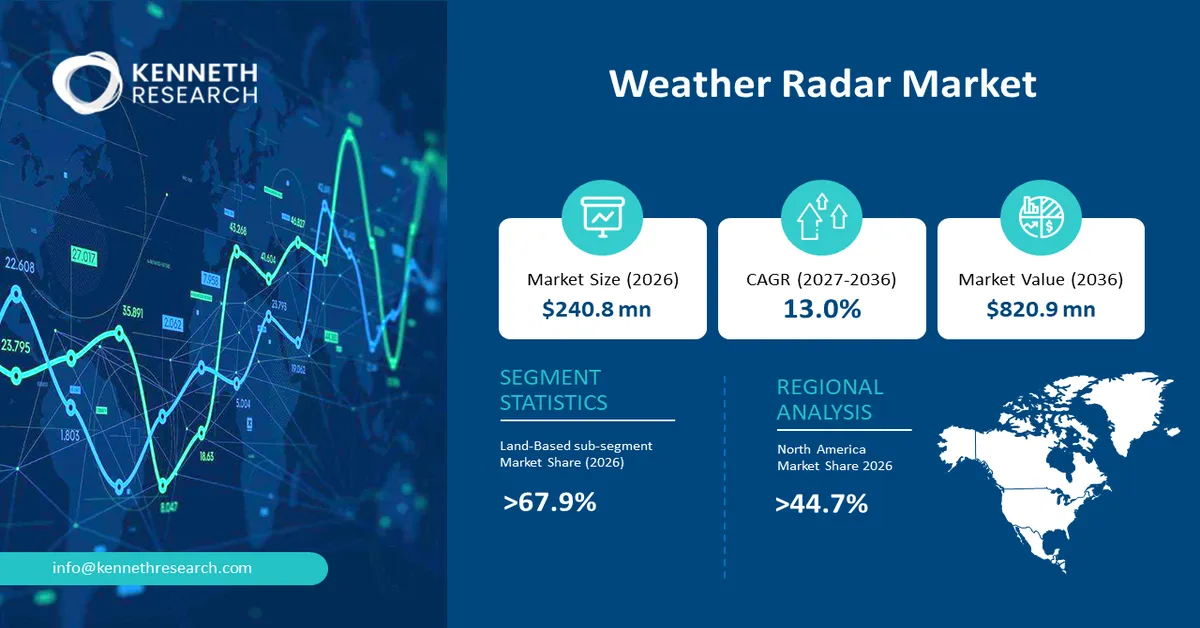
Weather Radar Market size was valued at USD 240.8 million in 2026 and is projected to reach USD 820.9 million by the end of 2036, rising at a CAGR of 13.0% during the forecast period, i.e., 2027-2036. In 2027, the industry size of the weather radar is estimated at USD 273.3 million.
The growing need for faster and more accurate detection of severe weather is driving demand for advanced weather radar systems. Radar-derived observations strengthen precipitation monitoring, wind assessment, storm tracking, and warning capabilities, supporting public safety, emergency management, aviation, transportation, and water-resource decision-making.
The weather radar market comprises radar-based hardware, systems, software, and related technologies used to observe, detect, track, and analyze atmospheric conditions. Weather radar systems transmit electromagnetic signals and interpret returned signals to identify precipitation, wind characteristics, storm structures, and other meteorological phenomena. Modern systems can incorporate Doppler and dual-polarization capabilities to improve the characterization of precipitation and atmospheric motion.
A defining characteristic of weather radar is its ability to provide localized, continuously updated observations that complement other meteorological information sources. Radar data can be processed into products that support precipitation estimation, storm identification, wind analysis, hail assessment, and severe-weather detection. Advanced radar architectures, including electronically scanned and phased-array technologies, are also being developed to enable more flexible and responsive atmospheric observation.
Key Weather Radar Market Insights Summary:
Key Takeaways: Market Trends & Insights
- Market size reaches USD 240.8 million in 2026, establishing a substantial base for continued expansion
- The market is projected to reach USD 820.9 million by 2036, reflecting a CAGR of 13.0% during 2027–2036
- Land-Based leads the Platform segment with a 67.9% share in 2026, supported by persistent atmospheric observation requirements
- North America dominates with a 44.7% share in 2026, reinforced by established radar infrastructure and modernization activity across the United States and Canada
Market Drivers
- Advanced radar capabilities and faster severe-weather detection
- Expansion of weather-dependent infrastructure and decision support
- Modernization of aging meteorological observation infrastructure
- Integration of radar data with digital forecasting and automated analytics
Challenges
- High Infrastructure, Integration, and Lifecycle Complexity
- Radio-Frequency Interference and Data-Quality Risks
Weather Radar Market Overview & Supply Chain
Adoption of weather radar systems is increasing globally as governments, meteorological agencies, infrastructure operators, and weather-sensitive industries seek more timely and localized atmospheric intelligence. Radar provides high-resolution observations that strengthen precipitation monitoring, storm tracking, severe-weather detection, and short-term forecasting. The technology is increasingly relevant to aviation and transportation safety, flood preparedness, water-resource management, agriculture, and emergency response.
The weather radar market value chain begins with specialized input materials and components, including semiconductor devices, radio-frequency electronics, antennas, transmitters, receivers, signal-processing hardware, mechanical structures, power systems, and computing equipment. Component suppliers provide the technological building blocks required for radar assembly and system integration. Manufacturers and system integrators combine these inputs with proprietary hardware, software, calibration capabilities, data-processing platforms, and network interfaces to produce operational radar systems. Distribution typically occurs through direct procurement, government tenders, specialized technology contractors, and system-integrator channels, with installation and maintenance frequently forming part of the delivery model. End users include national meteorological and hydrological agencies, aviation authorities, defense and emergency-management organizations, transportation operators, utilities, agricultural stakeholders, and research institutions.
Weather Radar Market: Growth Drivers & Challenges
Growth Drivers:
- Advanced radar capabilities and faster severe-weather detection: The transition toward faster-scanning, higher-resolution radar technologies is creating a strong upgrade cycle across meteorological observation infrastructure. Conventional radar networks can face limitations when rapidly developing storms evolve between successive scans, increasing the value of systems capable of producing atmospheric observations at shorter intervals. Phased-array radar, improved signal processing, dual-polarization functionality, automated algorithms, and integrated data platforms are therefore becoming important technology-development priorities.
- Expansion of weather-dependent infrastructure and decision support: Increasing dependence on reliable weather intelligence across infrastructure-intensive industries is strengthening demand for weather radar capabilities. Aviation operators require atmospheric observations for operational planning and safety, while transportation agencies use weather information to manage disruptions and hazardous conditions. Utilities, water-resource managers, agriculture stakeholders, emergency-management organizations, and public authorities similarly depend on timely precipitation and storm information to support operational decisions.
Challenges:
- High infrastructure, integration, and lifecycle complexity: Weather radar deployment requires substantially more than procurement of the radar unit itself. Projects can involve site preparation, towers, radomes, power systems, telecommunications, environmental considerations, calibration infrastructure, data-network integration, and specialized maintenance arrangements. These requirements increase project complexity and can extend procurement and commissioning timelines, particularly for remote or geographically difficult sites.
- Radio-frequency interference and data-quality risks: Weather radar performance depends on maintaining clean and reliable radio-frequency environments. Increasing use of wireless communications and other radio-frequency technologies can create interference that contaminates radar observations, potentially reducing the quality and reliability of meteorological products. Environment and Climate Change Canada reported that its weather-radar modernization program encountered radio-frequency interference from cell-phone signals and other sources, requiring specially designed filters to improve affected radar data.
Weather Radar Market Size and Forecast:
| Report Attribute | Details |
|---|---|
| Base Year |
2026 |
| Forecast Period |
2027-2036 |
| CAGR |
13.0% |
| Base Year Market Size (2026) |
USD 240.8 million |
| Forecast Year Market Size (2036) |
USD 820.9 million |
| Regional Scope |
|
Weather Radar Market Segmentation Analysis:
Platform Segment Analysis
In the platform segment, land-based sub-segment is anticipated to capture the largest market share of 67.9% by the end of 2026.
Land-Based systems dominate the platform segment because they provide persistent, geographically anchored atmospheric observation for national forecasting, severe-weather warnings, precipitation monitoring, aviation, transportation, and water management. Demand is reinforced by government-led modernization programs, particularly where aging radar infrastructure requires replacement with dual-polarization and higher-performance systems. Environment and Climate Change Canada’s modernization program demonstrates this continuing institutional demand: seven new radars were installed during 2021–22 as part of its national replacement effort.
Application Segment Analysis
The meteorology & hydrology is projected to grow as the second-largest segment in the weather radar market due to four converging demand drivers.
Meteorology & Hydrology is positioned for continued growth as radar-derived precipitation and atmospheric observations become increasingly important to forecasting, flood preparedness, water-resource management, and operational hydrology. Demand is being reinforced by closer integration between meteorological and hydrological services, particularly where rapid rainfall information is needed for flash-flood detection and short-term forecasting. The World Meteorological Organization reported that more than 80 weather-radar experts and operational meteorological and hydrological forecasters from five South Asian countries participated in radar-hydrology training during 2021, reflecting institutional efforts to expand the operational use of radar observations within hydrological forecasting systems.
Our in-depth analysis of the global weather radar market includes the following segments:
|
Segment |
Sub-segment |
|
Platform |
|
|
Component |
|
|
Frequency |
|
|
Application |
|
Weather Radar Market Regional Insights:
North America Market Trends & Insights:
North America weather radar market is projected to hold the largest revenue share of 44.7% by the end of 2026.
It is supported by mature meteorological infrastructure, established procurement frameworks, extensive radar coverage, and sustained investment in severe-weather monitoring. The region benefits from strong institutional demand across weather forecasting, aviation, emergency management, agriculture, transportation, and water-resource management. Government modernization programs further reinforce the regional ecosystem.
The United States remains a major regional demand center because of its extensive operational weather-observation infrastructure and strong public-sector investment in forecasting and warning capabilities.
Canada complements this demand through continued modernization and integration of radar observations into national forecasting systems. Together, the two markets provide a strong installed-base, technology-upgrade, and public procurement environment. Future regional growth should be supported by radar modernization, advanced data processing, severe-weather preparedness, and increasing integration of observations with automated forecasting and decision-support systems.
Asia Pacific Market Trends & Insights:
Asia Pacific presents significant opportunities for weather radar adoption as governments strengthen meteorological observation, disaster-risk reduction, and early-warning capabilities. Demand is supported by exposure to heavy rainfall, tropical cyclones, flooding, and other weather hazards, while expanding urban infrastructure and transportation networks increase the value of localized atmospheric intelligence.
China represents an important market because strengthening meteorological observation supports disaster prevention, forecasting, agriculture, transportation, and water management across a geographically diverse environment. Continued development of advanced observation and forecasting capabilities should create opportunities for radar modernization and integrated data platforms.
Japan has a highly developed operational radar ecosystem and continues to enhance observation capabilities for severe rainfall and disaster preparedness. The Japan Meteorological Agency is progressively upgrading its Doppler radar network with dual-polarization technology to improve precipitation measurement and monitoring of intense rainfall.
Leading Companies Operating in the Weather Radar Market:
Here is a list of upstream, downstream, and key players operating in global weather radar market competitive ecosystem:
- GAMIC GmbH (Germany)
- Company Overview
- Business Strategy
- Key Product Offerings
- Financial Performance
- Key Performance Indicators
- Risk Analysis
- Recent Development
- Regional Presence
- SWOT Analysis
- Glarun Technology (China)
- Furuno Electric Co., Ltd. (Japan)
- Enterprise Electronics Corporation (EEC) (United States)
Recent Developments
- In 2025, Furuno Electric Co., Ltd. continued expanding its ultra-compact weather radar deployments, with some 150 units now installed across 33 countries. The radar, measuring just 1 meter in diameter and weighing 65 kg, enables highly accurate rainfall detection at altitudes between 500 and 2,000 meters—filling gaps left by conventional large-scale systems that monitor broader regions and higher altitudes. Applications range from urban flood prediction in Singapore to wildfire behavior forecasting in Australia.
- In January 2026, Leonardo signed an agreement to acquire Enterprise Electronics Corporation (EEC) through its U.S. subsidiary, strengthening its meteorological and remote sensing portfolio. The U.S.-based EEC, which specializes in weather radar instruments and satellite receiving stations, will continue operating under its existing brand while benefiting from Leonardo's complementary offerings and global support capabilities. The combined entity brings over five decades of experience and a global installed base of more than 1,500 systems deployed across over 120 countries.
Frequently Asked Question
In 2026, the weather radar market exceeded USD 240.8 million.
The weather radar market is projected to reach USD 820.9 million by the end of 2036, expanding at a CAGR of 13.0% over the forecast period (2027-2036).
The major players in the market are GAMIC GmbH (Germany), Glarun Technology (China), Furuno Electric Co., Ltd. (Japan), Enterprise Electronics Corporation (EEC) (United States), and others.
In the Platform segment, the Land-Based sub-segment is anticipated to capture the largest market share of 67.9% in 2026 and exhibit lucrative growth opportunities during 2027-2036. This growth trajectory is largely attributed to increasing demand for persistent atmospheric observation for forecasting, severe-weather warnings, and precipitation monitoring.
North America is projected to hold the largest market share of 44.7% in 2026 and provide more business opportunities in the future. Continuous investments in radar modernization and advanced weather observation capabilities across the United States and Canada are fostering the region's dominance.
Why Choose Kenneth Research ?
-
Insight with Impact : We don’t just gather data — we uncover stories, trends, and opportunities that fuel business growth.
-
Experts Who Get It : Our team speaks your industry’s language and knows what really matters to your customers and market.
-
Custom-Built for You : Forget one-size-fits-all. We craft research and consulting solutions as unique as your business vision.
-
Partners, Not Just Providers : We work with you, not for you — collaborating closely to turn insights into smart, strategic moves.
-
Results That Speak : Our work powers brands, startups, and industry leaders alike — with a track record of ideas that work in the real world.
Report ID: 1329 |
Published Date: 28 Sep 2026 |
Report Format: |
Delivery Timeline: 48-72 Business Hours

Copyright © 2025 Kenneth Research. All rights reserved. Terms of Use | Privacy Policy
