Report ID: 1328 |
Published Date: 28 Sep 2026 |
Report Format: |
Delivery Timeline: 48-72 Business Hours
Screenless Display Market Outlook:
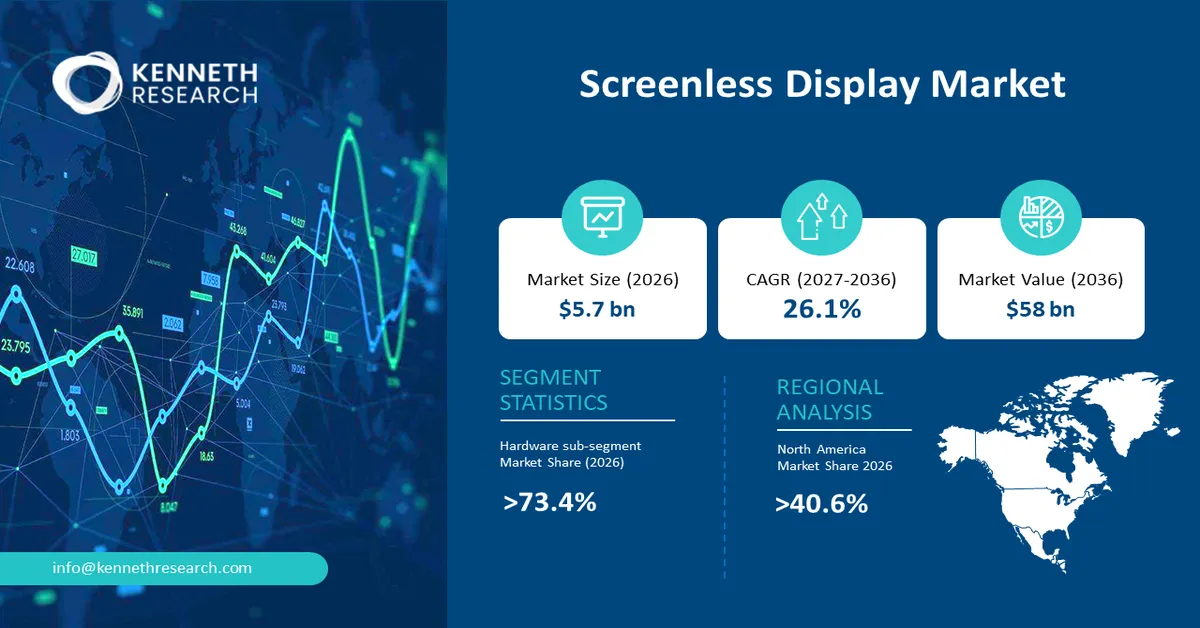
Screenless Display Market size was valued at USD 5.7 billion in 2026 and is projected to reach USD 58 billion by the end of 2036, rising at a CAGR of 26.1% during the forecast period, i.e., 2027-2036. In 2027, the industry size of the screenless display is estimated at USD 7.2 billion.
The primary growth driver for the screenless display market is increasing adoption of immersive technologies that deliver information without relying on conventional physical screens.
The screenless display market comprises technologies that present visual information without relying on conventional flat-panel screens as the primary viewing interface. These solutions use alternative mechanisms such as retinal projection, holographic imaging, head-up displays, virtual retinal displays, and other optical or perceptual techniques to deliver information directly within the user's visual field or environment.
Key characteristics include reduced dependence on physical display surfaces, immersive visualization, compact form factors, hands-free information access, enhanced spatial interaction, and integration with sensors, cameras, computing platforms, and artificial intelligence.
Key Screenless Display Market Insights Summary:
Key Takeaways: Market Trends & Insights
- Screenless display market is projected to grow from USD 5.7 billion in 2026 to USD 58 billion by 2036, expanding at a 26.1% CAGR.
- North America accounted for the largest regional share at 40.6% in 2026, supported by advanced technology ecosystems, strong R&D capabilities, and early adoption of immersive visualization technologies across the U.S. and Canada.
- Hardware is expected to remain the leading Component segment, accounting for 73.4% in 2026, driven by continued demand for optical engines, sensors, processors, projection components, and other enabling technologies.
- Visual Image Displays are positioned as a key Technology segment, supported by increasing demand for glasses-free visualization, holographic imaging, head-up displays, and other immersive visual interfaces.
Market Drivers
- Expansion of immersive interfaces across industrial applications
- Growing demand for hands-free and spatial visualization
- Increasing integration of screenless displays with augmented and mixed-reality systems
- Rising use of advanced visualization for training, maintenance, healthcare, and human-machine interaction
Challenges
- High optical and hardware complexity
- Interoperability, usability, and safety constraints
Screenless Display Market Overview & Supply Chain
Adoption of the screenless display market is increasing as organizations explore immersive interfaces that can deliver digital information without dependence on conventional display panels. Applications span manufacturing, healthcare, education, construction, defense, government services, and entertainment, creating opportunities for screenless and immersive visualization technologies across multiple professional environments. The OECD notes that immersive environments are being applied across manufacturing, healthcare, construction, education, government services, and defense, while falling technology costs and expanding use cases are increasing policy and industry interest.
The industry value chain begins with optical components, microdisplays, light sources, sensors, cameras, semiconductor devices, processors, projection components, waveguides, and specialized materials. Technology developers integrate these inputs into projection, retinal-imaging, holographic, head-up, and other screenless display architectures, followed by software integration, calibration, testing, and system validation.
Screenless Display Market: Growth Drivers & Challenges
Growth Drivers:
- Expansion of immersive interfaces across industrial applications: The increasing use of immersive interfaces across manufacturing, healthcare, training, and other professional environments is creating new demand for screenless display technologies. Unlike conventional displays, screenless solutions can present digital information within the user's field of view or directly within an immersive environment, supporting hands-free workflows and contextual visualization. The U.S. National Institute of Standards and Technology (NIST) has been evaluating mixed-reality interfaces for collaborative robot programming, highlighting AR and VR as promising approaches for reducing physical and cognitive workload in manufacturing operations.
- Growing demand for hands-free and spatial visualization: A second growth driver is the increasing requirement for hands-free access to digital information in environments where conventional screens can restrict mobility, attention, or workspace flexibility. Screenless technologies can support visualization through head-up, retinal, holographic, projection-based, and other approaches, allowing information to be incorporated into a user's operating environment. This capability is particularly relevant to industrial maintenance, engineering, healthcare visualization, defense, logistics, and workforce training.
Challenges:
- High optical and hardware complexity: Screenless display systems require sophisticated combinations of optics, light sources, sensors, processors, projection technologies, and specialized software. Achieving adequate brightness, resolution, field of view, image stability, compactness, and user comfort simultaneously remains technically demanding. These requirements can increase development costs and create barriers for manufacturers seeking to commercialize systems at scale. Compatibility with existing computing and enterprise platforms can further complicate deployment, particularly when solutions must operate across different hardware and software environments.
- Interoperability, usability, and safety constraints: Screenless displays increasingly interact with cameras, sensors, spatial-computing platforms, industrial software, and connected devices, making interoperability a significant commercial consideration. NIST identifies interoperability between AR presentation systems and traditional product-engineering software platforms as a barrier to wider industrial adoption.
Screenless Display Market Size and Forecast:
| Report Attribute | Details |
|---|---|
| Base Year |
2026 |
| Forecast Period |
2027-2036 |
| CAGR |
26.1% |
| Base Year Market Size (2026) |
USD 5.7 billion |
| Forecast Year Market Size (2036) |
USD 58 billion |
| Regional Scope |
|
Screenless Display Market Segmentation Analysis:
Component Segment Analysis
In the component segment, the Hardware sub-segment is anticipated to maintain its leading position, accounting for 73.4% in 2026.
Hardware forms the physical foundation of screenless display systems, encompassing optical engines, sensors, projection components, processors, light sources, waveguides, and other enabling technologies required to generate and deliver visual information without conventional display panels. Demand is supported by the expanding deployment of immersive and spatial-computing technologies across industrial, healthcare, automotive, defense, and enterprise applications. Government research activity is also strengthening the technological ecosystem. The U.S. Department of Energy's Building Technologies Office has identified advanced sensing and control technologies as important tools for improving building-system performance, demonstrating the broader shift toward connected physical technologies and intelligent interfaces.
Technology Segment Analysis
In the technology segment, the Visual Image Displays sub-segment is projected to grow as enterprises and specialized users increasingly seek ways to present digital information without relying exclusively on conventional physical screens. Demand is being supported by advances in augmented reality, holographic visualization, head-up displays, retinal projection, and other optical approaches that place information within the user's field of view. The U.S. Department of Homeland Security identifies retinal beam scanning, varifocal displays, and other emerging approaches as technologies being developed to improve AR visual experiences, while also noting the potential for future screenless interfaces.
Government-backed technology programs are also encouraging development of advanced visual interfaces. A 2024 U.S. Army SBIR award focused on mixed-reality off-the-visor head-up displays intended to provide daylight-readable information while preserving users' natural field of view and situational awareness.
Our in-depth analysis of the global screenless display market includes the following segments:
|
Segment |
Sub-segment |
|
Component |
|
|
Technology |
|
|
Display Type |
|
|
End User |
|
Screenless Display Market Regional Insights:
North America Market Trends & Insights:
North America is the dominant region in the screenless display market, accounting for 40.6% in 2026.
The region benefits from a mature technology ecosystem, strong research capabilities, advanced digital infrastructure, and early commercialization of augmented, mixed-reality, holographic, and head-up display technologies. The U.S. is particularly important because federal agencies continue to support immersive-technology research and industrial applications.
The U.S. represents the principal country-level market, supported by its concentration of technology developers, defense organizations, research institutions, automotive companies, and healthcare technology providers.
Canada complements regional development through investments in advanced digital technologies, research institutions, and innovation-oriented technology programs. Its proximity to the U.S. technology ecosystem also facilitates collaboration and commercialization.
Asia-Pacific Market Trends & Insights:
Asia-Pacific represents a major opportunity for the screenless display market as Japan and China expand advanced manufacturing, consumer electronics, automotive technologies, and immersive digital applications. The region's strong electronics production ecosystem provides access to optical components, semiconductors, sensors, and other hardware required for next-generation display systems. Government-supported digitalization and advanced-manufacturing initiatives are also encouraging businesses to adopt emerging visualization technologies.
Japan offers strong potential through its sophisticated electronics and automotive industries, established research capabilities, and emphasis on precision technologies. Japanese manufacturers can support development of compact optical systems and advanced human-machine interfaces.
China provides substantial opportunities through its large electronics manufacturing base, expanding automotive industry, and increasing deployment of immersive technologies. Its extensive supply chain for electronic and optical components can support scalable production and commercialization.
Leading Companies Operating in the Screenless Display Market:
Here is a list of upstream, downstream, and key players operating in the global screenless display market competitive ecosystem:
- Microsoft (U.S)
- Company Overview
- Business Strategy
- Key Product Offerings
- Financial Performance
- Key Performance Indicators
- Risk Analysis
- Recent Development
- Regional Presence
- SWOT Analysis
- Sony (Japan)
- MicroVision (U.S)
Recent Developments
- January 2026 - Sony announced a collaboration with Ameria to combine Sony’s Spatial Reality Display with Ameria’s StarKit gesture-control and content-management solution.
Frequently Asked Question
In 2026, the screenless display market exceeded USD 5.7 billion.
The screenless display market is projected to reach USD 58 billion by the end of 2036, expanding at a CAGR of 26.1% over the forecast period (2027-2036).
The major players in the market are Microsoft, Sony, MicroVision, RealView Imaging, Holoxica, and others.
In the Component segment, the Hardware sub-segment is anticipated to capture the largest market share of 73.4% in the future and exhibit lucrative growth opportunities during 2027-2036.
North America is projected to hold the largest market share of 40.6% by the end of 2026 and provide more business opportunities in the future.
Why Choose Kenneth Research ?
-
Insight with Impact : We don’t just gather data — we uncover stories, trends, and opportunities that fuel business growth.
-
Experts Who Get It : Our team speaks your industry’s language and knows what really matters to your customers and market.
-
Custom-Built for You : Forget one-size-fits-all. We craft research and consulting solutions as unique as your business vision.
-
Partners, Not Just Providers : We work with you, not for you — collaborating closely to turn insights into smart, strategic moves.
-
Results That Speak : Our work powers brands, startups, and industry leaders alike — with a track record of ideas that work in the real world.
Report ID: 1328 |
Published Date: 28 Sep 2026 |
Report Format: |
Delivery Timeline: 48-72 Business Hours

Copyright © 2025 Kenneth Research. All rights reserved. Terms of Use | Privacy Policy
