Report ID: 1333 |
Published Date: 28 Sep 2026 |
Report Format: |
Delivery Timeline: 48-72 Business Hours
Electronic Nose Market Outlook:
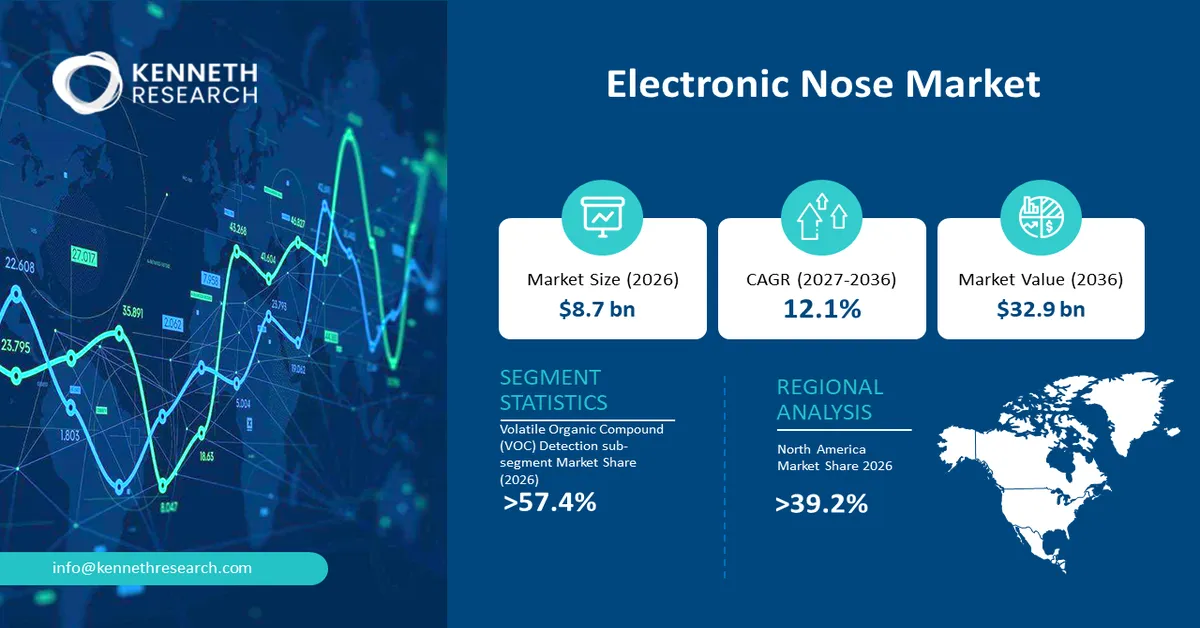
Electronic Nose Market size was valued at USD 8.7 billion in 2026 and is projected to reach USD 32.9 billion by the end of 2036, rising at a CAGR of 12.1% during the forecast period, i.e., 2027-2036. In 2027, the industry size of the electronic nose is estimated at USD 9.9 billion.
The primary growth driver for the electronic nose market is the increasing need for rapid, portable, and continuous detection of volatile organic compounds (VOCs) across environmental monitoring, industrial emissions control, process management, and safety applications.
The electronic nose market refers to the development, manufacturing, and deployment of instrumented olfactory-sensing systems designed to detect, distinguish, and classify odors or chemical compounds in gaseous environments. An electronic nose generally combines an array of partially selective chemical sensors with signal-processing and pattern-recognition algorithms. Rather than relying on a single sensing element, the system evaluates the collective response of multiple sensors to generate a characteristic response pattern for a target substance or mixture.
Key characteristics include sensor-array architecture, selective chemical interactions, signal acquisition, data processing, and pattern recognition. Depending on the configuration, systems can incorporate chemiresistive, polymer, metal-oxide, quartz-crystal, or other sensing technologies.
Key Electronic Nose Market Insights Summary:
Key Takeaways: Market Trends & Insights
- Electronic nose market is projected to grow from USD 8.7 billion in 2026 to USD 32.9 billion by 2036, expanding at a 12.1% CAGR during the forecast period.
- North America accounted for the largest regional share at 39.2% in 2026, supported by advanced sensing infrastructure, environmental monitoring capabilities, and adoption of intelligent gas-detection technologies across the U.S. and Canada.
- Volatile Organic Compound (VOC) Detection is the leading Detection Type segment, accounting for 57.4% in 2026, driven by increasing requirements for rapid identification and monitoring of chemical signatures across environmental and industrial applications.
- Sensor Modules are gaining importance within the component landscape as manufacturers integrate multiple sensing elements, signal-processing electronics, and connectivity into compact, application-ready electronic-nose platforms.
Market Drivers
- Growing demand for real-time VOC detection
- Expansion of sensor miniaturization and intelligent data processing
- Increasing adoption of connected and portable gas-monitoring systems
- Rising application of electronic noses in environmental, food, industrial, and healthcare monitoring
Challenges
- Sensor Drift and Cross-Sensitivity
- Complexity of Sensor Integration and Commercial Deployment
Electronic Nose Market Overview & Supply Chain
The electronic nose market is gaining relevance as industries and regulators seek faster, more flexible approaches to identifying and monitoring complex gaseous environments. Electronic-nose systems can combine multiple sensing elements with data-processing and pattern-recognition capabilities, supporting applications such as environmental monitoring, industrial emissions management, food quality, and process control. The U.S. Environmental Protection Agency is advancing lower-cost and portable air-measurement technologies that provide real-time mobile and stationary monitoring capabilities for pollutants including VOCs, supporting the broader shift toward distributed sensing and near-source monitoring.
The industry value chain begins with sourcing sensing materials, substrates, electronic components, packaging materials, and supporting hardware. Sensor manufacturers then fabricate individual sensing elements and integrate them into multi-sensor arrays or modules. System developers combine these sensor modules with signal-acquisition electronics, embedded software, communication interfaces, and pattern-recognition or machine-learning capabilities. Calibration and validation are important stages because sensor response can vary with environmental conditions and chemical mixtures.
Electronic Nose Market: Growth Drivers & Challenges
Growth Drivers:
- Growing demand for real-time VOC detection: The increasing requirement for rapid identification of volatile organic compounds (VOCs) across environmental monitoring, industrial safety, food processing, and healthcare is strengthening demand for electronic-nose technologies. Unlike conventional analytical approaches that may require laboratory-based processing, electronic noses can combine gas-sensor responses with pattern-recognition algorithms to identify chemical signatures directly at the point of measurement. Recent research from the Indian Institute of Technology Jodhpur demonstrated an IoT-enabled electronic-nose system using gas sensors and machine-learning algorithms to classify VOCs, illustrating the movement toward connected and intelligent sensing platforms.
- Expansion of sensor miniaturization and intelligent data processing: Advances in sensor materials, microelectromechanical systems, embedded electronics, and artificial intelligence are enabling electronic noses to become smaller, more energy-efficient, and easier to integrate into portable equipment. Single-sensor and compact-array architectures combined with machine-learning models can reduce hardware complexity while retaining the ability to distinguish complex gas signatures. These improvements can broaden deployment beyond dedicated analytical equipment toward distributed sensing, connected devices, and application-specific monitoring platforms.
Challenges:
- Sensor drift and cross-sensitivity: Sensor drift and cross-sensitivity remain major technical restraints for the electronic nose market because sensing elements can respond differently to temperature, humidity, concentration changes, and mixtures of interfering compounds. These effects can reduce repeatability and make it difficult to maintain consistent classification performance outside controlled environments. Electronic-nose systems therefore require robust calibration, compensation techniques, and appropriate data-processing algorithms to maintain reliable operation. The challenge becomes more pronounced when systems are deployed for continuous monitoring, where environmental conditions can change over time.
- Complexity of sensor integration and commercial deployment: Electronic noses require the coordinated integration of sensing elements, signal-acquisition electronics, processing hardware, software, and pattern-recognition models. This creates technical and commercial challenges because performance depends on the interaction of hardware and analytical algorithms rather than on the sensing element alone. Portable and IoT-oriented systems additionally require low power consumption, compact packaging, wireless connectivity, and reliable real-time processing
Electronic Nose Market Size and Forecast:
| Report Attribute | Details |
|---|---|
| Base Year |
2026 |
| Forecast Period |
2027-2036 |
| CAGR |
12.1% |
| Base Year Market Size (2026) |
USD 8.7 billion |
| Forecast Year Market Size (2036) |
USD 32.9 billion |
| Regional Scope |
|
Electronic Nose Market Segmentation Analysis:
Detection Type Segment Analysis
In the detection type segment, the Volatile Organic Compound (VOC) Detection sub-segment is anticipated to capture the largest market share of 57.4% in 2026.
Electronic noses use arrays of chemical sensors to generate response patterns that can distinguish complex gas mixtures, making them suitable for applications where multiple volatile compounds must be detected rather than a single target gas. NIST research highlights electronic-nose approaches for detecting VOCs in air and developing microsensor arrays with improved chemical selectivity. Demand is also supported by the increasing need for localized and rapid chemical monitoring. NIST identifies sensor-based chemical analysis as relevant to environmental monitoring and manufacturing process control, particularly where rapid, direct measurements can complement conventional analytical instruments.
Component Type Segment Analysis
In the component segment, the sensor modules sub-segment is projected to witness strong growth as electronic noses increasingly integrate sensing elements, signal-processing electronics, and communication capabilities into compact, application-ready platforms. Sensor modules simplify system development by reducing the need for users to assemble individual sensing components while enabling faster integration into environmental monitoring, industrial equipment, food-quality systems, and connected devices.
Government-backed technology development also demonstrates the importance of integrated sensor architectures. India’s Centre for Development of Advanced Computing (C-DAC) describes an electronic-nose system comprising a sensor array PCB, data-acquisition PCB, valve-control electronics, and associated odor-handling hardware, highlighting the role of integrated modules in complete e-nose platforms.
Our in-depth analysis of the global electronic nose market includes the following segments:
|
Segment |
Sub-segment |
|
Technology Type |
|
|
Application |
|
|
Component |
|
|
Deployment Mode |
|
|
Detection Type |
|
|
Technology Integration |
|
Electronic Nose Market Regional Insights:
North America Market Trends & Insights:
North America is the leading region in the electronic nose market, accounting for 39.2% in 2026.
Regional leadership is supported by strong environmental-monitoring capabilities, industrial technology adoption, and continued investment in advanced air-sensing infrastructure. The U.S. benefits from active government support for next-generation emission measurement technologies, including lower-cost and portable systems designed to provide real-time monitoring of VOC emissions.
The U.S. represents the principal country within the region because of its extensive industrial base, established environmental regulatory framework, and investment in sensor-based monitoring. The Environmental Protection Agency is specifically developing technologies for detecting and controlling fugitive industrial VOC emissions, including portable sensor systems and sensor networks for fenceline monitoring.
Canada complements regional growth through its structured national air-quality monitoring infrastructure. Environment and Climate Change Canada tracks VOC concentrations through the National Air Pollution Surveillance program, demonstrating an established institutional requirement for measuring gaseous pollutants.
Asia-Pacific Market Trends & Insights:
Asia-Pacific represents an important secondary market for electronic nose technologies, supported by expanding environmental monitoring, industrial automation, food-quality applications, and investment in advanced sensing technologies. Japan and China are particularly relevant because both countries have established capabilities in sensor engineering, analytical instrumentation, and applied research.
Japan benefits from a mature sensing-technology ecosystem and continued development of electronic-nose applications. The Asia Center for Air Pollution Research, operating within the Acid Deposition Monitoring Network in East Asia, conducted VOC monitoring training and capacity-building activities in Japan during 2024, involving participating countries including China. This indicates increasing regional emphasis on VOC measurement capabilities and analytical infrastructure.
China provides a strong manufacturing and research base for electronic noses and gas-sensing technologies. Researchers from China's National Institute of Metrology have contributed to recent work covering gas-sensitive materials, sensor arrays, applications, and data-analysis methods for electronic noses, demonstrating the country's active technical ecosystem in this field.
Leading Companies Operating in the Electronic Nose Market:
Here is a list of upstream, downstream, and key players operating in the global electronic nose market competitive ecosystem:
- Sensigent (U.S)
- Company Overview
- Business Strategy
- Key Product Offerings
- Financial Performance
- Key Performance Indicators
- Risk Analysis
- Recent Development
- Regional Presence
- SWOT Analysis
- Aryballe (France)
- UST Umweltsensortechnik (Germany)
Recent Developments
- May 2026: Aryballe introduced NeOse, a portable odor-detection product designed to bring digital olfaction into field and on-the-go applications.
- 2025: UST Umweltsensortechnik's Triplesensor platform provides an integrated electronic-nose architecture based on an active MOX gas-sensor module.
Frequently Asked Question
In 2026, the electronic nose market was valued at USD 8.7 billion.
The electronic nose market is projected to reach USD 32.9 billion by the end of 2036, expanding at a CAGR of 12.1% over the forecast period (2027–2036).
The major players in the market are Sensigent, Aryballe, Alpha MOS, Envirosuite Technologies, UST Umweltsensortechnik, and others.
In the Detection Type segment, the Volatile Organic Compound (VOC) Detection sub-segment is anticipated to capture the largest market share of 57.4% in 2026 and exhibit lucrative growth opportunities during 2027–2036.
North America is projected to hold the largest market share of 39.2% in 2026 and provide more business opportunities in the future.
Why Choose Kenneth Research ?
-
Insight with Impact : We don’t just gather data — we uncover stories, trends, and opportunities that fuel business growth.
-
Experts Who Get It : Our team speaks your industry’s language and knows what really matters to your customers and market.
-
Custom-Built for You : Forget one-size-fits-all. We craft research and consulting solutions as unique as your business vision.
-
Partners, Not Just Providers : We work with you, not for you — collaborating closely to turn insights into smart, strategic moves.
-
Results That Speak : Our work powers brands, startups, and industry leaders alike — with a track record of ideas that work in the real world.
Report ID: 1333 |
Published Date: 28 Sep 2026 |
Report Format: |
Delivery Timeline: 48-72 Business Hours

Copyright © 2025 Kenneth Research. All rights reserved. Terms of Use | Privacy Policy
