Report ID: 1330 |
Published Date: 09 Sep 2026 |
Report Format: |
Delivery Timeline: 48-72 Business Hours
Battery Felts Market Outlook:
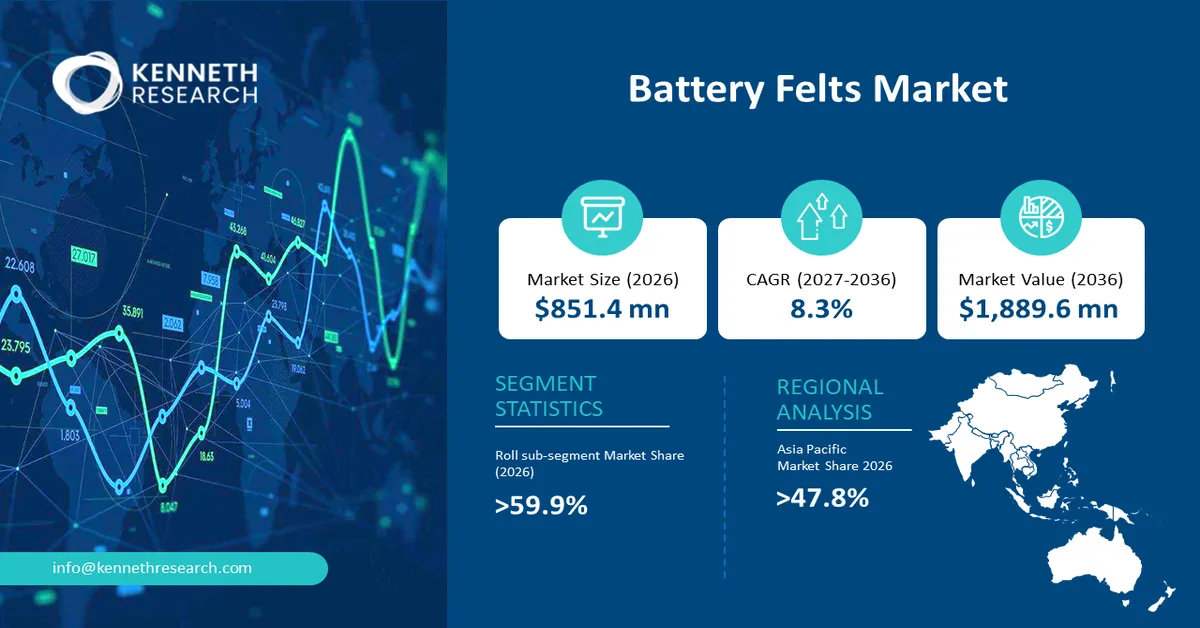
Battery Felts Market size was valued at USD 851.4 million in 2026 and is projected to reach USD 1,889.6 million by the end of 2036, rising at a CAGR of 8.3% during the forecast period, i.e., 2027-2036. In 2027, the industry size of the battery felts is estimated at USD 921.9 million.
The expansion of battery energy-storage systems is a primary growth driver for the battery felts market, as greater deployment creates demand for durable, chemically resistant electrode-support materials. The International Energy Agency reported that global battery-storage additions reached 42 GW in 2023, reinforcing the expanding industrial requirement for battery components and associated materials.
The battery felts market refers to the production and supply of fibrous felt materials engineered for use as functional components within battery systems. Battery felts are typically manufactured from electrically conductive or chemically resistant fiber structures and are selected according to requirements such as electrical performance, porosity, permeability, mechanical integrity, thermal stability, and resistance to chemical environments.
In industrial battery applications, felts can serve as electrode-support, current-distribution, reaction-surface, or structural materials, depending on the battery chemistry and cell architecture. Their interconnected fiber networks can provide substantial accessible surface area while allowing electrolyte movement through the material. These characteristics are particularly relevant to electrochemical systems in which electrode architecture influences reaction efficiency, charge-transfer behavior, and operating durability.
Key Battery Felts Market Insights Summary:
Key Takeaways: Market Trends & Insights
- The battery felts market is projected to expand from USD 851.4 million in 2026 to USD 1,889.6 million by 2036, reflecting sustained industry growth
- The market is expected to advance at a CAGR of 8.3% during 2027-2036, supported by expanding energy-storage deployment and battery manufacturing activity
- Roll is the leading Format sub-segment, accounting for 59.9% market share in 2026, supported by continuous processing and efficient integration into battery applications
- Asia Pacific dominates the global battery felts market with a 47.8% market share in 2026, driven by strong battery manufacturing capabilities and energy-storage development across the region
- Polyester is positioned as the second and fastest analysis segment, benefiting from demand for engineered materials offering processability, structural stability, and application-specific performance
Market Drivers
- Expansion of long-duration energy storage deployment
- Advancement of electrode-material engineering and battery manufacturing
- Increasing integration of renewable electricity with energy-storage systems
- Growing demand for durable and chemically resistant electrochemical components
Challenges
- High processing complexity and manufacturing-cost pressure
- Performance variability and application-specific qualification requirements
Battery Felts Market Overview & Supply Chain
Global adoption of battery felts is increasing alongside the broader deployment of electrochemical energy-storage technologies, particularly as power systems integrate greater volumes of variable renewable generation. Battery felts are relevant because their porous, conductive structures can support electrochemical reactions and facilitate electrolyte movement in applications such as flow batteries and other specialized storage systems. Their performance characteristics also make them relevant to industrial efforts to improve electrode durability, reaction efficiency, and system reliability. The energy-storage sector is receiving increasing policy and infrastructure attention as governments seek greater grid flexibility and energy security.
The battery felts value chain begins with raw-material suppliers providing precursor fibers and specialty materials, including carbon-based, synthetic, and other engineered fibers selected for electrical, chemical, thermal, and mechanical requirements. Material preparation can involve fiber formation, treatment, blending, and conversion into nonwoven or felt structures. Manufacturers subsequently engineer, consolidate, heat-treat, surface-modify, cut, and finish felts according to battery-application specifications. Distribution typically operates through direct manufacturer relationships, specialized material distributors, and battery-component suppliers serving regional production clusters. End users include battery manufacturers, energy-storage-system developers, electrochemical technology companies, research institutions, and industrial equipment producers.
Battery Felts Market: Growth Drivers & Challenges
Growth Drivers:
- Expansion of long-duration energy storage deployment: The growing need for long-duration energy storage is strengthening demand for specialized electrode materials, including battery felts used in flow-battery architectures. Unlike conventional short-duration storage, long-duration systems are designed to support electricity availability over extended operating periods, making electrode durability, conductivity, electrolyte compatibility, and structural stability increasingly important. This creates opportunities for felt manufacturers to develop materials optimized for specific electrochemical environments and operating conditions.
- Advancement of electrode-material engineering and battery manufacturing: Continuous advances in electrode engineering are creating opportunities for battery felts to move beyond standardized material formats toward application-specific solutions. Manufacturers are increasingly focused on controlling fiber architecture, porosity, surface characteristics, conductivity, thickness, and chemical resistance to optimize electrochemical performance. This development is particularly relevant to flow batteries, where electrodes must support electrolyte movement while maintaining effective reaction interfaces during repeated operating cycles.
Challenges:
- High processing complexity and manufacturing-cost pressure: A major restraint for the battery felts market is the processing complexity required to produce felts with consistent electrochemical and physical properties. Carbon-based felts can require controlled thermal treatment, surface modification, structural conditioning, and precise handling to achieve the conductivity, porosity, wettability, and chemical stability required by specific battery architectures. These additional processing stages increase equipment requirements, energy consumption, quality-control needs, and production complexity.
- Performance variability and application-specific qualification requirements: Another significant restraint is the need to tailor battery felts to particular electrochemical environments rather than relying on universally interchangeable materials. Differences in fiber structure, porosity, surface chemistry, thickness, compression behavior, and electrolyte compatibility can materially influence electrode performance. Consequently, battery developers often require extensive material characterization and application-specific qualification before integrating a felt into a commercial system.
Battery Felts Market Size and Forecast:
| Report Attribute | Details |
|---|---|
| Base Year |
2026 |
| Forecast Period |
2027-2036 |
| CAGR |
8.3% |
| Base Year Market Size (2026) |
USD 851.4 million |
| Forecast Year Market Size (2036) |
USD 1,889.6 million |
| Regional Scope |
|
Battery Felts Market Segmentation Analysis:
Format Segment Analysis
In the format segment, roll sub-segment is anticipated to capture the largest market share of 59.9% by the end of 2026.
The Roll format leads the battery felts market because its continuous cylindrical configuration aligns well with applications requiring consistent electrode coverage, predictable material handling, and efficient integration into battery assemblies. Demand is supported by expanding stationary energy-storage deployment, where battery systems increasingly require reliable electrode materials with controlled thickness, porosity, conductivity, and chemical resistance. Roll-format products can also offer manufacturing advantages through continuous processing, standardized dimensions, and comparatively efficient conversion into application-specific electrode components. On the demand side, the U.S. Energy Information Administration reported that 10.4 GW of new utility-scale battery storage capacity was added in the United States during 2024, demonstrating continued expansion of the downstream battery-storage infrastructure relevant to electrode-material suppliers.
Material Segment Analysis
The polyester sector is projected to grow as the second-largest segment in the battery felts market due to four converging demand drivers.
Polyester is projected to grow as battery-felt manufacturers seek material platforms that combine structural flexibility, processability, and compatibility with evolving battery-component designs. Demand is being supported by continued investment in battery manufacturing and the diversification of electrochemical storage technologies. Polyester-based structures can provide a useful foundation for engineered felt products where manufacturers prioritize controlled fiber architecture, dimensional stability, and scalable conversion. Supply-side development is also benefiting from advances in polymer processing and material engineering, enabling manufacturers to tailor fiber structures and surface characteristics for specific electrochemical environments. As battery producers increasingly emphasize manufacturing scalability, material consistency, and application-specific performance, polyester felts can gain adoption where these attributes align with cell and system requirements.
Our in-depth analysis of the global battery felts market includes the following segments:
|
Segment |
Sub-segment |
|
Format |
|
|
Material |
|
|
End-User |
|
Battery Felts Market Regional Insights:
Asia Pacific Market Trends & Insights:
Asia Pacific battery felts market is projected to hold the largest revenue share of 47.8% by the end of 2026.
Regional leadership is underpinned by a deeply established battery manufacturing ecosystem, extensive materials-processing capabilities, expanding energy-storage deployment, and sustained public-sector support for domestic battery supply chains.
China remains the principal country-level contributor, supported by large-scale battery production, extensive component manufacturing, and accelerating stationary-storage deployment.
Japan maintains strategic importance through advanced battery technologies, established materials expertise, and policy-led supply-chain development. Together, these markets reinforce Asia Pacific’s manufacturing depth, technology capabilities, and investment attractiveness. The region is therefore positioned to retain its leadership as battery manufacturers and energy-storage developers increasingly prioritize localized, scalable, and technically reliable component supply.
North America Market Trends & Insights:
North America represents an important secondary market for battery felts, supported by expanding battery manufacturing, grid-modernization requirements, electrification, and investment in domestic energy-storage supply chains. Industrial demand is strengthened by efforts to localize battery materials and components, reduce supply-chain vulnerabilities, and develop advanced manufacturing capabilities.
The United States is the region’s principal industrial hub, supported by federal programs targeting next-generation battery manufacturing, energy storage, critical materials, and supply-chain security. The policy environment encourages domestic production and technological development, creating opportunities for battery-felt suppliers able to meet demanding performance and qualification requirements.
Canada offers opportunities through its critical-mineral resources, battery-material development, research capabilities, and government-supported efforts to establish integrated domestic battery value chains. Recent federal initiatives have targeted lithium processing, battery innovation, and advanced energy-storage technologies, creating a supportive environment for specialized component suppliers.
Leading Companies Operating in the Battery Felts Market:
Here is a list of upstream, downstream, and key players operating in global battery felts market competitive ecosystem:
- American Elements (United States)
- Company Overview
- Business Strategy
- Key Product Offerings
- Financial Performance
- Key Performance Indicators
- Risk Analysis
- Recent Development
- Regional Presence
- SWOT Analysis
- CFC Carbon (China)
Recent Developments
- In 2025, American Elements was recognized as a key player in the global Battery Carbon and Graphite Felt market, supplying high-purity materials for advanced battery applications across industries including aerospace and consumer electronics.
- In October 2025, CFC Carbon highlighted its advanced rigid graphite felt boards designed for energy storage applications. The boards provide thermal insulation and structural support in high-temperature batteries, thermal energy storage, and fuel cells, operating in inert atmospheres up to 3000°C.
Frequently Asked Question
In 2026, the battery felts market exceeded USD 851.4 million.
The battery felts market is projected to reach USD 1,889.6 million by the end of 2036, expanding at a CAGR of 8.3% over the forecast period (2027-2036).
The major players in the market are American Elements, CFC Carbon, and others.
In the Format segment, the Roll sub-segment is anticipated to capture the largest market share of 59.9% in the future and exhibit lucrative growth opportunities during 2027-2036. This growth trajectory is largely attributed to its suitability for continuous processing and efficient integration into battery applications.
Asia Pacific is projected to hold the largest market share of 47.8% by the end of 2036 and provide more business opportunities in the future. Continuous investments in battery manufacturing, energy-storage infrastructure, and advanced battery technologies across China and Japan are fostering the region's dominance.
Why Choose Kenneth Research ?
-
Insight with Impact : We don’t just gather data — we uncover stories, trends, and opportunities that fuel business growth.
-
Experts Who Get It : Our team speaks your industry’s language and knows what really matters to your customers and market.
-
Custom-Built for You : Forget one-size-fits-all. We craft research and consulting solutions as unique as your business vision.
-
Partners, Not Just Providers : We work with you, not for you — collaborating closely to turn insights into smart, strategic moves.
-
Results That Speak : Our work powers brands, startups, and industry leaders alike — with a track record of ideas that work in the real world.
Report ID: 1330 |
Published Date: 09 Sep 2026 |
Report Format: |
Delivery Timeline: 48-72 Business Hours

Copyright © 2025 Kenneth Research. All rights reserved. Terms of Use | Privacy Policy
