Report ID: 1107 |
Published Date: 19 Aug 2026 |
Report Format: |
Delivery Timeline: 48-72 Business Hours
Geofoam Market Outlook:
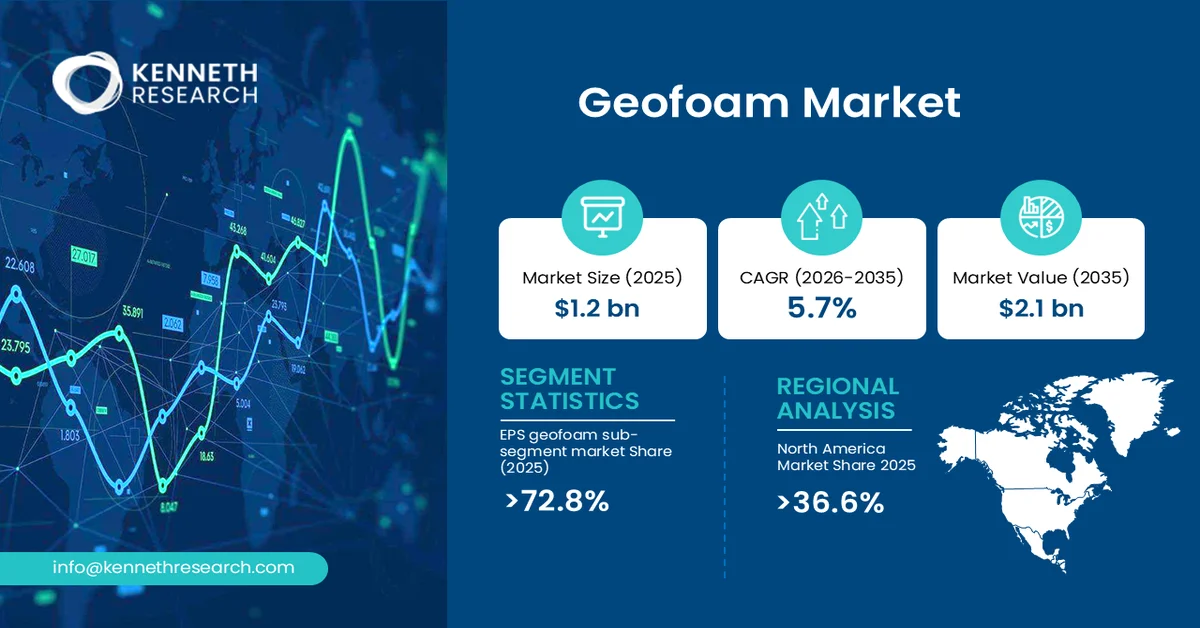
Geofoam Market size was valued at USD 1.2 billion in 2025 and is projected to reach USD 2.1 billion by the end of 2035, rising at a CAGR of 5.7% during the forecast period, i.e., 2026-2035. In 2026, the industry size of the geofoam is estimated at USD 1.3 billion.
Growing investment in transportation infrastructure and geotechnical stabilization projects is the primary driver of the geofoam market. As governments prioritize resilient roads, bridge approaches, embankments, and slope stabilization, lightweight geofoam solutions are increasingly adopted to reduce settlement, accelerate construction, and improve long-term structural performance in challenging soil conditions.
The geofoam market comprises the production, distribution, and application of engineered cellular polymer blocks used as lightweight geotechnical fill materials in civil engineering and infrastructure projects. Geofoam is primarily manufactured from expanded polystyrene (EPS) and extruded polystyrene (XPS), with EPS being the most widely utilized material because of its favorable balance of strength, low density, durability, and cost-effectiveness. These lightweight blocks are designed to replace conventional soil or aggregate fill in projects where reducing vertical loads is essential.
Geofoam is characterized by its exceptionally low density, high compressive strength relative to weight, dimensional stability, moisture resistance, ease of installation, and predictable engineering performance. The material can be factory-manufactured into customized block dimensions, enabling rapid placement and reducing construction time, equipment requirements, and settlement-related risks in difficult ground conditions.
The market plays a significant role across transportation, commercial, industrial, and public infrastructure development. Geofoam is extensively used in highway embankments, bridge approaches, retaining wall backfills, airport infrastructure, railways, utility protection, and slope stabilization projects, where it enhances structural reliability while minimizing foundation loading and improving long-term asset performance.
Key Geofoam Market Insights Summary:
Key Takeaways: Market Trends & Insights
- Geofoam Market projected to grow from USD 1.2 billion in 2025 to USD 2.1 billion by 2035 at a 5.7% CAGR.
- North America accounted for the largest regional share at 36.6% in 2025, supported by extensive transportation infrastructure modernization, mature geotechnical engineering practices, and sustained public investment in civil infrastructure.
- EPS Geofoam is expected to remain the leading Product Type segment with a 72.8% market share, driven by its lightweight characteristics, high compressive strength, ease of installation, and widespread use in transportation and geotechnical engineering projects.
- Road & Highway Construction is projected to be the fastest-growing application segment, supported by increasing investment in highway expansion, bridge approaches, embankment stabilization, and resilient transportation infrastructure.
- The market is benefiting from growing adoption of lightweight engineered fill materials, increasing focus on infrastructure resilience, advancements in geotechnical construction techniques, and rising demand for faster, cost-efficient civil engineering solutions.
Market Drivers
- Rising investment in transportation infrastructure and bridge rehabilitation
- Increasing adoption of lightweight engineered fill for geotechnical risk mitigation
- Expansion of climate-resilient infrastructure development
- Growing preference for faster and cost-efficient construction techniques
Challenges
- High dependence on petroleum-derived raw materials and price volatility
- Limited awareness and conservative engineering specifications in developing markets
Geofoam Market Overview & Supply Chain
The adoption of geofoam is increasing globally as infrastructure developers seek lightweight, durable, and engineered fill materials that reduce settlement, accelerate construction schedules, and improve long-term performance in transportation and civil engineering projects. Its use has expanded across highways, bridge approaches, retaining structures, rail corridors, airports, and utility installations where conventional fill materials impose excessive loads on weak subgrades. Growing emphasis on resilient infrastructure, lifecycle cost optimization, and sustainable construction practices has further strengthened demand for geofoam in both developed and emerging economies. Public infrastructure investment continues to reinforce this trend. According to the Organisation for Economic Co-operation and Development (OECD), government investment spending averaged 3.5% of GDP across OECD countries in 2023, reflecting sustained capital allocation toward long-term infrastructure assets, including transport networks that increasingly incorporate advanced geotechnical solutions such as geofoam.
The geofoam market value chain begins with the procurement of petrochemical-derived raw materials, primarily polystyrene resin, along with blowing agents, flame-retardant additives, and processing chemicals supplied by polymer manufacturers. These inputs are converted into engineered geofoam blocks through expansion, molding, curing, cutting, and quality testing processes that ensure compliance with geotechnical and construction specifications. Manufacturers then distribute finished products through specialized construction material suppliers, regional distributors, and direct project contracts with engineering firms and infrastructure contractors. Logistics providers play a critical role because geofoam blocks require efficient transportation and handling despite their lightweight nature. End users include transportation agencies, commercial builders, geotechnical contractors, airport authorities, railway developers, utility infrastructure companies, and public works organizations. The value chain is further supported by design consultants, geotechnical engineers, testing laboratories, regulatory authorities, and project management firms that oversee specification, installation, quality assurance, and long-term infrastructure performance.
Geofoam Market: Growth Drivers & Challenges
Growth Drivers
- Rising investment in transportation infrastructure and bridge rehabilitation: Ongoing investment in transportation infrastructure is a major catalyst for the geofoam market because highway expansions, bridge approach embankments, retaining structures, and interchange upgrades increasingly require lightweight fill materials to minimize settlement and reduce structural loading. Geofoam enables engineers to construct on weak or compressible soils without extensive ground improvement, improving project efficiency and extending infrastructure service life. As governments modernize aging transport networks, demand for engineered geotechnical solutions continues to expand. According to the U.S. Department of Transportation, the Bridge Investment Program awarded more than USD 5 billion in grants during 2022–2025 to improve the condition, safety, efficiency, and resilience of bridges across the United States. This sustained investment creates long-term opportunities for geofoam in bridge approaches and associated transportation infrastructure, while encouraging broader adoption of advanced geotechnical construction methods in future public infrastructure projects.
- Increasing adoption of lightweight engineered fill for geotechnical risk mitigation: The increasing use of lightweight engineered fill materials in geotechnical engineering is accelerating demand for geofoam across infrastructure and commercial construction projects. Conventional soil fill can create excessive loads on weak foundations, leading to differential settlement, structural deformation, and increased maintenance requirements. Geofoam addresses these challenges by significantly reducing vertical stress while maintaining structural stability and design flexibility. Engineers also benefit from simplified installation, reduced excavation requirements, and improved construction schedules, particularly in constrained urban environments and environmentally sensitive locations. As infrastructure owners place greater emphasis on lifecycle performance and resilient asset management, geofoam is becoming an integral component of modern geotechnical design practices. Continued innovation in engineering standards, project specifications, and sustainable construction methodologies is expected to reinforce its adoption across transportation, utility, industrial, and municipal infrastructure developments over the coming years.
Challenges:
- High dependence on petroleum-derived raw materials and price volatility: Geofoam production relies heavily on polystyrene-based feedstocks, making manufacturers vulnerable to fluctuations in petrochemical prices, supply chain disruptions, and energy cost variations. Changes in crude oil markets, refinery operations, and resin availability can significantly influence production costs and pricing strategies. Since many infrastructure contracts are awarded through competitive bidding with fixed budgets, manufacturers often have limited flexibility to transfer higher raw material costs to customers, placing pressure on profit margins. Contractors may also postpone procurement decisions when material prices become unpredictable, affecting project planning and inventory management. Over the long term, producers are expected to strengthen procurement strategies, diversify supplier networks, improve manufacturing efficiency, and develop more sustainable production practices to reduce exposure to raw material volatility while maintaining commercial competitiveness.
- Limited awareness and conservative engineering specifications in developing markets: Despite its proven engineering performance, geofoam remains underutilized in several developing economies because many infrastructure owners, consultants, and contractors continue to rely on conventional earth-fill materials that are familiar within existing construction practices. Limited technical expertise, insufficient design experience, and the absence of standardized specifications in some jurisdictions can slow project approvals and reduce confidence in adopting geofoam for critical applications. This conservative approach restricts market penetration even where geofoam could deliver significant technical and lifecycle benefits. Manufacturers frequently need to invest substantial resources in technical education, engineering support, demonstration projects, and stakeholder engagement to encourage acceptance. Looking ahead, broader inclusion of geofoam in national design standards, engineering education, and infrastructure specifications is expected to improve market acceptance and create stronger commercial opportunities across emerging construction markets.
Geofoam Market Size and Forecast:
| Report Attribute | Details |
|---|---|
| Base Year |
2025 |
| Forecast Year |
2026-2035 |
| CAGR |
5.7% |
| Base Year Market Size (2025) |
USD 1.2 billion |
| Forecast Year Market Size (2035) |
USD 2.1 billion |
| Regional Scope |
|
Geofoam Market Segmentation Analysis:
Product Type Segment Analysis
In the product type segment, the eps geofoam sub-segment is anticipated to capture the largest market share of 72.8% by the end of 2025.
EPS Geofoam is the leading product segment because it provides an optimal combination of lightweight performance, compressive strength, dimensional stability, and cost efficiency for large-scale civil engineering applications. Transportation agencies, engineering consultants, and contractors increasingly specify EPS geofoam for highway embankments, bridge approaches, retaining wall backfills, airport infrastructure, and slope stabilization projects where minimizing vertical loads is critical. Its ease of fabrication into customized block sizes, rapid installation, and predictable engineering behavior make it well suited for projects with tight construction schedules and complex ground conditions. On the supply side, established manufacturing processes, broad availability of raw materials, and mature production capabilities enable consistent product quality and dependable supply for infrastructure projects. The Federal Highway Administration (FHWA) identifies EPS-block geofoam as the most commonly used geofoam material and notes that it is widely used by State transportation agencies for lightweight fill applications, reinforcing its dominant position in transportation construction. Looking ahead, continued investment in resilient infrastructure and modernization of transportation networks is expected to sustain strong demand for EPS geofoam across both public and private construction sectors.
Application Type Segment Analysis
Road & highway construction is projected to witness strong growth in the geofoam market as transportation authorities increasingly seek engineered materials that improve pavement stability while reducing embankment loads on weak or compressible soils. Geofoam enables faster construction, minimizes differential settlement, and lowers the need for extensive ground improvement, making it particularly valuable for highway widening, bridge approaches, interchanges, and road rehabilitation projects. The application is gaining wider acceptance as infrastructure developers prioritize resilient transportation assets, shorter construction schedules, and reduced lifecycle maintenance costs. On the supply side, manufacturers are expanding production capabilities and offering project-specific engineering support to meet stringent transportation specifications and accelerate deployment. Demand is further supported by continued public investment in road infrastructure. According to Japan's Ministry of Land, Infrastructure, Transport and Tourism (MLIT), the government publishes annual Road Project Expenditure data for FY2023, reflecting sustained investment in national, prefectural, and municipal road development programs that support the adoption of advanced construction materials, including lightweight geotechnical solutions. Continued modernization of transportation infrastructure is expected to strengthen the long-term growth outlook for geofoam in road and highway applications.
Our in-depth analysis of the global geofoam market includes the following segments:
|
Segment |
Sub-segment |
|
Product Type |
|
|
Application |
|
|
Density |
|
|
End User |
|
|
Distribution Channel |
|
Geofoam Market Regional Insights:
North America Market Trends & Insights:
North America accounted for 36.6% of the geofoam market in 2025, making it the leading regional market.
The region's dominance is supported by extensive transportation infrastructure modernization, widespread adoption of advanced geotechnical engineering practices, and well-established design standards for lightweight fill applications. Public agencies and engineering firms have incorporated geofoam into bridge approaches, highway embankments, retaining structures, airport developments, and utility infrastructure to improve structural performance while reducing settlement risks. Mature manufacturing capabilities, strong collaboration between material suppliers and engineering consultants, and rigorous infrastructure quality requirements further reinforce regional leadership. Regulatory emphasis on resilient infrastructure, lifecycle asset management, and efficient construction practices continues to encourage the specification of engineered lightweight fill materials across major civil engineering projects. According to the U.S. Census Bureau, the value of construction put in place reached USD 2.20 trillion in 2024, demonstrating the substantial scale of construction activity that supports demand for advanced geotechnical materials across North America.
Within the region, the United States represents the principal market owing to continuous investment in highways, bridges, airports, and public infrastructure supported by federal and state transportation programs. Extensive engineering expertise and established procurement standards have accelerated the adoption of geofoam in complex infrastructure developments requiring lightweight structural fill.
Canada also contributes significantly through transportation corridor expansion, municipal infrastructure renewal, and climate-resilient construction initiatives. Increasing investment in road rehabilitation, bridge replacement, and northern infrastructure projects has strengthened demand for engineered geotechnical materials capable of improving foundation performance under challenging environmental conditions. The combined focus of both countries on infrastructure resilience and long-term asset reliability is expected to sustain North America's leadership in the geofoam market.
Europe Market Trends & Insights:
Asia Pacific is expected to remain a high-growth region for the geofoam market, supported by rapid infrastructure development, expanding urbanization, and increasing adoption of advanced geotechnical construction practices. Governments across the region are investing in transportation corridors, high-speed rail networks, airports, ports, flood protection systems, and urban redevelopment projects that require lightweight engineered fill to address weak soil conditions and reduce long-term settlement. The growing emphasis on resilient infrastructure, sustainable construction techniques, and lifecycle cost optimization is encouraging engineers and contractors to incorporate geofoam into complex civil engineering applications. At the same time, expanding domestic manufacturing capabilities, stronger collaboration between infrastructure authorities and engineering consultants, and the gradual incorporation of modern geotechnical standards are creating favorable conditions for wider commercial adoption. As infrastructure projects become larger and more technically demanding, the region offers significant long-term opportunities for geofoam manufacturers, technology providers, and specialized construction contractors.
Within Asia Pacific, Japan remains a mature market with extensive experience in applying geofoam for road embankments, bridge approaches, railway infrastructure, retaining structures, and disaster-resilient construction. The country's focus on maintaining aging infrastructure and improving resilience against earthquakes and challenging ground conditions continues to support demand for engineered lightweight fill solutions.
China is emerging as a major growth market, driven by ongoing investment in expressways, urban transit systems, airports, logistics infrastructure, and large-scale municipal development. The increasing adoption of advanced geotechnical engineering methods, combined with expanding domestic production capabilities and continuous modernization of construction practices, is expected to strengthen the use of geofoam across a broad range of infrastructure and commercial construction applications.
Leading Companies Operating in the Global Geofoam Market:
Here is a list of upstream, downstream, and key players operating in the global geofoam market competitive ecosystem:
- Atlas Molded Products(United States)
- Company Overview
- Business Strategy
- Key Product Offerings
- Financial Performance
- Key Performance Indicators
- Risk Analysis
- Recent Development
- Regional Presence
- SWOT Analysis
- Geofoam International(United States)
- SI Geofoam (Shree Insupac)(India)
- Foam Concepts, Inc.(United States)
Recent Developments
- July 2024: EIA Geomembrane Initiative- An initiative introduced geomembrane protection systems for EPS geofoam blocks to improve durability and environmental resistance in infrastructure projects.
Frequently Asked Question
In 2025, the geofoam market exceeded USD 1.2 billion.
The geofoam market is projected to reach USD 2.1 billion by the end of 2035, expanding at a CAGR of 5.7% over the forecast period (2026-2035).
The major players in the market are Atlas Molded Products, Beaver Plastics Ltd., Plasti-Fab Ltd., Geofoam International, SI Geofoam (Shree Insupac), Foam Concepts, Inc., and others.
In the product type segment, the eps geofoam sub-segment is anticipated to capture the largest market share of 72.8% in the future and exhibit lucrative growth opportunities during 2026-2035. This growth trajectory is largely attributed to its widespread adoption in transportation infrastructure owing to its lightweight properties, structural stability, and ability to minimize settlement in challenging ground conditions.
North America is projected to hold the largest market share of 36.6% by the end of 2025 and provide more business opportunities in the future. Continuous investments in transportation infrastructure modernization and geotechnical construction projects across the United States and Canada are fostering the region's dominance.
Why Choose Kenneth Research ?
-
Insight with Impact : We don’t just gather data — we uncover stories, trends, and opportunities that fuel business growth.
-
Experts Who Get It : Our team speaks your industry’s language and knows what really matters to your customers and market.
-
Custom-Built for You : Forget one-size-fits-all. We craft research and consulting solutions as unique as your business vision.
-
Partners, Not Just Providers : We work with you, not for you — collaborating closely to turn insights into smart, strategic moves.
-
Results That Speak : Our work powers brands, startups, and industry leaders alike — with a track record of ideas that work in the real world.
Report ID: 1107 |
Published Date: 19 Aug 2026 |
Report Format: |
Delivery Timeline: 48-72 Business Hours

Copyright © 2025 Kenneth Research. All rights reserved. Terms of Use | Privacy Policy
