Report ID: 1367 |
Published Date: 23 Sep 2026 |
Report Format: |
Delivery Timeline: 48-72 Business Hours
Gas Nitriding Furnace Market Outlook:
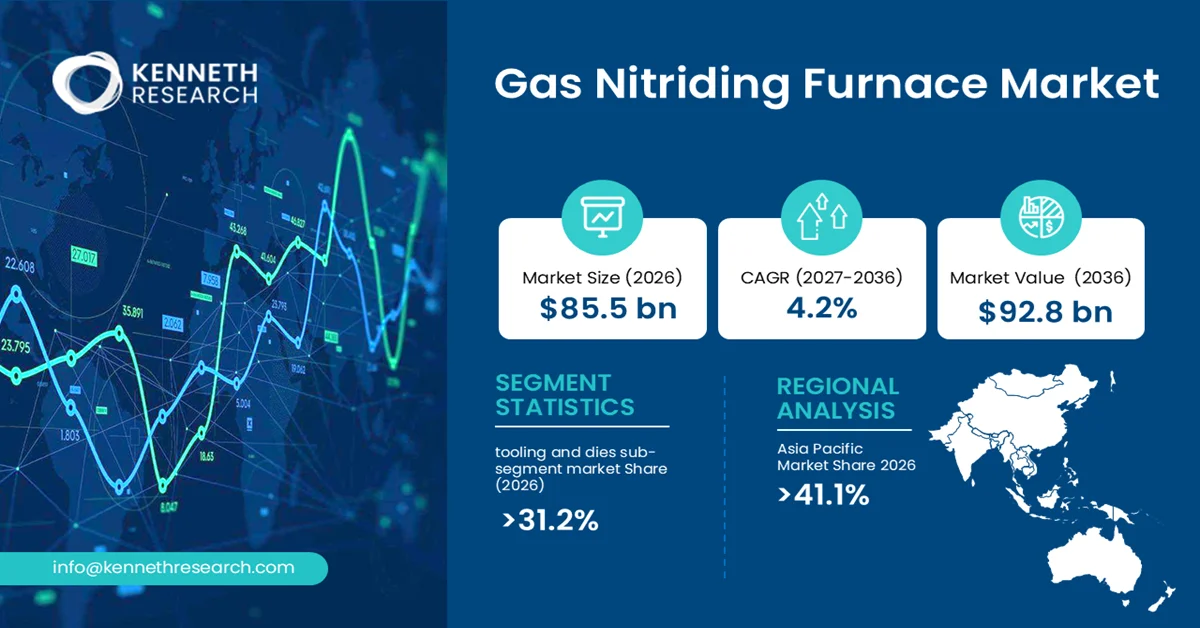
Gas Nitriding Furnace Market size was valued at USD 85.5 billion in 2026 and is projected to reach USD 92.8 billion by the end of 2036, rising at a CAGR of 4.2% during the forecast period, i.e., 2027–2036. In 2027, the industry size of the gas nitriding furnace market is estimated at USD 89.1 billion.
The primary growth driver for the gas nitriding furnace market is the increasing demand for high-wear-resistance and fatigue-resistant metal components across automotive, tooling, machinery, and precision-engineering applications.
The gas nitriding furnace market comprises industrial furnace systems designed to perform controlled gas nitriding heat treatments on ferrous and alloy-steel components. These systems use a nitrogen-rich atmosphere, typically involving ammonia, to diffuse nitrogen into the surface of metal parts and improve surface hardness, wear resistance, fatigue performance, and corrosion resistance.
Gas nitriding furnaces are used across automotive manufacturing, tooling and dies, aerospace, machinery, plastics processing, and other precision-engineering applications. Modern systems incorporate controlled gas flow, temperature regulation, automated process cycles, atmosphere monitoring, safety systems, and programmable controls to achieve consistent metallurgical results.
Key Gas Nitriding Furnace Market Insights Summary:
Gas Nitriding Furnace Market - Key Insights
- The market is driven by growing demand for wear-resistant, fatigue-resistant, and dimensionally stable metal components across automotive, tooling and dies, machinery, and precision-engineering applications.
- Tooling and dies represent the leading application area, supported by the need to improve tool durability and maintain dimensional accuracy under repeated production cycles.
- Automotive OEMs and suppliers remain a significant end-user group because gears, shafts, dies, molds, and other automotive components require controlled surface hardening.
- Asia-Pacific remains the leading regional market, with Japan and China benefiting from established automotive, machinery, tooling, and metalworking manufacturing ecosystems.
- Technological development is increasingly focused on automated process control, atmosphere monitoring, programmable treatment cycles, and digital process management.
Market Drivers
- Increasing production of wear-resistant automotive and industrial components.
- Rising demand for longer component service life and reduced maintenance requirements.
- Greater adoption of automated atmosphere-controlled heat-treatment systems.
- Increasing emphasis on precision manufacturing and dimensional stability during surface treatment.
Challenges
- High initial investment and installation costs for advanced gas nitriding furnace systems.
- Ammonia Handling, Safety Requirements, and Skilled-Operator Dependence
Gas Nitriding Furnace Market Overview & Supply Chain
Growth Drivers
- Expansion of durable-goods manufacturing and precision metal-component production: The expansion of durable-goods manufacturing is supporting demand for advanced heat-treatment equipment capable of improving the performance and service life of metal components. Gas nitriding is particularly relevant for components that operate under repeated mechanical loads, friction, and elevated wear, including gears, shafts, dies, molds, and other precision-engineered parts. In the U.S., the Bureau of Economic Analysis reported that durable-goods manufacturing increased in the third quarter of 2024, with motor vehicles, bodies and trailers, and parts among the leading contributors to growth in durable-goods manufacturing.
- Growing adoption of automated and precisely controlled heat-treatment processes: Manufacturers are increasingly seeking heat-treatment systems that provide repeatable metallurgical results, accurate atmosphere control, and consistent processing across production batches. Modern gas nitriding furnaces can integrate programmable temperature profiles, gas-flow regulation, atmosphere monitoring, automated loading systems, and process-recording capabilities. These capabilities help manufacturers reduce process variability and improve quality control for complex components.
Challenges
- High capital investment and process-integration complexity: High capital expenditure remains a significant challenge for manufacturers considering the installation or modernization of gas nitriding furnace systems. Industrial furnaces require specialized heating chambers, gas-distribution equipment, atmosphere-control systems, sensors, programmable controls, loading mechanisms, exhaust arrangements, and safety infrastructure. Integrating these systems into an existing heat-treatment facility can further increase installation complexity because furnace layouts, utilities, ventilation, production workflows, and material-handling systems may require modification.
- Ammonia handling, safety requirements, and skilled-operator dependence: Gas nitriding requires controlled handling of process gases, making safety management an important operational consideration. Facilities must establish appropriate procedures for gas charging, monitoring, ventilation, leak detection, emergency response, and equipment maintenance. OSHA guidance for ammonia systems emphasizes process hazard analysis, operating procedures, employee training, and pre-startup safety reviews when ammonia-containing equipment is introduced or significantly modified.
Gas Nitriding Furnace Market: Growth Drivers & Challenges
Growth Drivers
- Expansion of durable-goods manufacturing and precision metal-component production: The expansion of durable-goods manufacturing is supporting demand for advanced heat-treatment equipment capable of improving the performance and service life of metal components. Gas nitriding is particularly relevant for components that operate under repeated mechanical loads, friction, and elevated wear, including gears, shafts, dies, molds, and other precision-engineered parts. In the U.S., the Bureau of Economic Analysis reported that durable-goods manufacturing increased in the third quarter of 2024, with motor vehicles, bodies and trailers, and parts among the leading contributors to growth in durable-goods manufacturing.
- Growing adoption of automated and precisely controlled heat-treatment processes: Manufacturers are increasingly seeking heat-treatment systems that provide repeatable metallurgical results, accurate atmosphere control, and consistent processing across production batches. Modern gas nitriding furnaces can integrate programmable temperature profiles, gas-flow regulation, atmosphere monitoring, automated loading systems, and process-recording capabilities. These capabilities help manufacturers reduce process variability and improve quality control for complex components.
Challenges
- High capital investment and process-integration complexity: High capital expenditure remains a significant challenge for manufacturers considering the installation or modernization of gas nitriding furnace systems. Industrial furnaces require specialized heating chambers, gas-distribution equipment, atmosphere-control systems, sensors, programmable controls, loading mechanisms, exhaust arrangements, and safety infrastructure. Integrating these systems into an existing heat-treatment facility can further increase installation complexity because furnace layouts, utilities, ventilation, production workflows, and material-handling systems may require modification.
- Ammonia handling, safety requirements, and skilled-operator dependence: Gas nitriding requires controlled handling of process gases, making safety management an important operational consideration. Facilities must establish appropriate procedures for gas charging, monitoring, ventilation, leak detection, emergency response, and equipment maintenance. OSHA guidance for ammonia systems emphasizes process hazard analysis, operating procedures, employee training, and pre-startup safety reviews when ammonia-containing equipment is introduced or significantly modified.
Gas Nitriding Furnace Market Size and Forecast:
| Report Attribute | Details |
|---|---|
| Base Year |
2026 |
| Forecast Period |
2027-2036 |
| CAGR |
4.2% |
| Base Year Market Size (2026) |
USD 85.5 billion |
| Forecast Year Market Size (2036) |
USD 92.8 billion |
| Regional Scope |
|
Gas Nitriding Furnace Market Segmentation Analysis:
Application Type Segment Analysis
In the application segment, the tooling and dies sub-segment is anticipated to capture the largest market share, accounting for 31.2% in 2026.
Tooling and dies require surface properties that support resistance to wear, friction, fatigue, and repeated mechanical loading, making gas nitriding particularly suitable for extending operational performance. Gas nitriding forms a hardened surface layer while maintaining the properties of the underlying material, which is valuable for dies, molds, punches, cutting tools, and other precision tooling. Research on forging tools has demonstrated the relevance of gas nitriding for improving the wear, abrasion, fatigue, and corrosion resistance of dies exposed to demanding operating conditions. The adoption of nitriding is further supported by the increasing use of advanced tool steels in high-performance forming and machining applications.
End User Segment Analysis
In the end user segment, automotive oems and suppliers represent a key demand category for gas nitriding furnace systems because automotive manufacturing requires large volumes of components with high resistance to wear, friction, fatigue, and dimensional deformation. Nitriding is particularly relevant for gears, shafts, transmission components, dies, molds, and other metal parts subjected to repeated mechanical stresses. The treatment enables manufacturers to improve surface performance while maintaining the required properties of the component core, supporting longer service intervals and consistent component performance.
Our in-depth analysis of the global gas nitriding furnace market includes the following segments:
|
Segment |
Sub-segment |
|
By Type |
|
|
By Application |
|
|
By End User |
|
Gas Nitriding Furnace Market - Regional Analysis
Asia-Pacific Market Trends & Insights:
Asia-Pacific is the dominant region in the gas nitriding furnace market, accounting for 41.1% of the market share in 2026.
The region benefits from its extensive manufacturing base, particularly across automotive, machinery, tooling, metalworking, and precision-engineering industries. Gas nitriding furnaces are closely linked to these industries because manufacturers use the technology to improve the surface performance and service life of components subjected to friction, repeated loading, and wear. The presence of established industrial supply chains and a large base of heat-treatment and component manufacturers further strengthens regional demand.
Japan has a mature manufacturing ecosystem with strong capabilities in precision machinery, automotive components, tooling, and industrial equipment. METI reported that Japanese industrial production in 2024 was influenced substantially by automotive and general-purpose machinery industries, while specialized products such as cemented-carbide tools recorded strong increases linked partly to automotive-component processing demand.
China's manufacturing ecosystem also benefits from the presence of integrated supply chains spanning component production, equipment manufacturing, and downstream industrial applications.
North America Market Trends & Insights:
North America represents an important regional market for gas nitriding furnace systems, supported by established automotive, tooling, machinery, aerospace, and metal-processing industries. The region has a mature industrial heat-treatment ecosystem in which manufacturers use specialized surface-treatment technologies to improve the durability and operating performance of precision metal components.
The U.S. benefits from a broad base of automotive-component producers, special die and tool manufacturers, machinery producers, and industrial heat-treatment facilities. The U.S. Census Bureau separately identifies special die and tool, die set, jig, and fixture manufacturing as an established manufacturing industry, creating a relevant downstream customer base for nitriding technologies.
Canada complements this industrial ecosystem through its automotive, aerospace, machinery, and metal-fabrication activities. Increasing emphasis on component longevity, precision manufacturing, production automation, and refurbishment of existing industrial equipment is expected to create opportunities for gas nitriding furnace suppliers across North America.
Leading Companies Operating in the Global Gas Nitriding Furnace Market:
Here is a list of upstream, downstream, and key players operating in the global gas nitriding furnace Market competitive ecosystem:
- Nitrex (Canada)
- Company Overview
- Business Strategy
- Key Product Offerings
- Financial Performance
- Key Performance Indicators
- Risk Analysis
- Recent Development
- Regional Presence
- SWOT Analysis
- SECO/WARWICK (Poland)
- Surface Combustion (U.S)
Recent Developments
- 2025: Nitrex announced that it engineered and shipped what it described as its largest gas nitrider, designed for high-precision ship-marine propulsion gear applications.
- December 2025: In December 2025, SECO/WARWICK announced that Brazilian heat-treatment company Isoflama selected the company for its sixth furnace.
Frequently Asked Question
In 2026, the gas nitriding furnace market was valued at USD 85.5 billion.
The gas nitriding furnace market is projected to reach USD 92.8 billion by 2036, expanding at a CAGR of 4.2% during 2027–2036.
The major players include Nitrex, SECO/WARWICK, Surface Combustion, Ipsen, and AFC-Holcroft, among others.
In the application segment, tooling and dies is anticipated to hold the largest market share, accounting for 31.2% in 2026.
Asia-Pacific is the dominant region, accounting for 41.1% of the market in 2026, supported by strong automotive, machinery, tooling, and precision-manufacturing activity in Japan and China.
Why Choose Kenneth Research ?
-
Insight with Impact : We don’t just gather data — we uncover stories, trends, and opportunities that fuel business growth.
-
Experts Who Get It : Our team speaks your industry’s language and knows what really matters to your customers and market.
-
Custom-Built for You : Forget one-size-fits-all. We craft research and consulting solutions as unique as your business vision.
-
Partners, Not Just Providers : We work with you, not for you — collaborating closely to turn insights into smart, strategic moves.
-
Results That Speak : Our work powers brands, startups, and industry leaders alike — with a track record of ideas that work in the real world.
Report ID: 1367 |
Published Date: 23 Sep 2026 |
Report Format: |
Delivery Timeline: 48-72 Business Hours

Copyright © 2025 Kenneth Research. All rights reserved. Terms of Use | Privacy Policy
