Report ID: 1378 |
Published Date: 10 Sep 2026 |
Report Format: |
Delivery Timeline: 48-72 Business Hours
Future of EV Manufacturing Market Outlook:
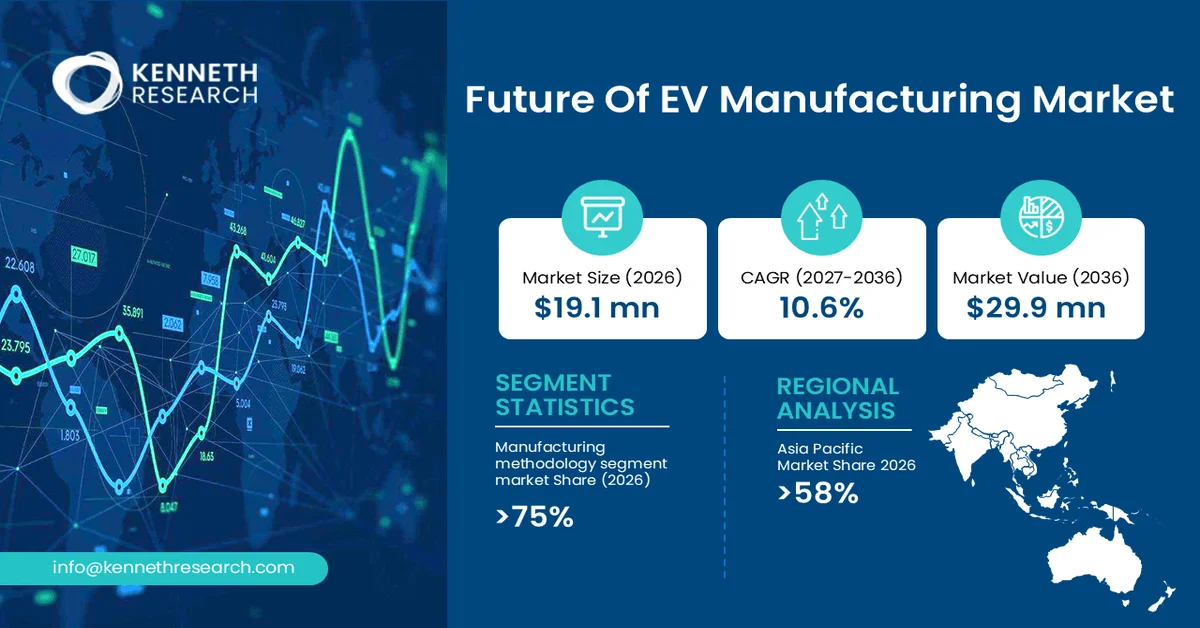
Future of EV Manufacturing Market size was valued at USD 19.1 million in 2026 and is projected to reach USD 29.9 million by the end of 2036, rising at a CAGR of 10.6% during the forecast period, i.e., 2027-2036. In 2027, the industry size of the future of EV manufacturing is estimated at USD 21.1 million.
The primary growth driver for the future of EV manufacturing market is the rapid expansion of electric vehicle production and the transition toward flexible, software-enabled, and highly automated manufacturing systems.
The future of EV manufacturing market encompasses technologies, systems, equipment, and manufacturing methodologies designed to support the next generation of electric vehicle production. It includes flexible production lines, automated assembly and material-handling systems, digital manufacturing platforms, robotics, advanced quality-control systems, battery and other solutions that improve the efficiency, flexibility, scalability, and reliability of EV manufacturing operations.
The market supports automotive manufacturers and suppliers across vehicle assembly, battery integration, propulsion-system production, component manufacturing, quality inspection, and production-line optimization. It also incorporates digitalization, automation, real-time production monitoring, and data-driven manufacturing approaches that allow production facilities to respond more efficiently to evolving EV technologies and consumer demand.
Key Future Of EV Manufacturing Market Insights Summary:
Key Takeaways: Market Trends & Insights
- The future of EV manufacturing market is projected to grow from USD 21.1 million in 2027 to USD 29.9 million by 2036, reflecting a 10.6% CAGR.
- Flexible shared production lines lead the manufacturing methodology segment, accounting for 75% in 2026, supported by demand for adaptable and scalable EV production environments.
- Battery Electric Vehicles (BEVs) represent the key sub-segment within Propulsion Type, driven by expanding zero-emission vehicle portfolios and increasing BEV production capabilities.
- Asia-Pacific dominates the regional landscape with a 58% share in 2026, supported by strong EV manufacturing ecosystems and investment across Japan and China.
Market Drivers
- Expansion of global EV production
- Increasing adoption of flexible and digitally integrated manufacturing
- Growing automation and robotics integration in EV factories
- Increasing demand for scalable battery and EV production infrastructure
Challenges
- High investment requirements for advanced and flexible manufacturing infrastructure
- Rapid changes in EV technologies creating equipment-obsolescence and reconfiguration risks
Future of EV Manufacturing Market Overview & Supply Chain
The future of EV manufacturing market is being shaped by the transition from conventional vehicle production toward highly flexible, digitally integrated, and scalable manufacturing ecosystems. Automakers are increasingly adapting production facilities to accommodate multiple EV architectures, battery configurations, propulsion systems, and vehicle models within interconnected manufacturing environments. The global EV manufacturing landscape is also becoming increasingly concentrated around major Asian production hubs. According to the International Energy Agency (IEA), nearly 22 million electric cars were produced globally in 2025, representing an increase of more than 25% from the previous year.
The supply chain begins with raw materials and specialized industrial inputs, including battery minerals, metals, electronic components, semiconductors, sensors, and industrial machinery. These inputs move to battery-cell manufacturers, component suppliers, automation providers, and vehicle-system manufacturers.
Future of EV Manufacturing Market: Growth Drivers & Challenges
Growth Drivers:
- Expansion of global EV production: The rapid expansion of electric vehicle manufacturing is increasing demand for adaptable production infrastructure, automated assembly technologies, battery integration systems, and digitally connected manufacturing platforms. According to the International Energy Agency (IEA), 17.3 million electric cars were produced globally in 2024, approximately one-quarter more than in 2023, demonstrating the accelerating scale of EV manufacturing. This expansion encourages automakers to modernize existing facilities and establish production environments capable of handling higher EV volumes and increasingly diverse vehicle architecture.
- Increasing adoption of flexible and digitally integrated manufacturing: The increasing complexity of EV architectures is encouraging manufacturers to replace rigid production structures with flexible, digitally integrated manufacturing environments. EVs require different battery packs, electric-drive components, electronic systems, software architectures, and thermal-management configurations than conventional vehicles, creating a need for production lines capable of accommodating frequent product and process changes. Flexible shared production lines allow manufacturers to utilize common equipment and infrastructure across multiple vehicle configurations, improving capacity utilization while reducing dependence on dedicated manufacturing assets.
Challenges:
- High retrofitting complexity of existing manufacturing facilities: Conventional vehicle plants are designed around internal-combustion-engine architectures, whereas EV production requires dedicated processes for battery packs, electric drivetrains, high-voltage electronics, and new assembly configurations. Retrofitting therefore involves substantial changes to equipment, material flows, safety systems, utilities, and workforce capabilities. Manufacturers may face production interruptions, integration difficulties, and extended commissioning periods when converting existing facilities.
- Rapid technology changes and manufacturing-system obsolescence: EV battery formats, cell chemistries, electric-drive architectures, and production processes continue to evolve rapidly. Manufacturing equipment designed around a specific vehicle or battery configuration can therefore become less suitable when product specifications change. Frequent design changes can require modifications to tooling, robotics, software, testing systems, and production controls. This creates additional engineering requirements and can disrupt manufacturing schedules.
Future of EV Manufacturing Market Size and Forecast:
| Report Attribute | Details |
|---|---|
| Base Year |
2026 |
| Forecast Period |
2027-2036 |
| CAGR |
10.6% |
| Base Year Market Size (2026) |
USD 19.1 million |
| Forecast Year Market Size (2036) |
USD 29.9 million |
| Regional Scope |
|
Future of EV Manufacturing Market Segmentation Analysis:
Manufacturing Methodology Segment Analysis
In the manufacturing methodology segment, flexible shared production lines is anticipated to capture the largest market share, accounting for 75% in 2026.
The approach enables automakers to share equipment, assembly stations, robotics, and production resources across vehicle programs, improving capacity utilization and reducing the need for dedicated lines. Demand is reinforced by the rapid expansion of EV production, particularly in Asia-Pacific, where manufacturers are scaling output while introducing diverse vehicle architectures. This production expansion is encouraging OEMs to invest in manufacturing systems that can accommodate changing battery designs, vehicle platforms, and production volumes.
Propulsion Type Segment Analysis
In the propulsion type segment, the battery electric vehicles (BEVs) sub-segment is projected to grow strongly as automakers expand zero-emission vehicle portfolios and consumers increasingly adopt vehicles powered entirely by electric drivetrains. BEVs require integrated battery packs, electric motors, power electronics, thermal-management systems, and dedicated manufacturing processes, increasing demand for specialized production infrastructure and adaptable factory technologies.
On the supply side, growing battery manufacturing capacity, automation, and supply-chain integration are supporting higher-volume BEV production.
Our in-depth analysis of the global future of EV manufacturing market includes the following segments:
|
Segment |
Sub-segment |
|
Propulsion Type |
|
|
Vehicle Type |
|
|
Component Technology |
|
|
Manufacturing Methodology |
|
Future of EV Manufacturing Market Regional Insights:
Asia-Pacific Market Trends & Insights:
Asia-Pacific is the dominant region in the future of EV manufacturing market, accounting for 58% in 2026.
The region’s leadership is supported by its extensive automotive manufacturing base, established battery and component supply chains, growing EV production, and substantial investment in factory modernization and automation. China remains the principal production center, while Japan contributes advanced automotive engineering, manufacturing technologies, and established OEM capabilities. Government policies supporting EV adoption and domestic manufacturing are further strengthening regional investment.
Japan maintains an important position through its globally established automotive industry and technological expertise in vehicle manufacturing, robotics, automation, and electrification.
China represents the region’s largest manufacturing powerhouse, supported by extensive domestic EV demand, integrated battery supply chains, large-scale component production, and strong industrial-policy support.
North America Market Trends & Insights:
North America represents an important secondary market for the future of EV manufacturing market, supported by established automotive manufacturing capabilities, expanding EV and battery production, and increasing investment in localized supply chains. The region benefits from integrated cross-border automotive operations, advanced engineering capabilities, and access to battery materials and manufacturing technologies. Government initiatives are also encouraging domestic EV production and strengthening regional supply chains.
U.S. remains the principal manufacturing hub in North America, supported by major automotive OEMs, established supplier networks, advanced automation capabilities, and ongoing investment in EV and battery production infrastructure.
Canada is strengthening its position through investments across EV components, batteries, critical minerals, semiconductor technologies, and advanced manufacturing. Its integrated relationship with the U.S. automotive sector and emphasis on clean-energy manufacturing create opportunities for next-generation vehicle production and flexible factory technologies.
Leading Companies Operating in the Global Future of EV Manufacturing Market:
Here is a list of upstream, downstream, and key players operating in the global future of EV manufacturing market competitive ecosystem:
- KUKA (Germany)
- Company Overview
- Business Strategy
- Key Product Offerings
- Financial Performance
- Key Performance Indicators
- Risk Analysis
- Recent Development
- Regional Presence
- SWOT Analysis
- Comau (Italy)
- ABB (Switzerland)
Recent Developments
- July 2025: KUKA received a follow-up order from a major U.S. automotive manufacturer for 12 additional friction stir welding cells for EV production.
- May 2025: Comau delivered an end-to-end automation solution for Li Auto’s next-generation range-extender production line.
Frequently Asked Question
In 2026, the future of EV manufacturing market exceeded USD 19.1 million.
The future of EV manufacturing market is projected to reach USD 29.9 million by the end of 2036, expanding at a CAGR of 10.6% over the forecast period (2027-2036).
The major players in the market are KUKA, Comau, ABB, and others.
In the manufacturing methodology segment, the flexible shared production lines sub-segment is anticipated to capture the largest market share of 75% in the future and exhibit lucrative growth opportunities during 2027-2036.
Why Choose Kenneth Research ?
-
Insight with Impact : We don’t just gather data — we uncover stories, trends, and opportunities that fuel business growth.
-
Experts Who Get It : Our team speaks your industry’s language and knows what really matters to your customers and market.
-
Custom-Built for You : Forget one-size-fits-all. We craft research and consulting solutions as unique as your business vision.
-
Partners, Not Just Providers : We work with you, not for you — collaborating closely to turn insights into smart, strategic moves.
-
Results That Speak : Our work powers brands, startups, and industry leaders alike — with a track record of ideas that work in the real world.
Report ID: 1378 |
Published Date: 10 Sep 2026 |
Report Format: |
Delivery Timeline: 48-72 Business Hours

Copyright © 2025 Kenneth Research. All rights reserved. Terms of Use | Privacy Policy
