Report ID: 1084 |
Published Date: 14 Aug 2026 |
Report Format: |
Delivery Timeline: 48-72 Business Hours
Fusion Biopsy Market Outlook:
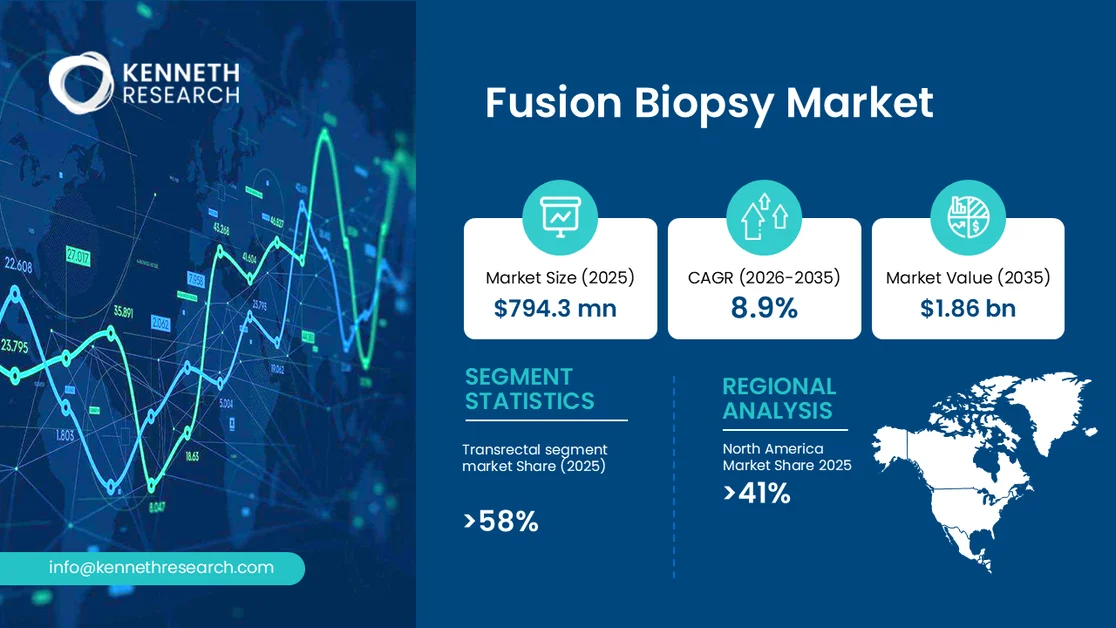
Fusion Biopsy Market size was valued at USD 794.3 million in 2025 and is projected to reach USD 1.86 billion by the end of 2035, rising at a CAGR of 8.9% during the forecast period, i.e., 2026–2035. In 2026, the industry size of the fusion biopsy is estimated at USD 865 million.
The primary growth driver of the fusion biopsy market is the increasing adoption of multiparametric magnetic resonance imaging (mpMRI)-guided targeted prostate cancer diagnosis. Fusion biopsy improves lesion localisation by combining MRI with real-time ultrasound, enabling more precise tissue sampling, earlier detection of clinically significant cancers, and improved treatment planning across urology practices.
The fusion biopsy market comprises imaging technologies, software platforms, navigation systems, biopsy guidance devices, and associated services used to perform MRI-ultrasound fusion-guided biopsies, primarily for the diagnosis of prostate cancer. Fusion biopsy combines pre-procedure magnetic resonance imaging (MRI) with real-time transrectal or transperineal ultrasound to generate a detailed three-dimensional view of the prostate, enabling clinicians to target suspicious lesions with greater precision than conventional ultrasound-guided biopsy alone.
The market is characterised by advanced image registration software, real-time navigation capabilities, interoperability with diagnostic imaging systems, and increasing integration into precision urology workflows. Fusion biopsy supports targeted tissue sampling while complementing systematic biopsy approaches where clinically appropriate, thereby enhancing diagnostic confidence and supporting evidence-based clinical decision-making.
From an industrial perspective, the market plays a significant role in the medical imaging and minimally invasive diagnostics ecosystem by supporting earlier identification of clinically significant prostate cancer, improving procedural efficiency, and facilitating personalised treatment planning in hospitals, specialty urology centres, and ambulatory surgical settings.
Key Fusion Biopsy Market Insights Summary:
Key Takeaways: Market Trends & Insights
- Fusion biopsy market projected to grow from USD 794.3 million in 2025 to USD 1.86 billion by 2035 at a CAGR of 8.9%.
- North America accounted for the largest regional share at 41% in 2025, supported by advanced diagnostic imaging infrastructure, high adoption of precision medicine, and established prostate cancer care pathways.
- Transrectal is expected to remain the leading biopsy route segment with a 58% market share, driven by its widespread clinical adoption, compatibility with MRI-ultrasound fusion systems, and established procedural workflow.
- Hospitals are projected to witness significant growth as the leading end-user segment, supported by increasing investments in advanced imaging technologies, multidisciplinary urology services, and integrated precision oncology programs.
- The market is benefiting from expanding adoption of MRI-ultrasound fusion-guided biopsy, continuous advancements in image fusion and navigation technologies, increasing integration of artificial intelligence into diagnostic workflows, and growing emphasis on early and accurate prostate cancer diagnosis.
Market Drivers
- Increasing prevalence of prostate cancer and rising demand for early, accurate diagnosis.
- Growing investments in precision medicine and minimally invasive diagnostic technologies.
- Expanding healthcare infrastructure and access to advanced MRI imaging in emerging economies.
- Rising collaborations among medical device manufacturers, imaging technology developers, and healthcare institutions.
Challenges
- High capital investment and advanced infrastructure requirements
- Requirement for specialised clinical expertise and workflow integration
Fusion Biopsy Market Overview & Supply Chain
The global adoption of fusion biopsy is increasing as healthcare systems prioritise more accurate and minimally invasive approaches for prostate cancer diagnosis. The integration of multiparametric magnetic resonance imaging (mpMRI) with real-time ultrasound has significantly improved lesion targeting, reducing unnecessary biopsies while enhancing the detection of clinically significant disease. Growing investments in precision medicine, advances in medical imaging software, expanding availability of MRI infrastructure, and increasing adherence to evidence-based diagnostic pathways are accelerating adoption across developed and emerging healthcare markets. The clinical need is reinforced by the increasing burden of prostate cancer worldwide. According to the International Agency for Research on Cancer (IARC), World Health Organization, there were 1,467,854 new prostate cancer cases globally in 2022, making prostate cancer the fourth most frequently diagnosed cancer worldwide. This rising disease burden continues to strengthen demand for advanced image-guided biopsy technologies across hospitals and specialised urology centres.
Market Overview
The global adoption of fusion biopsy is increasing as healthcare systems prioritise more accurate and minimally invasive approaches for prostate cancer diagnosis. The integration of multiparametric magnetic resonance imaging (mpMRI) with real-time ultrasound has significantly improved lesion targeting, reducing unnecessary biopsies while enhancing the detection of clinically significant disease. Growing investments in precision medicine, advances in medical imaging software, expanding availability of MRI infrastructure, and increasing adherence to evidence-based diagnostic pathways are accelerating adoption across developed and emerging healthcare markets. The clinical need is reinforced by the increasing burden of prostate cancer worldwide. According to the International Agency for Research on Cancer (IARC), World Health Organization, there were 1,467,854 new prostate cancer cases globally in 2022, making prostate cancer the fourth most frequently diagnosed cancer worldwide. This rising disease burden continues to strengthen demand for advanced image-guided biopsy technologies across hospitals and specialised urology centres.
The fusion biopsy market value chain begins with suppliers of advanced imaging components, including MRI hardware, ultrasound transducers, semiconductor-based electronics, optical tracking sensors, specialised biopsy needles, medical-grade polymers, and software development tools. Medical device manufacturers integrate these inputs to produce MRI-ultrasound fusion platforms, navigation systems, robotic assistance technologies, and biopsy guidance software while ensuring compliance with applicable quality and regulatory standards. The finished systems are distributed through direct sales teams, regional distributors, procurement organisations, and healthcare equipment partners that support installation, calibration, clinician training, and maintenance services. End users primarily include hospitals, academic medical centres, specialised urology clinics, ambulatory surgical centres, and diagnostic imaging facilities performing targeted prostate biopsies. Major stakeholders across the value chain include component suppliers, imaging equipment manufacturers, software developers, contract manufacturers, regulatory authorities, healthcare providers, reimbursement agencies, research institutions, and service providers responsible for system integration, technical support, and lifecycle management.
Fusion Biopsy Market: Growth Drivers & Challenges
Growth Drivers:
- Expanding clinical adoption of mri-targeted diagnostic pathways: The increasing integration of multiparametric magnetic resonance imaging (mpMRI) into prostate cancer diagnostic pathways is a major growth driver for the fusion biopsy market Healthcare providers are increasingly adopting MRI-ultrasound fusion biopsy because it enables targeted sampling of suspicious lesions, improving diagnostic precision compared with conventional systematic biopsy alone. This shift supports earlier identification of clinically significant prostate cancer while reducing unnecessary procedures and repeat biopsies, thereby improving patient management and resource utilisation. The growing incorporation of fusion-guided biopsy into clinical practice is also encouraging healthcare providers to invest in advanced imaging software, navigation platforms, and interoperable biopsy systems. Over the forecast period, continued refinement of imaging protocols, artificial intelligence-assisted lesion identification, and clinician training programmes are expected to further strengthen market penetration and accelerate the adoption of precision diagnostic technologies across both established and emerging healthcare systems. Supporting this trend, the National Institute for Health and Care Excellence (NICE) recommends that individuals with suspected clinically localised prostate cancer should be offered multiparametric MRI, and those with significant lesions should receive an mpMRI-influenced prostate biopsy, reinforcing the growing role of MRI fusion technologies in routine clinical practice.
- Continuous innovation in image fusion and navigation technologies: Rapid technological advancements in image fusion algorithms, real-time navigation software, electromagnetic tracking, and robotic-assisted biopsy platforms are significantly enhancing the clinical value of fusion biopsy systems. Modern platforms provide improved image registration accuracy, streamlined procedural workflows, and greater compatibility with hospital imaging infrastructure, enabling clinicians to perform targeted biopsies with increased confidence. These innovations also support workflow standardisation, facilitate integration with digital health ecosystems, and improve procedural efficiency in high-volume urology centres. As manufacturers continue investing in software upgrades, artificial intelligence-based image interpretation, cloud-enabled data management, and interoperable imaging solutions, fusion biopsy systems are expected to become increasingly accessible and user-friendly. The resulting improvements in diagnostic performance and operational efficiency are likely to encourage wider adoption among hospitals, specialty clinics, and ambulatory surgical centres, creating sustained long-term opportunities for technology developers and healthcare providers.
Challenges:
- High capital investment and infrastructure requirements: The widespread adoption of fusion biopsy systems is constrained by the substantial capital investment required for advanced MRI equipment, fusion software platforms, navigation systems, and compatible ultrasound devices. Successful implementation also depends on specialised imaging infrastructure, integration with hospital information systems, and continuous maintenance and software upgrades. These requirements create significant financial barriers for smaller hospitals, community healthcare providers, and facilities in resource-constrained regions. Commercially, manufacturers often encounter prolonged procurement cycles and budget-driven purchasing decisions, limiting rapid market expansion despite growing clinical demand. In addition, healthcare organisations must justify technology investments through demonstrable improvements in clinical outcomes and operational efficiency. Although technological advancements and broader market competition are expected to reduce system costs over time, infrastructure limitations will remain a key restraint, particularly in developing healthcare markets where access to advanced diagnostic imaging remains uneven.
- Requirement for specialised clinical expertise and workflow integration: Fusion biopsy procedures require multidisciplinary coordination involving radiologists, urologists, imaging technologists, and pathology teams with expertise in MRI interpretation and image-guided interventions. Achieving consistent diagnostic performance depends on accurate lesion identification, precise image registration, and operator proficiency, all of which involve dedicated training and experience. The associated learning curve can delay technology adoption and contribute to variability in procedural outcomes, particularly in healthcare facilities with limited experience in advanced prostate imaging. From a commercial perspective, vendors must invest significantly in clinician education, technical support, and post-installation training programmes to facilitate successful implementation. Healthcare providers may also need to redesign diagnostic workflows and allocate additional resources for staff development. As clinical training programmes become more standardised and software automation continues to improve, these operational barriers are expected to diminish gradually, although workforce capability will remain an important factor influencing market growth.
Fusion Biopsy Market Size and Forecast:
| Report Attribute | Details |
|---|---|
| Base Year |
2025 |
| Forecast Year |
2026-2035 |
| CAGR |
8.9% |
| Base Year Market Size (2025) |
USD 794.3 million |
| Forecast Year Market Size (2035) |
USD 1.86 billion |
| Regional Scope |
|
Fusion Biopsy Market Segmentation Analysis:
By Biopsy Route Segment Analysis
The transrectal segment dominates the fusion biopsy market share of 58% due to its widespread clinical adoption, established procedural workflow, and compatibility with MRI-ultrasound fusion platforms used in prostate cancer diagnosis. Most healthcare facilities are equipped with transrectal ultrasound (TRUS) systems, allowing clinicians to integrate fusion-guided biopsy into existing diagnostic pathways without substantial infrastructure modifications. The procedure is familiar to urologists, requires relatively short procedure times, and is supported by a broad ecosystem of compatible biopsy devices, imaging software, and navigation technologies. On the supply side, manufacturers continue to prioritise transrectal-compatible fusion systems because of their extensive installed base, facilitating product upgrades rather than complete equipment replacement. While transperineal approaches are gaining clinical interest, the availability of trained specialists, established procurement practices, and ongoing investments in transrectal imaging platforms continue to reinforce this segment's leadership. Future market growth is expected to be supported by advances in image registration, artificial intelligence-assisted targeting, and improved biopsy guidance technologies that enhance procedural accuracy and workflow efficiency.
Demand for transrectal fusion biopsy is underpinned by the continuing need for prostate tissue diagnosis. According to the U.S. Centers for Disease Control and Prevention (CDC), 255,395 new prostate cancer cases were reported in the United States in 2022, with 70% diagnosed at a localised stage, reinforcing the ongoing demand for image-guided biopsy procedures that facilitate early and accurate diagnosis.
End User Segment Analysis
The hospitals segment is projected to experience substantial growth in the fusion biopsy market owing to the increasing concentration of advanced diagnostic imaging infrastructure, multidisciplinary urology services, and specialised oncology care within hospital settings. Hospitals are increasingly investing in integrated MRI-ultrasound fusion platforms to support precision diagnostics, improve clinical workflows, and deliver comprehensive prostate cancer management. Growing adoption is also driven by the availability of experienced radiologists, urologists, anaesthesiology support, pathology laboratories, and post-procedural care under a single clinical environment. On the supply side, medical device manufacturers continue to prioritise hospitals for the deployment of next-generation fusion biopsy systems through long-term procurement contracts, service agreements, software upgrades, and clinician training programmes. Looking ahead, the expansion of digital imaging ecosystems, artificial intelligence-assisted biopsy planning, and interoperability with hospital information systems is expected to further strengthen hospital adoption, reinforcing their position as the fastest-growing end-user segment for advanced fusion biopsy technologies.
Supporting this trend, the Organisation for Economic Co-operation and Development (OECD) reports that the availability of MRI units has increased steadily across OECD countries over recent decades, with Japan recording the highest number of MRI units per capita and the United States ranking second in 2023, reflecting continued investment in advanced diagnostic imaging infrastructure that supports hospital-based fusion biopsy procedures.
Our in-depth analysis of the global fusion biopsy market includes the following segments:
|
Segment |
Sub-segment |
|
Biopsy Route |
|
|
Product Type |
|
|
Imaging Modality |
|
|
End User |
|
|
Application |
|
Fusion Biopsy Market Regional Insights:
North America Market Trends & Insights:
North America accounted for the largest revenue share of 41% in 2025 and continues to lead the fusion biopsy market due to its well-established healthcare infrastructure, widespread availability of advanced diagnostic imaging technologies, and strong adoption of precision medicine in urology.
The region benefits from substantial investments in MRI infrastructure, digital health integration, and minimally invasive diagnostic procedures. Favourable regulatory pathways for medical devices, the presence of leading imaging and biopsy system manufacturers, and continuous investments in clinical research further strengthen regional competitiveness. In addition, the increasing incorporation of MRI-guided diagnostic pathways into routine prostate cancer management has accelerated the deployment of fusion biopsy platforms across hospitals and specialised urology centres. These factors collectively position North America as the leading regional market for technologically advanced biopsy solutions.
The United States represents the largest national market within the region owing to its extensive network of tertiary hospitals, specialised cancer centres, and continuous investment in diagnostic innovation.
Canada is also witnessing growing adoption, supported by expanding access to advanced imaging services, strengthening cancer care programmes, and increasing emphasis on early disease detection through evidence-based clinical practice. Supporting North America's leadership, the National Cancer Institute (NCI), Surveillance, Epidemiology, and End Results (SEER) Program estimates that 313,780 new cases of prostate cancer will be diagnosed in the United States in 2025, highlighting the sustained clinical demand for advanced diagnostic technologies such as MRI-ultrasound fusion biopsy. The continued expansion of precision oncology programmes, investment in imaging infrastructure, and collaboration between healthcare providers and medical technology companies are expected to reinforce North America's market leadership throughout the forecast period.
Europe Market Trends & Insights:
Asia Pacific is expected to emerge as one of the fastest-growing regions in the fusion biopsy market, driven by the expanding burden of prostate cancer, improving access to advanced diagnostic technologies, and continuous investments in healthcare infrastructure. Governments across the region are prioritising the modernisation of medical imaging capabilities, strengthening oncology services, and promoting the adoption of precision medicine through national healthcare initiatives. Increasing availability of multiparametric magnetic resonance imaging (mpMRI), growing awareness of early cancer diagnosis, and the expansion of tertiary care hospitals are supporting greater utilisation of MRI-ultrasound fusion biopsy systems. Furthermore, international medical device manufacturers are increasing their regional presence through strategic partnerships, technology transfer, and distribution agreements, while domestic healthcare providers continue to invest in advanced urology and diagnostic imaging facilities. The ongoing digitalisation of healthcare systems, combined with rising clinician training and improved reimbursement environments in several countries, is expected to create significant long-term opportunities for fusion biopsy technology providers across Asia Pacific.
Japan represents a key market due to its highly developed healthcare system, widespread availability of advanced diagnostic imaging equipment, and strong emphasis on precision oncology. The country has consistently invested in sophisticated imaging technologies and maintains a well-established network of specialised hospitals capable of performing complex image-guided diagnostic procedures. Continuous research activities and the adoption of innovative medical technologies further support the integration of fusion biopsy into routine urological practice.
China is experiencing rapid growth owing to substantial investments in healthcare infrastructure, expanding hospital capacity, and increasing adoption of advanced medical imaging technologies. The country's ongoing healthcare reforms, rising focus on early cancer detection, and growing availability of specialised urology services are encouraging the deployment of MRI-ultrasound fusion biopsy systems. In addition, domestic medical device innovation, coupled with collaborations between international manufacturers and local healthcare institutions, is expected to accelerate technology adoption and strengthen the country's role as a major growth market for fusion biopsy solutions.
Leading Companies Operating in the Global Fusion Biopsy Market:
Here is a list of key manufacturers operating in the global fusion biopsy market competitive ecosystem:
- Philips (Netherlands)
- Company Overview
- Business Strategy
- Key Product Offerings
- Financial Performance
- Key Performance Indicators
- Risk Analysis
- Recent Development
- Regional Presence
- SWOT Analysis
- KOELIS (France)
Recent Developments
- September 2024 : KOELIS announced a strategic partnership with DeepHealth to integrate DeepHealth's artificial intelligence-powered prostate MRI software with the KOELIS Trinity® MRI-ultrasound fusion biopsy platform. The collaboration streamlines MRI interpretation, automates lesion segmentation, and enables seamless image transfer into fusion biopsy workflows.
Frequently Asked Question
In 2025, the fusion biopsy market exceeded USD 794.3 million.
The fusion biopsy market is projected to reach USD 1.86 billion by the end of 2035, expanding at a CAGR of 8.9% over the forecast period (2026-2035).
The major players in the market are GE HealthCare (BK Medical), Philips, KOELIS, Exact Imaging, MedCom, and others.
In the by biopsy route segment, the transrectal sub-segment is anticipated to capture the largest market share of 58% in the future and exhibit lucrative growth opportunities during 2026-2035. This growth trajectory is largely attributed to the widespread adoption of MRI-ultrasound fusion-guided prostate biopsy, established clinical workflows, and continued advancements in image-guided diagnostic technologies.
North America is projected to hold the largest market share of 41% by the end of 2025 and provide more business opportunities in the future. Continuous investments in advanced diagnostic imaging infrastructure, precision oncology, and the strong presence of healthcare technology innovators across the U.S. and Canada are fostering the region's dominance.
Why Choose Kenneth Research ?
-
Insight with Impact : We don’t just gather data — we uncover stories, trends, and opportunities that fuel business growth.
-
Experts Who Get It : Our team speaks your industry’s language and knows what really matters to your customers and market.
-
Custom-Built for You : Forget one-size-fits-all. We craft research and consulting solutions as unique as your business vision.
-
Partners, Not Just Providers : We work with you, not for you — collaborating closely to turn insights into smart, strategic moves.
-
Results That Speak : Our work powers brands, startups, and industry leaders alike — with a track record of ideas that work in the real world.
Report ID: 1084 |
Published Date: 14 Aug 2026 |
Report Format: |
Delivery Timeline: 48-72 Business Hours

Copyright © 2025 Kenneth Research. All rights reserved. Terms of Use | Privacy Policy
