Report ID: 1137 |
Published Date: 21 Aug 2026 |
Report Format: |
Delivery Timeline: 48-72 Business Hours
Foam Glass Market Outlook:
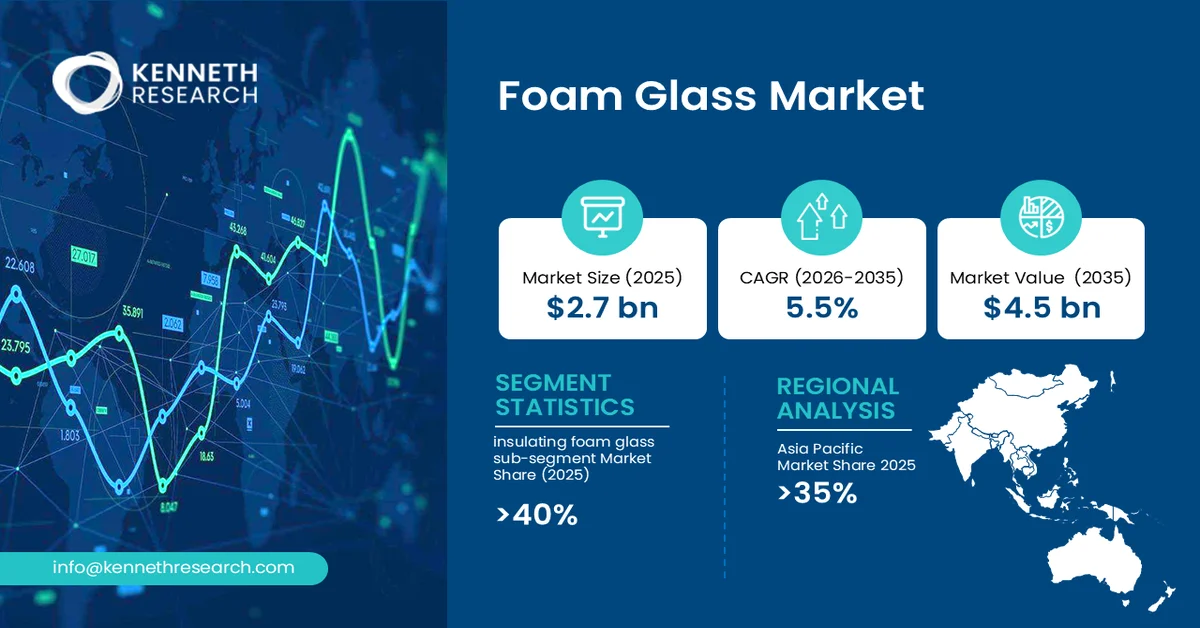
Foam Glass Market size was valued at USD 2.7 billion in 2025 and is projected to reach USD 4.5 billion by the end of 2035, rising at a CAGR of 5.5% during the forecast period, i.e., 2026-2035. In 2026, the industry size of the foam glass is estimated at USD 2.8 billion.
The primary growth driver for the foam glass market is the increasing emphasis on sustainable and energy-efficient construction materials. Foam glass offers exceptional thermal insulation, moisture resistance, non-combustibility, and long service life while being manufactured from recycled glass. Growing adoption of green building practices and stringent energy-efficiency requirements across commercial, industrial, and infrastructure projects continue to strengthen market demand.
Foam glass is a lightweight, rigid cellular material produced by heating finely ground glass with a foaming agent to create millions of enclosed air-filled cells. This closed-cell structure provides excellent thermal insulation, water and vapor resistance, dimensional stability, chemical inertness, and fire resistance, making it suitable for demanding operating environments. Depending on application requirements, foam glass is manufactured in different forms and grades for insulation, decorative, acoustic, and specialty engineering uses.
The foam glass market comprises the production, processing, distribution, and application of foam glass materials across diverse industries. It serves construction, industrial processing, energy, transportation, cryogenic systems, and infrastructure sectors where durable insulation and long-term performance are essential. The material's ability to retain its insulating properties throughout its lifecycle, resist biological degradation, and support sustainable construction objectives has enhanced its industrial relevance. As industries increasingly prioritize energy conservation, fire safety, circular economy principles, and low-maintenance building materials, foam glass continues to gain importance as a high-performance insulation and engineered material solution for both new installations and modernization projects.
Key Foam Glass Market Insights Summary:
Key Takeaways: Market Trends & Insights
- Foam Glass Market projected to grow from USD 2.7 billion in 2025 to USD 4.5 billion by 2035 at a 5.5% CAGR.
- Asia Pacific accounted for the largest regional share at 35% in 2025, supported by rapid infrastructure development, expanding industrial activity, and increasing adoption of energy-efficient construction materials across China and Japan.
- Insulating Foam Glass is expected to remain the leading Type segment with a 40% market share by 2035, driven by rising demand for high-performance thermal insulation, fire safety, and sustainable building solutions.
- Sound-Absorbing Decorative Foam Glass is projected to witness robust growth as architects and developers increasingly adopt multifunctional materials that combine acoustic performance, durability, and aesthetic appeal in commercial and institutional buildings.
- The market is benefiting from increasing emphasis on green building practices, greater utilization of recycled glass, expanding industrial and cryogenic insulation applications, and continuous investment in energy-efficient infrastructure and sustainable construction technologies.
Market Drivers
- Increasing utilization of recycled glass to support circular economy initiatives.
- Growing demand for fire-resistant insulation materials in commercial and industrial infrastructure.
- Expansion of energy-efficient and low-carbon building construction.
- Rising adoption in industrial and cryogenic insulation applications.
Challenges
- High manufacturing costs and energy-intensive production.
- Competition from established insulation materials.
Foam Glass Market Overview & Supply Chain
The global adoption of foam glass is increasing as industries seek durable insulation materials that support energy efficiency, fire safety, and circular economy objectives. Its closed-cell structure provides excellent thermal insulation, moisture resistance, chemical stability, and long service life, making it suitable for buildings, industrial facilities, cold storage, LNG infrastructure, and transportation applications. Governments are also strengthening building decarbonization and energy-efficiency policies, encouraging the use of high-performance insulation materials. According to the International Energy Agency (IEA), buildings accounted for 34% of global energy demand in 2022, underscoring the importance of advanced insulation technologies in reducing energy consumption and emissions. This policy-driven emphasis on efficient building envelopes continues to support the adoption of foam glass across both new construction and renovation projects.
The foam glass industry value chain begins with the procurement of recycled glass cullet, post-consumer glass waste, virgin glass materials, and foaming agents sourced from recycling companies, glass manufacturers, and mineral suppliers. These raw materials undergo crushing, grinding, blending, heating, and controlled foaming to create rigid closed-cell foam glass blocks, boards, gravel, or customized products for different industrial applications. Manufacturers then perform machining, finishing, quality testing, and certification before distributing products through construction material distributors, industrial insulation suppliers, engineering procurement contractors, and specialized wholesalers. End users include commercial and residential construction companies, industrial processing plants, petrochemical facilities, transportation infrastructure developers, district energy projects, and cold-chain operators. Major stakeholders across the value chain include recycled glass suppliers, raw material processors, foam glass manufacturers, equipment providers, logistics companies, architects, engineering consultants, contractors, distributors, regulatory authorities, and project owners responsible for specifying and deploying insulation solutions.
Foam Glass Market: Growth Drivers & Challenges
Growth Drivers:
- Expansion of energy-efficient and low-carbon building construction: The growing emphasis on energy-efficient buildings is significantly accelerating demand for foam glass insulation. As governments tighten building energy codes and promote low-carbon infrastructure, developers are increasingly selecting insulation materials that provide long-term thermal performance, fire resistance, moisture protection, and durability with minimal maintenance. Foam glass is particularly valued because its closed-cell structure retains insulating properties throughout its service life without degrading under harsh environmental conditions. The material also supports sustainable construction through the utilization of recycled glass feedstock. According to the International Energy Agency (IEA), investment in energy efficiency worldwide exceeded USD 600 billion in 2024, reflecting the increasing priority given to technologies that reduce building energy consumption. This investment trend is expected to encourage wider adoption of high-performance insulation materials, creating long-term growth opportunities for foam glass manufacturers across commercial, industrial, and infrastructure projects.
- Rising adoption in industrial and cryogenic insulation applications: The increasing deployment of foam glass in industrial processing facilities and cryogenic systems is creating new growth opportunities for the market. Industries handling liquefied gases, petrochemicals, chemicals, and district energy systems require insulation materials capable of maintaining structural integrity under extreme temperatures while resisting moisture ingress and chemical exposure. Foam glass satisfies these requirements through its non-combustible composition, dimensional stability, and resistance to corrosion, making it suitable for pipelines, storage tanks, and process equipment. Growing investments in industrial modernization and energy infrastructure are further expanding its application scope. As industries continue to prioritize operational efficiency, safety, and asset longevity, manufacturers are expected to develop specialized foam glass products with enhanced mechanical properties and customized performance characteristics, strengthening the material's position in high-value industrial insulation applications.
Challenges:
- High manufacturing costs and energy-intensive production: Foam glass manufacturing involves high-temperature processing, specialized foaming technology, and stringent quality control to achieve a uniform closed-cell structure. These production requirements increase capital investment, energy consumption, and operating expenses compared with several conventional insulation materials. The dependence on advanced manufacturing equipment and controlled processing conditions can also limit production scalability, particularly for new market entrants. Commercially, higher production costs often translate into premium product pricing, making adoption more difficult in cost-sensitive construction and industrial projects where procurement decisions are largely price driven. Although lifecycle performance and durability offer long-term value, initial investment remains a barrier for many customers. Continued improvements in manufacturing efficiency, energy optimization, and recycling technologies are expected to gradually reduce production costs and improve the competitiveness of foam glass over the coming years.
- Competition from established insulation materials: The foam glass market faces intense competition from well-established insulation materials such as mineral wool, expanded polystyrene, extruded polystyrene, polyurethane foam, and cellular glass alternatives that have extensive distribution networks and strong market acceptance. Many of these materials offer lower upfront costs, broader product availability, and long-standing relationships with contractors and project developers. As a result, foam glass manufacturers often encounter challenges in demonstrating the long-term economic advantages of their products despite superior moisture resistance, fire performance, and durability. Commercial adoption may also be slowed by limited awareness among end users and conservative specification practices within the construction industry. Future market expansion will depend on greater industry education, product innovation, and stronger collaboration with architects, engineers, and regulatory bodies to highlight the lifecycle benefits of foam glass.
Foam glass Market Size and Forecast:
| Report Attribute | Details |
|---|---|
| Base Year |
2025 |
| Forecast Year |
2026-2035 |
| CAGR |
5.5% |
| Base Year Market Size (2025) |
USD 2.7 billion |
| Forecast Year Market Size (2035) |
USD 4.5 billion |
| Regional Scope |
|
Foam Glass Market Segmentation Analysis:
Type Segment Analysis
In the type segment, the insulating foam glass sub-segment is anticipated to capture the largest market share of 40% by the end of 2025.
Insulating Foam Glass is the largest segment in the foam glass market due to its superior thermal insulation, moisture resistance, fire safety, and long operational lifespan. Its closed-cell structure makes it highly suitable for commercial buildings, industrial plants, cryogenic facilities, underground pipelines, and transportation infrastructure where reliable insulation performance is essential. Increasing implementation of energy-efficient building standards and industrial decarbonization initiatives has further strengthened demand for this segment. On the supply side, manufacturers continue to expand the use of recycled glass feedstock and improve production technologies to deliver high-performance insulation products with enhanced durability and environmental benefits. The segment also benefits from growing specification by architects, engineering firms, and infrastructure developers seeking low-maintenance and non-combustible insulation materials. According to the International Energy Agency (IEA), global building floor area is expected to increase by around 15% by 2030, reinforcing the need for high-performance insulation solutions that improve building energy efficiency and reduce operational energy consumption. This sustained expansion of construction activity is expected to support the long-term dominance of insulating foam glass across residential, commercial, and industrial applications.
Type Segment Analysis
The sound-absorbing decorative foam glass segment is projected to witness significant growth as modern construction increasingly prioritizes both acoustic comfort and aesthetic performance. Commercial buildings, educational institutions, healthcare facilities, transportation terminals, hospitality venues, and public infrastructure are adopting materials that simultaneously improve indoor sound quality and enhance architectural design. Foam glass offers a unique combination of sound absorption, fire resistance, moisture resistance, and durability, making it suitable for interior and exterior decorative applications in high-occupancy environments. On the supply side, manufacturers are expanding product portfolios with customized textures, colors, and panel configurations to meet evolving architectural specifications while incorporating recycled glass to support sustainability objectives. Growing collaboration between architects, designers, and material manufacturers is further accelerating product adoption. According to the OECD Global Monitoring of Policies for Decarbonising Buildings (2024), 89% of surveyed countries have implemented mandatory energy-efficiency building codes, reflecting the increasing focus on high-performance building materials that combine functionality with sustainability. As green building practices continue to evolve, decorative acoustic foam glass is expected to gain wider acceptance in premium residential, commercial, and institutional construction projects.
Our in-depth analysis of the global foam glass market includes the following segments:
|
Segment |
Sub-segment |
|
Type |
|
|
Application |
|
|
Form |
|
|
Density |
|
|
End user |
|
Foam Glass Market Trends & Insights:
Asia Pacific Market Trends & Insights:
Asia Pacific accounted for 35% of the global foam glass market in 2025, making it the leading regional market.
The region's dominance is supported by rapid urbanization, expanding industrial infrastructure, and strong investments in energy-efficient buildings, transportation networks, and industrial facilities. Growing emphasis on sustainable construction, stricter building efficiency regulations, and increasing adoption of advanced insulation materials continue to strengthen regional demand. Asia Pacific also benefits from an extensive manufacturing ecosystem, abundant recycled glass availability, well-established construction material supply chains, and significant investments in commercial, industrial, and public infrastructure. Continuous modernization of manufacturing facilities and the implementation of green building initiatives further reinforce the region's leadership in foam glass production and consumption.
Japan continues to drive regional demand through its focus on high-performance, resilient, and energy-efficient buildings, particularly in commercial, industrial, and public infrastructure projects. The country's stringent building standards and emphasis on fire-resistant construction encourage the adoption of advanced insulation materials. China remains the largest construction and manufacturing hub in the region, supported by large-scale infrastructure development and sustainable urbanization programs. According to the National Bureau of Statistics of China, the total output value of the construction industry reached CNY 32.65 trillion in 2024, highlighting the country's substantial construction activity that supports demand for high-performance insulation materials such as foam glass. Together, Japan's emphasis on quality infrastructure and China's large-scale construction sector continue to reinforce Asia Pacific's leadership in the foam glass market.
North America Market Trends & Insights:
North America represents a significant market for foam glass, supported by strong demand for high-performance insulation materials across commercial construction, industrial processing, transportation, and energy infrastructure. The region's emphasis on improving building energy efficiency, enhancing fire safety, and reducing lifecycle maintenance costs continues to encourage the use of durable insulation solutions. Government policies promoting sustainable construction, building retrofits, and industrial decarbonization are further strengthening market adoption. Increasing investments in cold-chain logistics, liquefied gas infrastructure, data centers, and industrial modernization are expanding application opportunities for foam glass. Manufacturers are also focusing on product innovation, recycled material utilization, and advanced production technologies to meet evolving environmental and performance requirements. These factors are expected to create long-term opportunities as public and private sectors continue to prioritize resilient and energy-efficient infrastructure.
The United States remains the largest contributor to regional demand due to its extensive commercial construction sector, large industrial manufacturing base, and continuous investment in energy, transportation, and public infrastructure. Growing adoption of sustainable building materials and modernization of aging facilities are further supporting foam glass consumption.
Canada is also emerging as an important market, driven by investments in green buildings, industrial facilities, mining operations, and cold-climate infrastructure where high-performance thermal insulation is essential. The country's focus on sustainable construction, energy conservation, and resilient infrastructure development is expected to encourage greater adoption of foam glass across residential, commercial, and industrial applications.
Leading Companies Operating in the Global Foam Glass Market:
Here is a list of upstream, downstream, and key players operating in the global foam glass market competitive ecosystem:
- Owens Corning (FOAMGLAS®)(United States)
- Company Overview
- Business Strategy
- Key Product Offerings
- Financial Performance
- Key Performance Indicators
- Risk Analysis
- Recent Development
- Regional Presence
- SWOT Analysis
- GLAPOR Werk Mitterteich GmbH(Germany)
- MISAPOR AG(Switzerland)
- Foamit Group Oy(Finland)
Recent Developments
- November 2025: Owens Corning announced the completion of the acquisition of the glass wool insulation business of Saint-Gobain in select European countries, strengthening its insulation portfolio, including FOAMGLAS® cellular glass solutions.
- September 2025: GLAPOR introduced expanded applications for its cellular glass products for sustainable infrastructure and foundation engineering, highlighting improved solutions for lightweight fill and thermal insulation.
Frequently Asked Question
In 2025, the foam glass market exceeded USD 2.7 billion.
The foam glass market is projected to reach USD 4.5 billion by the end of 2035, expanding at a CAGR of 5.5% over the forecast period (2026-2035).
The major players in the market are Owens Corning (FOAMGLAS®), GLAPOR Werk Mitterteich GmbH, MISAPOR AG, Foamit Group Oy, Glasopor AS, and others.
In the type segment, the insulating foam glass sub-segment is anticipated to capture the largest market share of 40% in the future and exhibit lucrative growth opportunities during 2026-2035. This growth trajectory is largely attributed to the increasing demand for energy-efficient, fire-resistant, and sustainable insulation materials across commercial, industrial, and infrastructure applications.
Asia Pacific is projected to hold the largest market share of 35% by the end of 2025 and provide more business opportunities in the future. Continuous investments in sustainable construction, industrial infrastructure, and energy-efficient buildings across Japan and China are fostering the region's dominance.
Why Choose Kenneth Research ?
-
Insight with Impact : We don’t just gather data — we uncover stories, trends, and opportunities that fuel business growth.
-
Experts Who Get It : Our team speaks your industry’s language and knows what really matters to your customers and market.
-
Custom-Built for You : Forget one-size-fits-all. We craft research and consulting solutions as unique as your business vision.
-
Partners, Not Just Providers : We work with you, not for you — collaborating closely to turn insights into smart, strategic moves.
-
Results That Speak : Our work powers brands, startups, and industry leaders alike — with a track record of ideas that work in the real world.
Report ID: 1137 |
Published Date: 21 Aug 2026 |
Report Format: |
Delivery Timeline: 48-72 Business Hours

Copyright © 2025 Kenneth Research. All rights reserved. Terms of Use | Privacy Policy
