Report ID: 1133 |
Published Date: 21 Aug 2026 |
Report Format: |
Delivery Timeline: 48-72 Business Hours
Fluoropolymer Films Market Outlook:
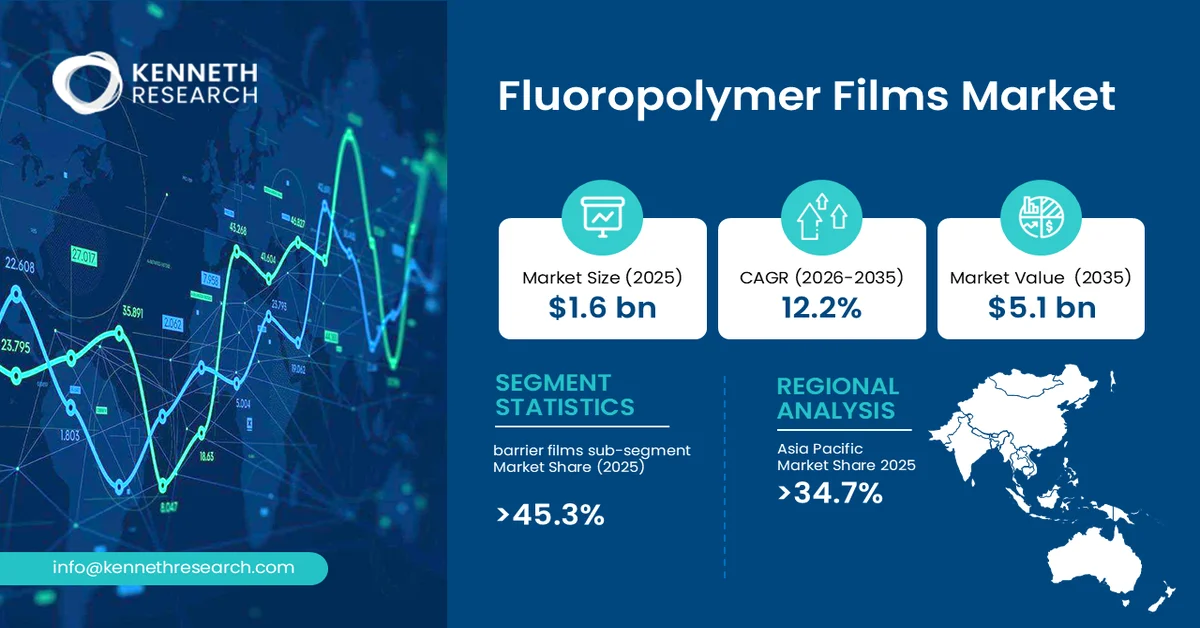
Fluoropolymer Films Market size was valued at USD 1.6 billion in 2025 and is projected to reach USD 5.1 billion by the end of 2035, rising at a CAGR of 12.2% during the forecast period, i.e., 2026-2035. In 2026, the industry size of the fluoropolymer films is estimated at USD 1.8 billion.
The primary growth driver of the fluoropolymer films market is the rapid expansion of high-performance electronics and solar photovoltaic manufacturing. Increasing demand for chemically resistant, weatherable, electrically insulating, and durable film materials in semiconductor fabrication, photovoltaic modules, automotive electrification, and advanced industrial applications continues to accelerate commercial adoption worldwide.
The fluoropolymer films market comprises high-performance polymer films manufactured from fluorinated resins such as polytetrafluoroethylene (PTFE), polyvinylidene fluoride (PVDF), ethylene tetrafluoroethylene (ETFE), fluorinated ethylene propylene (FEP), and perfluoroalkoxy (PFA). These films are engineered to deliver exceptional resistance to chemicals, ultraviolet radiation, moisture, corrosion, and extreme temperatures while maintaining excellent dielectric strength, low surface energy, optical clarity, and long operational life. Their unique material properties make them suitable for demanding environments where conventional polymer films cannot consistently perform.
Fluoropolymer films play a critical role across industries including electronics, renewable energy, automotive, aerospace, healthcare, construction, and industrial processing. They are widely used as barrier films, release liners, electrical insulation layers, photovoltaic module components, protective laminates, and chemically resistant membranes. Growing investments in advanced semiconductor manufacturing, electrified mobility, clean energy infrastructure, and high-reliability industrial systems are strengthening demand for these specialty materials. According to the International Energy Agency, global photovoltaic installations reached record deployment levels in recent years, reinforcing demand for durable polymeric materials used in solar module protection and long-term outdoor performance.
Key Fluoropolymer Films Market Insights Summary:
Key Takeaways: Market Trends & Insights
- Fluoropolymer Films Market projected to grow from USD 1.6 billion in 2025 to USD 5.1 billion by 2035 at a 12.2% CAGR.
- Asia Pacific accounted for the largest regional share at 34.7% in 2025, supported by strong electronics manufacturing, expanding semiconductor production, and robust investments in renewable energy and electric vehicle industries across Japan and China.
- Barrier Films remained the leading Application segment with a 45.3% market share in 2025, driven by increasing demand for superior moisture, chemical, and ultraviolet protection in photovoltaic modules, electronics, advanced packaging, and industrial applications.
- The Automotive end-use segment is expected to witness significant growth, fueled by rising electric vehicle production and increasing integration of fluoropolymer films in battery systems, high-voltage insulation, sensors, and lightweight automotive components.
- The market is benefiting from growing adoption of high-performance fluoropolymer films in semiconductor manufacturing, clean energy infrastructure, aerospace, and advanced industrial processing, supported by continuous innovation in specialty film technologies and expanding investments in advanced manufacturing.
Market Drivers
- Rising adoption of fluoropolymer barrier films in pharmaceutical and medical packaging applications.
- Increasing utilization of chemically resistant films in semiconductor fabrication and industrial processing equipment.
- Growing demand for lightweight, durable protective films in aerospace and defense applications.
- Advancements in multilayer film processing and surface-modification technologies enabling new high-value applications.
Challenges
- Regulatory pressure on fluorinated chemistry and increasingly stringent compliance requirements.
- High production complexity and dependence on specialized raw materials and processing technologies.
Fluoropolymer films Market – Market Overview & Supply chain
The adoption of fluoropolymer films is increasing globally as industries demand materials capable of maintaining performance under aggressive chemical exposure, high temperatures, ultraviolet radiation, and electrically sensitive environments. Their superior durability makes them indispensable in semiconductor fabrication, renewable energy systems, electric vehicles, aerospace assemblies, and advanced industrial equipment. Sustainability policies encouraging low-carbon technologies have further accelerated deployment, particularly in photovoltaic applications where long service life and weather resistance are essential. The International Energy Agency (IEA) reported that global annual renewable capacity additions increased by almost 50% to nearly 510 GW in 2023, with solar photovoltaic accounting for three-quarters of new renewable capacity additions, reinforcing demand for high-performance encapsulation and protective film materials used in solar energy infrastructure. This expanding industrial ecosystem continues to strengthen the strategic importance of fluoropolymer films across multiple manufacturing sectors.
The fluoropolymer films industry begins with the procurement of fluorinated monomers and specialty chemical feedstocks, which are converted into high-performance resins including PTFE, PVDF, ETFE, FEP, and PFA by specialty polymer manufacturers. These resins undergo extrusion, casting, calendaring, lamination, surface treatment, and precision finishing to produce films with application-specific mechanical, optical, electrical, and chemical characteristics. Quality assurance and compliance testing are integrated throughout production to satisfy stringent industrial and regulatory requirements. Finished films are distributed through direct supply agreements, regional distributors, specialty material suppliers, and value-added converters serving global manufacturing networks. End users include electronics manufacturers, automotive OEMs, renewable energy equipment producers, aerospace companies, healthcare device manufacturers, construction material suppliers, and industrial processing firms. Major stakeholders comprise raw material producers, fluoropolymer resin manufacturers, film converters, equipment suppliers, system integrators, regulatory bodies, logistics providers, and industrial customers participating across the global advanced materials supply chain.
Fluoropolymer films Market: Growth Drivers & Challenges
Growth Drivers:
- Rising investments in renewable energy manufacturing and advanced solar technologies: The accelerating global transition toward renewable energy is creating sustained demand for fluoropolymer films used in photovoltaic modules, backsheets, front-sheet protection, and weather-resistant laminates. These materials offer exceptional ultraviolet stability, moisture resistance, electrical insulation, and long-term durability, making them well suited for harsh outdoor environments and extended asset lifecycles. As governments continue supporting domestic clean energy manufacturing and resilient supply chains, manufacturers are expanding the use of high-performance polymer films in next-generation solar systems. The U.S. Department of Energy announced a USD 71 million investment in 18 projects across 10 states to strengthen domestic solar manufacturing and supply chains, supporting innovation in solar production technologies where advanced fluoropolymer materials play an enabling role. Such initiatives are expected to accelerate material innovation, strengthen supplier ecosystems, and expand commercial opportunities for specialty fluoropolymer film manufacturers.
- Expanding demand for high-reliability materials in electronics and electric mobility: The rapid evolution of semiconductor manufacturing, electric vehicles, battery systems, and high-frequency electronics is increasing the need for materials capable of performing reliably under demanding operating conditions. Fluoropolymer films provide outstanding dielectric properties, dimensional stability, chemical inertness, and thermal endurance, making them suitable for insulation, protective barriers, flexible electronic components, and battery-related applications. As manufacturers pursue miniaturization, higher operating efficiencies, and longer product lifecycles, conventional polymer films are increasingly being replaced by specialty fluoropolymer alternatives. Continued investment in advanced manufacturing, automation, and high-performance electronic systems is expected to broaden the application landscape for these materials. In the coming years, innovations in lightweight mobility platforms, smart devices, and industrial electronics are likely to reinforce the strategic importance of fluoropolymer films within global advanced manufacturing supply chains.
Challenges:
- Regulatory pressure on fluorinated chemistry and compliance requirements: Increasing environmental scrutiny surrounding fluorinated substances has become a significant restraint for fluoropolymer film manufacturers. Although many high-performance fluoropolymers used in industrial applications differ from regulated fluorinated chemicals, evolving environmental policies and tighter compliance frameworks have increased documentation, testing, and product stewardship obligations across the value chain. Manufacturers must invest in regulatory assessments, alternative processing technologies, traceability systems, and sustainability reporting to maintain market access in multiple jurisdictions. These additional compliance requirements can extend product qualification timelines and increase operational complexity, particularly for suppliers serving highly regulated sectors such as electronics, healthcare, and automotive. Commercially, rising compliance costs may affect profit margins and delay new product introductions. Looking ahead, companies that proactively develop environmentally responsible manufacturing practices and strengthen regulatory readiness will be better positioned to compete in global markets while adapting to evolving policy landscapes.
- High production complexity and dependence on specialized raw materials: The production of fluoropolymer films requires sophisticated processing technologies, tightly controlled manufacturing conditions, and access to specialized fluoropolymer resins that are produced by a relatively limited number of suppliers. Maintaining consistent film thickness, optical quality, surface characteristics, and performance specifications demands advanced equipment and extensive technical expertise. Any disruption in the availability of specialty resins, processing chemicals, or precision manufacturing equipment can affect production schedules and customer deliveries. Commercially, these factors contribute to higher manufacturing costs and create barriers for new market entrants attempting to establish competitive production capabilities. End users in industries with stringent qualification requirements may also face extended approval cycles before adopting alternative suppliers. Over the long term, investments in supply chain diversification, process optimization, and advanced manufacturing technologies are expected to improve production resilience, although technical complexity will remain a defining characteristic of the industry.
Fluoropolymer films Market Size and Forecast:
| Report Attribute | Details |
|---|---|
| Base Year |
2025 |
| Forecast Year |
2026-2035 |
| CAGR |
12.2% |
| Base Year Market Size (2025) |
USD 1.6 billion |
| Forecast Year Market Size (2035) |
USD 5.1 billion |
| Regional Scope |
|
Fluoropolymer Films Market Segmentation Analysis:
Application Segment Analysis
In the application segment, the barrier films sub-segment is anticipated to capture the largest market share of 45.3% by the end of 2025.
Barrier films represent the leading application segment in the fluoropolymer films market because they combine exceptional moisture, chemical, oxygen, ultraviolet, and contaminant resistance with long-term durability in demanding operating environments. Their ability to preserve product integrity has made them indispensable across food processing, pharmaceutical packaging, electronics, lithium-ion battery components, and photovoltaic module protection. Increasing emphasis on product safety, extended service life, and reliable performance under harsh environmental conditions continues to accelerate adoption among manufacturers seeking premium packaging and protective material solutions. On the supply side, advancements in multilayer film extrusion, precision coating technologies, and resin engineering have enabled manufacturers to produce barrier films with improved optical clarity, mechanical strength, and application-specific functionality while meeting increasingly stringent industrial specifications.
Demand fundamentals remain strong, supported by the growing use of advanced packaging and protective materials across manufacturing industries. According to Eurostat, the European Union generated 84 million tonnes of packaging waste in 2021, highlighting the scale of packaging activity that continues to drive demand for high-performance barrier materials capable of improving product protection and extending service life. Looking ahead, continued innovation in sustainable packaging technologies, semiconductor manufacturing, healthcare packaging, and renewable energy systems is expected to reinforce the dominant position of barrier films within the fluoropolymer films market.
End-use Segment Analysis
The automotive end-use segment is projected to witness strong growth as vehicle manufacturers increasingly incorporate fluoropolymer films into electric powertrains, battery systems, sensors, wire insulation, fuel systems, lightweight components, and interior electronic assemblies. Their outstanding dielectric performance, chemical resistance, thermal stability, and durability enable reliable operation in demanding automotive environments while supporting the industry's shift toward electrification and connected vehicle technologies. Automakers are also adopting these films to improve component longevity, reduce maintenance requirements, and enhance protection against moisture, corrosive fluids, and extreme temperatures.
On the supply side, manufacturers are expanding production capabilities for application-specific fluoropolymer films designed for battery packs, high-voltage cable insulation, and advanced electronic modules. Collaboration between specialty material producers and automotive OEMs is accelerating the development of customized solutions that meet stringent performance and safety requirements. Supporting this trend, Statistics Canada reported that 264,277 zero-emission vehicles were sold in Canada in 2024, representing 13.8% of all new motor vehicle units sold, reflecting the continued expansion of electric mobility and the corresponding demand for advanced materials used throughout EV systems. Looking ahead, continued investments in vehicle electrification, autonomous technologies, and lightweight engineering are expected to further strengthen the automotive segment's growth trajectory.
Our in-depth analysis of the global Fluoropolymer films Market includes the following segments:
|
Segment |
Sub-segment |
|
Application |
|
|
Film Type |
|
|
Thickness |
|
|
End use |
|
|
Processing Technology |
|
Fluoropolymer Films Market Regional Insights:
Asia Pacific Market Trends & Insights:
Asia Pacific accounted for the largest share of 34.7% in 2025, making it the leading regional market due to its extensive manufacturing ecosystem, integrated chemical supply chains, and strong demand from electronics, automotive, renewable energy, and industrial processing industries.
The region benefits from the presence of major fluoropolymer resin producers, advanced film processing facilities, and globally competitive downstream manufacturers that consume high-performance specialty materials. Continuous investments in semiconductor fabrication, electric vehicle production, photovoltaic manufacturing, and industrial automation have further strengthened regional demand for fluoropolymer films with superior chemical resistance, dielectric performance, and weatherability. Supportive industrial policies, expanding export-oriented manufacturing, and ongoing capacity additions across specialty chemicals and advanced materials continue to reinforce Asia Pacific's leadership in both production and consumption of fluoropolymer films.
Japan and China remain the principal contributors to regional growth. Japan's advanced electronics, semiconductor materials, and precision manufacturing industries create sustained demand for high-performance fluoropolymer films used in insulation, cleanroom applications, and electronic components. According to the Japan Electronics and Information Technology Industries Association (JEITA), based on Ministry of Economy, Trade and Industry (METI) statistics, Japan's industrial electronic equipment production reached ¥3,376,387 million in 2024, reflecting the scale of the country's advanced electronics manufacturing sector that relies on specialty polymer materials. China complements this leadership through its large-scale production of photovoltaic modules, electric vehicles, electronics, and industrial equipment, supported by extensive domestic manufacturing capacity and integrated supply networks. Together, these two countries provide a robust foundation for innovation, production efficiency, and long-term demand, ensuring Asia Pacific remains the dominant regional market.
North America Market Trends & Insights:
North America represents a strategically important market for fluoropolymer films, supported by strong demand from semiconductor manufacturing, aerospace, electric vehicles, healthcare technologies, renewable energy, and advanced industrial processing. Manufacturers across the region increasingly specify fluoropolymer films for applications requiring exceptional chemical resistance, electrical insulation, thermal stability, and long-term durability. The region also benefits from sustained investments in domestic advanced manufacturing, clean energy deployment, and resilient supply chains for critical materials. Government initiatives promoting semiconductor production, electrification, and next-generation energy infrastructure are encouraging greater adoption of specialty performance materials. In parallel, continued research into high-performance polymers and increasing collaboration between material developers and end-use industries are creating new opportunities for product innovation. As manufacturers prioritize reliability, sustainability, and operational efficiency, demand for application-specific fluoropolymer films is expected to broaden across multiple industrial sectors.
The United States remains the principal contributor to regional demand due to its leadership in aerospace, semiconductor fabrication, medical technology, and electric mobility. Ongoing investments in advanced manufacturing facilities and high-value industrial production continue to expand opportunities for fluoropolymer film suppliers serving technically demanding applications.
Canada is strengthening its position through growing activity in electric vehicle supply chains, clean technology manufacturing, renewable energy projects, and industrial modernization. Canadian manufacturers are increasingly integrating high-performance materials into automotive components, electrical systems, and energy infrastructure to improve product reliability and operational performance. Collectively, these developments position North America as a key innovation hub where continued investment, technological advancement, and industrial diversification are expected to sustain long-term demand for fluoropolymer films.
Leading Companies Operating in the Global Fluoropolymer Films Market:
Here is a list of upstream, downstream, and key players operating in the global fluoropolymer films Market competitive ecosystem:
- Daikin Industries Ltd(Japan)
- Company Overview
- Business Strategy
- Key Product Offerings
- Financial Performance
- Key Performance Indicators
- Risk Analysis
- Recent Development
- Regional Presence
- SWOT Analysis
- AGC Inc.(Japan)
- Saint-Gobain(France)
- The Chemours Company(United States)
- Chukoh Chemical Industries, Ltd.(Japan)
Recent Developments
- May 2025: The Chemours announced the commercial launch of its Teflon™ PFA 6050HP, a high-purity perfluoroalkoxy resin developed for semiconductor fluid-handling applications requiring ultra-low extractables.
- October 2024: Daikin announced the expansion of its fluorochemical business strategy through continued investment in advanced fluoropolymer materials for electronics, automotive, and environmental technologies.
Frequently Asked Question
In 2025, the fluoropolymer films market exceeded USD 1.6 billion.
The fluoropolymer films market is projected to reach USD 5.1 billion by the end of 2035, expanding at a CAGR of 12.2% over the forecast period (2026-2035).
The major players in the market are Daikin Industries, Ltd., AGC Inc., Saint-Gobain, The Chemours Company, Chukoh Chemical Industries, Ltd., Polyflon Technology Ltd., and others.
In the application segment, the barrier films sub-segment is anticipated to capture the largest market share of 45.3% in the future and exhibit lucrative growth opportunities during 2026-2035. This growth trajectory is largely attributed to increasing demand for high-performance protective materials in photovoltaic modules, electronics, and advanced packaging applications requiring superior chemical and moisture barrier performance.
Asia Pacific is projected to hold the largest market share of 34.7% by the end of 2025 and provide more business opportunities in the future. Continuous investments in advanced electronics, semiconductor manufacturing, electric vehicle production, and photovoltaic industries across Japan and China are fostering the region's dominance.
Why Choose Kenneth Research ?
-
Insight with Impact : We don’t just gather data — we uncover stories, trends, and opportunities that fuel business growth.
-
Experts Who Get It : Our team speaks your industry’s language and knows what really matters to your customers and market.
-
Custom-Built for You : Forget one-size-fits-all. We craft research and consulting solutions as unique as your business vision.
-
Partners, Not Just Providers : We work with you, not for you — collaborating closely to turn insights into smart, strategic moves.
-
Results That Speak : Our work powers brands, startups, and industry leaders alike — with a track record of ideas that work in the real world.
Report ID: 1133 |
Published Date: 21 Aug 2026 |
Report Format: |
Delivery Timeline: 48-72 Business Hours

Copyright © 2025 Kenneth Research. All rights reserved. Terms of Use | Privacy Policy
