Report ID: 1299 |
Published Date: 28 Sep 2026 |
Report Format: |
Delivery Timeline: 48-72 Business Hours
Flow Battery Market Outlook:
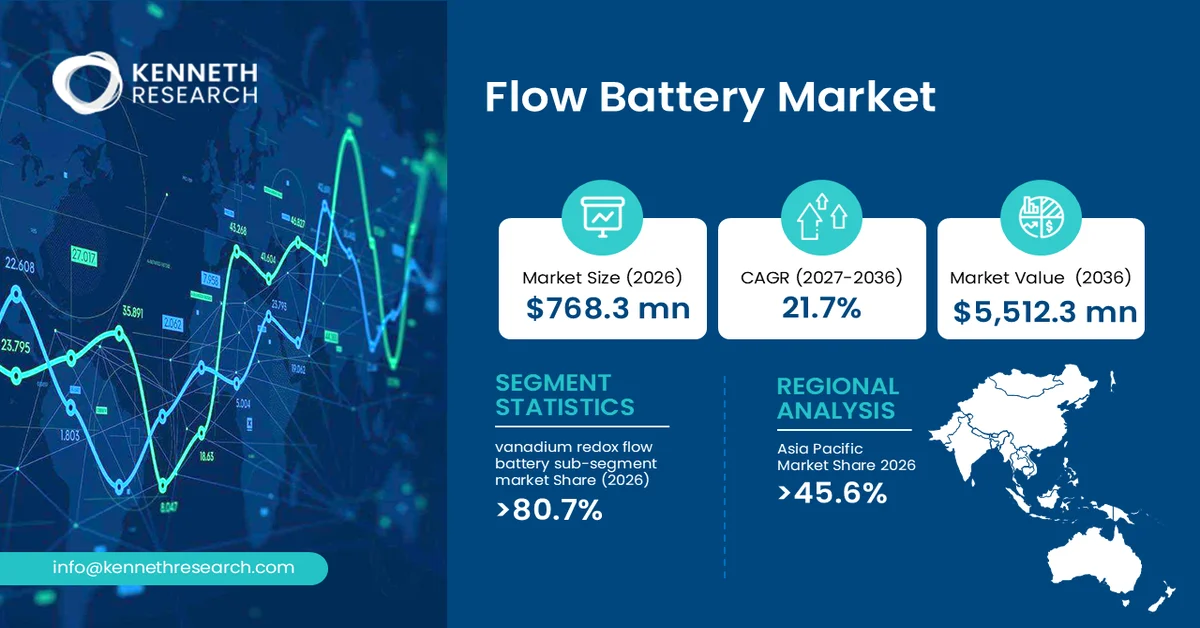
The global flow battery market size was valued at USD 768.3 million in 2026 and is projected to reach USD 5,512.3 million by the end of 2036, rising at a CAGR of 21.7% during the forecast period, i.e., 2027–2036. In 2027, the industry size of the global flow battery market is estimated at USD 941.2 million.
The primary growth driver for the flow battery market is rising demand for long-duration, grid-scale energy storage that can integrate variable renewable generation while strengthening electricity-system reliability and resilience. Government energy programs increasingly prioritize flow batteries as a pathway for durable, scalable stationary storage.
The flow battery market comprises electrochemical energy-storage systems that store and release electricity through reversible oxidation-reduction reactions involving active materials dissolved in liquid electrolytes. Unlike conventional batteries in which energy capacity and power capability are closely tied to cell configuration, flow batteries separate these functions: power is primarily determined by the electrochemical stack, while stored energy can be expanded through larger electrolyte storage tanks. This architecture supports flexible system sizing and makes flow batteries particularly relevant to stationary applications requiring extended discharge periods.
Key characteristics include liquid electrolyte circulation, modular stack-based power conversion, scalable energy capacity, and the ability to use different electrochemical couples, including vanadium-based systems and emerging chemistries. These attributes can support repeated charging and discharging and enable system designs tailored to utility and industrial requirements.
Key Flow Battery Market Insights Summary:
Key Takeaways: Market Trends & Insights
- Flow battery market reached USD 768.3 million in 2026 and is projected to reach USD 5,512.3 million by 2036 at a 21.7% CAGR
- Vanadium redox flow batteries lead the battery type segment with an 80.7% market share in 2026
- Large-scale systems above 10 MWh are identified as the second and fastest analysis segment, supported by growing demand for long-duration grid storage
- Asia Pacific dominates the regional landscape with a 45.6% market share in 2026, led by China and Japan
- The market is being supported by long-duration storage requirements, renewable-energy integration, grid modernization, and government-backed flow-battery manufacturing and demonstration initiatives
Market Drivers
- Expansion of long-duration energy storage demonstrations
- Rising renewable-energy integration requirements
- Increasing demand for grid resilience and reliability
- Advancements in electrolyte, membrane, and system manufacturing technologies
Challenges
- High System and Component Costs
- Supply-Chain Fragmentation and Manufacturing Scale-Up
Flow Battery Market Overview & Supply Chain
Flow Battery Market adoption is increasing as power systems require flexible, durable storage to integrate variable renewable generation, improve grid resilience, and support the transition toward lower-carbon electricity. Flow batteries are particularly relevant to long-duration applications because their energy-storage capacity can be scaled independently from power output, making them suitable for utility-scale systems and renewable-energy integration. Government policy is also strengthening the technology landscape. China’s National Energy Administration reported that, by the end of June 2024, the country had 44.44 GW of installed new-type energy-storage capacity, while flow-battery projects were among the technologies entering operation.
The flow battery market value chain begins with sourcing active electrolyte materials, membranes, electrodes, tanks, pumps, power-conditioning equipment, and other balance-of-system components. Upstream suppliers provide chemical and engineered inputs, while specialized manufacturers formulate electrolytes, fabricate electrochemical stacks, assemble storage modules, and integrate control and power-conversion systems. System integrators then configure complete installations according to project-specific power, duration, safety, and grid-interconnection requirements. Distribution typically involves direct project sales, engineering-procurement-construction contractors, energy-storage developers, and specialized technology providers. End users include utilities, renewable-energy operators, commercial and industrial facilities, microgrids, and other large-scale electricity consumers.
Flow Battery Market: Growth Drivers & Challenges
Growth Drivers
- Expansion of long-duration energy storage demonstrations: The increasing need for long-duration energy storage is strengthening the commercial case for flow batteries, particularly where renewable generation must be shifted across extended periods or where critical loads require prolonged backup. Flow batteries are structurally suited to this requirement because their energy capacity can be expanded through electrolyte storage without requiring a proportional increase in the electrochemical stack. Government-backed demonstration programs are helping address the remaining technology, performance, and bankability barriers.
- Rising renewable-energy integration requirements: The rapid expansion of variable renewable generation is increasing the need for storage technologies capable of balancing supply and demand over longer operating windows. Solar and wind output can fluctuate according to weather and time of day, creating periods of surplus generation as well as supply gaps that require flexible resources. Flow batteries can address this requirement by storing electricity when renewable output is available and releasing it when demand rises or generation declines.
Challenges
- High system and component costs: A major restraint for the flow battery market is the cost structure of specialized components and system architecture. Flow batteries require electrolyte tanks, pumps, membranes, electrodes, stacks, power electronics, and associated balance-of-plant equipment, creating a more complex installation than some competing storage technologies.
- Supply-chain fragmentation and manufacturing scale-up: Fragmented supply chains and limited manufacturing maturity create another significant constraint for the flow battery market. The technology depends on specialized materials and components that are not yet supported by the highly standardized, high-volume manufacturing ecosystem available to more established battery technologies.
Flow Battery Market Size and Forecast:
| Report Attribute | Details |
|---|---|
| Base Year |
2026 |
| Forecast Period |
2027-2036 |
| CAGR |
21.7% |
| Base Year Market Size (2026) |
USD 768.3 Million |
| Forecast Year Market Size (2036) |
USD 5,512.3 Million |
| Regional Scope |
|
Flow Battery Market Segmentation Analysis:
Battery Type Segment Analysis
In the battery type segment, vanadium redox flow battery sub-segment is anticipated to capture the largest market share of 80.7% by the end of 2026.
The vanadium redox flow battery segment leads the flow battery market because its established chemistry, long cycle-life characteristics, flexible energy-duration configuration, and suitability for stationary applications align closely with the requirements of utility-scale storage. Demand is being supported by renewable-energy integration, grid balancing, and the increasing deployment of storage systems designed for extended operating periods. Government-led demonstration activity is also strengthening technology validation and procurement confidence. In 2024, China’s National Energy Administration identified 8 flow-battery projects among its 56 new-type energy-storage pilot demonstration projects, indicating active institutional support for flow-battery deployment and technology development.
System Size Segment Analysis
The Large-Scale (>10 MWh) sector is projected to grow as the second-largest segment in the flow battery market due to four converging demand drivers.
The large-scale (>10 MWh) segment is projected to grow as utilities and renewable-power developers increasingly require storage systems capable of supporting grid balancing, renewable integration, peak management, and resilience at utility scale. Larger installations are particularly attractive for flow batteries because the chemistry allows energy capacity to be expanded independently from power-conversion equipment, making longer-duration configurations operationally flexible. Adoption is also being reinforced by government-backed deployment and demonstration programs targeting utility-scale long-duration storage. Going forward, grid modernization and renewable penetration should strengthen demand for large-scale storage, supporting continued deployment of flow-battery systems in utility and infrastructure applications.
Our in-depth analysis of the flow battery market includes the following segments:
|
Segment |
Sub-segment |
|
Battery Type |
|
|
System Size |
|
|
Application |
|
|
End User |
|
Flow Battery Market Regional Insights:
Asia Pacific Market Trends & Insights:
Asia Pacific flow battery market is projected to hold the largest revenue share of 45.6% by the end of 2026.
Asia Pacific maintains its leading position in the flow battery market, supported by rapid renewable-power deployment, expanding grid infrastructure, large-scale energy-storage investment, and active government programs for emerging storage technologies.
China represents the principal country-level growth engine, benefiting from extensive renewable-energy capacity, domestic manufacturing capabilities, grid investment, and government-led technology demonstrations. Its policy framework increasingly emphasizes new energy storage as an enabler of the evolving power system, creating opportunities for flow-battery suppliers and system integrators.
Japan is another important regional market, supported by its focus on stationary storage, grid flexibility, renewable integration, and storage-system deployment. Japan’s Ministry of Economy, Trade and Industry continues to examine measures for expanding stationary storage adoption, including grid-scale storage and market mechanisms that can improve the commercial environment for storage assets. Together, China and Japan provide complementary demand conditions spanning large-scale grid applications, renewable-energy integration, and technology development.
North America Market Trends & Insights:
North America represents an important market for long-duration energy storage, supported by rising electricity demand, renewable-energy integration, grid-resilience requirements, and efforts to modernize aging power infrastructure. In the United States, federal initiatives are helping move emerging storage technologies from research toward commercial deployment, with particular emphasis on non-lithium and long-duration systems.
The United States is the principal country-level opportunity in North America because of its extensive utility infrastructure, renewable-energy expansion, federal support for long-duration storage demonstrations, and growing focus on grid reliability. DOE initiatives are also encouraging commercialization of flow-battery technologies and diversification beyond lithium-based storage.
Canada offers complementary opportunities through renewable-power development, grid modernization, and government-backed programs supporting storage deployment. Its emphasis on reliable, low-emission electricity systems creates a favorable environment for long-duration technologies that can provide flexibility and resilience. Together, the two countries offer opportunities across utility-scale storage, renewable integration, critical infrastructure, microgrids, and industrial applications.
Flow Battery Market Competitive Landscape
Here is a list of upstream, downstream, and key players operating in flow battery market competitive ecosystem:
- Invinity Energy Systems plc (United Kingdom)
- Company Overview
- Business Strategy
- Key Product Offerings
- Financial Performance
- Key Performance Indicators
- Risk Analysis
- Recent Development
- Regional Presence
- SWOT Analysis
- ESS Tech, Inc. (United States)
- CellCube Energy Storage Systems Inc. (Canada)
- Largo Clean Energy Corp. (Storion Energy) (United States)
Recent Developments in Flow Battery Market
- In June 2026, Invinity Energy Systems partnered with the First Nations Utility Batteries Partnership (FNUBP) to deploy long-duration vanadium flow battery projects across Canada. FNUBP will act as lead developer managing commercial and regulatory activities, while Invinity will supply its Endurium™ platform for utility-scale applications, with projects targeting British Columbia and other provinces.
- In March 2026, CellCube completed installation of a vanadium redox flow battery storage system at Nagel-Group's Bochum site in Germany. The system enables 100% self-utilization of on-site solar power, features a 30-year lifespan with over 30,000 charging cycles, and uses non-flammable, reusable vanadium electrolyte recycled from steel industry by-products.
Frequently Asked Question
In 2026, the flow battery market exceeded USD 768.3 million.
The flow battery market is projected to reach USD 5,512.3 million by the end of 2036, expanding at a CAGR of 21.7% over the forecast period (2027-2036).
The major players in the market are Invinity Energy Systems plc, ESS Tech, Inc., CellCube Energy Storage Systems Inc., Largo Clean Energy Corp. (Storion Energy), and others.
In the Battery Type segment, the Vanadium Redox Flow Battery sub-segment is anticipated to capture the largest market share of 80.7% in the future and exhibit lucrative growth opportunities during 2027-2036. This growth trajectory is largely attributed to its suitability for utility-scale energy storage and renewable-energy integration.
Asia Pacific is projected to hold the largest market share of 45.6% by the end of 2036 and provide more business opportunities in the future. Continuous investments in grid infrastructure, renewable-energy integration, and large-scale energy-storage deployment across China and Japan are fostering the region's dominance.
Why Choose Kenneth Research ?
-
Insight with Impact : We don’t just gather data — we uncover stories, trends, and opportunities that fuel business growth.
-
Experts Who Get It : Our team speaks your industry’s language and knows what really matters to your customers and market.
-
Custom-Built for You : Forget one-size-fits-all. We craft research and consulting solutions as unique as your business vision.
-
Partners, Not Just Providers : We work with you, not for you — collaborating closely to turn insights into smart, strategic moves.
-
Results That Speak : Our work powers brands, startups, and industry leaders alike — with a track record of ideas that work in the real world.
Report ID: 1299 |
Published Date: 28 Sep 2026 |
Report Format: |
Delivery Timeline: 48-72 Business Hours

Copyright © 2025 Kenneth Research. All rights reserved. Terms of Use | Privacy Policy
