Report ID: 1382 |
Published Date: 11 Sep 2026 |
Report Format: |
Delivery Timeline: 48-72 Business Hours
Floating Offshore Wind Market Outlook:
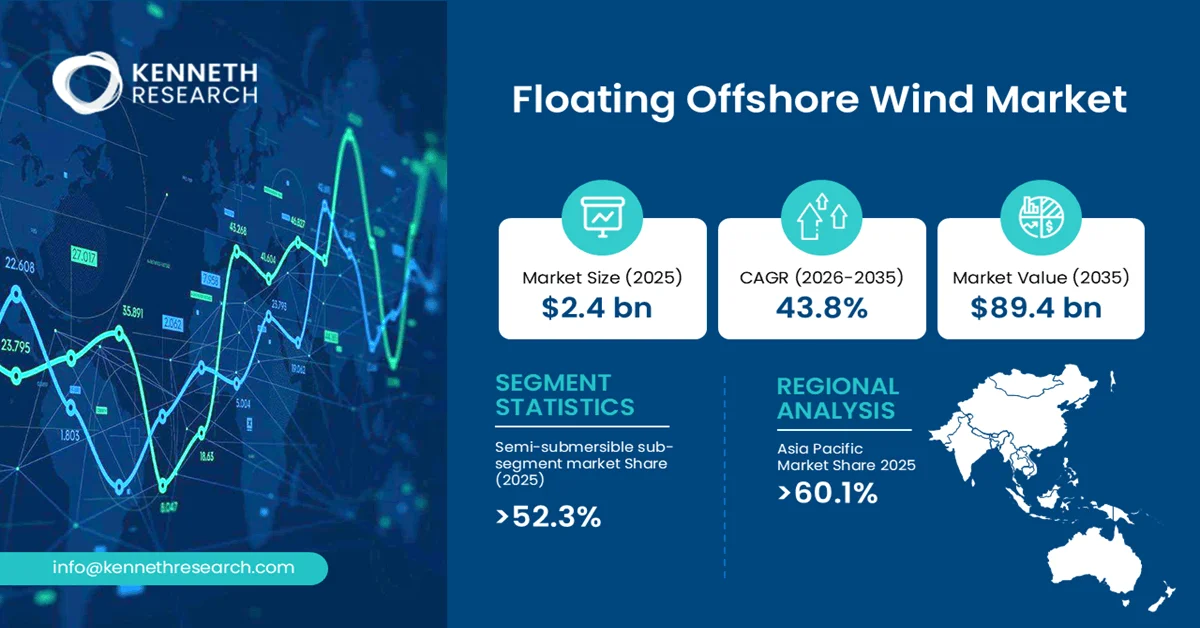
Floating Offshore Wind Market size was valued at USD 2.4 billion in 2025 and is projected to reach USD 89.4 billion by 2035, expanding at a CAGR of 43.8% during 2026-2035. In 2026, the industry size of floating offshore wind is estimated at USD 3.4 billion.
The primary growth driver is increasing investment in offshore renewable power as floating wind technology enables wind projects to access deeper waters beyond the practical limits of fixed-bottom foundations.
Floating offshore wind market comprises wind-power generation projects that use floating platforms to support offshore wind turbines in water depths where fixed-bottom foundations are technically or economically less suitable. The market encompasses floating platform technologies, mooring systems, anchors, dynamic cables, turbines, offshore electrical infrastructure, installation services, operations and maintenance, and associated project-development activities.
Floating wind enables developers to access areas with strong and consistent wind resources farther from shore, particularly in deep-water locations. The technology can therefore expand the geographic potential of offshore wind development in countries with limited shallow-water seabed availability.
Key Floating Offshore Wind Market Insights Summary:
Key Takeaways: Market Trends & Insights
- Floating Offshore Wind Market is projected to grow from USD 2.4 billion in 2025 to USD 89.4 billion by 2035, registering a 43.8% CAGR during the forecast period.
- Asia Pacific held the largest 60.1% share in 2025, with its leading position reinforced by strong offshore renewable-energy development, deep-water resource availability, government-backed demonstration programs, and established offshore engineering capabilities.
- The semi-submersible sub-segment is projected to command a 52.3% market share by 2025, supported by deep-water suitability, offshore stability, port-based fabrication and towing capabilities, and ongoing engineering optimization to reduce structural weight, improve hydrodynamic performance, and lower project costs.
- The transitional water product type segment is poised for expansion as floating offshore wind technology enables development in deeper waters beyond the practical range of fixed-bottom foundations while retaining proximity to established offshore infrastructure and grid connections.
Market Drivers
- Rising demand for deep-water offshore renewable-energy development
- Increasing government support for floating wind commercialization
- Advancements in floating-platform, mooring, and installation technologies
- Growing investment in offshore wind supply-chain infrastructure
Challenges
- High project costs and immature floating-wind supply chains
- Complex marine permitting, environmental assessment, and grid-infrastructure requirements
Floating Offshore Wind Market Overview & Supply Chain
The floating offshore wind market is gaining momentum as developers seek to access deeper offshore areas with strong wind resources that are unsuitable for conventional fixed-bottom projects. Government-backed policy support, demonstration programs, and commercialization initiatives are strengthening the technology ecosystem. Japan’s Ministry of Economy, Trade and Industry (METI) and NEDO selected floating offshore wind demonstration projects in 2024, including semi-submersible platforms, specifically to advance technologies required for lower-cost commercialization and mass production.
The value chain begins with suppliers of steel, composites, cables, anchors, mooring equipment, electrical components, and turbine systems. Platform manufacturers then fabricate floating foundations and integrate them with turbines, dynamic cables, mooring systems, and offshore electrical equipment. Engineering and construction companies provide project design, fabrication, port handling, towing, installation, commissioning, and marine construction services. Developers and utilities coordinate project financing, seabed leasing, permitting, grid connection, and long-term operations. Specialized vessels, ports, offshore logistics providers, inspection companies, and maintenance contractors support project execution and lifecycle management.
Floating Offshore Wind Market: Growth Drivers & Challenges
Growth Drivers:
- Increasing government support for floating wind commercialization: Government-backed research and commercialization programs are accelerating the development of floating offshore wind by addressing technology costs, platform design, manufacturing, installation, and supply-chain limitations. The U.S. Department of Energy's Floating Offshore Wind Shot established a coordinated federal effort involving DOE, Interior, Commerce, and Transportation to advance floating offshore wind design, development, and manufacturing. The program specifically targets substantial cost reductions and emphasizes development of a domestic supply chain.
- Growing demand for deep-water offshore wind development: The availability of deeper-water offshore areas is creating an important opportunity for floating wind technology. Unlike fixed-bottom systems, floating platforms can support turbines in waters where conventional foundations become technically challenging or uneconomic. The U.S. Department of Energy notes that approximately two-thirds of U.S. offshore wind potential is located in waters too deep for today's fixed-bottom foundations, highlighting the strategic importance of floating platforms for accessing additional offshore resources.
Challenges:
- High project costs and immature supply chains: High capital requirements remain a major challenge for floating offshore wind because the technology requires specialized platforms, mooring systems, dynamic cables, ports, vessels, and installation capabilities. The U.S. Department of Energy identifies cost reduction and supply-chain development as key priorities for floating offshore wind commercialization. DOE's Floating Offshore Wind Shot specifically targets reductions in technology costs while emphasizing the need to establish robust domestic supply chains.
- Complex marine permitting, environmental assessment, and grid requirements: Floating offshore wind projects face complex permitting and environmental requirements because developments can interact with fisheries, marine ecosystems, navigation, coastal communities, and other ocean users. The U.S. Department of Energy's Floating Offshore Wind Shot identifies siting and leasing, environmental impacts, fisheries, communities, and transmission among the priorities that must be addressed for expanded deployment. Federal agencies are consequently required to coordinate environmental reviews and stakeholder engagement before offshore projects can progress.
Floating Offshore Wind Market Size and Forecast:
| Report Attribute | Details |
|---|---|
| Base Year |
2025 |
| Forecast Period |
2026-2035 |
| CAGR |
43.8% |
| Base Year Market Size (2025) |
USD 2.4 billion |
| Forecast Year Market Size (2035) |
USD 89.4 billion |
| Regional Scope |
|
Floating Offshore Wind Market Segmentation Analysis:
Platform Segment Analysis
In the platform segment, the semi-submersible sub-segment is anticipated to capture the largest market share of 52.3% by the end of 2025.
Its strong position is supported by its suitability for deep-water deployment, stability in challenging offshore conditions, and potential for port-based fabrication and towing to project sites. The U.S. Department of Energy's National Renewable Energy Laboratory identified a semi-submersible design among the finalists of its FLOWIN Prize, noting that the platform could be assembled at ports and was designed to withstand harsh operating environments.
Semi-submersible platforms also benefit from ongoing engineering optimization aimed at reducing structural weight, improving hydrodynamic performance, and lowering project costs. NREL's 2024 offshore-wind cost assessment specifically models the semisubmersible as the floating technology and emphasizes that investment in enabling infrastructure, particularly ports, will be important for reducing future floating-wind costs.
Product Type Segment Analysis
The transitional water product type segment is projected to expand as floating offshore wind technology enables development in water depths where fixed-bottom foundations become less suitable, while remaining closer to established offshore infrastructure and grid connections. Floating platforms can broaden the geographic range of offshore wind deployment and provide developers with greater flexibility in selecting project locations. The U.S. Department of Energy identifies floating wind as particularly important for deeper-water areas, with approximately two-thirds of U.S. offshore wind potential located in waters too deep for today's fixed-bottom foundations.
Government-backed research is also targeting technologies that can improve deployment in these offshore environments. In 2024, the U.S. Department of Energy and Innovation Fund Denmark announced a funding opportunity focused on mooring technologies for floating wind turbines in deep water, including mooring lines, anchors, and associated components.
Our in-depth analysis of the global floating offshore wind market includes the following segments:
|
Segment |
Sub-segment |
|
Platform |
|
|
Product Type |
|
|
Turbine Capacity |
|
|
Application |
|
|
Component |
|
Floating Offshore Wind Market Regional Insights:
Asia Pacific Market Trends & Insights:
Asia Pacific accounted for the largest share of the floating offshore wind market at 60.1% in 2025, supported by strong offshore renewable-energy development, deep-water resource availability, government-backed demonstration programs, and established offshore engineering capabilities.
Japan is a key market for floating offshore wind because of its deep coastal waters and limited availability of shallow seabed suitable for fixed-bottom development. Japan's Ministry of Economy, Trade and Industry (METI) and NEDO selected floating offshore wind demonstration projects in 2024, including projects using semi-submersible platforms, to advance technologies toward commercialization and mass production.
China represents another major opportunity because of its extensive offshore wind industry, large manufacturing base, and growing interest in floating technology for deeper waters. The combination of turbine manufacturing, offshore engineering expertise, port infrastructure, and expanding renewable-energy deployment provides a foundation for scaling floating projects.
Leading Companies Operating in the Global Floating Offshore Wind Market:
Here is a list of upstream, downstream, and key players operating in the global floating offshore wind market competitive ecosystem:
- Equinor(Norway)
- Company Overview
- Business Strategy
- Key Product Offerings
- Financial Performance
- Key Performance Indicators
- Risk Analysis
- Recent Development
- Regional Presence
- SWOT Analysis
- Saipem(Italy)
- Samsung Heavy Industries(South Korea)
- MODEC(Japan)
- Sumitomo Heavy Industries (Toky0)
Recent Developments
- July 2026 – Sumitomo Heavy Industries and FAWT Consortium: An experimental Floating Axis Wind Turbine (FAWT) was installed in Iki City, Nagasaki, Japan, beginning an offshore demonstration aimed at developing a lower-cost, domestically sourced floating-wind system.
- March 2026 – UK Government: The UK Government announced up to £64 million for development of Port Talbot as a dedicated floating offshore wind hub in the Celtic Sea.
Frequently Asked Question
In 2025, the floating offshore wind market was valued at USD 2.4 billion.
The floating offshore wind market is projected to reach USD 89.4 billion by the end of 2035, expanding at a CAGR of 43.8% during the forecast period (2026-2035).
Major participants include Equinor, Saipem, Samsung Heavy Industries, MODEC, and Stiesdal, among others.
In the Platform segment, the Semi-submersible sub-segment is anticipated to maintain the largest market share of 52.3% and present significant growth opportunities during 2026-2035. Its suitability for deep-water deployment, stability, and potential for port-based fabrication support its strong market position.
Asia Pacific is projected to remain the leading region, with a 60.1% share in 2025. Japan and China are key markets, supported by offshore renewable-energy development, floating-wind demonstration programs, deep-water resources, and investments in offshore wind technology and infrastructure.
Why Choose Kenneth Research ?
-
Insight with Impact : We don’t just gather data — we uncover stories, trends, and opportunities that fuel business growth.
-
Experts Who Get It : Our team speaks your industry’s language and knows what really matters to your customers and market.
-
Custom-Built for You : Forget one-size-fits-all. We craft research and consulting solutions as unique as your business vision.
-
Partners, Not Just Providers : We work with you, not for you — collaborating closely to turn insights into smart, strategic moves.
-
Results That Speak : Our work powers brands, startups, and industry leaders alike — with a track record of ideas that work in the real world.
Report ID: 1382 |
Published Date: 11 Sep 2026 |
Report Format: |
Delivery Timeline: 48-72 Business Hours

Copyright © 2025 Kenneth Research. All rights reserved. Terms of Use | Privacy Policy
