Report ID: 1337 |
Published Date: 28 Sep 2026 |
Report Format: |
Delivery Timeline: 48-72 Business Hours
Flexible, Printed and Thin Film Battery Market Outlook:
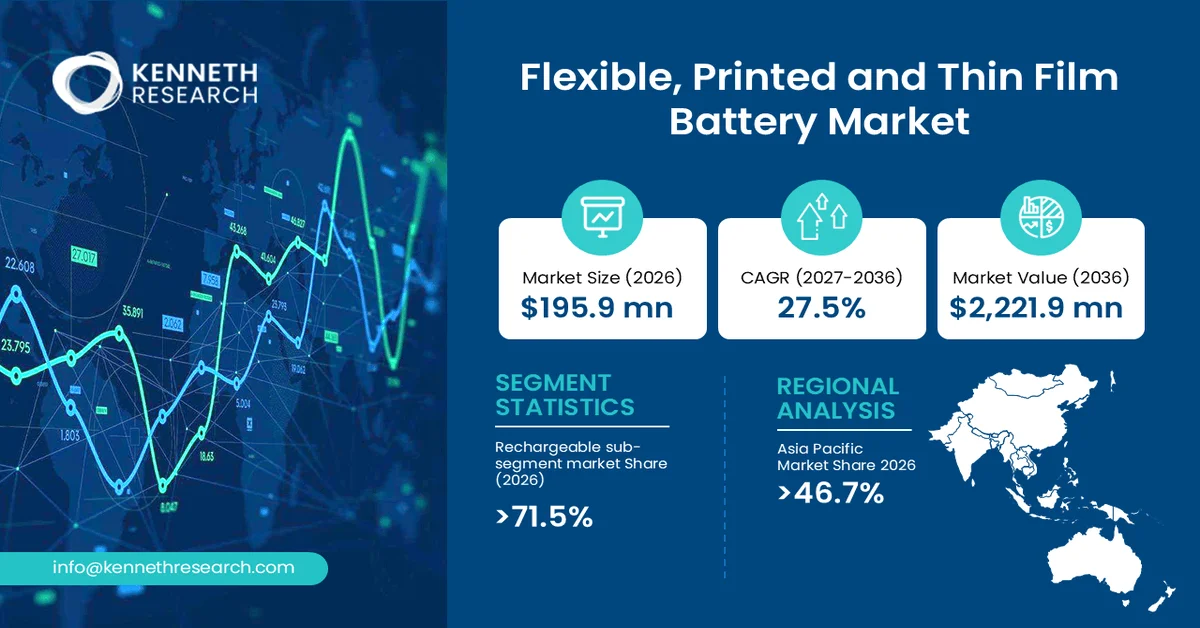
Flexible, Printed and Thin Film Battery Market size was valued at USD 195.9 million in 2026 and is projected to reach USD 2,221.9 million by the end of 2036, rising at a CAGR of 27.5% during the forecast period, i.e., 2027-2036. In 2027, the industry size of the flexible, printed and thin film battery is estimated at USD 249.5 million.
The growing need for compact, lightweight, and conformable power sources is driving adoption of flexible, printed and thin film batteries. Government-backed battery research highlights their suitability for wearable electronics, sensors, medical devices, and other space-constrained applications, where conventional rigid batteries can limit device design and functionality.
The flexible, printed and thin film battery market comprises batteries designed with thin, lightweight, bendable, or conformable architectures and manufacturing approaches that enable integration into electronic products with constrained or non-planar form factors. These batteries can employ lithium-based, solid-state, or other electrochemical technologies and may use thin-film deposition, printing, or advanced fabrication techniques to produce compact energy-storage components. Government research describes printed battery concepts as capable of being fabricated on flexible substrates, while solid-state approaches can support thinner and more adaptable battery configurations.
Key characteristics include low-profile construction, mechanical flexibility, customizable form factors, and compatibility with miniaturized electronics. These attributes allow batteries to be incorporated into devices where conventional rigid cells may constrain packaging or product architecture. Applications include wearable electronics, sensors, medical devices, hearables, smart devices, and other portable or connected technologies.
Key Flexible, Printed and Thin Film Battery Market Insights Summary:
Key Takeaways: Market Trends & Insights
- Flexible, printed and thin film battery market is projected to reach USD 2,221.9 million by 2036, rising from USD 195.9 million in 2026
- The market is expected to expand at a CAGR of 27.5% during 2027-2036, reflecting strong demand for compact and conformable energy-storage solutions
- Rechargeable batteries lead the Type segment with a 71.5% market share in 2026, supported by recurring-use requirements across wearable and medical electronics
- Wearables represent the fastest-growing analysis segment as manufacturers increasingly integrate compact power sources into smartwatches, health monitors, sensors, and other connected devices
- Asia Pacific leads the regional landscape with a 46.7% market share in 2026, supported by established battery and electronics manufacturing ecosystems across China and Japan
Market Drivers
- Expansion of wearable and digital health electronics
- Advancements in flexible battery materials and architectures
- Increasing integration of sensors and connected electronic devices
- Growing demand for compact, lightweight, and conformable power sources
Challenges
- Mechanical durability and performance trade-offs
- Manufacturing scalability and cost complexity
Flexible, Printed and Thin Film Battery Market Overview & Supply Chain
Adoption of flexible, printed and thin film batteries is increasing as electronics, healthcare devices, sensors, connected products, and energy technologies increasingly require compact power sources that can conform to constrained product architectures. Their thin profiles and adaptable form factors support device miniaturization while enabling manufacturers to integrate energy storage into applications where conventional rigid cells are less suitable. Broader battery-sector development is also strengthening the industrial ecosystem around advanced materials, cell manufacturing, and energy-storage technologies.
The value chain for flexible, printed and thin film batteries begins with upstream suppliers of lithium compounds, conductive materials, electrode materials, polymers, specialty substrates, electrolytes, and other functional components. Material processors and specialty-chemical companies refine these inputs to meet electrochemical, mechanical, and printing requirements. Battery manufacturers then undertake electrode preparation, layer formation, cell assembly, encapsulation, testing, and quality assurance, with production methods varying according to chemistry and device architecture. Distribution involves specialist component distributors, battery integrators, electronics supply networks, and direct manufacturer-to-customer channels. End users include wearable-device manufacturers, medical-technology companies, sensor developers, consumer-electronics producers, smart-label and IoT companies, and other equipment manufacturers.
Flexible, Printed and Thin Film Battery Market: Growth Drivers & Challenges
Growth Drivers:
- Expansion of wearable and digital health electronics: The increasing adoption of wearable electronics is creating stronger requirements for batteries that are lightweight, compact, flexible, and capable of operating within body-worn form factors. Conventional rigid cells can constrain device geometry, whereas flexible and thin batteries can be incorporated into curved, skin-mounted, textile-based, and other space-constrained systems. This creates a direct technology pull for manufacturers serving smart wearables, healthcare monitors, sensors, and connected devices.
- Advancements in flexible battery materials and architectures: Rapid progress in electrode materials, electrolytes, current collectors, substrates, encapsulation, and cell architectures is improving the technical feasibility of flexible and thin battery systems. Manufacturers and research institutions are increasingly able to engineer cells around the mechanical and spatial requirements of specific electronic products rather than adapting products to conventional battery geometries.
Challenges:
- Mechanical durability and performance trade-offs: The core restraint is the difficulty of maintaining electrochemical performance while repeatedly bending, folding, stretching, or otherwise deforming the battery. Flexible architectures place additional mechanical stress on electrodes, current collectors, interfaces, electrolytes, and encapsulation layers. Repeated deformation can cause cracking, delamination, loss of interlayer contact, electrolyte leakage, and accelerated capacity degradation.
- Manufacturing scalability and cost complexity: Flexible, printed and thin film batteries face a significant scale-up challenge because laboratory fabrication methods do not always translate efficiently into high-throughput commercial production. Specialized deposition, printing, patterning, multilayer assembly, encapsulation, and inspection processes can increase manufacturing complexity and require tightly controlled materials and equipment.
Flexible, Printed and Thin Film Battery Market Size and Forecast:
| Report Attribute | Details |
|---|---|
| Base Year |
2026 |
| Forecast Period |
2027-2036 |
| CAGR |
27.5% |
| Base Year Market Size (2026) |
USD 195.9 million |
| Forecast Year Market Size (2036) |
USD 2,221.9 million |
| Regional Scope |
|
Flexible, Printed and Thin Film Battery Market Segmentation Analysis:
Type Segment Analysis
In the type segment, rechargeable sub-segment is anticipated to capture the largest market share of 71.5% by the end of 2026.
The rechargeable segment dominates because its ability to undergo repeated charging aligns closely with the operating requirements of wearable electronics, medical monitoring devices, sensors, and connected consumer products. These applications require dependable power without frequent battery replacement, making rechargeable architectures commercially attractive for devices designed for continuous or recurring use. Demand is reinforced by the broader expansion of health-oriented wearables, where compact and conformable rechargeable batteries can support increasingly sophisticated sensing functionality. A recent U.S. National Institutes of Health study based on nationally representative HINTS data found that wearable-device use among U.S. adults reached 41.1% in 2024, demonstrating a substantial and expanding user base for battery-powered wearable applications.
Application Segment Analysis
The wearables sector is projected to grow as the second-largest segment in the flexible, printed and thin film battery market due to four converging demand drivers.
The wearables segment is projected to grow as smartwatches, fitness trackers, medical wearables, and body-mounted sensors increasingly combine continuous monitoring with compact electronic architectures. Wearable products require power sources that can fit within small, curved, lightweight designs without compromising user comfort, making flexible and thin film batteries particularly relevant. Demand is also supported by expanding health-monitoring functionality, including activity, cardiovascular, sleep, and other physiological measurements. A U.S. National Institutes of Health–indexed study using the 2022 Health Information National Trends Survey found that 37.8% of respondents reported using wearable devices for health or physical-activity monitoring.
Our in-depth analysis of the flexible, printed and thin film battery market includes the following segments:
|
Segment |
Sub-segment |
|
Type |
|
|
Application |
|
Flexible, Printed and Thin Film Battery Market Regional Insights:
Asia Pacific Trends & Insights:
Asia Pacific flexible, printed and thin film battery market is projected to hold the largest revenue share of 46.7% by the end of 2026.
It is supported by a deeply established battery manufacturing ecosystem, advanced electronics production, extensive component supply chains, and strong investment in next-generation energy technologies.
China remains the principal country within the region because of its integrated battery ecosystem spanning materials, cells, equipment, and end-use electronics. Its large domestic electronics and electrification industries provide an extensive customer base, while established manufacturing capabilities facilitate technology commercialization.
Japan represents another important market, supported by advanced electronics manufacturing, battery research, and established industrial capabilities. Its Ministry of Economy, Trade and Industry maintains dedicated production statistics covering battery manufacturing and related electrical and electronic industries, reflecting the sector's continuing industrial significance.
North America Trends & Insights:
North America is an important market for flexible, printed and thin film batteries because demand is supported by advanced consumer electronics, medical technology, industrial sensors, defense-related electronics, and connected-device development. The region is also strengthening domestic battery capabilities to reduce supply-chain exposure and encourage advanced manufacturing.
The United States represents the region's principal industrial hub, supported by federal programs targeting domestic battery materials, manufacturing, recycling, and next-generation battery technologies. Its strong electronics, healthcare, aerospace, and technology industries provide diverse potential customers for compact power solutions.
Canada is developing complementary capabilities across critical minerals, battery materials, research, and manufacturing. Government initiatives are strengthening its battery innovation ecosystem, including support for dedicated battery research infrastructure and industrial supply-chain development. Together, the two countries provide a combination of technology development, industrial demand, resource access, and policy support that can facilitate future adoption of flexible battery architectures.
Leading Companies Operating in the Global Flexible, Printed and Thin Film Battery Market:
Here is a list of upstream, downstream, and key players operating in flexible, printed and thin film battery market competitive ecosystem:
- LG Chem (South Korea)
- Company Overview
- Business Strategy
- Key Product Offerings
- Financial Performance
- Key Performance Indicators
- Risk Analysis
- Recent Development
- Regional Presence
- SWOT Analysis
- Enfucell (Finland)
- ProLogium Technology (Taiwan)
- VARTA Microbattery GmbH (Germany)
Recent Developments
- In October 2025, VARTA AG presented its comprehensive portfolio of primary and rechargeable batteries for hearing aids and medical applications at EUHA 2025, the world's largest trade event for the hearing aid industry. The company showcased solutions ranging from standard cells to individually developed batteries, with compact, powerful, and longer-lasting designs that enable smaller hearing systems and improved quality of life for users.
- In January 2025, ProLogium Technology showcased its 100% silicon composite anode solid-state batteries at CES 2025, demonstrating continued advancement in solid-state battery technology. The company, founded in 2006 with core expertise in oxide electrolytes and Multi-Axis Bipolar (MAB) pack design, continues to target applications across electric vehicles, IoT, and consumer electronics.
Frequently Asked Question
In 2026, the flexible, printed and thin film battery market exceeded USD 195.9 million.
The flexible, printed and thin film battery market is projected to reach USD 2,221.9 million by the end of 2036, expanding at a CAGR of 27.5% over the forecast period (2027-2036).
The major players in the market are LG Chem, Enfucell, ProLogium Technology, VARTA Microbattery GmbH, and others.
In the type segment, the rechargeable sub-segment is anticipated to capture the largest market share of 71.5% in 2026 and exhibit lucrative growth opportunities during 2027-2036. This growth trajectory is largely attributed to increasing demand for compact, rechargeable power sources in wearable electronics and medical devices.
Asia Pacific is projected to hold the largest market share of 46.7% in 2026 and provide more business opportunities in the future. Continuous investments in battery manufacturing, advanced electronics, and next-generation battery technologies in China and Japan are fostering the region's dominance.
Why Choose Kenneth Research ?
-
Insight with Impact : We don’t just gather data — we uncover stories, trends, and opportunities that fuel business growth.
-
Experts Who Get It : Our team speaks your industry’s language and knows what really matters to your customers and market.
-
Custom-Built for You : Forget one-size-fits-all. We craft research and consulting solutions as unique as your business vision.
-
Partners, Not Just Providers : We work with you, not for you — collaborating closely to turn insights into smart, strategic moves.
-
Results That Speak : Our work powers brands, startups, and industry leaders alike — with a track record of ideas that work in the real world.
Report ID: 1337 |
Published Date: 28 Sep 2026 |
Report Format: |
Delivery Timeline: 48-72 Business Hours

Copyright © 2025 Kenneth Research. All rights reserved. Terms of Use | Privacy Policy
