Report ID: 1130 |
Published Date: 21 Aug 2026 |
Report Format: |
Delivery Timeline: 48-72 Business Hours
Flexible Epoxy Resin Market Outlook:
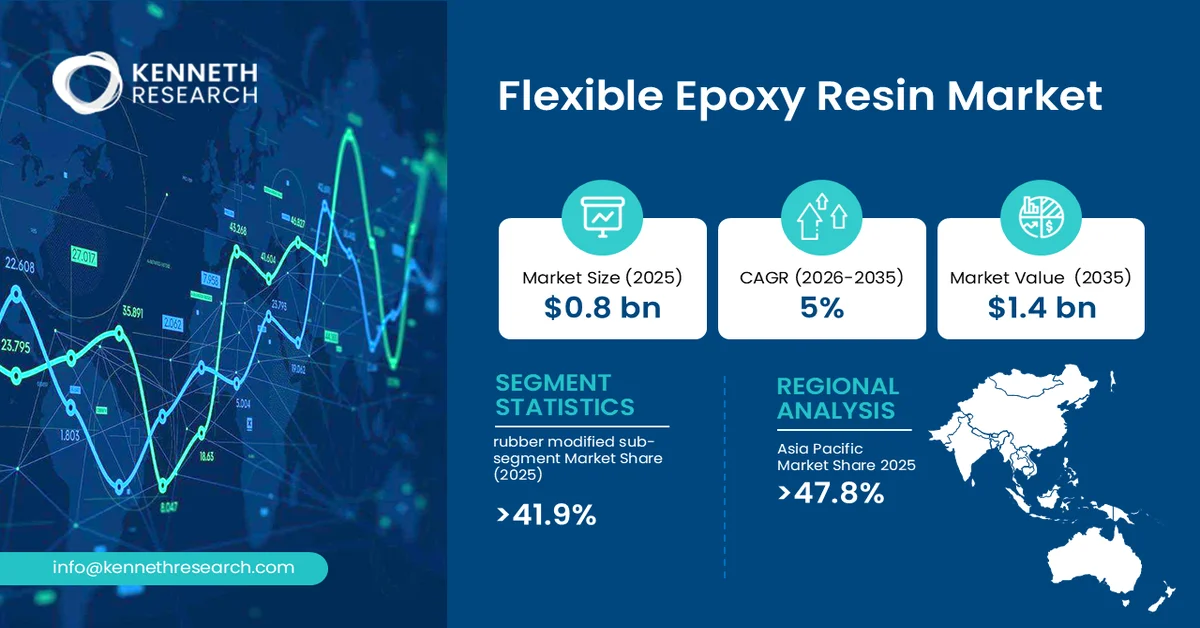
Flexible Epoxy Resin Market size was valued at USD 0.8 billion in 2025 and is projected to reach USD 1.4 billion by the end of 2035, rising at a CAGR of 5% during the forecast period, i.e., 2026-2035. In 2026, the industry size of the flexible epoxy resin is estimated at USD 0.9 billion.
The primary growth driver for the flexible epoxy resin market is expanding demand for lightweight, durable, and high-performance materials in electric vehicles, renewable energy systems, electronics, and industrial infrastructure. Global policy support for clean energy technologies is accelerating manufacturing investments, increasing the consumption of advanced adhesive, coating, composite, and encapsulation materials.
Flexible epoxy resin refers to a modified thermosetting polymer system engineered to provide greater flexibility, impact resistance, and toughness than conventional epoxy resins while maintaining excellent adhesion, chemical resistance, electrical insulation, and mechanical integrity. These materials are formulated through the incorporation of elastomeric modifiers, reactive diluents, or specialized curing systems, enabling them to withstand cyclic loading, thermal expansion, and mechanical stress without significant cracking or loss of performance.
Flexible epoxy resins are widely used in structural adhesives, protective coatings, composite materials, electronic encapsulation, flooring systems, automotive components, wind energy structures, marine equipment, and construction applications where durability and resilience are critical. Their ability to bond dissimilar substrates, absorb vibration, and maintain performance under demanding environmental conditions makes them suitable for both industrial manufacturing and infrastructure projects.
The market plays an important role in supporting advanced manufacturing by enabling lightweight product design, extending component service life, and improving reliability across transportation, energy, electronics, and industrial sectors. As industries increasingly prioritize durable, high-performance materials for modern engineering applications, flexible epoxy resins continue to gain strategic importance in value-added manufacturing ecosystems.
Key Flexible Epoxy Resin Market Insights Summary:
Key Takeaways: Market Trends & Insights
- Flexible Epoxy Resin Market is projected to grow from USD 0.9 billion in 2026 to USD 1.4 billion by 2035 at a CAGR of 5%
- Rubber Modified remained the leading type segment with a 41.9% market share in 2025 driven by its superior toughness, flexibility, and adoption in structural adhesives, coatings, composites, and electronics
- Asia Pacific held the dominant regional position with a 47.8% market share in 2025 supported by strong manufacturing capabilities, integrated chemical supply chains, and industrial expansion across China and India
- Growing adoption of flexible epoxy resins in electric vehicles, renewable energy systems, industrial adhesives, and advanced composites is accelerating long-term demand across high-performance manufacturing industries
- The Middle East and Africa is emerging as a high-potential region as industrial diversification, petrochemical expansion, infrastructure investments, and manufacturing modernization in Saudi Arabia and South Africa continue to create new application opportunities
Market Drivers
- Increasing investments in industrial infrastructure modernization
- Growing adoption of advanced electronic encapsulation materials
- Expansion of lightweight transportation and mobility applications
- Rising demand for durable protective coatings in harsh operating environments
Challenges
- Volatility in petrochemical feedstock availability and cost
- Complex performance and regulatory qualification requirements
Flexible Epoxy Resin Market Overview & Supply Chain
Global adoption of flexible epoxy resins is increasing as manufacturers seek materials that combine mechanical strength with flexibility, fatigue resistance, and long-term durability in demanding applications. These resins are increasingly specified for wind turbine blades, electric vehicle components, electronics encapsulation, protective coatings, and structural adhesives where resistance to thermal cycling and vibration is essential. Sustainability policies, electrification initiatives, and investments in renewable energy infrastructure are further strengthening demand for advanced polymer systems. The industrial relevance of flexible epoxy resins is reinforced by the rapid expansion of renewable energy installations. According to the International Energy Agency, global annual renewable capacity additions increased by almost 50% to nearly 510 GW in 2023, marking the fastest growth rate in over two decades, thereby creating greater demand for high-performance resin systems used in composite structures and industrial bonding applications.
The value chain of the flexible epoxy resin market begins with the procurement of petrochemical-based feedstocks, including epoxy precursors, curing agents, elastomeric modifiers, plasticizers, reactive diluents, and specialty additives sourced from global chemical manufacturers. Resin producers formulate these materials through controlled polymerization and blending processes to achieve the required flexibility, adhesion, chemical resistance, and mechanical performance for specific industrial applications. Finished flexible epoxy resins are supplied directly to formulators or converted into adhesives, coatings, composite matrices, encapsulants, sealants, and flooring materials by downstream manufacturers. Distribution occurs through direct industrial supply agreements, regional chemical distributors, and specialized material suppliers serving diverse manufacturing sectors. End users include automotive, construction, electrical and electronics, renewable energy, marine, aerospace, and industrial equipment manufacturers. Key stakeholders across the value chain comprise raw material suppliers, resin manufacturers, compounders, distributors, OEMs, engineering contractors, regulatory bodies, and industrial technology providers working to ensure product quality, compliance, and supply continuity.
Flexible Epoxy Resin Market: Growth Drivers & Challenges
Growth Drivers:
- Rising electrification and renewable energy infrastructure investments: The increasing deployment of electric vehicles, renewable energy assets, and grid modernization projects is creating sustained demand for flexible epoxy resins that offer superior adhesion, impact resistance, and long-term durability. These materials are extensively utilized in battery assemblies, electrical insulation, wind turbine blade composites, protective coatings, and structural bonding applications where thermal stability and mechanical flexibility are essential. As governments and industries prioritize decarbonization, manufacturers are investing in advanced resin formulations capable of meeting stringent performance and reliability requirements. This trend is expanding the adoption of flexible epoxy systems across high-value industrial applications while encouraging continuous product innovation.
- Increasing demand for high-performance industrial adhesives and composites: The growing use of lightweight materials and high-performance bonding technologies across industrial manufacturing is strengthening the demand for flexible epoxy resins. Manufacturers are replacing conventional fastening methods with structural adhesives that improve design flexibility, reduce component weight, and enhance fatigue resistance without compromising mechanical strength. Flexible epoxy formulations also provide excellent compatibility with composites, metals, plastics, and advanced engineering materials, enabling their widespread use in automotive, aerospace, electronics, marine, and construction applications. As production processes become increasingly automated and precision-driven, industries require resin systems capable of delivering consistent curing characteristics and long-term operational reliability. Future demand is expected to benefit from continued innovation in composite manufacturing, advanced electronics packaging, and sustainable infrastructure development, reinforcing the strategic importance of flexible epoxy resins in next-generation industrial production.
Challenges:
- Volatility in petrochemical feedstock availability and cost: Flexible epoxy resin production depends on a complex network of petrochemical-derived raw materials, specialty modifiers, curing agents, and performance additives whose availability and pricing are influenced by fluctuations in crude oil markets, refinery operations, regional production capacity, and geopolitical disruptions. Frequent changes in feedstock costs make it difficult for manufacturers to maintain stable production economics and long-term pricing agreements with industrial customers. The resulting uncertainty affects procurement strategies, inventory management, and contract negotiations throughout the value chain. Smaller manufacturers are particularly vulnerable because they often have limited purchasing leverage and fewer options for supply diversification. Over time, producers are expected to strengthen sourcing resilience through supplier diversification, regional manufacturing expansion, and increased investment in alternative formulations, although raw material volatility is likely to remain a persistent commercial challenge.
- Complex performance and regulatory qualification requirements: Flexible epoxy resins are used in applications where long-term mechanical reliability, chemical resistance, electrical insulation, and environmental durability are critical. As a result, manufacturers must satisfy rigorous qualification procedures, customer-specific performance standards, and evolving environmental and chemical compliance requirements before products can be commercially adopted. Developing formulations that simultaneously achieve flexibility, structural strength, processability, and regulatory compliance often requires extensive research, validation, and customer testing, increasing development costs and extending commercialization timelines. These technical barriers can slow product introduction and reduce the speed at which innovative formulations enter high-value industries such as transportation, electronics, renewable energy, and industrial infrastructure. Going forward, companies that invest in advanced formulation technologies, compliance capabilities, and collaborative product development with end users will be better positioned to overcome these market entry challenges.
Flexible Epoxy Resin Market Size and Forecast:
| Report Attribute | Details |
|---|---|
| Base Year |
2025 |
| Forecast Year |
2026-2035 |
| CAGR |
5% |
| Base Year Market Size (2025) |
USD 0.8 billion |
| Forecast Year Market Size (2035) |
USD 1.4 billion |
| Regional Scope |
|
Flexible Epoxy Resin Market Segmentation Analysis:
Type Segment Analysis
In the type segment, the rubber modified sub-segment is anticipated to capture the largest market share of 41.9% by the end of 2025.
The rubber modified segment dominates the flexible epoxy resin market because it delivers an optimal balance of toughness, flexibility, impact resistance, and adhesion, making it suitable for demanding industrial applications. These formulations are widely adopted in structural adhesives, automotive assemblies, wind turbine components, protective coatings, and electronic encapsulation, where resistance to vibration, thermal cycling, and mechanical stress is critical. Demand continues to grow as manufacturers increasingly replace conventional rigid epoxy systems with tougher materials that improve product durability and service life. On the supply side, established manufacturing technologies, broad raw material availability, and continuous formulation improvements have enabled resin producers to commercialize rubber-modified systems across multiple industries at scale. Industrial expansion in transportation and advanced manufacturing further reinforces this leadership.
Application Segment Analysis
The adhesives is projected to grow as the second-largest segment in the flexible epoxy resin market due to four converging demand drivers.
The adhesives segment is projected to witness the fastest growth in the flexible epoxy resin market owing to increasing demand for high-strength bonding solutions in automotive, construction, electronics, renewable energy, and industrial manufacturing. Flexible epoxy adhesives provide excellent adhesion, impact resistance, fatigue performance, and compatibility with a wide range of substrates, enabling manufacturers to reduce mechanical fasteners, improve structural integrity, and support lightweight product designs. Their ability to maintain performance under thermal cycling and dynamic loading has accelerated adoption in electric vehicles, wind energy components, and advanced electronic assemblies. On the supply side, resin manufacturers are expanding specialized adhesive formulations with improved curing characteristics, durability, and environmental compliance to meet evolving industrial specifications. Demand is further reinforced by infrastructure development. According to India's Ministry of Road Transport and Highways, the country's National Highway network expanded to 146,145 km in 2023, reflecting sustained infrastructure growth that supports the use of high-performance structural adhesives in construction and civil engineering applications.
Our in-depth analysis of the global flexible epoxy resin market includes the following segments:
|
Segment |
Sub-segment |
|
Type |
|
|
Application |
|
Flexible Epoxy Resin Market Regional Insights:
Asia Pacific Market Trends & Insights:
Asia Pacific flexible epoxy resin market is projected to hold the largest revenue share of 47.8% by the end of 2025.
The region benefits from integrated petrochemical supply chains, competitive production costs, and continuous investments in advanced materials manufacturing. Government-led industrial development programs, infrastructure expansion, and clean energy initiatives further support the consumption of flexible epoxy resins in structural adhesives, protective coatings, composites, and electronic encapsulation applications. The presence of large-scale chemical manufacturing clusters and well-established export networks also enables regional suppliers to efficiently serve both domestic and international markets.
China remains the region's largest producer and consumer of flexible epoxy resins, supported by its expansive automotive, electronics, wind energy, and industrial manufacturing sectors. Continuous investments in advanced manufacturing, electric mobility, and high-performance materials reinforce demand for specialty resin formulations across multiple end-use industries.
India is emerging as a significant growth market as investments in chemicals, infrastructure, transportation, and domestic manufacturing continue to expand. Government initiatives promoting industrial production and value-added manufacturing, together with increasing demand for advanced adhesives, coatings, and composite materials, are strengthening the country's role within the regional supply chain. The combination of China's manufacturing scale and India's rapidly expanding industrial base is expected to sustain Asia Pacific's leadership in the flexible epoxy resin market over the long term.
Middle East and Africa Market Trends & Insights:
The middle east and africa is emerging as an important growth region for the flexible epoxy resin market, supported by expanding industrial diversification, infrastructure development, and increasing investments in manufacturing and energy-related projects. Demand for flexible epoxy resins is rising across construction, industrial coatings, structural adhesives, electrical equipment, and composite applications as governments prioritize economic diversification and local value addition. The development of petrochemical complexes and downstream chemical manufacturing capabilities is improving regional access to key raw materials while encouraging domestic production of specialty materials. In parallel, investments in renewable energy facilities, transportation networks, and industrial infrastructure are creating new application opportunities for durable, high-performance resin systems. Growing emphasis on sustainable industrial development and advanced manufacturing technologies is expected to strengthen long-term demand for flexible epoxy resins across both mature and developing markets in the region.
Saudi Arabia is reinforcing its position through continued investment in petrochemicals, industrial manufacturing, renewable energy projects, and large-scale infrastructure developments that require advanced adhesive, coating, and composite materials. National industrial transformation initiatives are also encouraging greater localization of specialty chemical production and downstream manufacturing.
South Africa remains a key market due to its diversified industrial base, including construction, mining, automotive, and electrical equipment manufacturing, where flexible epoxy resins are used to enhance product durability and operational reliability. Increasing industrial modernization, maintenance activities, and infrastructure upgrades are expected to support broader adoption of high-performance resin technologies, enabling both countries to play increasingly important roles in the regional flexible epoxy resin value chain.
Leading Companies Operating in the Global Flexible Epoxy Resin Market:
Here is a list of upstream, downstream, and key players operating in the global flexible epoxy resin market competitive ecosystem:
- Hexion Inc. (United States)
- Company Overview
- Business Strategy
- Key Product Offerings
- Financial Performance
- Key Performance Indicators
- Risk Analysis
- Recent Development
- Regional Presence
- SWOT Analysis
- Olin Corporation (United States)
- KUKDO Chemical Co., Ltd. (South Korea)
- Nan Ya Plastics Corporation (Taiwan)
- Aditya Birla Chemicals (India)
- Sicomin Epoxy Systems (France)
Recent Developments
- In 2025, researchers developed a novel approach using flexible three-dimensional Covalent Organic Frameworks (NH2-POSS-COF) as uniform cross-linking sites within epoxy systems. Published in Composites Part A: Applied Science and Manufacturing, the study demonstrated that integration of NH2-POSS-COF significantly enhances fracture toughness and tensile strength of epoxy resin at both room temperature and cryogenic conditions. This research opens new avenues for optimizing epoxy performance in low-temperature aerospace applications.
- In June 2025, Master Bond introduced EP40, a new highly flexible two-component epoxy resin compound featuring outstanding shear and peel strength. Designed for bonding, sealing, and casting engineering plastics and metals, EP40 cures readily at ambient or elevated temperatures with a convenient 1:1 mix ratio by weight or volume. The compound offers superior resistance to thermal cycling, mechanical vibration, and shock, with an impressive service temperature range of -100°F to +230°F. Shear strength values for steel and aluminum bonds reached as high as 1800 psi and 1500 psi respectively, while polycarbonate bonds achieved shear strength of 1000 psi and peel strength of 20 pli.
Frequently Asked Question
In 2025, the flexible epoxy resin market exceeded USD 0.8 billion.
The flexible epoxy resin market is projected to reach USD 1.4 billion by the end of 2035, expanding at a CAGR of 5% over the forecast period (2026-2035).
The major players in the market are Hexion Inc. (United States), Olin Corporation (United States), KUKDO Chemical Co., Ltd. (South Korea), Nan Ya Plastics Corporation (Taiwan), Aditya Birla Chemicals (India), Sicomin Epoxy Systems (France), and others.
In the type segment, the rubber modified sub-segment is anticipated to capture the largest market share of 41.9% in the future and exhibit lucrative growth opportunities during 2026-2035. This growth trajectory is largely attributed to increasing demand for high-performance materials in electric vehicles, renewable energy systems, electronics, and industrial manufacturing applications.
Asia Pacific is projected to hold the largest market share of 47.8% by the end of 2025 and provide more business opportunities in the future. Continuous investments in advanced manufacturing, petrochemical production, infrastructure development, and renewable energy projects across China and India are fostering the region's dominance.
Why Choose Kenneth Research ?
-
Insight with Impact : We don’t just gather data — we uncover stories, trends, and opportunities that fuel business growth.
-
Experts Who Get It : Our team speaks your industry’s language and knows what really matters to your customers and market.
-
Custom-Built for You : Forget one-size-fits-all. We craft research and consulting solutions as unique as your business vision.
-
Partners, Not Just Providers : We work with you, not for you — collaborating closely to turn insights into smart, strategic moves.
-
Results That Speak : Our work powers brands, startups, and industry leaders alike — with a track record of ideas that work in the real world.
Report ID: 1130 |
Published Date: 21 Aug 2026 |
Report Format: |
Delivery Timeline: 48-72 Business Hours

Copyright © 2025 Kenneth Research. All rights reserved. Terms of Use | Privacy Policy
