Report ID: 1032 |
Published Date: 28 Jul 2026 |
Report Format: |
Delivery Timeline: 48-72 Business Hours
Flexible Elastomeric Foam Market Outlook:
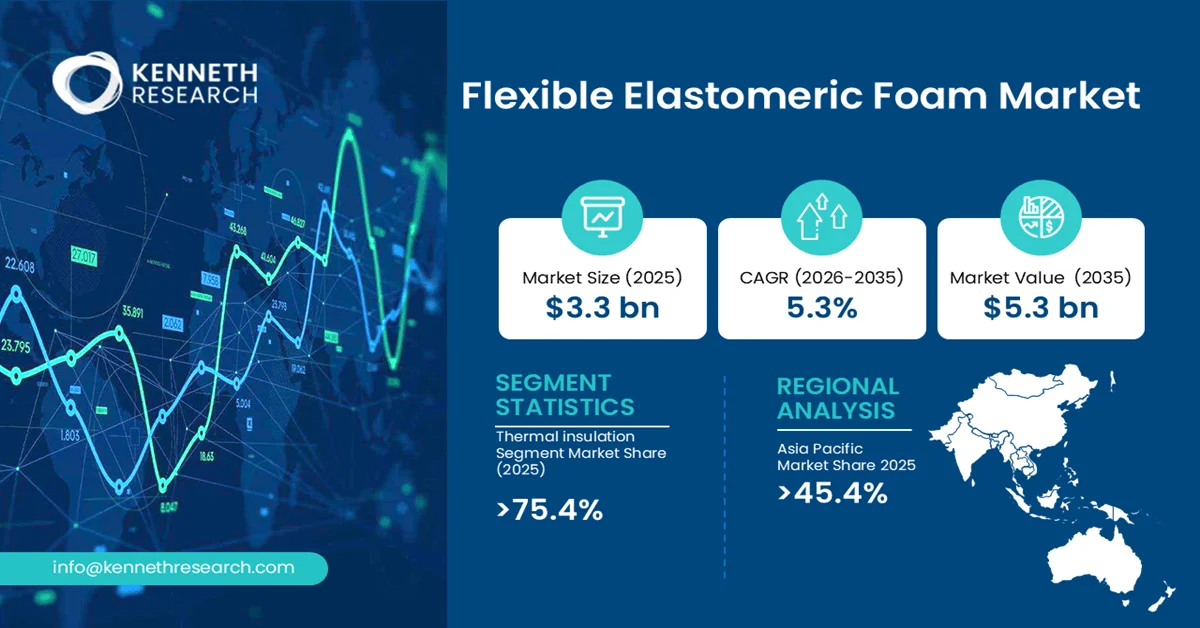
The Flexible Elastomeric Foam Market size was valued at USD 3.3 billion in 2025 and is projected to reach USD 5.3 billion by the end of 2035, rising at a CAGR of 5.3% during the forecast period, i.e., 2026–2035. In 2026, the industry size of the Flexible Elastomeric Foam Market is estimated at USD 3.6 billion.
The primary growth driver for the Flexible Elastomeric Foam Market is the increasing global emphasis on energy efficiency in buildings and industrial infrastructure. Governments are strengthening efficiency policies and retrofit programs, accelerating demand for high-performance thermal insulation materials that reduce energy losses, improve HVAC efficiency, and support decarbonization objectives.
The Flexible Elastomeric Foam Market comprises closed-cell insulation materials manufactured primarily from elastomeric polymers such as nitrile butadiene rubber (NBR), polyvinyl chloride (PVC), EPDM, and other specialty elastomers. These materials are engineered to provide thermal insulation, condensation control, acoustic dampening, and moisture resistance across a broad operating temperature range. Their flexible structure enables easy installation around complex piping, ductwork, tanks, and mechanical equipment while maintaining long-term thermal performance.
Flexible elastomeric foam is widely utilized across commercial buildings, industrial processing facilities, refrigeration systems, HVAC infrastructure, transportation, and energy applications where minimizing thermal losses and preventing condensation are critical for operational efficiency. The material's low thermal conductivity, high vapor diffusion resistance, lightweight nature, and durability contribute to reduced maintenance requirements and enhanced equipment reliability.
From an industrial perspective, the market plays an important role in supporting energy-efficient infrastructure, sustainable building practices, and optimized industrial operations. Growing investment in energy conservation, stricter building performance standards, and modernization of heating, ventilation, air conditioning, and refrigeration systems continue to reinforce the strategic importance of flexible elastomeric foam insulation across both developed and emerging economies.
Key Flexible Elastomeric Foam Market Insights Summary:
Key Takeaways: Market Trends & Insights
- Flexible Elastomeric Foam Market valued at USD 3.3 Billion in 2025 and projected to reach USD 5.3 Billion by 2035 at a 5.3% CAGR
- Thermal Insulation led the Function segment with a 75.4% market share in 2025 driven by rising demand for energy-efficient HVAC and industrial insulation applications
- NBR/PVC remained the leading Type segment owing to its superior thermal insulation, moisture resistance, and widespread adoption across commercial and industrial infrastructure
- Asia Pacific accounted for the largest regional share at 45.4% in 2025 supported by strong manufacturing capabilities and infrastructure investments across China and India
- Growing investments in energy-efficient buildings, cold-chain infrastructure, industrial modernization, and sustainable construction continue to strengthen long-term market demand
Market Drivers
- Increasing emphasis on energy-efficient buildings and HVAC modernization
- Expansion of cold-chain, refrigeration, and industrial processing infrastructure
- Rising adoption of sustainable insulation materials in green construction
- Growth in industrial manufacturing and commercial infrastructure investments
Challenges
- Raw Material Price Volatility and Petrochemical Supply Chain Dependence
- Stringent Fire Safety, Environmental, and Product Compliance Requirements
Flexible Elastomeric Foam Market Overview & Supply Chain
Global adoption of flexible elastomeric foam is accelerating as governments, industries, and building owners prioritize energy-efficient infrastructure, improved HVAC performance, and lower lifecycle operating costs. The material's closed-cell structure minimizes heat transfer and condensation, making it well suited for commercial buildings, industrial processing plants, refrigeration systems, and cold-chain infrastructure. Increasingly stringent building energy codes and industrial decarbonization initiatives are reinforcing demand for high-performance insulation materials that enhance system efficiency while reducing maintenance requirements. This trend is supported by expanding investment in energy-efficiency measures worldwide. According to the International Energy Agency (IEA), countries representing 70% of global energy demand have introduced or significantly strengthened energy-efficiency policy packages since the onset of the energy crisis in early 2022, underscoring the growing policy focus that supports advanced insulation solutions such as flexible elastomeric foam.
The value chain of the Flexible Elastomeric Foam Market begins with the procurement of elastomeric polymers such as nitrile butadiene rubber (NBR), polyvinyl chloride (PVC), EPDM, synthetic rubber compounds, plasticizers, flame retardants, blowing agents, fillers, and specialty additives sourced from global petrochemical and specialty chemical suppliers. Manufacturers convert these raw materials into closed-cell foam through compounding, extrusion, vulcanization, and expansion processes while maintaining stringent quality and thermal-performance standards. Finished products are supplied as sheets, tubes, rolls, and customized insulation components through distributors, insulation specialists, HVAC equipment suppliers, and industrial product wholesalers. End users include commercial construction companies, industrial facilities, refrigeration and cold-chain operators, energy utilities, transportation manufacturers, and OEMs integrating thermal insulation into equipment and systems. Key stakeholders across the value chain include raw material suppliers, foam manufacturers, equipment fabricators, distributors, engineering contractors, regulatory authorities, certification bodies, and maintenance service providers.
Flexible Elastomeric Foam Market: Growth Drivers & Challenges
Growth Drivers:
- Increasing Emphasis on Energy-Efficient Buildings and HVAC Modernization: The growing focus on reducing building energy consumption is a major catalyst for the Flexible Elastomeric Foam Market. Building owners, industrial operators, and facility managers are increasingly investing in insulation solutions that minimize thermal losses, prevent condensation, and improve HVAC system efficiency throughout the equipment lifecycle. Flexible elastomeric foam is well positioned to address these requirements due to its low thermal conductivity, moisture resistance, and ease of installation across complex mechanical systems. As governments continue to promote building decarbonization and energy-efficient infrastructure, demand for advanced insulation materials is expected to expand across commercial, institutional, and industrial facilities. Supporting this trend, the U.S. Department of Energy announced in 2024 the Better Buildings Commercial Building Heat Pump Accelerator, an initiative designed to accelerate the commercialization and adoption of higher-efficiency rooftop heat pump technologies, reinforcing investment in high-performance building envelopes and associated insulation systems.
- Expansion of Cold-Chain, Refrigeration, and Industrial Processing Infrastructure: The rapid expansion of temperature-controlled logistics, food processing, pharmaceutical manufacturing, and industrial refrigeration is creating sustained demand for flexible elastomeric foam insulation. These applications require insulation materials capable of maintaining stable operating temperatures while preventing condensation, corrosion under insulation, and energy losses in piping and equipment. Flexible elastomeric foam provides a combination of thermal performance, mechanical flexibility, and moisture resistance that supports operational reliability across demanding environments. As industries continue modernizing production facilities and investing in automated cold-chain infrastructure, insulation performance becomes increasingly important for improving process efficiency and reducing maintenance costs. Future demand is expected to benefit from continued investments in industrial automation, refrigerated transportation, life sciences manufacturing, and energy-efficient processing facilities, positioning flexible elastomeric foam as a critical material for long-term infrastructure resilience and operational sustainability.
Challenges:
- Raw Material Price Volatility and Petrochemical Supply Chain Dependence: The Flexible Elastomeric Foam Market remains highly exposed to fluctuations in the prices of petrochemical-derived raw materials, particularly synthetic rubber compounds, polymers, plasticizers, and specialty additives. Supply disruptions caused by feedstock shortages, refinery outages, geopolitical tensions, or transportation bottlenecks can significantly affect production costs and procurement planning. Manufacturers often face compressed profit margins because long-term supply contracts with customers may limit their ability to immediately transfer increased material costs. This volatility also complicates inventory management and pricing strategies for distributors and insulation contractors. Commercially, unpredictable input costs can delay procurement decisions for large infrastructure and industrial projects, particularly those operating under fixed budgets. Looking ahead, companies are expected to strengthen supplier diversification, optimize sourcing strategies, and invest in material innovations to improve resilience against future supply chain disruptions.
- Stringent Fire Safety, Environmental, and Product Compliance Requirements: Manufacturers of flexible elastomeric foam must comply with increasingly rigorous fire performance, emissions, indoor air quality, and environmental regulations across multiple regional markets. Meeting evolving certification requirements often requires reformulating products, upgrading manufacturing processes, and conducting extensive product testing, increasing development costs and extending commercialization timelines. Compliance challenges become more pronounced for companies operating globally, where regulatory frameworks and certification standards differ between jurisdictions. Commercially, the additional investment required for product qualification can create barriers for smaller manufacturers and slow the introduction of new product variants. Customers in sectors such as commercial construction, healthcare, transportation, and industrial processing increasingly demand certified insulation solutions, making regulatory compliance a competitive necessity. Over the long term, continuous innovation in low-emission, high-performance insulation materials will remain essential for sustaining market competitiveness and securing access to regulated end-use industries.
Flexible Elastomeric Foam Market Size and Forecast:
| Report Attribute | Details |
|---|---|
| Base Year |
2025 |
| Forecast Year |
2026-2035 |
| CAGR |
5.3% |
| Base Year Market Size (2025) |
USD 3.3 billion |
| Forecast Year Market Size (2035) |
USD 5.3 billion |
| Regional Scope |
|
Flexible Elastomeric Foam Market Segmentation Analysis:
Function Segment Analysis
In the function segment, the thermal insulation sub-segment is anticipated to capture the largest market share of 75.4% by the end of 2025.
Thermal insulation dominates the Flexible Elastomeric Foam Market owing to its essential role in improving energy efficiency, preventing condensation, and maintaining process temperatures across commercial buildings, industrial facilities, refrigeration systems, and HVAC infrastructure. Rising investments in sustainable construction, building retrofits, and energy-efficient mechanical systems continue to strengthen demand for elastomeric foam insulation because of its low thermal conductivity, closed-cell structure, and long service life. The segment is also benefiting from stricter building energy regulations and increasing adoption of high-performance insulation materials in healthcare, pharmaceuticals, food processing, and cold-chain logistics where temperature stability is critical.
On the supply side, manufacturers are expanding production capabilities while developing advanced insulation products with improved fire performance, lower emissions, and enhanced durability to comply with evolving industry standards. The availability of multiple product formats, including tubes, sheets, and rolls, further supports widespread adoption across diverse applications. Supporting this demand, the International Energy Agency (IEA) reported that buildings accounted for more than 55% of global electricity consumption, highlighting the importance of energy-efficient building systems and insulation materials in reducing operational energy demand. Looking ahead, continued investment in green buildings, HVAC modernization, and industrial energy optimization is expected to sustain the segment's market leadership.
Type Segment Analysis
The NBR/PVC (Nitrile Butadiene Rubber/Polyvinyl Chloride) is projected to grow as the second-largest segment in the flexible elastomeric foam market due to four converging demand drivers.
The NBR/PVC (Nitrile Butadiene Rubber/Polyvinyl Chloride) segment is projected to experience sustained growth due to its excellent balance of thermal insulation, moisture resistance, flexibility, and mechanical durability. These properties make it the preferred material for HVAC systems, refrigeration equipment, chilled-water piping, industrial process plants, and commercial buildings where long-term thermal performance and condensation control are essential. Demand is also increasing as industries seek insulation materials that are easy to install, cost-effective over their service life, and capable of meeting increasingly stringent building and industrial performance requirements. On the supply side, manufacturers continue to enhance NBR/PVC formulations with improved fire performance, lower volatile emissions, and greater environmental compliance, enabling broader adoption across regulated applications. Supporting this trend, the International Energy Agency (IEA) reported that world electricity consumption is forecast to grow by 4% in 2024, with increased cooling demand in emerging and developing economies serving as a major driver. This expanding cooling infrastructure is expected to reinforce long-term demand for NBR/PVC insulation used in energy-efficient HVAC and refrigeration systems.
Our in-depth analysis of the global Flexible Elastomeric Foam market includes the following segments:
|
Segment |
Sub-segment |
|
Function |
|
|
Type |
|
|
Application |
|
Flexible Elastomeric Foam Market Regional Insights:
Asia Pacific Market Trends & Insights:
Asia Pacific flexible elastomeric foam market is projected to hold the largest revenue share of 45.4% by the end of 2025.
The region's dominance is supported by its extensive manufacturing base, rapid urbanization, expanding commercial and industrial construction, and continued investment in energy-efficient infrastructure. Strong demand from HVAC, refrigeration, cold-chain logistics, industrial processing, and transportation industries has accelerated the adoption of flexible elastomeric foam insulation across both new installations and retrofit projects. Government policies promoting energy conservation, sustainable buildings, and industrial modernization further strengthen regional demand. In addition, the presence of large-scale insulation manufacturers, established petrochemical supply chains, and cost-competitive production capabilities enables Asia Pacific to maintain its leadership in both production and consumption of elastomeric foam products. Supporting the region's industrial relevance, the International Energy Agency (IEA) states that China will account for 40% of global renewable capacity expansion between 2019 and 2024, reflecting the scale of infrastructure and energy investments that continue to stimulate demand for advanced insulation materials.
China serves as the region's primary production hub, supported by its extensive manufacturing ecosystem, strong chemical industry, and ongoing investments in energy-efficient buildings and industrial infrastructure. The country's broad HVAC, refrigeration, and industrial equipment manufacturing sectors create sustained demand for high-performance insulation materials.
India is emerging as a key growth market due to increasing commercial construction, expansion of cold-chain infrastructure, rising industrial investments, and government initiatives encouraging energy-efficient buildings and modern manufacturing. Growing urbanization, expanding healthcare infrastructure, and continued investment in food processing and pharmaceuticals are further strengthening demand for flexible elastomeric foam across both countries.
North America Market Trends & Insights:
North America represents a strategically important market for flexible elastomeric foam, supported by sustained demand from commercial construction, industrial manufacturing, healthcare facilities, data centers, refrigeration, and HVAC modernization projects. The region places significant emphasis on improving energy efficiency, reducing operational costs, and enhancing the performance of mechanical systems, which continues to encourage the adoption of advanced thermal insulation materials. Government-led initiatives promoting building decarbonization, infrastructure renewal, and energy-efficient technologies further reinforce market demand. The presence of well-established insulation manufacturers, mature distribution networks, and stringent product performance standards also contributes to consistent adoption across commercial and industrial applications. Looking ahead, opportunities are expected to emerge from the expansion of cold-chain logistics, semiconductor manufacturing, clean energy facilities, and large-scale infrastructure upgrades, where reliable thermal insulation is essential for operational efficiency and long-term asset protection.
The United States remains the largest contributor to regional demand due to its extensive commercial building stock, advanced HVAC industry, strong industrial manufacturing base, and continuous investments in infrastructure modernization. The country's growing focus on energy-efficient retrofits, healthcare expansion, and high-performance buildings continues to support demand for flexible elastomeric foam insulation.
Canada is witnessing increasing adoption driven by sustainable construction practices, modernization of commercial facilities, investments in energy infrastructure, and the expansion of food processing and cold-storage facilities. Demand is also supported by the country's emphasis on reducing energy consumption in buildings and improving thermal performance across industrial and institutional applications.
Leading Companies Operating in the Global Flexible Elastomeric Foam Market:
Here is a list of upstream, downstream, and key players operating in the global Flexible Elastomeric Foam Market competitive ecosystem:
- Armacell International S.A. (Luxembourg)
- NMC International SA (Belgium)
- Rogers Corporation (United States)
- Zotefoams plc (United Kingdom)
- Rubberlite, Inc. (United States)
- Union Foam (United States)
Recent Developments
- In 2025, BASF developed Basotect UF, a new highly flexible variant of its melamine resin foam. The thermoset foam retains flame-retardant, temperature-resistant, and sound-absorbing properties while offering greater processing flexibility, making it suitable for fireproof mattresses, upholstered furniture, and acoustic insulation applications.
- In December 2025, Armacell announced that its Brampton plant in Canada was awarded a Silver Medal in the 2025 EcoVadis sustainability assessment, ranking among the top 15% of more than 150,000 companies assessed globally. The recognition highlights Armacell's leadership in sustainability across Environment, Labour & Human Rights, Ethics, and Sustainable Procurement.
Frequently Asked Question
In 2025, the flexible elastomeric foam market exceeded USD 3.3 Billion.
The flexible elastomeric foam market is projected to reach USD 5.3 Billion by the end of 2035, expanding at a CAGR of 5.3% over the forecast period (2026–2035).
The major players in the market are Armacell International S.A. (Luxembourg), NMC International SA (Belgium), Rogers Corporation (United States), Zotefoams plc (United Kingdom), Rubberlite, Inc. (United States), Union Foam (United States), and others.
In the Function segment, the Thermal Insulation sub-segment is anticipated to capture the largest market share of 75.4% in the future and exhibit lucrative growth opportunities during 2026–2035. This growth trajectory is largely attributed to increasing investments in energy-efficient buildings, HVAC modernization, and industrial thermal management applications.
Asia Pacific is projected to hold the largest market share of 45.4% by the end of 2035 and provide more business opportunities in the future. Continuous investments in manufacturing capacity, energy-efficient infrastructure, and commercial construction across China and India are fostering the region's dominance.
Why Choose Kenneth Research ?
-
Insight with Impact : We don’t just gather data — we uncover stories, trends, and opportunities that fuel business growth.
-
Experts Who Get It : Our team speaks your industry’s language and knows what really matters to your customers and market.
-
Custom-Built for You : Forget one-size-fits-all. We craft research and consulting solutions as unique as your business vision.
-
Partners, Not Just Providers : We work with you, not for you — collaborating closely to turn insights into smart, strategic moves.
-
Results That Speak : Our work powers brands, startups, and industry leaders alike — with a track record of ideas that work in the real world.
Report ID: 1032 |
Published Date: 28 Jul 2026 |
Report Format: |
Delivery Timeline: 48-72 Business Hours

Copyright © 2025 Kenneth Research. All rights reserved. Terms of Use | Privacy Policy
